MyCompetitiveExams Logo MyCompetitiveExams
Search 1,140+ Questions
Chapters, formulas, speed tricks
→
⚡ Brahmastra NEET 2027
720 MARKS

Dynamic 180-question full-length simulator mixed dynamically from all 6 years for 2027 & 2026 aspirants.

Launch Brahmastra 2027 Test →
Start Practice →
100% Free · No Login Required
Q.87 Chemistry · Section B ⭐ 360° Option Elimination Active
Vault ↗

NEET 2024 Chemistry Question 87 Solution

Topic: Equilibrium · Official NTA Booklet Code T1
NEET 2024 Chemistry Question 87: Equilibrium Constant and Degree of Dissociation (α) of NO(g)

Question

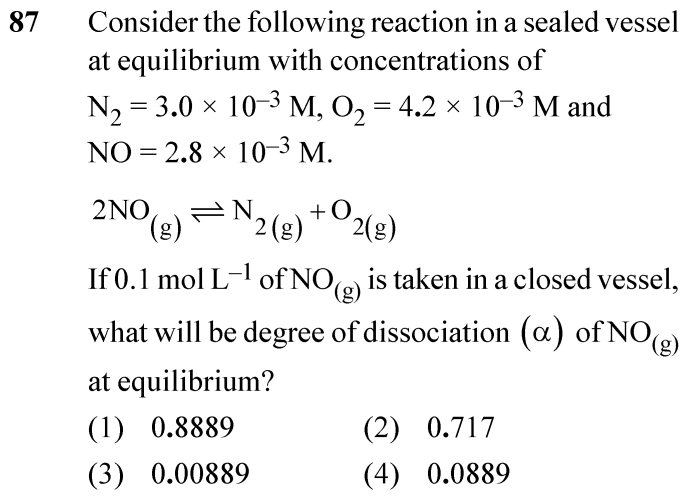
Consider the following reaction in a sealed vessel at equilibrium with concentrations of N₂ = 3.0×10⁻³ M, O₂ = 4.2×10⁻³ M and NO = 2.8×10⁻³ M. 2NO(g) ⇌ N₂(g) + O₂(g). If 0.1 mol L⁻¹ of NO(g) is taken in a closed vessel, what will be degree of dissociation (α) of NO(g) at equilibrium?

✓
Verified Against NTA Final Answer Key
Option (2) : 0.717
📚 Equilibrium Medium
📋 Given Parameters & Problem Setup
Equilibrium reaction 2 NO(g) ⇌ N2(g) + O2(g)
Given equilibrium concentrations [N2] = 3.0 × 10^-3 M, [O2] = 4.2 × 10^-3 M, [NO] = 2.8 × 10^-3 M
New initial condition 0.1 mol/L of NO(g) taken in a closed vessel
⚡

The 30-Second Exam Hall Shortcut: ⚡ Square Root Equilibrium Shortcut

⏱️ Save ~60 seconds

K_c = [N2][O2]/[NO]² = (3e-3 × 4.2e-3)/(2.8e-3)² = 12.6/7.84 = 1.607. For 2NO ⇌ N2 + O2, √K_c = α / [2(1 - α)]. √1.607 ≈ 1.268 -> α ≈ 0.717!

1 Compute K_c from first equilibrium: K_c = (3.0 × 10⁻³ × 4.2 × 10⁻³) / (2.8 × 10⁻³)² = 12.6 / 7.84 = 1.6071.
2 For dissociation of NO: 2 NO ⇌ N2 + O2. At equilibrium: [NO] = C(1 - α), [N2] = Cα/2, [O2] = Cα/2.
3 K_c = (Cα/2)² / [C(1 - α)]² = α² / [4(1 - α)²]. Note that concentration C cancels completely because Δn_g = 0!
4 Take square root: √K_c = α / [2(1 - α)].
5 Substitute: √1.6071 ≈ 1.2677 -> 2.5354(1 - α) = α -> 2.5354 = 3.5354 α.
6 α = 2.5354 / 3.5354 ≈ 0.717.
7 Option (2) in under 45 seconds!
🛡️
Why You Can 100% Trust This Shortcut: NCERT Chemistry · Equilibrium (Homogeneous chemical equilibria in gas phase and calculation of degree of dissociation α).
📐

Step-by-Step Rigorous Workflow & Mathematical Proof

Step 1

Determination of Equilibrium Constant Kc

For the gas-phase reaction 2 NO(g) ⇌ N2(g) + O2(g), the equilibrium constant expression is:

Kc=[N2][O2][NO]2=(3.0×10⁻³)(4.2×10⁻³)(2.8×10⁻³)2=12.6×10−67.84×10−6=1.6071K_c = \frac{[\text{N}_2][\text{O}_2]}{[\text{NO}]^2} = \frac{(3.0 \times 10^{-3})(4.2 \times 10^{-3})}{(2.8 \times 10^{-3})^2} = \frac{12.6 \times 10^{-6}}{7.84 \times 10^{-6}} = 1.6071
Step 2

ICE Table for Initial NO Concentration of 0.1 M

Let initial concentration of NO be C = 0.1 mol/L and degree of dissociation be α: - Initial: [NO] = C, [N2] = 0, [O2] = 0 - Change: [NO] = -Cα, [N2] = +Cα/2, [O2] = +Cα/2 - Equilibrium: [NO] = C(1 - α), [N2] = Cα/2, [O2] = Cα/2

[NO]=C(1−α),[N2]=Cα2,[O2]=Cα2[\text{NO}] = C(1 - \alpha), \quad [\text{N}_2] = \frac{C\alpha}{2}, \quad [\text{O}_2] = \frac{C\alpha}{2}
Step 3

Setting up Equilibrium Expression and Algebraic Solution

Substituting equilibrium expressions into Kc:

Kc=(Cα2)(Cα2)[C(1−α)]2=α24(1−α)2K_c = \frac{\left(\frac{C\alpha}{2}\right)\left(\frac{C\alpha}{2}\right)}{[C(1 - \alpha)]^2} = \frac{\alpha^2}{4(1 - \alpha)^2}
Step 4

Solving for α

Taking square roots on both sides:

Kc=α2(1−α)  ⟹  1.6071=1.2677=α2(1−α)\sqrt{K_c} = \frac{\alpha}{2(1 - \alpha)} \implies \sqrt{1.6071} = 1.2677 = \frac{\alpha}{2(1 - \alpha)}
Step 5

Final Arithmetic Simplification

Expanding and solving the linear equation in α:

2×1.2677×(1−α)=α  ⟹  2.5354−2.5354α=α  ⟹  3.5354α=2.5354  ⟹  α=2.53543.5354≈0.7172 \times 1.2677 \times (1 - \alpha) = \alpha \implies 2.5354 - 2.5354\alpha = \alpha \implies 3.5354\alpha = 2.5354 \implies \alpha = \frac{2.5354}{3.5354} \approx 0.717
⭐

360° Option Elimination Engine Key Feature

Diagnose every choice: Know exactly why the right option works and why distractors fail.

4-Option Deep Scan
1 (1)
✗ Incorrect
Verdict & Scientific Reason:

Result of omitting the stoichiometric factor of 2 in the denominator (writing Kc = α² / (1-α)²).

⚠️
Student Fallacy (Why candidates pick this trap): Forgetting that 2 NO produces 1/2 N2 and 1/2 O2.
2 (2)
✓ 100% Correct
Verdict & Scientific Reason:

Exact solution to the quadratic equilibrium expression.

💡
Why this is airtight: None.
3 (3)
✗ Incorrect
Verdict & Scientific Reason:

Off by two orders of magnitude due to improper square root extraction.

⚠️
Student Fallacy (Why candidates pick this trap): Assuming α ≪ 1 when Kc > 1.
4 (4)
✗ Incorrect
Verdict & Scientific Reason:

Decimal place calculation error.

⚠️
Student Fallacy (Why candidates pick this trap): Dividing by initial concentration C = 0.1 erroneously.
⚠️

NTA Trap Alert: Approximating (1 - α) ≈ 1 When Kc > 1

Because Kc = 1.607 is of order unity, α is very large (~72%). You CANNOT make the approximation 1 - α ≈ 1! You must solve the exact square-root equation.

🛡️ How to avoid the -1 mark: Only approximate 1 - α ≈ 1 when Kc is extremely small (e.g. < 10⁻⁵).
📖

Core NEET Syllabus Standard

Chemistry Core Physical Chemistry · Equilibrium Standard Benchmark
Core Scientific Principle Tested:

"For a symmetric reaction 2A ⇌ B + C, Kc = α² / [4(1-α)²], and the degree of dissociation α is independent of total pressure and initial concentration."

Syllabus Focus: Homogeneous Equilibrium: Evaluation of Equilibrium Constants
✓ Core NEET UG Syllabus Anchor Syllabus & Academic Standards ↗
Two moles to two moles: C disappears, root of 1.6 yields zero-point-seven-one-seven in clear cheers!

Ready to attempt under real exam pressure?

Test your speed and accuracy in the authentic 200-minute timed NTA simulator.

Launch NEET 2024 CBT Test →

Spotted a mistake in this solution? Report an error ([email protected])

⚖️ Legal & Fair Dealing Notice: Sourced from publicly released NEET 2024 question papers and NEET answer keys for private study, research, and non-commercial educational practice under Fair Dealing (Section 52(1)(a) of the Indian Copyright Act, 1957). Not affiliated with or endorsed by NTA or NMC.

Solve 4 NEET Questions a Day — One per Subject

Cover all 1,140 official NEET questions in 285 days at your own pace. Progress is saved on your device. No login needed.