MyCompetitiveExams Logo MyCompetitiveExams
Search 1,140+ Questions
Chapters, formulas, speed tricks
→
⚡ Brahmastra NEET 2027
720 MARKS

Dynamic 180-question full-length simulator mixed dynamically from all 6 years for 2027 & 2026 aspirants.

Launch Brahmastra 2027 Test →
Start Practice →
100% Free · No Login Required
Q.92 Chemistry ⭐ 360° Option Elimination Active
Vault ↗

NEET 2020 Chemistry Question 92 Solution

Topic: Equilibrium · Official NTA Booklet Code E1
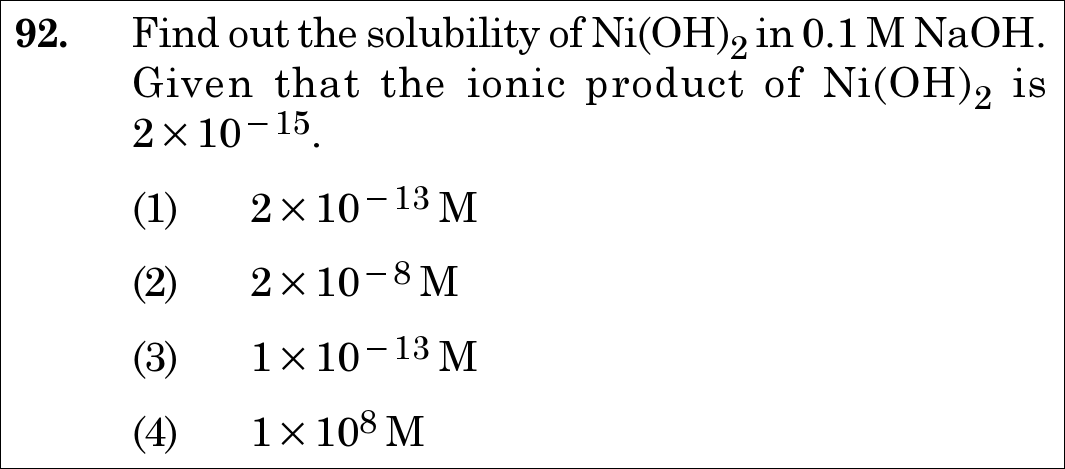
NEET 2020 Chemistry Question 92: Common Ion Effect on Solubility: Solubility of Ni(OH)2 in Presence of NaOH

Question

Find out the solubility of Ni(OH)₂ in 0.1 M NaOH. Given that the ionic product of Ni(OH)₂ is 2×10⁻¹⁵.

✓
Verified Against NTA Final Answer Key
Option (1) : 2×10⁻¹³ M
📚 Equilibrium Easy
📋 Given Parameters & Problem Setup
Salt Ni(OH)2 (Sparingly soluble base)
Ionic Product / Ksp Ksp = 2 × 10^-15
Medium 0.1 M NaOH (Strong electrolyte)
⚡

The 30-Second Exam Hall Shortcut: ⚡ "Common Ion Effect: s = Ksp / [OH-]^2 = (2 × 10^-15) / (0.1)^2 = 2 × 10^-13 M!"

⏱️ 25 seconds

In 0.1 M NaOH, the strong base completely dissociates, providing [OH−]=0.1 M=10−1 M[OH^-] = 0.1\text{ M} = 10^{-1}\text{ M}. The contribution of OH−OH^- from sparingly soluble Ni(OH)2Ni(OH)_2 (2s2s) is negligible (2s≪0.12s \ll 0.1). Thus: s=Ksp[OH−]2=2×10⁻¹⁵(10−1)2=2×10⁻¹³ Ms = \frac{K_{sp}}{[OH^-]^2} = \frac{2 \times 10^{-15}}{(10^{-1})^2} = 2 \times 10^{-13}\text{ M}. Mark Option (1) in 10 seconds!

1 Strong base dissociation: NaOH -> Na+ + OH-, so [OH-] = 0.1 M.
2 Ni(OH)2 dissolution equilibrium: Ni(OH)2 (s) <=> Ni2+ (aq) + 2OH- (aq).
3 Solubility expression: Ksp = [Ni2+][OH-]^2 = s × (0.1 + 2s)^2 ≈ s × (0.1)^2.
4 Solve for s: s = (2 × 10^-15) / (0.01) = 2 × 10^-13 M.
5 Select Option (1).
🛡️
Why You Can 100% Trust This Shortcut: NCERT Chemistry · Equilibrium (Ionic Equilibrium: Common Ion Effect on Solubility of Sparingly Soluble Salts)
📐

Step-by-Step Rigorous Workflow & Mathematical Proof

Step 1

Dissociation of Strong Electrolyte

Sodium hydroxide (NaOH) is a strong base that dissociates completely in aqueous solution: NaOH (aq)→Na+(aq)+OH−(aq)\text{NaOH (aq)} \to \text{Na}^+ \text{(aq)} + \text{OH}^- \text{(aq)} Given [NaOH]=0.1 M\text{[NaOH]} = 0.1\text{ M}, the contribution of hydroxide ions from NaOH is [OH−]NaOH=0.1 M=10−1 M[\text{OH}^-]_{\text{NaOH}} = 0.1\text{ M} = 10^{-1}\text{ M}.

Step 2

Solubility Equilibrium of Ni(OH)2

Nickel hydroxide is a sparingly soluble salt that establishes the following dissolution equilibrium: Ni(OH)2 (s)⇌Ni2+(aq)+2OH−(aq)\text{Ni(OH)}_2 \text{ (s)} \rightleftharpoons \text{Ni}^{2+} \text{(aq)} + 2\text{OH}^- \text{(aq)} If ss is the molar solubility of Ni(OH)2\text{Ni(OH)}_2 in this solution: [Ni2+]=s[\text{Ni}^{2+}] = s [OH−]=0.1+2s[\text{OH}^-] = 0.1 + 2s

Step 3

Apply Common Ion Approximation

Because Ksp=2×10⁻¹⁵K_{sp} = 2 \times 10^{-15} is extremely small, s≪0.1s \ll 0.1, and hence 2s2s is negligible compared to 0.10.1: [OH−]≈0.1 M=10−1 M[\text{OH}^-] \approx 0.1\text{ M} = 10^{-1}\text{ M}

Step 4

Solve for Molar Solubility

Substitute into the solubility product expression: Ksp=[Ni2+][OH−]2K_{sp} = [\text{Ni}^{2+}][\text{OH}^-]^2 2×10−15=s×(0.1)2=s×10−22 \times 10^{-15} = s \times (0.1)^2 = s \times 10^{-2} s=2×10−1510−2=2×10⁻¹³ Ms = \frac{2 \times 10^{-15}}{10^{-2}} = 2 \times 10^{-13}\text{ M} This confirms the approximation (2×(2×10−13)=4×10⁻¹³≪0.12 \times (2 \times 10^{-13}) = 4 \times 10^{-13} \ll 0.1).

⭐

360° Option Elimination Engine Key Feature

Diagnose every choice: Know exactly why the right option works and why distractors fail.

4-Option Deep Scan
1 A
✓ 100% Correct
Verdict & Scientific Reason:

Factually and mathematically exact; s=2×10⁻¹⁵(0.1)2=2×10⁻¹³ Ms = \frac{2 \times 10^{-15}}{(0.1)^2} = 2 \times 10^{-13}\text{ M}.

💡
Why this is airtight: None; straightforward common ion calculation.
2 B
✗ Incorrect
Verdict & Scientific Reason:

Incorrect; forgetting to square the hydroxide concentration gives s=2×10−150.1=2×10⁻¹⁴s = \frac{2 \times 10^{-15}}{0.1} = 2 \times 10^{-14}, or confusing with pure water solubility (4s3=Ksp4s^3 = K_{sp}).

⚠️
Student Fallacy (Why candidates pick this trap): Ignoring the stoichiometry coefficient 2 in [OH−]2[\text{OH}^-]^2.
3 C
✗ Incorrect
Verdict & Scientific Reason:

Incorrect; erroneously dividing by 2.

⚠️
Student Fallacy (Why candidates pick this trap): Incorrect coefficient arithmetic.
4 D
✗ Incorrect
Verdict & Scientific Reason:

Physically impossible; a positive exponent (108 M10^8\text{ M}) would represent a concentration higher than pure liquid density.

⚠️
Student Fallacy (Why candidates pick this trap): Sign error in exponent.
⚠️

NTA Trap Alert: Don't Forget to Square [OH-]!

The formula for Ni(OH)2Ni(OH)_2 has two hydroxides: Ksp=[Ni2+][OH−]2K_{sp} = [Ni^{2+}][OH^-]^2. You must divide KspK_{sp} by (0.1)2=10−2(0.1)^2 = 10^{-2}, NOT by 0.10.1!

🛡️ How to avoid the -1 mark: Write the Ksp expression clearly: [OH−]2[OH^-]^2 has the exponent 2!
📖

Core NEET Syllabus Standard

Chemistry · Equilibrium Standard Benchmark
Core Scientific Principle Tested:

""

Syllabus Focus: Common Ion Effect on Solubility: Solubility of Ni(OH)2 in Presence of NaOH
✓ Core NEET UG Syllabus Anchor Syllabus & Academic Standards ↗

Ready to attempt under real exam pressure?

Test your speed and accuracy in the authentic 180-minute timed NTA simulator.

Launch NEET 2020 CBT Test →

Spotted a mistake in this solution? Report an error ([email protected])

⚖️ Legal & Fair Dealing Notice: Sourced from publicly released NEET 2020 question papers and NEET answer keys for private study, research, and non-commercial educational practice under Fair Dealing (Section 52(1)(a) of the Indian Copyright Act, 1957). Not affiliated with or endorsed by NTA or NMC.

Solve 4 NEET Questions a Day — One per Subject

Cover all 1,140 official NEET questions in 285 days at your own pace. Progress is saved on your device. No login needed.