MyCompetitiveExams Logo MyCompetitiveExams
Search 1,140+ Questions
Chapters, formulas, speed tricks
→
⚡ Brahmastra NEET 2027
720 MARKS

Dynamic 180-question full-length simulator mixed dynamically from all 6 years for 2027 & 2026 aspirants.

Launch Brahmastra 2027 Test →
Start Practice →
100% Free · No Login Required
Q.90 Chemistry ⭐ 360° Option Elimination Active
Vault ↗

NEET 2025 Chemistry Question 90 Solution

Topic: Organic Chemistry - Some Basic Principles and Techniques · Official NTA Booklet Code 45
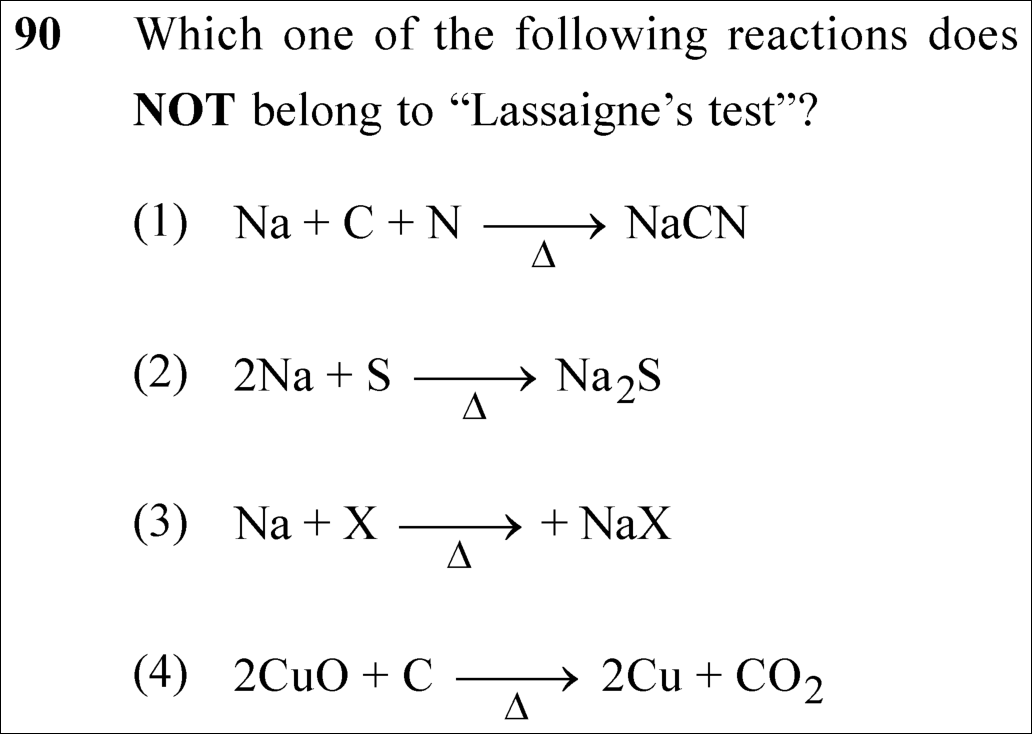
NEET 2025 Chemistry Question 90: Distinction Between Lassaigne’s Sodium Fusion Test and Copper Oxide Test for Carbon

Question

Which one of the following reactions does NOT belong to "Lassaigne's test"?

✓
Verified Against NTA Final Answer Key
Option (4) : 2CuO + C ⟶(Δ) 2Cu + CO₂ (Belongs to Copper Oxide Test for Carbon, NOT Lassaigne’s Test)
📚 Organic Chemistry - Some Basic Principles and Techniques Easy
📋 Given Parameters & Problem Setup
Reaction (1) Na + C + N ⟶(Δ) NaCN (Sodium fusion for nitrogen detection)
Reaction (2) 2Na + S ⟶(Δ) Na₂S (Sodium fusion for sulfur detection)
Reaction (3) Na + X ⟶(Δ) NaX (Sodium fusion for halogen detection)
Reaction (4) 2CuO + C ⟶(Δ) 2Cu + CO₂
⚡

The 30-Second Exam Hall Shortcut: ⚡ Sodium Fusion vs. Copper Oxide Test

⏱️ Save ~25 seconds

Lassaigne’s test is the SODIUM FUSION TEST (fusing with Na to form NaCN, Na₂S, NaX)! Reaction (4) uses cupric oxide (CuO) to detect carbon as CO₂—this is the COPPER OXIDE TEST, NOT Lassaigne’s test! ⟹ Reaction (4) does NOT belong to Lassaigne’s test!

1 Recall definition: Lassaigne’s test (Sodium Fusion Test) converts covalent N, S, and halogens in organic compounds into ionic water-soluble sodium salts using metallic sodium (Na):
2 - Na + C + N → NaCN (Test for Nitrogen) ⟹ Belongs to Lassaigne’s test.
3 - 2Na + S → Na₂S (Test for Sulfur) ⟹ Belongs to Lassaigne’s test.
4 - Na + X → NaX (Test for Halogens: Cl, Br, I) ⟹ Belongs to Lassaigne’s test.
5 Examine Reaction (4): 2CuO + C → 2Cu + CO₂. This reaction heats the organic compound with dry cupric oxide (CuO) to oxidize carbon to CO₂ (turning lime water milky). This is the classic Liebig Copper Oxide Test for Carbon and Hydrogen, NOT Lassaigne’s test!
6 Therefore, Reaction (4) does NOT belong to Lassaigne’s test.
7 Select Option (4) in under 10 seconds!
🛡️
Why You Can 100% Trust This Shortcut: Lassaigne’s Sodium Fusion Test for Heteroatoms (NCERT Chemistry · Organic Chemistry: Some Basic Principles and Techniques).
📐

Step-by-Step Rigorous Workflow & Mathematical Proof

Step 1

Review Principles of Lassaigne’s Test (Sodium Fusion Test)

Nitrogen, sulfur, halogens, and phosphorus present in an organic compound are covalently bonded. To detect them, they must be converted into ionic inorganic salts by fusing the compound with metallic sodium in an ignition tube:

Na+C+N→ΔNaCN,2Na+S→ΔNa2S,Na+X→ΔNaX\text{Na} + \text{C} + \text{N} \xrightarrow{\Delta} \text{NaCN}, \quad 2\text{Na} + \text{S} \xrightarrow{\Delta} \text{Na}_2\text{S}, \quad \text{Na} + \text{X} \xrightarrow{\Delta} \text{NaX}
  • • Reactions (1), (2), and (3) are the three foundational fusion reactions of Lassaigne’s test.
Step 2

Analyze the Copper Oxide Test for Carbon and Hydrogen

The detection of carbon and hydrogen is performed separately by heating the organic compound with dry cupric oxide (CuO) in a hard glass test tube:

C+2CuO→Δ2Cu+CO2↑,2H+CuO→ΔCu+H2O\text{C} + 2\text{CuO} \xrightarrow{\Delta} 2\text{Cu} + \text{CO}_2 \uparrow, \quad 2\text{H} + \text{CuO} \xrightarrow{\Delta} \text{Cu} + \text{H}_2\text{O}
  • • The evolved CO₂ is detected by passing it through lime water (which turns milky), and H₂O is detected by anhydrous copper sulfate (turning blue).
  • • This test does not use metallic sodium and is completely distinct from Lassaigne’s test.
Step 3

Select Matching Option

Reaction (4) belongs to the detection of carbon via copper oxide and does NOT belong to Lassaigne’s test:

Reaction (4): 2CuO+C→Δ2Cu+CO2  ⟹  Option (4)\text{Reaction (4): } 2\text{CuO} + \text{C} \xrightarrow{\Delta} 2\text{Cu} + \text{CO}_2 \implies \text{Option (4)}
  • • Matches Option (4) perfectly.
⭐

360° Option Elimination Engine Key Feature

Diagnose every choice: Know exactly why the right option works and why distractors fail.

4-Option Deep Scan
1 A
✗ Incorrect
Verdict & Scientific Reason:

Incorrect. This is the primary fusion reaction in Lassaigne’s test for nitrogen detection.

⚠️
Student Fallacy (Why candidates pick this trap): Thinking nitrogen is not detected via NaCN.
2 B
✗ Incorrect
Verdict & Scientific Reason:

Incorrect. This is the primary fusion reaction in Lassaigne’s test for sulfur detection.

⚠️
Student Fallacy (Why candidates pick this trap): Thinking sulfur is not detected via sodium sulfide.
3 C
✗ Incorrect
Verdict & Scientific Reason:

Incorrect. This is the primary fusion reaction in Lassaigne’s test for halogen detection.

⚠️
Student Fallacy (Why candidates pick this trap): Thinking halogens are not converted to sodium halides.
4 D
✓ 100% Correct
Verdict & Scientific Reason:

100% correct. This belongs to the Copper Oxide test for carbon, NOT Lassaigne’s sodium fusion test.

💡
Why this is airtight: None; textbook mastery of organic qualitative analysis.
⚠️

NTA Trap Alert: Assuming All Organic Detection Reactions are "Lassaigne’s Test"

Lassaigne’s test is SPECIFICALLY the sodium fusion test for heteroatoms (N, S, Halogens, P). Carbon and hydrogen are detected using CuO (Copper Oxide Test), NEVER through Lassaigne’s test!

🛡️ How to avoid the -1 mark: Remember: Lassaigne = Sodium (Na) fusion for N, S, X; CuO = Carbon & Hydrogen!
📖

Core NEET Syllabus Standard

NEET Chemistry Core Syllabus · Organic Chemistry - Some Basic Principles and Techniques Standard Benchmark
Core Scientific Principle Tested:

"Lassaigne’s test uses sodium fusion for N, S, and halogens; carbon is detected using CuO."

Syllabus Focus: Qualitative Analysis: Detection of Carbon, Hydrogen and Heteroatoms
✓ Core NEET UG Syllabus Anchor Syllabus & Academic Standards ↗
Lassaigne uses SODIUM (Na); CuO is the Copper Oxide test for Carbon ⟹ Reaction (4)!

Ready to attempt under real exam pressure?

Test your speed and accuracy in the authentic 180-minute timed NTA simulator.

Launch NEET 2025 CBT Test →

Spotted a mistake in this solution? Report an error ([email protected])

⚖️ Legal & Fair Dealing Notice: Sourced from publicly released NEET 2025 question papers and NEET answer keys for private study, research, and non-commercial educational practice under Fair Dealing (Section 52(1)(a) of the Indian Copyright Act, 1957). Not affiliated with or endorsed by NTA or NMC.

Solve 4 NEET Questions a Day — One per Subject

Cover all 1,140 official NEET questions in 285 days at your own pace. Progress is saved on your device. No login needed.