MyCompetitiveExams Logo MyCompetitiveExams
Search 1,140+ Questions
Chapters, formulas, speed tricks
→
⚡ Brahmastra NEET 2027
720 MARKS

Dynamic 180-question full-length simulator mixed dynamically from all 6 years for 2027 & 2026 aspirants.

Launch Brahmastra 2027 Test →
Start Practice →
100% Free · No Login Required
Q.89 Chemistry ⭐ 360° Option Elimination Active
Vault ↗

NEET 2026 Chemistry Question 89 Solution

Topic: Organic Chemistry: Some Basic Principles and Techniques · Official NTA Booklet Code 50
NEET 2026 Chemistry Question 89: Increasing Order of Polarity of Organic Functional Groups

Question

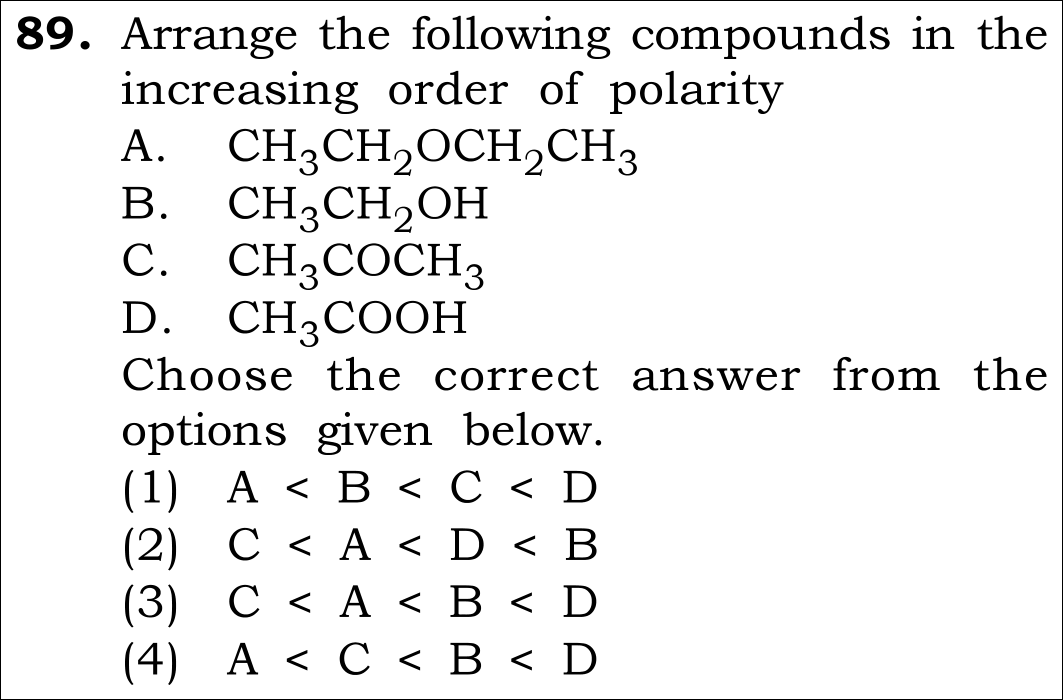
Arrange the following compounds in the increasing order of polarity A. CH₃CH₂OCH₂CH₃ B. CH₃CH₂OH C. CH₃COCH₃ D. CH₃COOH Choose the correct answer from the options given below.

✓
Verified Against NTA Final Answer Key
Option (4) : A < C < B < D
📚 Organic Chemistry: Some Basic Principles and Techniques Medium
📋 Given Parameters & Problem Setup
Compound A CH₃CH₂OCH₂CH₃ (Diethyl ether)
Compound B CH₃CH₂OH (Ethanol)
Compound C CH₃COCH₃ (Acetone)
Compound D CH₃COOH (Acetic acid)
Requirement Increasing order of polarity
⚡

The 30-Second Exam Hall Shortcut: ⚡ Standard Chromatographic Polarity Hierarchy

⏱️ Save ~50 seconds

Ether < Carbonyl (Ketone) < Alcohol < Carboxylic Acid!

1 A. Diethyl ether: Low dielectric constant (ε ≈ 4.3), non-hydrogen-bonding donor -> LEAST polar (A is lowest).
2 C. Acetone: Polar carbonyl group (>C=O, dipole moment ~2.9 D), but lacks H-bonding donor ability -> Intermediate polarity.
3 B. Ethanol: Protic solvent with strong intermolecular hydrogen bonding (-O-H) -> Highly polar.
4 D. Acetic acid: Strongly polar with extensive hydrogen-bonding dimer formation and acidic ionization -> MOST polar (D is highest).
5 Order of increasing polarity: A (Ether) < C (Ketone) < B (Alcohol) < D (Carboxylic acid).
6 Look at Option (4): A < C < B < D! Done in 15 seconds!
🛡️
Why You Can 100% Trust This Shortcut: NCERT Practical Chemistry / Organic Purification: Standard eluotropic polarity series used in chromatography: Hydrocarbons < Ethers < Ketones/Esters < Alcohols < Carboxylic acids.
📐

Step-by-Step Rigorous Workflow & Mathematical Proof

Step 1

Understand the Physical Factors Governing Polarity

Molecular polarity depends on the dipole moment, the presence of electronegative heteroatoms (O), and above all, the ability to engage in hydrogen bonding (both as a donor and acceptor), which dictates chromatographic adsorption and dielectric properties.

Polarity∝Dipole Moment+Hydrogen Bonding Strength\text{Polarity} \propto \text{Dipole Moment} + \text{Hydrogen Bonding Strength}
  • • Hydrogen bond donors (protic) are significantly more polar than aprotic species of comparable molecular weight.
Step 2

Classify and Rank Each Functional Group

1. Diethyl ether (CH₃CH₂OCH₂CH₃, A): Symmetrical ether with bent C-O-C geometry. Weak dipole moment (μ ≈ 1.15 D), lacks hydrogen-bonding protons. Least polar of the four. 2. Acetone (CH₃COCH₃, C): Polar aprotic ketone containing a strongly polarized carbonyl group (>C=O, μ ≈ 2.88 D). More polar than ether, but cannot donate hydrogen bonds. 3. Ethanol (CH₃CH₂OH, B): Polar protic alcohol. Contains a highly polarized O-H bond capable of acting as both a strong hydrogen bond donor and acceptor. 4. Acetic acid (CH₃COOH, D): Contains both a carbonyl (>C=O) and a highly polarized hydroxyl (-O-H) group. Readily forms cyclic hydrogen-bonded dimers and exhibits strong ion-dipole/polar interactions, making it the most polar.

Ether (A)<Ketone (C)<Alcohol (B)<Acid (D)\text{Ether (A)} < \text{Ketone (C)} < \text{Alcohol (B)} < \text{Acid (D)}
  • • Increasing order: A < C < B < D.
Step 3

Conclusion

The correct sequence in increasing order of polarity is A < C < B < D.

A<C<B<D\text{A} < \text{C} < \text{B} < \text{D}
  • • Matches Option (4).
⭐

360° Option Elimination Engine Key Feature

Diagnose every choice: Know exactly why the right option works and why distractors fail.

4-Option Deep Scan
1 A
✗ Incorrect
Verdict & Scientific Reason:

Incorrect. Places ethanol below acetone in polarity, but protic hydrogen bonding makes alcohol more polar than a simple ketone.

⚠️
Student Fallacy (Why candidates pick this trap): Comparing dipole moments without considering hydrogen bonding.
2 B
✗ Incorrect
Verdict & Scientific Reason:

Incorrect. Diethyl ether is far less polar than acetone.

⚠️
Student Fallacy (Why candidates pick this trap): Thinking ether is more polar than a ketone.
3 C
✗ Incorrect
Verdict & Scientific Reason:

Incorrect. Places acetone as the least polar compound.

⚠️
Student Fallacy (Why candidates pick this trap): Assuming symmetrical ketones have zero polarity.
4 D
✓ 100% Correct
Verdict & Scientific Reason:

Exact match with the standard chromatographic and physicochemical polarity series.

💡
Why this is airtight: None; rigorous understanding of intermolecular forces.
⚠️

NTA Trap Alert: Confusing Gas-Phase Dipole Moment with Solution Polarity

Acetone has a higher gas-phase dipole moment (~2.9 D) than ethanol (~1.7 D), tempting students to place acetone above ethanol. However, in condensed phases and chromatography, strong hydrogen bonding makes alcohols significantly MORE polar than ketones!

🛡️ How to avoid the -1 mark: Remember the chromatographic eluotropic rule: Ethers < Ketones < Alcohols < Acids.
📖

Core NEET Syllabus Standard

NEET Chemistry Core Syllabus · General Organic Chemistry Standard Benchmark
Core Scientific Principle Tested:

"Chromatographic retention and polarity increase from ethers to carbonyls, alcohols, and carboxylic acids."

Syllabus Focus: Principles of chromatography and relative polarities of organic functional groups
✓ Core NEET UG Syllabus Anchor Syllabus & Academic Standards ↗
Ether is low, Ketone can glow, Alcohol flows, Acid steals the show: A < C < B < D!

Ready to attempt under real exam pressure?

Test your speed and accuracy in the authentic 180-minute timed NTA simulator.

Launch NEET 2026 CBT Test →

Spotted a mistake in this solution? Report an error ([email protected])

⚖️ Legal & Fair Dealing Notice: Sourced from publicly released NEET 2026 question papers and NEET answer keys for private study, research, and non-commercial educational practice under Fair Dealing (Section 52(1)(a) of the Indian Copyright Act, 1957). Not affiliated with or endorsed by NTA or NMC.

Solve 4 NEET Questions a Day — One per Subject

Cover all 1,140 official NEET questions in 285 days at your own pace. Progress is saved on your device. No login needed.