MyCompetitiveExams Logo MyCompetitiveExams
Search 1,140+ Questions
Chapters, formulas, speed tricks
→
⚡ Brahmastra NEET 2027
720 MARKS

Dynamic 180-question full-length simulator mixed dynamically from all 6 years for 2027 & 2026 aspirants.

Launch Brahmastra 2027 Test →
Start Practice →
100% Free · No Login Required
Q.75 Chemistry · Section A ⭐ 360° Option Elimination Active
Vault ↗

NEET 2024 Chemistry Question 75 Solution

Topic: Organic Chemistry - Some Basic Principles and Techniques · Official NTA Booklet Code T1
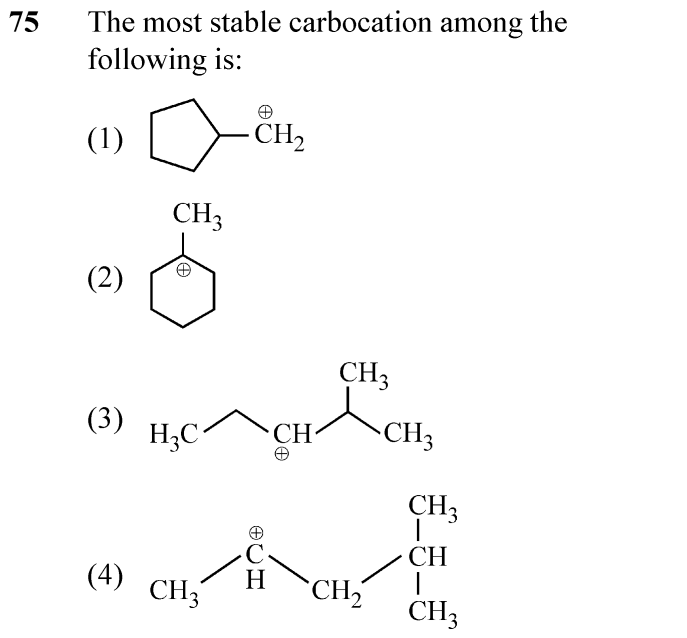
NEET 2024 Chemistry Question 75: Stability Order of Alkyl Carbocations (Hyperconjugation and Inductive Effect)

Question

The most stable carbocation among the following is: E)

✓
Verified Against NTA Final Answer Key
Option (2) : 1-methylcyclohexyl carbocation (3° carbocation with 7 α-hydrogens)
📚 Organic Chemistry - Some Basic Principles and Techniques Easy
📋 Given Parameters & Problem Setup
Cation 1 (Cyclopentylmethyl) carbocation (1°)
Cation 2 1-methylcyclohexyl carbocation (3°)
Cation 3 2-methylpentan-3-yl carbocation (2°)
Cation 4 4-methylpentan-2-yl carbocation (2°)
⚡

The 30-Second Exam Hall Shortcut: ⚡ Degree of Carbocation Instant Win

⏱️ Save ~30 seconds

Tertiary (3°) > Secondary (2°) > Primary (1°)! Structure (2) is a TERTIARY (3°) carbocation with 7 α-hydrogens -> Unrivaled stability!

1 Inspect the degree of each carbocation center:
2 - Option (1): Positive charge is on -CH2⁺ attached to cyclopentyl -> Primary (1°) carbocation.
3 - Option (2): Positive charge is on ring carbon bonded to a methyl group and two ring CH2 carbons -> Tertiary (3°) carbocation.
4 - Option (3): Positive charge is on -C⁺H- attached to -CH2CH3 and -CH(CH3)2 -> Secondary (2°) carbocation.
5 - Option (4): Positive charge is on -C⁺H- attached to -CH3 and -CH2CH(CH3)2 -> Secondary (2°) carbocation.
6 Tertiary carbocations are vastly more stable than secondary or primary carbocations due to maximum hyperconjugative structures and +I inductive effects.
7 1-methylcyclohexyl cation has 3 (from methyl) + 2 (ring C2) + 2 (ring C6) = 7 α-hydrogens.
8 Option (2) in 3 seconds!
🛡️
Why You Can 100% Trust This Shortcut: NCERT Chemistry · Organic Chemistry - Some Basic Principles and Techniques (Carbocation intermediates, inductive effect, and hyperconjugation stability order: 3° > 2° > 1°).
📐

Step-by-Step Rigorous Workflow & Mathematical Proof

Step 1

Fundamental Factors Governing Carbocation Stability

A carbocation is an sp²-hybridized, planar, sextet electron-deficient carbon. Stability is enhanced by electron donation through: 1. Inductive effect (+I): Alkyl groups push electron density toward the positive center. 2. Hyperconjugation: Delocalization of σ(C-H) electrons of α-carbons into the empty 2pz orbital of the carbocation. The more α-hydrogens, the greater the number of hyperconjugative resonance structures.

Carbocation Stability∝Number of α-Hydrogens  (3∘>2∘>1∘>C⊕H3)\text{Carbocation Stability} \propto \text{Number of } \alpha\text{-Hydrogens} \; (3^\circ > 2^\circ > 1^\circ > \overset{\oplus}{\text{C}}\text{H}_3)
Step 2

Classification of the Four Given Structures

Evaluating the α-hydrogen count and degree of each carbocation: - Option (1): Cyclopentyl-CH2⁺: Primary (1°) carbocation. Only 1 α-hydrogen (at the methine bridgehead). Very unstable. - Option (2): 1-Methylcyclohexyl cation: Tertiary (3°) carbocation. C-1 is bonded to three carbon atoms: the exocyclic methyl carbon (3 α-H) and two endocyclic methylene carbons at C-2 (2 α-H) and C-6 (2 α-H). Total α-H = 3 + 2 + 2 = 7 α-hydrogens! - Option (3): (CH3)2CH-C⁺H-CH2CH3: Secondary (2°) carbocation. α-hydrogens = 1 (from isopropyl CH) + 2 (from ethyl CH2) = 3 α-hydrogens. - Option (4): CH3-C⁺H-CH2-CH(CH3)2: Secondary (2°) carbocation. α-hydrogens = 3 (from terminal methyl) + 2 (from methylene CH2) = 5 α-hydrogens.

nα(Option 2)=7  (3∘)  >  nα(Option 4)=5  (2∘)  >  nα(Option 3)=3  (2∘)  >  nα(Option 1)=1  (1∘)n_\alpha(\text{Option 2}) = 7 \; (3^\circ) \;>\; n_\alpha(\text{Option 4}) = 5 \; (2^\circ) \;>\; n_\alpha(\text{Option 3}) = 3 \; (2^\circ) \;>\; n_\alpha(\text{Option 1}) = 1 \; (1^\circ)
Step 3

Conclusion

Structure (2) is the only tertiary (3°) carbocation in the set. Its tertiary status combined with 7 hyperconjugative α-hydrogens makes it by far the most stable species.

Most Stable=1-methylcyclohexyl cation (Option 2)\text{Most Stable} = \text{1-methylcyclohexyl cation (Option 2)}
⭐

360° Option Elimination Engine Key Feature

Diagnose every choice: Know exactly why the right option works and why distractors fail.

4-Option Deep Scan
1 (1)
✗ Incorrect
Verdict & Scientific Reason:

Primary carbocation with only 1 α-hydrogen; extremely unstable.

⚠️
Student Fallacy (Why candidates pick this trap): Thinking ring size alone imparts stability.
2 (2)
✓ 100% Correct
Verdict & Scientific Reason:

Tertiary (3°) carbocation with 7 hyperconjugative α-hydrogens and favorable six-membered chair relaxation.

💡
Why this is airtight: None.
3 (3)
✗ Incorrect
Verdict & Scientific Reason:

Secondary (2°) carbocation with only 3 α-hydrogens.

⚠️
Student Fallacy (Why candidates pick this trap): Assuming branched chain makes it tertiary.
4 (4)
✗ Incorrect
Verdict & Scientific Reason:

Secondary (2°) carbocation with 5 α-hydrogens.

⚠️
Student Fallacy (Why candidates pick this trap): Overlooking that positive charge is secondary, not tertiary.
⚠️

NTA Trap Alert: Confusing Branched Aliphatic Chain with Tertiary Carbocation

In Option (3), the isopropyl group is branched, but the carbon bearing the positive charge is bonded to only 2 carbons (secondary). In Option (2), the carbocation carbon itself is bonded to 3 carbons (tertiary).

🛡️ How to avoid the -1 mark: Count how many carbons are directly attached to the positive carbon: 3 = tertiary (most stable).
📖

Core NEET Syllabus Standard

Chemistry Core Organic Chemistry · Organic Chemistry - Some Basic Principles and Techniques Standard Benchmark
Core Scientific Principle Tested:

"Carbocation stability follows the order 3° > 2° > 1° > methyl due to hyperconjugation and +I inductive effects of adjacent alkyl substituents."

Syllabus Focus: Carbocation Intermediates: Structure and Relative Stability
✓ Core NEET UG Syllabus Anchor Syllabus & Academic Standards ↗
Three-degree with seven alpha-H: Stability crowned in the cyclohexyl cage!

Ready to attempt under real exam pressure?

Test your speed and accuracy in the authentic 200-minute timed NTA simulator.

Launch NEET 2024 CBT Test →

Spotted a mistake in this solution? Report an error ([email protected])

⚖️ Legal & Fair Dealing Notice: Sourced from publicly released NEET 2024 question papers and NEET answer keys for private study, research, and non-commercial educational practice under Fair Dealing (Section 52(1)(a) of the Indian Copyright Act, 1957). Not affiliated with or endorsed by NTA or NMC.

Solve 4 NEET Questions a Day — One per Subject

Cover all 1,140 official NEET questions in 285 days at your own pace. Progress is saved on your device. No login needed.