MyCompetitiveExams Logo MyCompetitiveExams
Search 1,140+ Questions
Chapters, formulas, speed tricks
→
⚡ Brahmastra NEET 2027
720 MARKS

Dynamic 180-question full-length simulator mixed dynamically from all 6 years for 2027 & 2026 aspirants.

Launch Brahmastra 2027 Test →
Start Practice →
100% Free · No Login Required
🧪 Chemistry ⭐ High Weightage (~2–3 Qs/Year)

NEET Organic Chemistry: Some Basic Principles and Techniques Previous Year Questions with Solutions

Complete repository of official NTA NEET questions for Organic Chemistry: Some Basic Principles and Techniques from 2020 to 2026. Every question includes 30-second elimination tricks, step-by-step NCERT solutions, option-by-option traps, and official answer keys.

12 Questions 6 Exam Years (2026, 2025, 2024, 2023, 2021, 2020) 9 Easy · 3 Medium · 0 Challenging
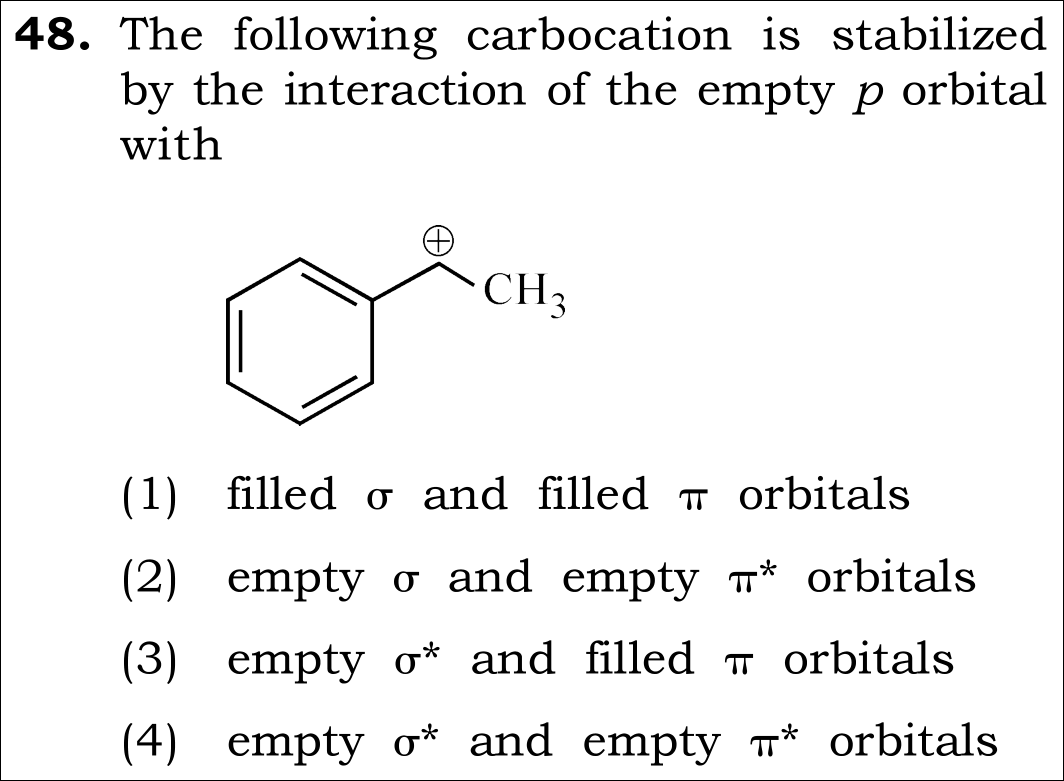
NEET 2026 · Q48 Medium
Official NEET 2026 Question 48 - Organic Chemistry: Some Basic Principles and Techniques
1 ✓ Key
2
3
4
💡 Verified Solution & 30-Second Hack
✓
Verified Against NTA Final Answer Key
Option (1) : filled σ and filled π orbitals
📚 Organic Chemistry: Some Basic Principles and Techniques Medium
📋 Given Parameters & Problem Setup
Species 1-phenylethyl cation [PhCH(⁺)CH₃]
Carbocation Carbon sp² hybridized with a vacant, unhybridized 2p orbital
Adjacent Groups Phenyl ring (π system) and methyl group (C-H σ bonds)
⚡

The 30-Second Exam Hall Shortcut: ⚡ Electron Donor Rules: Empty Accepts from Filled!

⏱️ Save ~60 seconds

Stabilization requires electron density to flow INTO the vacant p orbital from FILLED orbitals!

1 The carbocation carbon has an EMPTY p-orbital (electron-deficient).
2 To stabilize this deficiency, neighboring groups must DONATE electron density.
3 Donation comes from: (i) the FILLED π-orbitals of the aromatic ring (resonance), and (ii) the FILLED σ-orbitals of the adjacent C-H bonds (hyperconjugation).
4 Empty cannot donate to empty! Both donating orbitals must be FILLED (filled σ and filled π orbitals). Option (1) is instantly deduced in 10 seconds!
🛡️
Why You Can 100% Trust This Shortcut: Fundamental molecular orbital theory: Chemical stabilization via delocalization always involves overlap between a filled donor orbital (HOMO/bonding σ or π) and an empty acceptor orbital (LUMO/vacant p).
📐

Step-by-Step Rigorous Workflow & Mathematical Proof

Step 1

Analyze the Electronic Structure of the Carbocation

In the 1-phenylethyl carbocation, the positively charged carbon is sp² hybridized. It forms three σ bonds in a trigonal planar geometry, leaving one unhybridized 2p orbital that is completely empty (contains 0 electrons).

Carbocation C: [sp2]3(empty 2pz orbital, LUMO)\text{Carbocation C: } [\text{sp}^2]^3 \quad (\text{empty } 2p_z \text{ orbital, LUMO})
  • • Hybridization of C⁺: sp².
  • • Acceptor orbital: vacant unhybridized 2p orbital.
Step 2

Resonance Stabilization with the Aromatic Benzene Ring

The empty 2p orbital on the benzylic carbon aligns parallel to the adjacent p-orbitals of the aromatic ring. This enables delocalization of the filled aromatic π-bonding electrons into the empty p-orbital, dispersing the positive charge across the ortho and para positions of the benzene ring.

πfilled(ring)⟶pempty(C+)(Resonance / Mesomeric effect)\pi_{\text{filled}}(\text{ring}) \longrightarrow p_{\text{empty}}(\text{C}^+) \quad (\text{Resonance / Mesomeric effect})
  • • Donor: Filled π-bonding molecular orbitals of the benzene ring.
  • • Effect: Extensive benzylic resonance stabilization.
Step 3

Hyperconjugative Stabilization with the Adjacent Methyl Group

The empty 2p orbital also interacts with the adjacent sp³-hybridized C-H σ-bonding orbitals of the methyl group. This no-bond resonance (hyperconjugation) involves the overlap of the filled C-H σ orbital with the empty p orbital.

σC-H, filled⟶pempty(C+)(Hyperconjugation)\sigma_{\text{C-H, filled}} \longrightarrow p_{\text{empty}}(\text{C}^+) \quad (\text{Hyperconjugation})
  • • Donor: Filled σ orbitals of the adjacent C-H bonds.
  • • Overall Interaction: Empty p orbital interacts with filled σ and filled π orbitals.
⭐

360° Option Elimination Engine Key Feature

Diagnose every choice: Know exactly why the right option works and why distractors fail.

4-Option Deep Scan
1 A
✓ 100% Correct
Verdict & Scientific Reason:

Exact physical description. Filled C-H σ-orbitals donate via hyperconjugation, and filled aromatic π-orbitals donate via resonance into the vacant p-orbital.

💡
Why this is airtight: None; rigorous application of frontier molecular orbital theory.
2 B
✗ Incorrect
Verdict & Scientific Reason:

Incorrect. Overlap between two empty orbitals provides zero electron density and zero electronic stabilization.

⚠️
Student Fallacy (Why candidates pick this trap): Assuming orbitals of the same occupancy interact to stabilize.
3 C
✗ Incorrect
Verdict & Scientific Reason:

Incorrect. The empty p-orbital does not get stabilized by empty σ* antibonding orbitals; it is stabilized by filled bonding σ orbitals.

⚠️
Student Fallacy (Why candidates pick this trap): Confusing hyperconjugation with back-bonding into antibonding orbitals.
4 D
✗ Incorrect
Verdict & Scientific Reason:

Incorrect. Empty antibonding orbitals cannot donate electrons to a positively charged empty orbital.

⚠️
Student Fallacy (Why candidates pick this trap): Selecting antibonding orbitals without considering electron occupancy.
⚠️

NTA Trap Alert: Confusing Donor and Acceptor Roles in Hyperconjugation

Students frequently confuse whether hyperconjugation involves σ→p\sigma \to p or σ→π∗\sigma \to \pi^*. In carbocations, the acceptor is the vacant p-orbital, and the donors are the FILLED bonding σ and π orbitals.

🛡️ How to avoid the -1 mark: Remember: Stabilization of a cation requires electron donation. Donors must be FILLED; acceptors are EMPTY.
📖

Core NEET Syllabus Standard

NEET Chemistry Core Syllabus · General Organic Chemistry Standard Benchmark
Core Scientific Principle Tested:

"Carbocations are stabilized by overlap of the vacant p orbital with filled adjacent σ and π orbitals."
Syllabus Focus: Carbocation stability, Resonance, and Hyperconjugation
✓ Core NEET UG Syllabus Anchor Syllabus & Academic Standards ↗
Empty p needs electron feast: Filled σ and Filled π feed the beast!
NEET 2026 · Q83 Easy
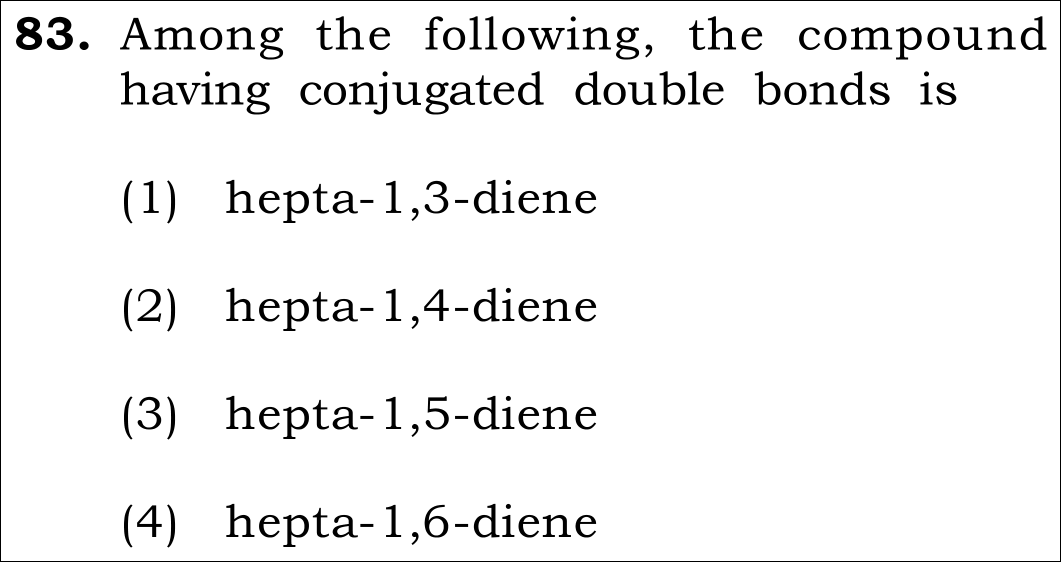
Official NEET 2026 Question 83 - Organic Chemistry: Some Basic Principles and Techniques
1 ✓ Key
2
3
4
💡 Verified Solution & 30-Second Hack
✓
Verified Against NTA Final Answer Key
Option (1) : hepta-1,3-diene
📚 Organic Chemistry: Some Basic Principles and Techniques Easy
📋 Given Parameters & Problem Setup
Requirement The compound having conjugated double bonds
Options hepta-1,3-diene, hepta-1,4-diene, hepta-1,5-diene, hepta-1,6-diene
⚡

The 30-Second Exam Hall Shortcut: ⚡ Conjugated Double Bond Rule (1,3-relationship)

⏱️ Save ~40 seconds

Alternate double and single bonds (-C=C-C=C-) mean locants differ by 2 (1,3-diene)!

1 Conjugated dienes require two double bonds separated by exactly ONE single bond.
2 In hepta-1,3-diene: C₁=C₂ - C₃=C₄ - C₅ - C₆ - C₇. Double bonds at positions 1 and 3 are separated by a single C₂-C₃ bond -> CONJUGATED!
3 In 1,4-diene: separated by two single bonds (isolated).
4 In 1,5-diene and 1,6-diene: separated by three and four single bonds (isolated).
5 Option (1) is instantly deduced in 5 seconds flat!
🛡️
Why You Can 100% Trust This Shortcut: IUPAC and fundamental organic chemistry definition: A conjugated system has overlapping p-orbitals across alternating single and double bonds.
📐

Step-by-Step Rigorous Workflow & Mathematical Proof

Step 1

Define Conjugated, Isolated, and Cumulated Dienes

1. Conjugated Dienes: Double bonds are separated by exactly one single bond (-C=C-C=C-). Continuous unhybridized p-orbitals allow π-electron delocalization. 2. Isolated Dienes: Double bonds are separated by two or more sp³ hybridized carbon atoms / single bonds (-C=C-(CH₂)ₙ-C=C-). 3. Cumulated Dienes (Allenes): Double bonds are adjacent to the same carbon atom (-C=C=C-).

Conjugated system≡−C=C−C=C−\text{Conjugated system} \equiv -\text{C}=\text{C}-\text{C}=\text{C}-
  • • Delocalization stabilizes the system.
Step 2

Draw and Analyze the Structure of hepta-1,3-diene

Writing the IUPAC structure of hepta-1,3-diene: CH₂=CH-CH=CH-CH₂-CH₂-CH₃

C1=C2−C3=C4−C5−C6−C7\text{C}_1=\text{C}_2-\text{C}_3=\text{C}_4-\text{C}_5-\text{C}_6-\text{C}_7
  • • The first double bond is between C1 and C2.
  • • The second double bond is between C3 and C4.
  • • They are separated by a single σ bond between C2 and C3.
  • • Thus, hepta-1,3-diene contains conjugated double bonds.
Step 3

Analyze the Other Compounds

1. hepta-1,4-diene: CH₂=CH-CH₂-CH=CH-CH₂-CH₃ (separated by one -CH₂- group; isolated). 2. hepta-1,5-diene: CH₂=CH-CH₂-CH₂-CH=CH-CH₃ (separated by two -CH₂- groups; isolated). 3. hepta-1,6-diene: CH₂=CH-CH₂-CH₂-CH₂-CH=CH₂ (separated by three -CH₂- groups; isolated).

Only hepta-1,3-diene is conjugated (Option 1)\text{Only hepta-1,3-diene is conjugated (Option 1)}
  • • Matches Option (1).
⭐

360° Option Elimination Engine Key Feature

Diagnose every choice: Know exactly why the right option works and why distractors fail.

4-Option Deep Scan
1 A
✓ 100% Correct
Verdict & Scientific Reason:

Exact match with the definition of a conjugated diene (alternating double and single bonds).

💡
Why this is airtight: None; elementary organic principle.
2 B
✗ Incorrect
Verdict & Scientific Reason:

Incorrect. An isolated diene with an intervening sp³ methylene bridge.

⚠️
Student Fallacy (Why candidates pick this trap): Thinking a single methylene group allows conjugation.
3 C
✗ Incorrect
Verdict & Scientific Reason:

Incorrect. Isolated diene with two intervening methylene groups.

⚠️
Student Fallacy (Why candidates pick this trap): Misunderstanding the term conjugated.
4 D
✗ Incorrect
Verdict & Scientific Reason:

Incorrect. Terminal isolated diene with three intervening methylene groups.

⚠️
Student Fallacy (Why candidates pick this trap): Confusing terminal double bonds with conjugated double bonds.
⚠️

NTA Trap Alert: Confusing Cumulated, Conjugated, and Isolated Dienes

Students occasionally mix up conjugated (1,3-diene) with isolated (1,4-diene). Conjugation REQUIRES p-orbital overlap across adjacent carbons without an intervening sp³ spacer.

🛡️ How to avoid the -1 mark: Locants 1,3 = Conjugated; Locants 1,2 = Cumulated; Locants 1,4 or greater = Isolated.
📖

Core NEET Syllabus Standard

NEET Chemistry Core Syllabus · General Organic Chemistry Standard Benchmark
Core Scientific Principle Tested:

"A conjugated system consists of alternating single and multiple bonds."

Syllabus Focus: Classification of hydrocarbons, resonance, and conjugated systems
✓ Core NEET UG Syllabus Anchor Syllabus & Academic Standards ↗
1 and 3 are side-by-side conjugated glee; 1 and 4 are isolated at sea!
NEET 2026 · Q89 Medium
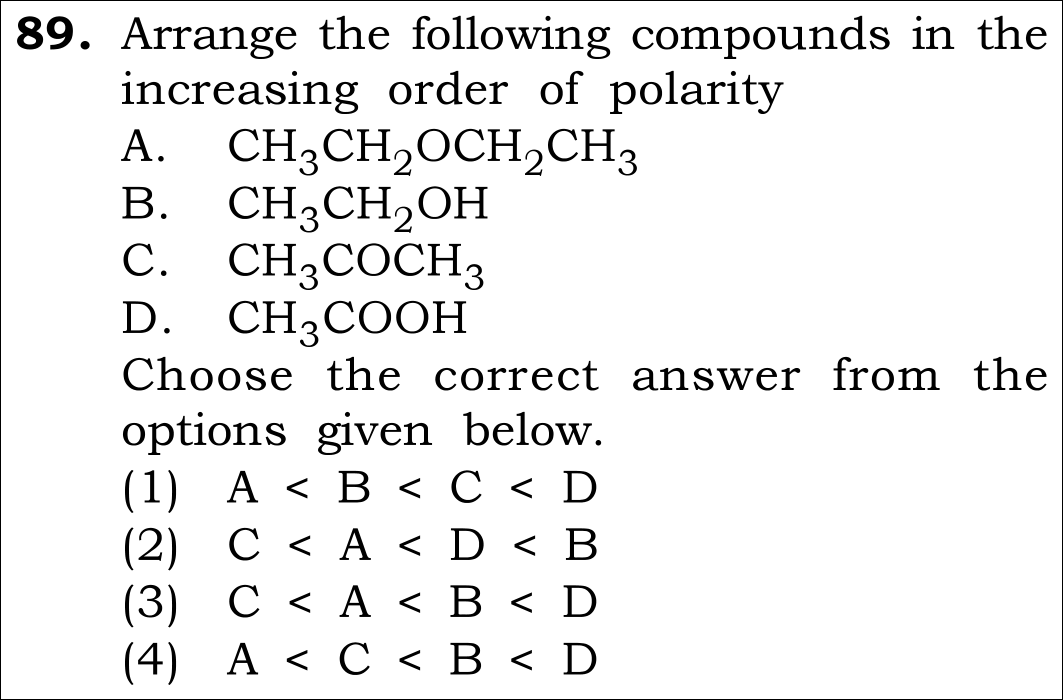
Official NEET 2026 Question 89 - Organic Chemistry: Some Basic Principles and Techniques
1
2
3
4 ✓ Key
💡 Verified Solution & 30-Second Hack
✓
Verified Against NTA Final Answer Key
Option (4) : A < C < B < D
📚 Organic Chemistry: Some Basic Principles and Techniques Medium
📋 Given Parameters & Problem Setup
Compound A CH₃CH₂OCH₂CH₃ (Diethyl ether)
Compound B CH₃CH₂OH (Ethanol)
Compound C CH₃COCH₃ (Acetone)
Compound D CH₃COOH (Acetic acid)
Requirement Increasing order of polarity
⚡

The 30-Second Exam Hall Shortcut: ⚡ Standard Chromatographic Polarity Hierarchy

⏱️ Save ~50 seconds

Ether < Carbonyl (Ketone) < Alcohol < Carboxylic Acid!

1 A. Diethyl ether: Low dielectric constant (ε ≈ 4.3), non-hydrogen-bonding donor -> LEAST polar (A is lowest).
2 C. Acetone: Polar carbonyl group (>C=O, dipole moment ~2.9 D), but lacks H-bonding donor ability -> Intermediate polarity.
3 B. Ethanol: Protic solvent with strong intermolecular hydrogen bonding (-O-H) -> Highly polar.
4 D. Acetic acid: Strongly polar with extensive hydrogen-bonding dimer formation and acidic ionization -> MOST polar (D is highest).
5 Order of increasing polarity: A (Ether) < C (Ketone) < B (Alcohol) < D (Carboxylic acid).
6 Look at Option (4): A < C < B < D! Done in 15 seconds!
🛡️
Why You Can 100% Trust This Shortcut: NCERT Practical Chemistry / Organic Purification: Standard eluotropic polarity series used in chromatography: Hydrocarbons < Ethers < Ketones/Esters < Alcohols < Carboxylic acids.
📐

Step-by-Step Rigorous Workflow & Mathematical Proof

Step 1

Understand the Physical Factors Governing Polarity

Molecular polarity depends on the dipole moment, the presence of electronegative heteroatoms (O), and above all, the ability to engage in hydrogen bonding (both as a donor and acceptor), which dictates chromatographic adsorption and dielectric properties.

Polarity∝Dipole Moment+Hydrogen Bonding Strength\text{Polarity} \propto \text{Dipole Moment} + \text{Hydrogen Bonding Strength}
  • • Hydrogen bond donors (protic) are significantly more polar than aprotic species of comparable molecular weight.
Step 2

Classify and Rank Each Functional Group

1. Diethyl ether (CH₃CH₂OCH₂CH₃, A): Symmetrical ether with bent C-O-C geometry. Weak dipole moment (μ ≈ 1.15 D), lacks hydrogen-bonding protons. Least polar of the four. 2. Acetone (CH₃COCH₃, C): Polar aprotic ketone containing a strongly polarized carbonyl group (>C=O, μ ≈ 2.88 D). More polar than ether, but cannot donate hydrogen bonds. 3. Ethanol (CH₃CH₂OH, B): Polar protic alcohol. Contains a highly polarized O-H bond capable of acting as both a strong hydrogen bond donor and acceptor. 4. Acetic acid (CH₃COOH, D): Contains both a carbonyl (>C=O) and a highly polarized hydroxyl (-O-H) group. Readily forms cyclic hydrogen-bonded dimers and exhibits strong ion-dipole/polar interactions, making it the most polar.

Ether (A)<Ketone (C)<Alcohol (B)<Acid (D)\text{Ether (A)} < \text{Ketone (C)} < \text{Alcohol (B)} < \text{Acid (D)}
  • • Increasing order: A < C < B < D.
Step 3

Conclusion

The correct sequence in increasing order of polarity is A < C < B < D.

A<C<B<D\text{A} < \text{C} < \text{B} < \text{D}
  • • Matches Option (4).
⭐

360° Option Elimination Engine Key Feature

Diagnose every choice: Know exactly why the right option works and why distractors fail.

4-Option Deep Scan
1 A
✗ Incorrect
Verdict & Scientific Reason:

Incorrect. Places ethanol below acetone in polarity, but protic hydrogen bonding makes alcohol more polar than a simple ketone.

⚠️
Student Fallacy (Why candidates pick this trap): Comparing dipole moments without considering hydrogen bonding.
2 B
✗ Incorrect
Verdict & Scientific Reason:

Incorrect. Diethyl ether is far less polar than acetone.

⚠️
Student Fallacy (Why candidates pick this trap): Thinking ether is more polar than a ketone.
3 C
✗ Incorrect
Verdict & Scientific Reason:

Incorrect. Places acetone as the least polar compound.

⚠️
Student Fallacy (Why candidates pick this trap): Assuming symmetrical ketones have zero polarity.
4 D
✓ 100% Correct
Verdict & Scientific Reason:

Exact match with the standard chromatographic and physicochemical polarity series.

💡
Why this is airtight: None; rigorous understanding of intermolecular forces.
⚠️

NTA Trap Alert: Confusing Gas-Phase Dipole Moment with Solution Polarity

Acetone has a higher gas-phase dipole moment (~2.9 D) than ethanol (~1.7 D), tempting students to place acetone above ethanol. However, in condensed phases and chromatography, strong hydrogen bonding makes alcohols significantly MORE polar than ketones!

🛡️ How to avoid the -1 mark: Remember the chromatographic eluotropic rule: Ethers < Ketones < Alcohols < Acids.
📖

Core NEET Syllabus Standard

NEET Chemistry Core Syllabus · General Organic Chemistry Standard Benchmark
Core Scientific Principle Tested:

"Chromatographic retention and polarity increase from ethers to carbonyls, alcohols, and carboxylic acids."

Syllabus Focus: Principles of chromatography and relative polarities of organic functional groups
✓ Core NEET UG Syllabus Anchor Syllabus & Academic Standards ↗
Ether is low, Ketone can glow, Alcohol flows, Acid steals the show: A < C < B < D!
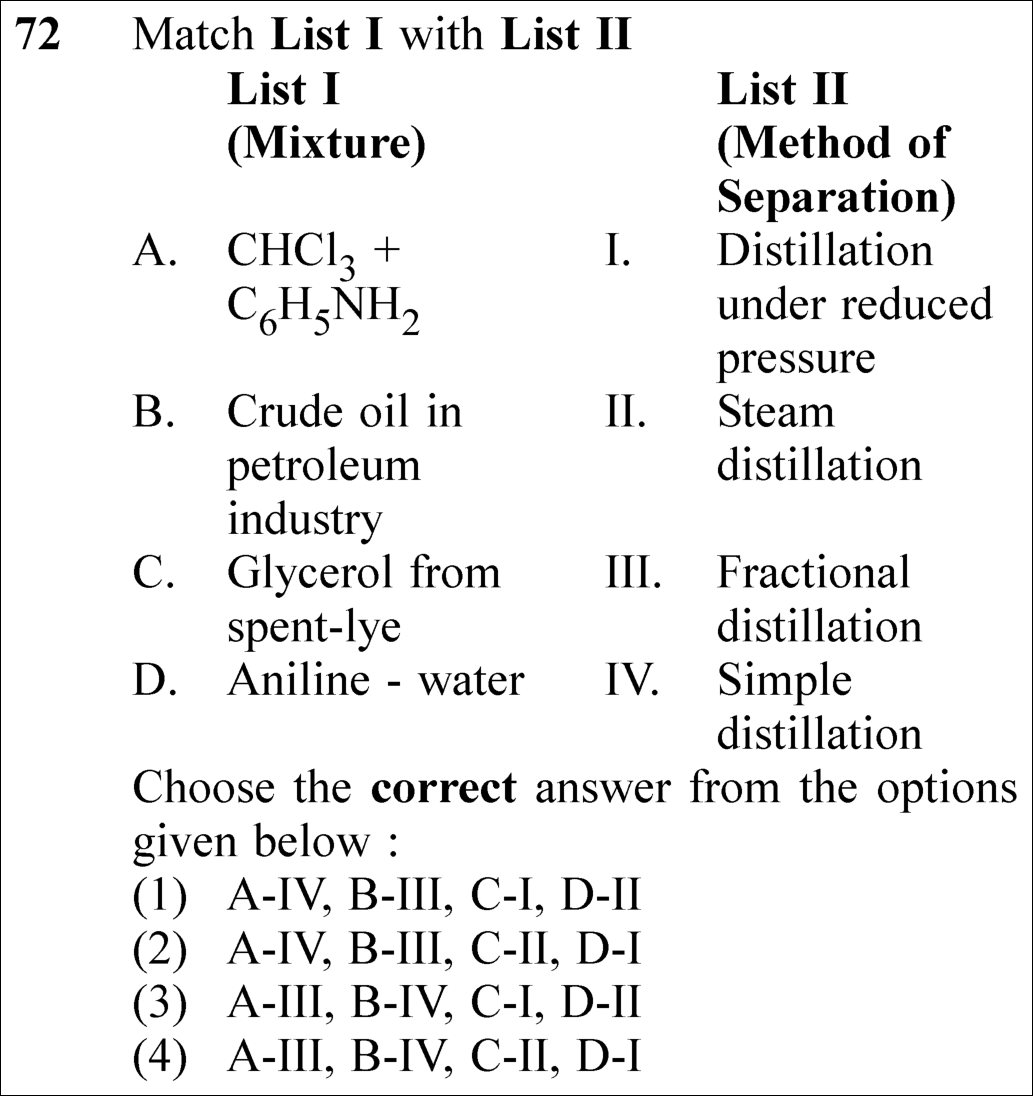
NEET 2025 · Q72 Easy
Official NEET 2025 Question 72 - Organic Chemistry: Some Basic Principles and Techniques
1 ✓ Key
2
3
4
💡 Verified Solution & 30-Second Hack
✓
Verified Against NTA Final Answer Key
Option (1) : A-IV, B-III, C-I, D-II
📚 Organic Chemistry - Some Basic Principles and Techniques Easy
📋 Given Parameters & Problem Setup
Mixture A CHCl₃ + C₆H₅NH₂ (Chloroform + Aniline, large boiling point difference)
Mixture B Crude oil in petroleum industry (Multi-component mixture with close boiling points)
Mixture C Glycerol from spent-lye (High boiling liquid decomposing at normal bp)
Mixture D Aniline - water (Steam volatile substance immiscible with water)
⚡

The 30-Second Exam Hall Shortcut: ⚡ Purification Technique Fingerprint

⏱️ Save ~40 seconds

Large ΔT_b (CHCl₃ + Aniline) = Simple distillation (A-IV). Petroleum fractions = Fractional distillation (B-III). Glycerol (spent-lye, decomposes at bp) = Distillation under reduced pressure (C-I). Aniline-water (steam volatile) = Steam distillation (D-II)!

1 A. CHCl₃ (bp 334 K) and Aniline (bp 457 K) have a massive boiling point difference of ~123 K ⟹ Simple Distillation (A matches IV).
2 Look at options: Only Option (1) and (2) start with A-IV, B-III.
3 B. Crude oil has multiple hydrocarbon fractions boiling closely ⟹ Fractional Distillation (B matches III).
4 C. Glycerol boils at 563 K but decomposes before reaching this temperature; it is recovered from spent-lye by ⟹ Distillation under reduced pressure (C matches I).
5 D. Aniline is steam volatile and immiscible with water ⟹ Steam Distillation (D matches II).
6 Complete match: A-IV, B-III, C-I, D-II.
7 Select Option (1) in under 10 seconds!
🛡️
Why You Can 100% Trust This Shortcut: Chromatographic and Fractional Distillation Principles (NCERT Chemistry · Organic Chemistry: Some Basic Principles and Techniques).
📐

Step-by-Step Rigorous Workflow & Mathematical Proof

Step 1

Match Simple Distillation and Fractional Distillation

Examine separation methods based on boiling point differentials:

Simple Distillation (IV): ΔTb>30−50 K  ⟹  CHCl3 (334 K)+C6H5NH2 (457 K)\text{Simple Distillation (IV): } \Delta T_b > 30-50\text{ K} \implies \text{CHCl}_3\,(334\text{ K}) + \text{C}_6\text{H}_5\text{NH}_2\,(457\text{ K})
  • • A matches IV (A-IV).
  • • Fractional Distillation (III): Used when boiling point differences are small (fractions of crude oil in petroleum refining).
  • • B matches III (B-III).
Step 2

Match Vacuum Distillation (Reduced Pressure) and Steam Distillation

Examine specialized distillation techniques for delicate or steam-volatile compounds:

Distillation under reduced pressure (I): Used for liquids decomposing at or below normal bp\text{Distillation under reduced pressure (I): Used for liquids decomposing at or below normal bp}
  • • Glycerol boils at 563 K with decomposition, but boils at 453 K without decomposition under 12 mm Hg pressure; it is separated from spent-lye by vacuum distillation (C-I).
  • • Steam Distillation (II): Used for substances which are steam volatile and immiscible with water (such as the aniline-water mixture, D-II).
Step 3

Synthesize the Complete Match

Assemble all pairs:

A-IV, B-III, C-I, D-II  ⟹  Option (1)\text{A-IV, B-III, C-I, D-II} \implies \text{Option (1)}
  • • Matches Option (1) with 100% textbook precision.
⭐

360° Option Elimination Engine Key Feature

Diagnose every choice: Know exactly why the right option works and why distractors fail.

4-Option Deep Scan
1 A
✓ 100% Correct
Verdict & Scientific Reason:

100% correct. Chloroform+aniline (simple), crude oil (fractional), glycerol (reduced pressure), aniline+water (steam).

💡
Why this is airtight: None; textbook purification methods.
2 B
✗ Incorrect
Verdict & Scientific Reason:

Incorrect. Swaps glycerol (reduced pressure) with aniline-water (steam distillation).

⚠️
Student Fallacy (Why candidates pick this trap): Confusing steam distillation with vacuum distillation.
3 C
✗ Incorrect
Verdict & Scientific Reason:

Incorrect. Uses fractional distillation for chloroform+aniline.

⚠️
Student Fallacy (Why candidates pick this trap): Thinking simple distillation is for petroleum.
4 D
✗ Incorrect
Verdict & Scientific Reason:

Incorrect. Scrambled match.

⚠️
Student Fallacy (Why candidates pick this trap): Multiple errors.
⚠️

NTA Trap Alert: Glycerol Decomposition Trap

Glycerol from spent-lye is the single most famous NCERT example of "distillation under reduced pressure". Students who forget that glycerol decomposes at its normal boiling point mistakenly pick simple or steam distillation.

🛡️ How to avoid the -1 mark: Remember: Glycerol = Reduced Pressure (Vacuum); Aniline = Steam Distillation!
📖

Core NEET Syllabus Standard

NEET Chemistry Core Syllabus · Organic Chemistry - Some Basic Principles and Techniques Standard Benchmark
Core Scientific Principle Tested:

"Simple: large ΔT_b; Fractional: close boiling points; Reduced pressure: decomposes at bp; Steam: steam-volatile & water-immiscible."

Syllabus Focus: Purification of Organic Compounds: Distillation Methods
✓ Core NEET UG Syllabus Anchor Syllabus & Academic Standards ↗
CHCl₃/Aniline = Simple (IV), Petroleum = Fractional (III), Glycerol = Vacuum (I), Aniline/Water = Steam (II)!
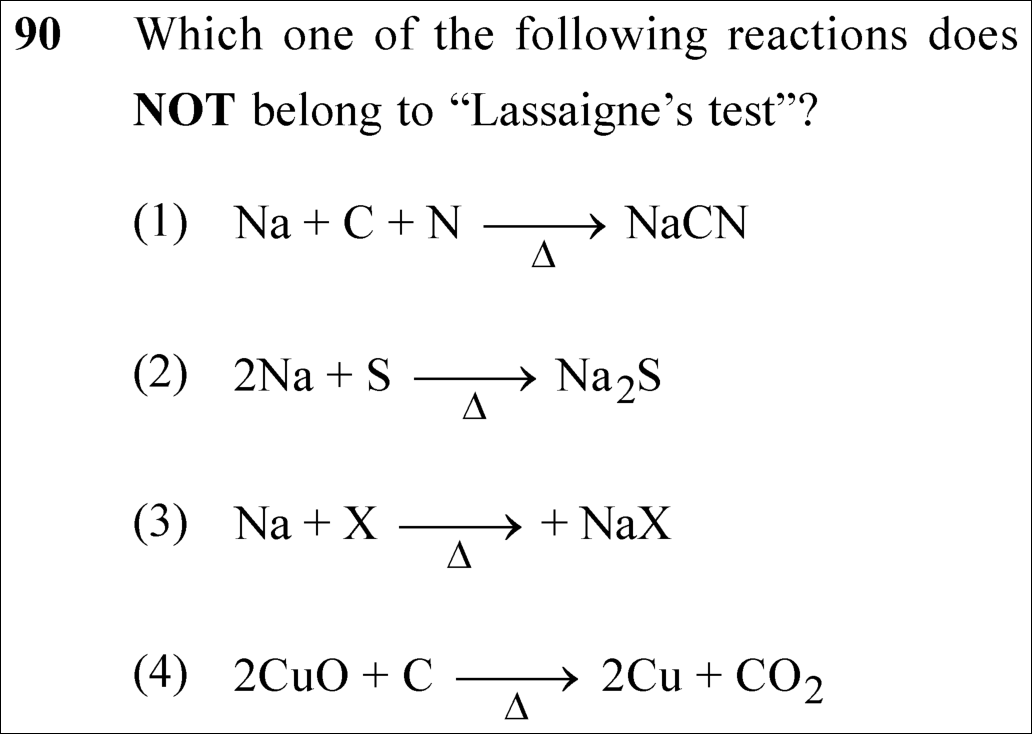
NEET 2025 · Q90 Easy
Official NEET 2025 Question 90 - Organic Chemistry: Some Basic Principles and Techniques
1
2
3
4 ✓ Key
💡 Verified Solution & 30-Second Hack
✓
Verified Against NTA Final Answer Key
Option (4) : 2CuO + C ⟶(Δ) 2Cu + CO₂ (Belongs to Copper Oxide Test for Carbon, NOT Lassaigne’s Test)
📚 Organic Chemistry - Some Basic Principles and Techniques Easy
📋 Given Parameters & Problem Setup
Reaction (1) Na + C + N ⟶(Δ) NaCN (Sodium fusion for nitrogen detection)
Reaction (2) 2Na + S ⟶(Δ) Na₂S (Sodium fusion for sulfur detection)
Reaction (3) Na + X ⟶(Δ) NaX (Sodium fusion for halogen detection)
Reaction (4) 2CuO + C ⟶(Δ) 2Cu + CO₂
⚡

The 30-Second Exam Hall Shortcut: ⚡ Sodium Fusion vs. Copper Oxide Test

⏱️ Save ~25 seconds

Lassaigne’s test is the SODIUM FUSION TEST (fusing with Na to form NaCN, Na₂S, NaX)! Reaction (4) uses cupric oxide (CuO) to detect carbon as CO₂—this is the COPPER OXIDE TEST, NOT Lassaigne’s test! ⟹ Reaction (4) does NOT belong to Lassaigne’s test!

1 Recall definition: Lassaigne’s test (Sodium Fusion Test) converts covalent N, S, and halogens in organic compounds into ionic water-soluble sodium salts using metallic sodium (Na):
2 - Na + C + N → NaCN (Test for Nitrogen) ⟹ Belongs to Lassaigne’s test.
3 - 2Na + S → Na₂S (Test for Sulfur) ⟹ Belongs to Lassaigne’s test.
4 - Na + X → NaX (Test for Halogens: Cl, Br, I) ⟹ Belongs to Lassaigne’s test.
5 Examine Reaction (4): 2CuO + C → 2Cu + CO₂. This reaction heats the organic compound with dry cupric oxide (CuO) to oxidize carbon to CO₂ (turning lime water milky). This is the classic Liebig Copper Oxide Test for Carbon and Hydrogen, NOT Lassaigne’s test!
6 Therefore, Reaction (4) does NOT belong to Lassaigne’s test.
7 Select Option (4) in under 10 seconds!
🛡️
Why You Can 100% Trust This Shortcut: Lassaigne’s Sodium Fusion Test for Heteroatoms (NCERT Chemistry · Organic Chemistry: Some Basic Principles and Techniques).
📐

Step-by-Step Rigorous Workflow & Mathematical Proof

Step 1

Review Principles of Lassaigne’s Test (Sodium Fusion Test)

Nitrogen, sulfur, halogens, and phosphorus present in an organic compound are covalently bonded. To detect them, they must be converted into ionic inorganic salts by fusing the compound with metallic sodium in an ignition tube:

Na+C+N→ΔNaCN,2Na+S→ΔNa2S,Na+X→ΔNaX\text{Na} + \text{C} + \text{N} \xrightarrow{\Delta} \text{NaCN}, \quad 2\text{Na} + \text{S} \xrightarrow{\Delta} \text{Na}_2\text{S}, \quad \text{Na} + \text{X} \xrightarrow{\Delta} \text{NaX}
  • • Reactions (1), (2), and (3) are the three foundational fusion reactions of Lassaigne’s test.
Step 2

Analyze the Copper Oxide Test for Carbon and Hydrogen

The detection of carbon and hydrogen is performed separately by heating the organic compound with dry cupric oxide (CuO) in a hard glass test tube:

C+2CuO→Δ2Cu+CO2↑,2H+CuO→ΔCu+H2O\text{C} + 2\text{CuO} \xrightarrow{\Delta} 2\text{Cu} + \text{CO}_2 \uparrow, \quad 2\text{H} + \text{CuO} \xrightarrow{\Delta} \text{Cu} + \text{H}_2\text{O}
  • • The evolved CO₂ is detected by passing it through lime water (which turns milky), and H₂O is detected by anhydrous copper sulfate (turning blue).
  • • This test does not use metallic sodium and is completely distinct from Lassaigne’s test.
Step 3

Select Matching Option

Reaction (4) belongs to the detection of carbon via copper oxide and does NOT belong to Lassaigne’s test:

Reaction (4): 2CuO+C→Δ2Cu+CO2  ⟹  Option (4)\text{Reaction (4): } 2\text{CuO} + \text{C} \xrightarrow{\Delta} 2\text{Cu} + \text{CO}_2 \implies \text{Option (4)}
  • • Matches Option (4) perfectly.
⭐

360° Option Elimination Engine Key Feature

Diagnose every choice: Know exactly why the right option works and why distractors fail.

4-Option Deep Scan
1 A
✗ Incorrect
Verdict & Scientific Reason:

Incorrect. This is the primary fusion reaction in Lassaigne’s test for nitrogen detection.

⚠️
Student Fallacy (Why candidates pick this trap): Thinking nitrogen is not detected via NaCN.
2 B
✗ Incorrect
Verdict & Scientific Reason:

Incorrect. This is the primary fusion reaction in Lassaigne’s test for sulfur detection.

⚠️
Student Fallacy (Why candidates pick this trap): Thinking sulfur is not detected via sodium sulfide.
3 C
✗ Incorrect
Verdict & Scientific Reason:

Incorrect. This is the primary fusion reaction in Lassaigne’s test for halogen detection.

⚠️
Student Fallacy (Why candidates pick this trap): Thinking halogens are not converted to sodium halides.
4 D
✓ 100% Correct
Verdict & Scientific Reason:

100% correct. This belongs to the Copper Oxide test for carbon, NOT Lassaigne’s sodium fusion test.

💡
Why this is airtight: None; textbook mastery of organic qualitative analysis.
⚠️

NTA Trap Alert: Assuming All Organic Detection Reactions are "Lassaigne’s Test"

Lassaigne’s test is SPECIFICALLY the sodium fusion test for heteroatoms (N, S, Halogens, P). Carbon and hydrogen are detected using CuO (Copper Oxide Test), NEVER through Lassaigne’s test!

🛡️ How to avoid the -1 mark: Remember: Lassaigne = Sodium (Na) fusion for N, S, X; CuO = Carbon & Hydrogen!
📖

Core NEET Syllabus Standard

NEET Chemistry Core Syllabus · Organic Chemistry - Some Basic Principles and Techniques Standard Benchmark
Core Scientific Principle Tested:

"Lassaigne’s test uses sodium fusion for N, S, and halogens; carbon is detected using CuO."

Syllabus Focus: Qualitative Analysis: Detection of Carbon, Hydrogen and Heteroatoms
✓ Core NEET UG Syllabus Anchor Syllabus & Academic Standards ↗
Lassaigne uses SODIUM (Na); CuO is the Copper Oxide test for Carbon ⟹ Reaction (4)!
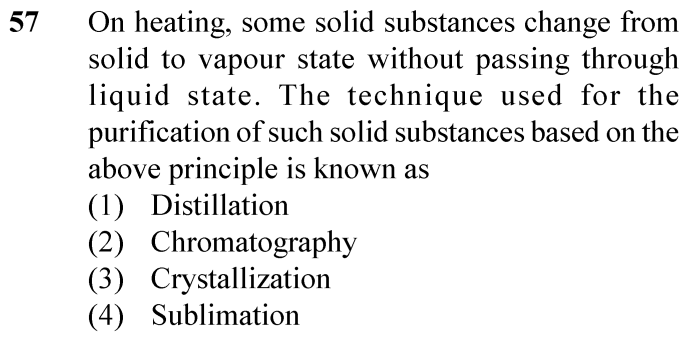
NEET 2024 · Q57 Easy
Official NEET 2024 Question 57 - Organic Chemistry: Some Basic Principles and Techniques
1 Distillation
2 Chromatography
3 Crystallization
4 Sublimation ✓ Key
💡 Verified Solution & 30-Second Hack
✓
Verified Against NTA Final Answer Key
Option (4) : Sublimation
📚 Organic Chemistry - Some Basic Principles and Techniques Easy
📋 Given Parameters & Problem Setup
Phenomenon Direct phase transformation from solid to vapour on heating without passing through liquid state
Objective Purification technique for such solid substances
⚡

The 30-Second Exam Hall Shortcut: ⚡ Phase Change Direct Definition

⏱️ Save ~30 seconds

Solid to Gas without Liquid = Sublimation! Textbook purification technique for camphor, benzoic acid, naphthalene, iodine, and anthracene!

1 Direct transition from Solid -> Vapour on heating is the physical definition of sublimation.
2 Purification technique based on this principle is Sublimation.
3 Distillation separates liquids based on boiling point differences.
4 Chromatography separates based on differential adsorption/partition.
5 Crystallization relies on solubility differences in a suitable solvent.
6 Direct match: Option (4) in 2 seconds!
🛡️
Why You Can 100% Trust This Shortcut: NCERT Chemistry · Organic Chemistry - Some Basic Principles and Techniques (Purification of organic compounds: Sublimation).
📐

Step-by-Step Rigorous Workflow & Mathematical Proof

Step 1

Thermodynamic and Physical Basis of Sublimation

Sublimation is a phase transition that occurs at temperatures and pressures below a substance’s triple point in its phase diagram, where the solid phase’s vapour pressure equals atmospheric pressure before melting occurs. When heated, the solid transitions directly into vapour without entering the liquid state:

Solid  ⇌depositionsublimation  Vapour\text{Solid} \;\xrightleftharpoons[\text{deposition}]{\text{sublimation}}\; \text{Vapour}
Step 2

Application in Purification of Organic Solids

Sublimation is employed to separate sublimable solids (e.g., naphthalene, anthracene, benzoic acid, camphor, ammonium chloride, iodine) from non-sublimable impurities. On cooling, the pure vapours condense directly into solid form on a chilled surface (such as an inverted funnel plugged with cotton), leaving non-volatile impurities behind in the dish.

Impure Solid→ΔPure Vapour+Residue (Insoluble Impurities)→CoolingPure Crystal Condensate\text{Impure Solid} \xrightarrow{\Delta} \text{Pure Vapour} + \text{Residue (Insoluble Impurities)} \xrightarrow{\text{Cooling}} \text{Pure Crystal Condensate}
⭐

360° Option Elimination Engine Key Feature

Diagnose every choice: Know exactly why the right option works and why distractors fail.

4-Option Deep Scan
1 (1)
✗ Incorrect
Verdict & Scientific Reason:

Distillation is used to separate volatile liquids from non-volatile impurities or liquid mixtures with different boiling points.

⚠️
Student Fallacy (Why candidates pick this trap): Confusing vaporization of liquids with sublimation of solids.
2 (2)
✗ Incorrect
Verdict & Scientific Reason:

Chromatography is a separation technique based on differential partitioning between stationary and mobile phases.

⚠️
Student Fallacy (Why candidates pick this trap): Equating phase transition with chromatographic separation.
3 (3)
✗ Incorrect
Verdict & Scientific Reason:

Crystallization is based on the differential solubility of a compound and its impurities in a chosen solvent.

⚠️
Student Fallacy (Why candidates pick this trap): Assuming crystal formation involves direct vapour-solid transition.
4 (4)
✓ 100% Correct
Verdict & Scientific Reason:

Verbatim physical and textbook definition of sublimation purification.

💡
Why this is airtight: None.
⚠️

NTA Trap Alert: Distillation vs Sublimation

Both involve vapor formation on heating, but distillation starts from a liquid, whereas sublimation starts directly from a solid.

🛡️ How to avoid the -1 mark: Check the starting phase: Solid directly to vapour without melting = Sublimation.
📖

Core NEET Syllabus Standard

Chemistry Core Organic Techniques · Organic Chemistry - Some Basic Principles and Techniques Standard Benchmark
Core Scientific Principle Tested:

"Sublimation is used to separate sublimable substances that pass directly from solid to vapour on heating from non-sublimable impurities."

Syllabus Focus: Methods of Purification of Organic Compounds
✓ Core NEET UG Syllabus Anchor Syllabus & Academic Standards ↗
Skip the liquid, leap the station: Solid to gas is Sublimation!
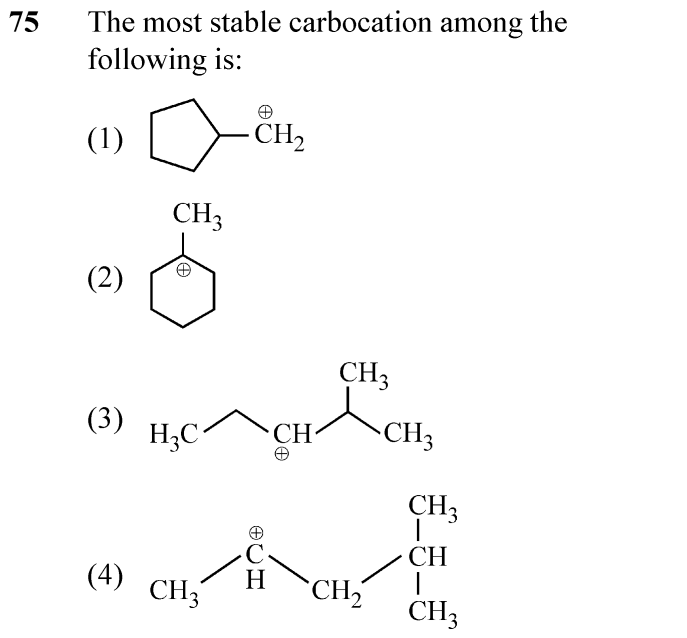
NEET 2024 · Q75 Easy
Official NEET 2024 Question 75 - Organic Chemistry: Some Basic Principles and Techniques
1
2 ✓ Key
3
4
💡 Verified Solution & 30-Second Hack
✓
Verified Against NTA Final Answer Key
Option (2) : 1-methylcyclohexyl carbocation (3° carbocation with 7 α-hydrogens)
📚 Organic Chemistry - Some Basic Principles and Techniques Easy
📋 Given Parameters & Problem Setup
Cation 1 (Cyclopentylmethyl) carbocation (1°)
Cation 2 1-methylcyclohexyl carbocation (3°)
Cation 3 2-methylpentan-3-yl carbocation (2°)
Cation 4 4-methylpentan-2-yl carbocation (2°)
⚡

The 30-Second Exam Hall Shortcut: ⚡ Degree of Carbocation Instant Win

⏱️ Save ~30 seconds

Tertiary (3°) > Secondary (2°) > Primary (1°)! Structure (2) is a TERTIARY (3°) carbocation with 7 α-hydrogens -> Unrivaled stability!

1 Inspect the degree of each carbocation center:
2 - Option (1): Positive charge is on -CH2⁺ attached to cyclopentyl -> Primary (1°) carbocation.
3 - Option (2): Positive charge is on ring carbon bonded to a methyl group and two ring CH2 carbons -> Tertiary (3°) carbocation.
4 - Option (3): Positive charge is on -C⁺H- attached to -CH2CH3 and -CH(CH3)2 -> Secondary (2°) carbocation.
5 - Option (4): Positive charge is on -C⁺H- attached to -CH3 and -CH2CH(CH3)2 -> Secondary (2°) carbocation.
6 Tertiary carbocations are vastly more stable than secondary or primary carbocations due to maximum hyperconjugative structures and +I inductive effects.
7 1-methylcyclohexyl cation has 3 (from methyl) + 2 (ring C2) + 2 (ring C6) = 7 α-hydrogens.
8 Option (2) in 3 seconds!
🛡️
Why You Can 100% Trust This Shortcut: NCERT Chemistry · Organic Chemistry - Some Basic Principles and Techniques (Carbocation intermediates, inductive effect, and hyperconjugation stability order: 3° > 2° > 1°).
📐

Step-by-Step Rigorous Workflow & Mathematical Proof

Step 1

Fundamental Factors Governing Carbocation Stability

A carbocation is an sp²-hybridized, planar, sextet electron-deficient carbon. Stability is enhanced by electron donation through: 1. Inductive effect (+I): Alkyl groups push electron density toward the positive center. 2. Hyperconjugation: Delocalization of σ(C-H) electrons of α-carbons into the empty 2pz orbital of the carbocation. The more α-hydrogens, the greater the number of hyperconjugative resonance structures.

Carbocation Stability∝Number of α-Hydrogens  (3∘>2∘>1∘>C⊕H3)\text{Carbocation Stability} \propto \text{Number of } \alpha\text{-Hydrogens} \; (3^\circ > 2^\circ > 1^\circ > \overset{\oplus}{\text{C}}\text{H}_3)
Step 2

Classification of the Four Given Structures

Evaluating the α-hydrogen count and degree of each carbocation: - Option (1): Cyclopentyl-CH2⁺: Primary (1°) carbocation. Only 1 α-hydrogen (at the methine bridgehead). Very unstable. - Option (2): 1-Methylcyclohexyl cation: Tertiary (3°) carbocation. C-1 is bonded to three carbon atoms: the exocyclic methyl carbon (3 α-H) and two endocyclic methylene carbons at C-2 (2 α-H) and C-6 (2 α-H). Total α-H = 3 + 2 + 2 = 7 α-hydrogens! - Option (3): (CH3)2CH-C⁺H-CH2CH3: Secondary (2°) carbocation. α-hydrogens = 1 (from isopropyl CH) + 2 (from ethyl CH2) = 3 α-hydrogens. - Option (4): CH3-C⁺H-CH2-CH(CH3)2: Secondary (2°) carbocation. α-hydrogens = 3 (from terminal methyl) + 2 (from methylene CH2) = 5 α-hydrogens.

nα(Option 2)=7  (3∘)  >  nα(Option 4)=5  (2∘)  >  nα(Option 3)=3  (2∘)  >  nα(Option 1)=1  (1∘)n_\alpha(\text{Option 2}) = 7 \; (3^\circ) \;>\; n_\alpha(\text{Option 4}) = 5 \; (2^\circ) \;>\; n_\alpha(\text{Option 3}) = 3 \; (2^\circ) \;>\; n_\alpha(\text{Option 1}) = 1 \; (1^\circ)
Step 3

Conclusion

Structure (2) is the only tertiary (3°) carbocation in the set. Its tertiary status combined with 7 hyperconjugative α-hydrogens makes it by far the most stable species.

Most Stable=1-methylcyclohexyl cation (Option 2)\text{Most Stable} = \text{1-methylcyclohexyl cation (Option 2)}
⭐

360° Option Elimination Engine Key Feature

Diagnose every choice: Know exactly why the right option works and why distractors fail.

4-Option Deep Scan
1 (1)
✗ Incorrect
Verdict & Scientific Reason:

Primary carbocation with only 1 α-hydrogen; extremely unstable.

⚠️
Student Fallacy (Why candidates pick this trap): Thinking ring size alone imparts stability.
2 (2)
✓ 100% Correct
Verdict & Scientific Reason:

Tertiary (3°) carbocation with 7 hyperconjugative α-hydrogens and favorable six-membered chair relaxation.

💡
Why this is airtight: None.
3 (3)
✗ Incorrect
Verdict & Scientific Reason:

Secondary (2°) carbocation with only 3 α-hydrogens.

⚠️
Student Fallacy (Why candidates pick this trap): Assuming branched chain makes it tertiary.
4 (4)
✗ Incorrect
Verdict & Scientific Reason:

Secondary (2°) carbocation with 5 α-hydrogens.

⚠️
Student Fallacy (Why candidates pick this trap): Overlooking that positive charge is secondary, not tertiary.
⚠️

NTA Trap Alert: Confusing Branched Aliphatic Chain with Tertiary Carbocation

In Option (3), the isopropyl group is branched, but the carbon bearing the positive charge is bonded to only 2 carbons (secondary). In Option (2), the carbocation carbon itself is bonded to 3 carbons (tertiary).

🛡️ How to avoid the -1 mark: Count how many carbons are directly attached to the positive carbon: 3 = tertiary (most stable).
📖

Core NEET Syllabus Standard

Chemistry Core Organic Chemistry · Organic Chemistry - Some Basic Principles and Techniques Standard Benchmark
Core Scientific Principle Tested:

"Carbocation stability follows the order 3° > 2° > 1° > methyl due to hyperconjugation and +I inductive effects of adjacent alkyl substituents."

Syllabus Focus: Carbocation Intermediates: Structure and Relative Stability
✓ Core NEET UG Syllabus Anchor Syllabus & Academic Standards ↗
Three-degree with seven alpha-H: Stability crowned in the cyclohexyl cage!
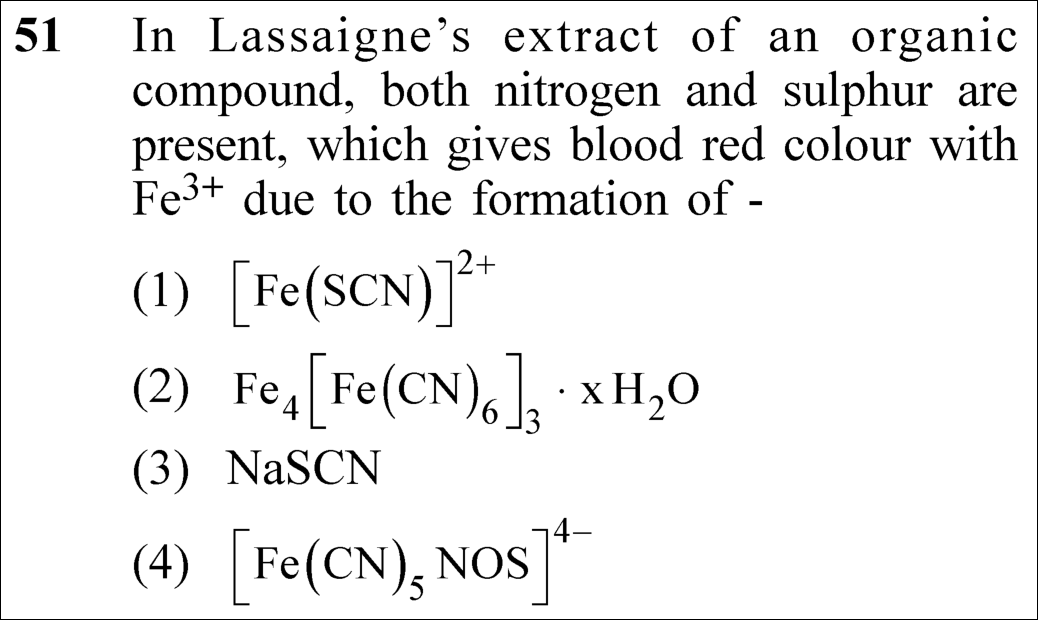
NEET 2023 · Q51 Easy
Official NEET 2023 Question 51 - Organic Chemistry: Some Basic Principles and Techniques
1 ✓ Key
2
3
4
💡 Verified Solution & 30-Second Hack
✓
Verified Against NTA Final Answer Key
Option (1) : [Fe(SCN)]²⁺
📚 Organic Chemistry – Some Basic Principles and Techniques Easy
📋 Given Parameters & Problem Setup
Elements present simultaneously Nitrogen (N) and Sulphur (S)
Fusion medium Sodium fusion extract (Lassaigne’s extract)
Reagent added Acidified FeCl₃ (Fe³⁺ ions)
Observed coloration Blood red
⚡

The 30-Second Exam Hall Shortcut: ⚡ N + S Simultaneous Fusion Rule: Fe³⁺ + SCN⁻ ⟶ [Fe(SCN)]²⁺

⏱️ Save ~35 seconds

Both N and S present ⟹ Na + C + N + S ⟶ NaSCN. Adding Fe³⁺ yields blood-red [Fe(SCN)]²⁺ in 5 seconds! (No Prussian blue forms because no free CN⁻ is present).

1 Check elements: When an organic compound contains BOTH Nitrogen and Sulphur, sodium fusion forms sodium thiocyanate: Na + C + N + S ⟶ NaSCN.
2 No free cyanide (NaCN) or sulphide (Na₂S) is formed if sodium is not in huge excess.
3 When ferric chloride (Fe³⁺) is added to the acidified extract, thiocyanate ions coordinate with Fe³⁺.
4 Reaction: Fe³⁺ + SCN⁻ ⟶ [Fe(SCN)]²⁺.
5 This monothiocyanatoiron(III) complex imparts an intense, characteristic BLOOD-RED coloration.
6 Lock Option (1) [Fe(SCN)]²⁺ immediately!
🛡️
Why You Can 100% Trust This Shortcut: Organic Qualitative Analysis · Lassaigne’s Test Principles (Blood-red coloration with Fe³⁺ specifically identifies the thiocyanatoiron(III) complex [Fe(SCN)]²⁺ when N and S coexist).
📐

Step-by-Step Rigorous Workflow & Mathematical Proof

Step 1

Sodium Fusion Reaction with Coexisting Nitrogen and Sulphur

During the preparation of Lassaigne’s extract, the organic compound is fused with molten metallic sodium. When both nitrogen and sulphur are present in the organic framework, they react jointly with carbon and sodium to form sodium thiocyanate rather than separate sodium cyanide and sodium sulphide:

Na+C+N+S→ΔNaSCN\text{Na} + \text{C} + \text{N} + \text{S} \xrightarrow{\Delta} \text{NaSCN}
Step 2

Extraction and Acidification

The fused mass is boiled with distilled water and filtered. The resulting alkaline sodium fusion extract contains soluble sodium thiocyanate (NaSCN), dissociating into sodium cations and thiocyanate anions:

NaSCN(aq)⟶Na+(aq)+SCN−(aq)\text{NaSCN}(aq) \longrightarrow \text{Na}^+(aq) + \text{SCN}^-(aq)
Step 3

Complexation with Ferric Ions (Fe³⁺)

When acidified with dilute hydrochloric acid and treated with a few drops of ferric chloride solution, ferric ions (Fe³⁺) coordinate with thiocyanate ions to form the soluble blood-red colored coordination complex ion:

Fe3+(aq)+SCN−(aq)⟶[Fe(SCN)]2+(aq)(Blood-red complex)\text{Fe}^{3+}(aq) + \text{SCN}^-(aq) \longrightarrow [\text{Fe(SCN)}]^{2+}(aq) \quad (\text{Blood-red complex})
Step 4

Differentiation from Prussian Blue

Prussian blue, Fe₄[Fe(CN)₆]₃ · xH₂O, requires free cyanide ions (CN⁻). Because nitrogen is tied up as SCN⁻, no Prussian blue forms unless an excess of sodium is used to break thiocyanate into cyanide and sulphide.

NaSCN+2Na (excess)→ΔNaCN+Na2S\text{NaSCN} + 2\text{Na (excess)} \xrightarrow{\Delta} \text{NaCN} + \text{Na}_2\text{S}
⭐

360° Option Elimination Engine Key Feature

Diagnose every choice: Know exactly why the right option works and why distractors fail.

4-Option Deep Scan
1 (1)
✓ 100% Correct
Verdict & Scientific Reason:

Accurate formula of the monothiocyanatoiron(III) complex responsible for the blood-red color.

💡
Why this is airtight: None. Candidate correctly identified the joint N and S detection complex.
2 (2)
✗ Incorrect
Verdict & Scientific Reason:

Prussian blue complex formed when ONLY nitrogen is present (free CN⁻ reacting with Fe²⁺/Fe³⁺).

⚠️
Student Fallacy (Why candidates pick this trap): Candidate confused the blood-red thiocyanate test with the Prussian blue test for pure nitrogen.
3 (3)
✗ Incorrect
Verdict & Scientific Reason:

NaSCN is the colorless intermediate in the extract, NOT the colored complex formed upon adding Fe³⁺.

⚠️
Student Fallacy (Why candidates pick this trap): Candidate confused the unreacted extract salt with the colored coordination complex.
4 (4)
✗ Incorrect
Verdict & Scientific Reason:

Violet-colored sodium thionitroprusside complex formed in the sodium nitroprusside test for SULPHUR alone.

⚠️
Student Fallacy (Why candidates pick this trap): Candidate confused the thiocyanate test with the sodium nitroprusside test for sulphur.
⚠️

NTA Trap Alert: Confusing the Intermediate Salt (NaSCN) with the Colored Complex ([Fe(SCN)]²⁺)

The question asks what chemical species imparts the BLOOD RED color upon reaction with Fe³⁺. NaSCN is the colorless salt in the extract; the colored species is the coordination complex ion [Fe(SCN)]²⁺.

🛡️ How to avoid the -1 mark: Identify the question target: The COLOR arises from the metal complex [Fe(SCN)]²⁺, not the sodium salt NaSCN.
📖

Core NEET Syllabus Standard

National Eligibility cum Entrance Test (NEET UG) · Organic Chemistry – Some Basic Principles and Techniques Standard Benchmark
Core Scientific Principle Tested:

"If both N and S are present, NaSCN is formed which gives a blood-red coloration with Fe³⁺ due to [Fe(SCN)]²⁺."

Syllabus Focus: Qualitative Analysis of Organic Compounds (Lassaigne’s Test)
Preserved in Rationalized Curriculum Syllabus & Academic Standards ↗
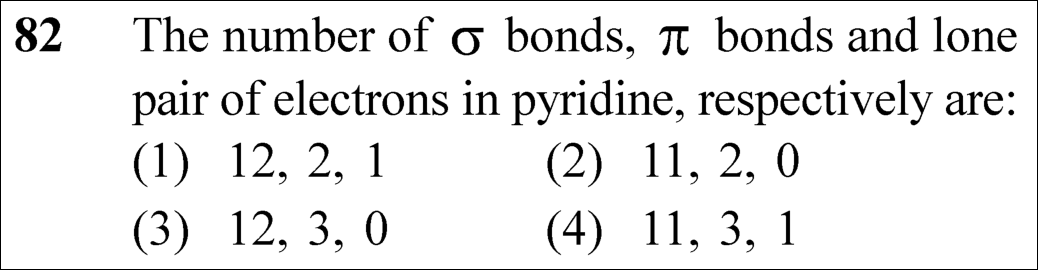
NEET 2023 · Q82 Medium
Official NEET 2023 Question 82 - Organic Chemistry: Some Basic Principles and Techniques
1 12, 2,1
2 11, 2, 0
3 12, 3,0
4 11, 3,1 ✓ Key
💡 Verified Solution & 30-Second Hack
✓
Verified Against NTA Final Answer Key
Option (4) : 11, 3, 1
📚 Organic Chemistry – Some Basic Principles and Techniques Medium
📋 Given Parameters & Problem Setup
Molecule Pyridine (C₅H₅N)
Quantities to determine Number of σ bonds, π bonds, and lone pairs of electrons
⚡

The 30-Second Exam Hall Shortcut: ⚡ Pyridine Skeletal Inventory: 11 σ, 3 π, and 1 Lone Pair

⏱️ Save ~30 seconds

Pyridine formula is C₅H₅N. Number of σ bonds = (Ring bonds) + (C–H bonds) = 6 + 5 = 11. Conjugated aromatic π bonds = 3 (aromatic sextet). Nitrogen has 1 unshared lone pair in an sp² hybrid orbital in the ring plane = 1 lone pair. Sequence: 11, 3, 1 in 10 seconds!

1 Total atoms: 5 carbons, 5 hydrogens, 1 nitrogen (11 atoms).
2 Ring framework σ bonds: 5 C–C/C=C + 1 C–N/C=N = 6 σ bonds in the ring.
3 Exocyclic σ bonds: 5 C–H single bonds.
4 Total σ bonds = 6 + 5 = 11.
5 Alternating double bonds in aromatic ring = 3 π bonds.
6 Nitrogen lone pair: occupies an sp² hybrid orbital in the ring plane = 1 lone pair.
7 Answer triplet: 11, 3, 1 (Option 4).
🛡️
Why You Can 100% Trust This Shortcut: Valence bond theory structure of heterocyclic pyridine C₅H₅N.
📐

Step-by-Step Rigorous Workflow & Mathematical Proof

Step 1

Determine the Molecular Structure of Pyridine

Pyridine has the chemical formula C₅H₅N. It consists of a planar hexagonal ring of 5 carbon atoms and 1 nitrogen atom, with each carbon bonded to one hydrogen atom:

Pyridine: C5H5N(Planar 6-membered aromatic ring)\text{Pyridine: } \text{C}_5\text{H}_5\text{N} \quad (\text{Planar 6-membered aromatic ring})
Step 2

Count Sigma (σ) Bonds

Sum the ring skeletal bonds and the peripheral C–H single bonds:

Ring σ bonds=6,C–H σ bonds=5  ⟹  Total σ bonds=6+5=11\text{Ring } \sigma \text{ bonds} = 6, \quad \text{C–H } \sigma \text{ bonds} = 5 \implies \text{Total } \sigma \text{ bonds} = 6 + 5 = 11
Step 3

Count Pi (π) Bonds

The aromatic sextet consists of 6 delocalized π electrons distributed across 3 conjugated double bonds:

Delocalized 6π system  ⟹  Total π bonds=3\text{Delocalized } 6\pi \text{ system} \implies \text{Total } \pi \text{ bonds} = 3
Step 4

Identify the Lone Pair on Nitrogen

The nitrogen atom in pyridine is sp² hybridized. One unhybridized p_z orbital contributes 1 electron to the aromatic π cloud, while the third sp² hybrid orbital holds an unshared lone pair in the ring plane:

Nitrogen lone pair=1(localized in an sp2 orbital, orthogonal to the π system)\text{Nitrogen lone pair} = 1 \quad (\text{localized in an } sp^2 \text{ orbital, orthogonal to the } \pi \text{ system})
⭐

360° Option Elimination Engine Key Feature

Diagnose every choice: Know exactly why the right option works and why distractors fail.

4-Option Deep Scan
1 (1)
✗ Incorrect
Verdict & Scientific Reason:

Overcounts σ bonds (12 instead of 11) and undercounts π bonds (2 instead of 3).

⚠️
Student Fallacy (Why candidates pick this trap): Candidate miscounted the number of double bonds in the aromatic ring.
2 (2)
✗ Incorrect
Verdict & Scientific Reason:

Undercounts π bonds and claims zero lone pairs on nitrogen.

⚠️
Student Fallacy (Why candidates pick this trap): Candidate incorrectly assumed nitrogen’s lone pair participates in the aromatic ring (like in pyrrole).
3 (3)
✗ Incorrect
Verdict & Scientific Reason:

Overcounts σ bonds and ignores the nitrogen lone pair.

⚠️
Student Fallacy (Why candidates pick this trap): Candidate counted an extra σ bond on the nitrogen atom.
4 (4)
✓ 100% Correct
Verdict & Scientific Reason:

Accurate: 11 σ bonds (6 ring + 5 C-H), 3 π bonds (aromatic sextet), and 1 localized lone pair on nitrogen.

💡
Why this is airtight: None. Candidate correctly visualized all bonded pairs and non-bonding electrons.
⚠️

NTA Trap Alert: Confusing Pyridine with Pyrrole Aromaticity

In pyrrole, the nitrogen lone pair resides in a p-orbital and is part of the aromatic sextet (so it is delocalized and has no basic character). In pyridine, the aromatic sextet comes from the 5 carbon p-electrons and 1 nitrogen p-electron; nitrogen’s lone pair is localized in an sp² hybrid orbital in the ring plane and counts as 1 distinct lone pair!

🛡️ How to avoid the -1 mark: Remember: Pyridine = lone pair is sp² and NOT in the π-system. Total lone pairs = 1.
📖

Core NEET Syllabus Standard

National Eligibility cum Entrance Test (NEET UG) · Organic Chemistry – Some Basic Principles and Techniques Standard Benchmark
Core Scientific Principle Tested:

"Every single bond is a σ bond; double bonds contain one σ and one π bond; lone pairs occupy non-bonding hybrid or atomic orbitals."

Syllabus Focus: Structure and Hybridisation of Organic Compounds
Preserved in Rationalized Curriculum Syllabus & Academic Standards ↗
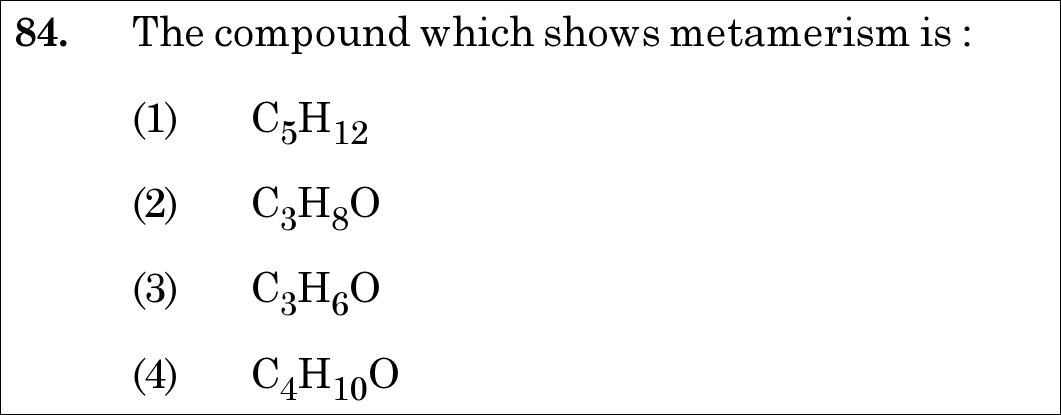
NEET 2021 · Q84 Easy
Official NEET 2021 Question 84 - Organic Chemistry: Some Basic Principles and Techniques
1 C5H12
2 C3H8O
3 C3H6O
4 C4H10O ✓ Key
💡 Verified Solution & 30-Second Hack
✓
Verified Against NTA Final Answer Key
Option (4) : C4H10O
📚 Organic Chemistry - Some Basic Principles and Techniques Easy
📋 Given Parameters & Problem Setup
Isomerism Type Metamerism
⚡

The 30-Second Exam Hall Shortcut: ⚡ Metamers Require Polyvalent Group with ≥ 4 Carbons (C4H10O Ethers)

⏱️ Save ~15 seconds

Metamerism is structural isomerism arising from unequal distribution of carbon atoms on either side of a polyvalent functional group (such as −O−-O- in ethers). With 4 carbons (C4H10OC_4H_{10}O), ethers form metamers: ethoxyethane (C2H5−O−C2H5C_2H_5-O-C_2H_5) and 1-methoxypropane (CH3−O−C3H7CH_3-O-C_3H_7). Hydrocarbons (C5H12C_5H_{12}) lack functional groups, and 3-carbon compounds (C3H8O,C3H6OC_3H_8O, C_3H_6O) have insufficient carbons for metameric variations. Match Option (4)!

1 Definition of metamerism: Different alkyl chains attached to the same polyvalent functional group.
2 C5H12C_5H_{12}: Alkane (pentane); only shows chain isomerism (no polyvalent heteroatom).
3 C3H8OC_3H_8O: Only 1 ether possible (CH3−O−C2H5CH_3-O-C_2H_5); no second ether isomer exists   ⟹  \implies No metamerism.
4 C3H6OC_3H_6O: Acetone (CH3−CO−CH3CH_3-CO-CH_3) has identical methyl groups; propanal is an aldehyde (monovalent)   ⟹  \implies No metamerism.
5 C4H10OC_4H_{10}O: Ethers include diethyl ether (C2H5−O−C2H5C_2H_5-O-C_2H_5) and methyl propyl ether (CH3−O−C3H7CH_3-O-C_3H_7)   ⟹  \implies Classic metamers!
6 Match Option (4).
🛡️
Why You Can 100% Trust This Shortcut: Canonical NCERT Organic Chemistry section on Metamerism.
📐

Step-by-Step Rigorous Workflow & Mathematical Proof

Step 1

Definition of Metamerism

According to NCERT, metamerism is a type of constitutional isomerism that arises due to different alkyl chains attached to the same polyvalent functional group (e.g., ether −O−-O-, thioether −S−-S-, secondary amine −NH−-NH-, or ketone −CO−-CO-) in the molecule.

Step 2

Analyzing C4H10O Ethers

The molecular formula C4H10OC_4H_{10}O corresponds to saturated mono-oxygenated compounds (degree of unsaturation DBE=0DBE = 0). Among the isomeric ethers, we can distribute the 4 carbons on either side of the divalent oxygen atom in multiple distinct ways: 1. Ethoxyethane (Diethyl ether): CH3−CH2−O−CH2−CH3CH_3-CH_2-O-CH_2-CH_3 (symmetrical 2+22 + 2 split) 2. 1-Methoxypropane (Methyl propyl ether): CH3−O−CH2−CH2−CH3CH_3-O-CH_2-CH_2-CH_3 (1+31 + 3 linear split) 3. 2-Methoxypropane (Methyl isopropyl ether): CH3−O−CH(CH3)2CH_3-O-CH(CH_3)_2 (1+31 + 3 branched split) These compounds belong to the same homologous family and have identical functional groups, but differ in the alkyl chains flanking the oxygen atom. They are metamers.

Step 3

Evaluating Other Options

- C5H12C_5H_{12}: Saturated pentane; exhibits only chain isomerism (pentane, isopentane, neopentane) as it contains no polyvalent heteroatom. - C3H8OC_3H_8O: Ethers require dividing 3 carbons across oxygen; the only possible division is 1+21 + 2 (CH3−O−C2H5CH_3-O-C_2H_5). No second ether isomer exists. - C3H6OC_3H_6O: Ketone is propan-2-one (CH3−CO−CH3CH_3-CO-CH_3), which cannot have unequal alkyl groups since only 2 carbons remain to flank the carbonyl carbon.

⭐

360° Option Elimination Engine Key Feature

Diagnose every choice: Know exactly why the right option works and why distractors fail.

4-Option Deep Scan
1 1
✗ Incorrect
Verdict & Scientific Reason:

Hydrocarbon alkane exhibiting only chain isomerism, no polyvalent functional group.

⚠️
Student Fallacy (Why candidates pick this trap): Confusing chain isomerism with metamerism.
2 2
✗ Incorrect
Verdict & Scientific Reason:

Only one ether (CH3−O−C2H5CH_3-O-C_2H_5) can be constructed; insufficient carbons to form a metameric pair.

⚠️
Student Fallacy (Why candidates pick this trap): Assuming 3 carbons are enough for ether metamerism.
3 3
✗ Incorrect
Verdict & Scientific Reason:

Only propan-2-one (CH3COCH3CH_3COCH_3) exists as a ketone; no alternative alkyl distribution exists.

⚠️
Student Fallacy (Why candidates pick this trap): Assuming acetone shows metamerism.
4 4
✓ 100% Correct
Verdict & Scientific Reason:

Classic textbook example: C2H5−O−C2H5C_2H_5-O-C_2H_5 and CH3−O−C3H7CH_3-O-C_3H_7 are metamers.

💡
Why this is airtight: None; textbook structural isomerism recall.
⚠️

NTA Trap Alert: Minimum Carbon Requirement for Ether Metamerism Trap

Students frequently pick C3H8OC_3H_8O (Option 2) because it forms an ether (CH3−O−C2H5CH_3-O-C_2H_5). However, to form METAMERS, you need AT LEAST TWO different ether structures with different alkyl groups! That requires a minimum of 4 carbon atoms (C4H10OC_4H_{10}O).

🛡️ How to avoid the -1 mark: Ether metamerism requires ≥4\ge 4 carbons (2+22+2 vs 1+31+3). Ketone metamerism requires ≥5\ge 5 carbons (2+22+2 vs 1+31+3).
📖

Core NEET Syllabus Standard

NCERT Chemistry · Organic Chemistry - Some Basic Principles and Techniques Standard Benchmark
Core Scientific Principle Tested:

"Metamerism arises due to different alkyl chains on either side of the functional group in the molecule (e.g., C4H10O ethers)."

Syllabus Focus: Isomerism (Metamerism)
✓ Core NEET UG Syllabus Anchor Syllabus & Academic Standards ↗
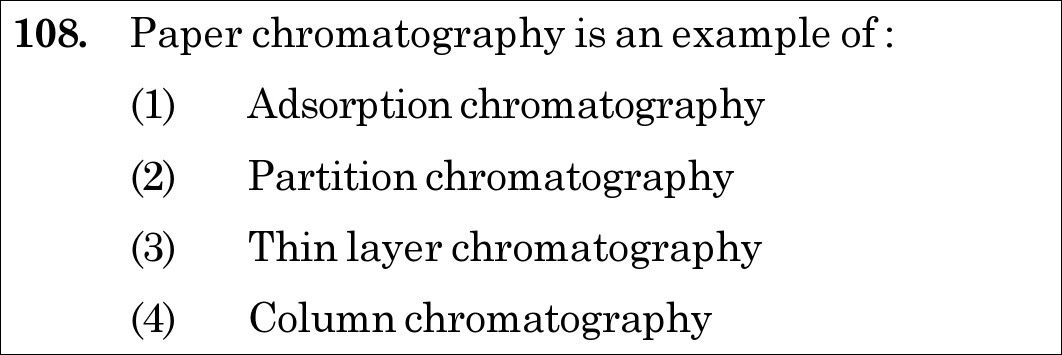
NEET 2020 · Q108 Easy
Official NEET 2020 Question 108 - Organic Chemistry: Some Basic Principles and Techniques
1 Adsorption chromatography
2 Partition chromatography ✓ Key
3 Thin layer chromatography
4 Column chromatography
💡 Verified Solution & 30-Second Hack
✓
Verified Against NTA Final Answer Key
Option (2) : Partition chromatography
📚 Organic Chemistry: Some Basic Principles and Techniques Easy
📋 Given Parameters & Problem Setup
Separation Technique Paper chromatography
Question Objective Identify which chromatographic class it exemplifies
⚡

The 30-Second Exam Hall Shortcut: ⚡ "Paper Chromatography = PARTITION Chromatography (Water Trapped in Cellulose)!"

⏱️ 20 seconds

In paper chromatography, a special chromatography paper contains water trapped in the cellulose network which acts as the stationary liquid phase. The mobile solvent phase moves past it, and components partition continuously between the two liquid phases. Hence, Paper Chromatography is an example of PARTITION Chromatography! Mark Option (2) in 5 seconds.

1 Adsorption chromatography includes: Column chromatography and Thin Layer Chromatography (TLC).
2 Partition chromatography includes: Paper chromatography.
3 In paper chromatography, water trapped in paper is stationary phase, developing solvent is mobile phase.
4 Separation is based on continuous differential partitioning of components.
5 Select Option (2) Partition chromatography.
🛡️
Why You Can 100% Trust This Shortcut: NCERT Chemistry · Organic Chemistry: Some Basic Principles and Techniques (Purification: Chromatography)
📐

Step-by-Step Rigorous Workflow & Mathematical Proof

Step 1

Classify Chromatographic Techniques in NCERT

Based on the principle of separation, chromatography is classified into two broad categories: 1. Adsorption chromatography 2. Partition chromatography.

Step 2

Adsorption Chromatography Types

Adsorption chromatography is based on the differential adsorption of components on a solid adsorbent (silica gel or alumina). It encompasses: (a) Column chromatography (b) Thin layer chromatography (TLC).

Step 3

Partition Chromatography Mechanism

Partition chromatography is based on continuous differential partitioning of components between stationary and mobile phases. In Paper Chromatography, a special chromatography paper contains water trapped in the cellulose fibers which acts as the stationary liquid phase. A strip of chromatography paper spotted at the base is suspended in a suitable mobile solvent which rises by capillary action.

Step 4

Conclude Option 2

NCERT explicitly highlights: "Paper chromatography is an example of partition chromatography."

⭐

360° Option Elimination Engine Key Feature

Diagnose every choice: Know exactly why the right option works and why distractors fail.

4-Option Deep Scan
1 A
✗ Incorrect
Verdict & Scientific Reason:

Incorrect; adsorption chromatography relies on solid adsorbents (e.g. column chromatography and TLC), whereas paper chromatography relies on liquid-liquid partitioning.

⚠️
Student Fallacy (Why candidates pick this trap): Assuming the paper acts as a solid adsorbent.
2 B
✓ 100% Correct
Verdict & Scientific Reason:

Factually exact; paper chromatography is the textbook exemplar of partition chromatography.

💡
Why this is airtight: None; direct NCERT classification statement.
3 C
✗ Incorrect
Verdict & Scientific Reason:

Incorrect; thin layer chromatography (TLC) is a distinct technique belonging to adsorption chromatography.

⚠️
Student Fallacy (Why candidates pick this trap): Confusing thin flat paper strips with thin layer glass plates.
4 D
✗ Incorrect
Verdict & Scientific Reason:

Incorrect; column chromatography is an adsorption technique utilizing a packed vertical glass column.

⚠️
Student Fallacy (Why candidates pick this trap): Mispairing chromatographic classes.
⚠️

NTA Trap Alert: TLC vs Paper Chromatography Principle

Thin Layer Chromatography (TLC) = ADSORPTION chromatography (uses solid silica gel layer). Paper Chromatography = PARTITION chromatography (uses liquid water trapped in paper fibers).

🛡️ How to avoid the -1 mark: Paper = Partition (both start with "P")!
📖

Core NEET Syllabus Standard

Chemistry · Organic Chemistry: Some Basic Principles and Techniques Standard Benchmark
Core Scientific Principle Tested:

""

Syllabus Focus: Chromatographic Methods: Paper Chromatography as Partition Chromatography
✓ Core NEET UG Syllabus Anchor Syllabus & Academic Standards ↗
NEET 2020 · Q112 Easy
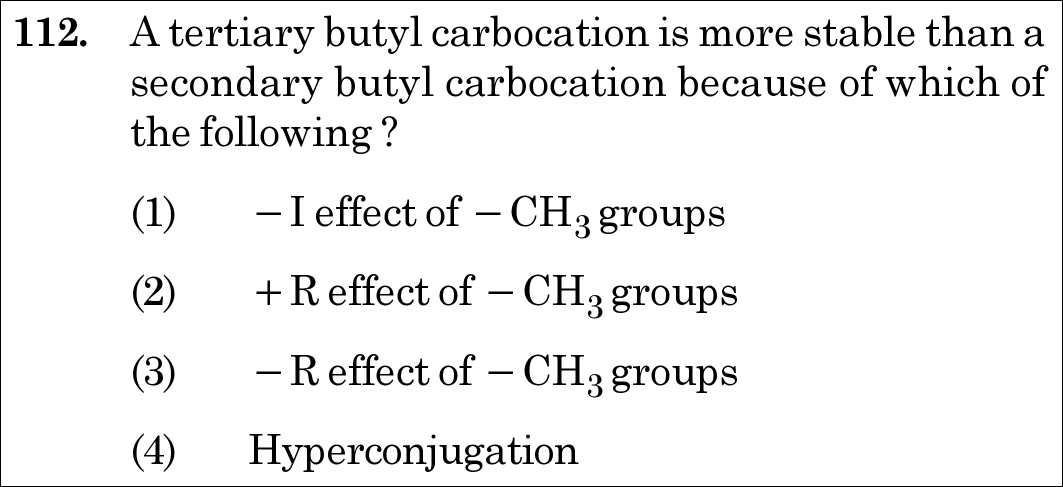
Official NEET 2020 Question 112 - Organic Chemistry: Some Basic Principles and Techniques
1
2
3
4 ✓ Key
💡 Verified Solution & 30-Second Hack
✓
Verified Against NTA Final Answer Key
Option (4) : Hyperconjugation
📚 Organic Chemistry: Some Basic Principles and Techniques Easy
📋 Given Parameters & Problem Setup
Chemical Species 1 Tertiary butyl carbocation [(CH3)3C+]
Chemical Species 2 Secondary butyl carbocation [CH3-CH(+)-CH2-CH3]
Phenomenon Relative thermodynamic stability difference
Question Objective Identify the primary electronic effect responsible
⚡

The 30-Second Exam Hall Shortcut: ⚡ "Carbocation Stability Order (3° > 2° > 1°) is Explained Primarily by HYPERCONJUGATION!"

⏱️ 20 seconds

In carbocations, hyperconjugation (delocalisation of σ electrons of C-H bonds into the vacant p-orbital of carbocationic carbon) is a permanent, stronger stabilising effect than inductive effect (+I). Tert-butyl carbocation has 9 α-hydrogens (9 hyperconjugative structures), whereas sec-butyl carbocation has only 5 α-hydrogens. Hyperconjugation stabilizes tert-butyl carbocation! Mark Hyperconjugation (Option 4) in 5 seconds.

1 Tert-butyl carbocation: (CH3)3C+ has 3 methyl groups = 9 α-hydrogens.
2 Sec-butyl carbocation: CH3-CH(+)-CH2CH3 has 3 + 2 = 5 α-hydrogens.
3 Greater number of α-C-H bonds enables greater hyperconjugative delocalisation.
4 Alkyl groups do not show resonance (+R or -R).
5 The dominant stabilizing effect is Hyperconjugation.
6 Select Option (4).
🛡️
Why You Can 100% Trust This Shortcut: NCERT Chemistry · Organic Chemistry: Some Basic Principles and Techniques (Hyperconjugation and Carbocation Stability)
📐

Step-by-Step Rigorous Workflow & Mathematical Proof

Step 1

Understand Carbocation Geometry and Vacant Orbital

Carbocations possess a sp2-hybridized planar central carbon with an unhybridized, empty p-orbital perpendicular to the molecular plane.

Step 2

Mechanism of Hyperconjugation

Hyperconjugation involves the overlap of σ\sigma-electrons of adjacent C−H\text{C}-\text{H} bonds of the alkyl group with the empty pp-orbital of the carbocationic carbon (also called no-bond resonance). This delocalizes the positive charge across multiple hydrogen atoms, dispersing charge and stabilizing the cation.

Step 3

Compare α-Hydrogens in Tert-Butyl vs Sec-Butyl

- Tertiary butyl carbocation, (CH3)3C+(\text{CH}_3)_3\text{C}^+, has three methyl groups directly attached to the carbocationic carbon, giving a total of 3×3=9 α-hydrogens3 \times 3 = 9\text{ }\alpha\text{-hydrogens}, yielding 9 hyperconjugative canonical structures. - Secondary butyl carbocation, CH3−CH+−CH2−CH3\text{CH}_3-\text{CH}^+-\text{CH}_2-\text{CH}_3, has one methyl (3 α-H3\text{ }\alpha\text{-H}) and one methylene (2 α-H2\text{ }\alpha\text{-H}), totaling only 5 α-hydrogens5\text{ }\alpha\text{-hydrogens}, yielding 5 hyperconjugative structures.

Step 4

Eliminate Incorrect Effects in Options

- Methyl groups exhibit +I+I effect, NOT −I-I effect (Option 1 is false). - Methyl groups lack lone pairs or π\pi-bonds and CANNOT exhibit resonance (+R+R or −R-R) effects (Options 2 and 3 are chemically invalid). - Thus, Hyperconjugation uniquely and correctly accounts for the superior stability of tert-butyl carbocation.

⭐

360° Option Elimination Engine Key Feature

Diagnose every choice: Know exactly why the right option works and why distractors fail.

4-Option Deep Scan
1 A
✗ Incorrect
Verdict & Scientific Reason:

Incorrect; methyl (alkyl) groups are electron-donating by inductive effect (+I+I), not electron-withdrawing (−I-I).

⚠️
Student Fallacy (Why candidates pick this trap): Confusing +I with -I sign.
2 B
✗ Incorrect
Verdict & Scientific Reason:

Incorrect; saturated alkyl groups have no pi-electrons or lone pairs and cannot show mesomeric/resonance (+R+R) effects.

⚠️
Student Fallacy (Why candidates pick this trap): Confusing hyperconjugation with true resonance.
3 C
✗ Incorrect
Verdict & Scientific Reason:

Incorrect; alkyl groups do not exert −R-R resonance withdrawal.

⚠️
Student Fallacy (Why candidates pick this trap): Random resonance option.
4 D
✓ 100% Correct
Verdict & Scientific Reason:

Factually and mechanistically exact; greater number of α-C-H bonds (9 vs 5) provides extensive hyperconjugative stabilization to tert-butyl carbocation.

💡
Why this is airtight: None; core organic chemistry concept explicitly highlighted in NCERT.
⚠️

NTA Trap Alert: Hyperconjugation vs Inductive Effect Primacy

Although alkyl groups show +I+I effect, NCERT states: "Hyperconjugation is a permanent effect... more the number of alkyl groups attached to a positively charged carbon, greater is the hyperconjugation interaction and stability of the cation."

🛡️ How to avoid the -1 mark: Alkyl carbocation stability: HYPERCONJUGATION is the primary explanation!
📖

Core NEET Syllabus Standard

Chemistry · Organic Chemistry: Some Basic Principles and Techniques Standard Benchmark
Core Scientific Principle Tested:

""

Syllabus Focus: Carbocation Stability: Hyperconjugation (No-Bond Resonance) vs Inductive Effect
✓ Core NEET UG Syllabus Anchor Syllabus & Academic Standards ↗

Solve 4 NEET Questions a Day — One per Subject

Cover all 1,140 official NEET questions in 285 days at your own pace. Progress is saved on your device. No login needed.