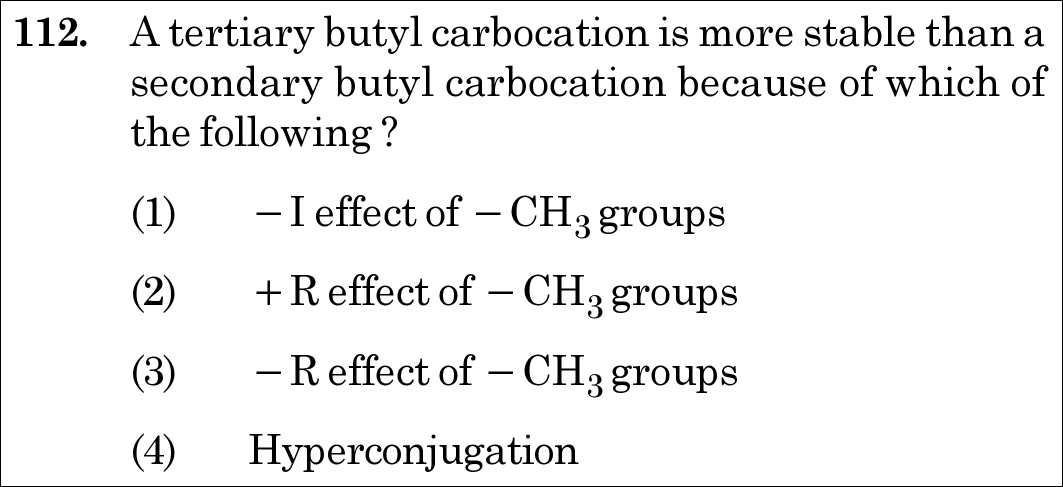
NEET 2020 Chemistry Question 112 Solution
Question
A tertiary butyl carbocation is more stable than a secondary butyl carbocation because of which of the following?
Dynamic 180-question full-length simulator mixed dynamically from all 6 years for 2027 & 2026 aspirants.
A tertiary butyl carbocation is more stable than a secondary butyl carbocation because of which of the following?
In carbocations, hyperconjugation (delocalisation of σ electrons of C-H bonds into the vacant p-orbital of carbocationic carbon) is a permanent, stronger stabilising effect than inductive effect (+I). Tert-butyl carbocation has 9 α-hydrogens (9 hyperconjugative structures), whereas sec-butyl carbocation has only 5 α-hydrogens. Hyperconjugation stabilizes tert-butyl carbocation! Mark Hyperconjugation (Option 4) in 5 seconds.
Carbocations possess a sp2-hybridized planar central carbon with an unhybridized, empty p-orbital perpendicular to the molecular plane.
Hyperconjugation involves the overlap of -electrons of adjacent bonds of the alkyl group with the empty -orbital of the carbocationic carbon (also called no-bond resonance). This delocalizes the positive charge across multiple hydrogen atoms, dispersing charge and stabilizing the cation.
- Tertiary butyl carbocation, , has three methyl groups directly attached to the carbocationic carbon, giving a total of , yielding 9 hyperconjugative canonical structures. - Secondary butyl carbocation, , has one methyl () and one methylene (), totaling only , yielding 5 hyperconjugative structures.
- Methyl groups exhibit effect, NOT effect (Option 1 is false). - Methyl groups lack lone pairs or -bonds and CANNOT exhibit resonance ( or ) effects (Options 2 and 3 are chemically invalid). - Thus, Hyperconjugation uniquely and correctly accounts for the superior stability of tert-butyl carbocation.
Diagnose every choice: Know exactly why the right option works and why distractors fail.
Incorrect; methyl (alkyl) groups are electron-donating by inductive effect (), not electron-withdrawing ().
Incorrect; saturated alkyl groups have no pi-electrons or lone pairs and cannot show mesomeric/resonance () effects.
Incorrect; alkyl groups do not exert resonance withdrawal.
Factually and mechanistically exact; greater number of α-C-H bonds (9 vs 5) provides extensive hyperconjugative stabilization to tert-butyl carbocation.
Although alkyl groups show effect, NCERT states: "Hyperconjugation is a permanent effect... more the number of alkyl groups attached to a positively charged carbon, greater is the hyperconjugation interaction and stability of the cation."
""
Test your speed and accuracy in the authentic 180-minute timed NTA simulator.
Spotted a mistake in this solution? Report an error ([email protected])
Cover all 1,140 official NEET questions in 285 days at your own pace. Progress is saved on your device. No login needed.