MyCompetitiveExams Logo MyCompetitiveExams
Search 1,140+ Questions
Chapters, formulas, speed tricks
→
⚡ Brahmastra NEET 2027
720 MARKS

Dynamic 180-question full-length simulator mixed dynamically from all 6 years for 2027 & 2026 aspirants.

Launch Brahmastra 2027 Test →
Start Practice →
100% Free · No Login Required
Q.108 Chemistry ⭐ 360° Option Elimination Active
Vault ↗

NEET 2020 Chemistry Question 108 Solution

Topic: Organic Chemistry: Some Basic Principles and Techniques · Official NTA Booklet Code E1
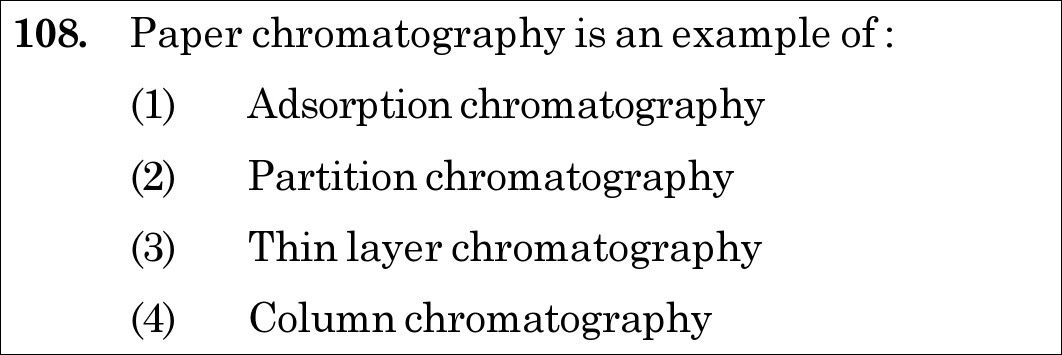
NEET 2020 Chemistry Question 108: Chromatographic Methods: Paper Chromatography as Partition Chromatography

Question

Paper chromatography is an example of:

  1. (1)Adsorption chromatography
  2. (2)Partition chromatography
  3. (3)Thin layer chromatography
  4. (4)Column chromatography
✓
Verified Against NTA Final Answer Key
Option (2) : Partition chromatography
📚 Organic Chemistry: Some Basic Principles and Techniques Easy
📋 Given Parameters & Problem Setup
Separation Technique Paper chromatography
Question Objective Identify which chromatographic class it exemplifies
⚡

The 30-Second Exam Hall Shortcut: ⚡ "Paper Chromatography = PARTITION Chromatography (Water Trapped in Cellulose)!"

⏱️ 20 seconds

In paper chromatography, a special chromatography paper contains water trapped in the cellulose network which acts as the stationary liquid phase. The mobile solvent phase moves past it, and components partition continuously between the two liquid phases. Hence, Paper Chromatography is an example of PARTITION Chromatography! Mark Option (2) in 5 seconds.

1 Adsorption chromatography includes: Column chromatography and Thin Layer Chromatography (TLC).
2 Partition chromatography includes: Paper chromatography.
3 In paper chromatography, water trapped in paper is stationary phase, developing solvent is mobile phase.
4 Separation is based on continuous differential partitioning of components.
5 Select Option (2) Partition chromatography.
🛡️
Why You Can 100% Trust This Shortcut: NCERT Chemistry · Organic Chemistry: Some Basic Principles and Techniques (Purification: Chromatography)
📐

Step-by-Step Rigorous Workflow & Mathematical Proof

Step 1

Classify Chromatographic Techniques in NCERT

Based on the principle of separation, chromatography is classified into two broad categories: 1. Adsorption chromatography 2. Partition chromatography.

Step 2

Adsorption Chromatography Types

Adsorption chromatography is based on the differential adsorption of components on a solid adsorbent (silica gel or alumina). It encompasses: (a) Column chromatography (b) Thin layer chromatography (TLC).

Step 3

Partition Chromatography Mechanism

Partition chromatography is based on continuous differential partitioning of components between stationary and mobile phases. In Paper Chromatography, a special chromatography paper contains water trapped in the cellulose fibers which acts as the stationary liquid phase. A strip of chromatography paper spotted at the base is suspended in a suitable mobile solvent which rises by capillary action.

Step 4

Conclude Option 2

NCERT explicitly highlights: "Paper chromatography is an example of partition chromatography."

⭐

360° Option Elimination Engine Key Feature

Diagnose every choice: Know exactly why the right option works and why distractors fail.

4-Option Deep Scan
1 A
✗ Incorrect
Verdict & Scientific Reason:

Incorrect; adsorption chromatography relies on solid adsorbents (e.g. column chromatography and TLC), whereas paper chromatography relies on liquid-liquid partitioning.

⚠️
Student Fallacy (Why candidates pick this trap): Assuming the paper acts as a solid adsorbent.
2 B
✓ 100% Correct
Verdict & Scientific Reason:

Factually exact; paper chromatography is the textbook exemplar of partition chromatography.

💡
Why this is airtight: None; direct NCERT classification statement.
3 C
✗ Incorrect
Verdict & Scientific Reason:

Incorrect; thin layer chromatography (TLC) is a distinct technique belonging to adsorption chromatography.

⚠️
Student Fallacy (Why candidates pick this trap): Confusing thin flat paper strips with thin layer glass plates.
4 D
✗ Incorrect
Verdict & Scientific Reason:

Incorrect; column chromatography is an adsorption technique utilizing a packed vertical glass column.

⚠️
Student Fallacy (Why candidates pick this trap): Mispairing chromatographic classes.
⚠️

NTA Trap Alert: TLC vs Paper Chromatography Principle

Thin Layer Chromatography (TLC) = ADSORPTION chromatography (uses solid silica gel layer). Paper Chromatography = PARTITION chromatography (uses liquid water trapped in paper fibers).

🛡️ How to avoid the -1 mark: Paper = Partition (both start with "P")!
📖

Core NEET Syllabus Standard

Chemistry · Organic Chemistry: Some Basic Principles and Techniques Standard Benchmark
Core Scientific Principle Tested:

""

Syllabus Focus: Chromatographic Methods: Paper Chromatography as Partition Chromatography
✓ Core NEET UG Syllabus Anchor Syllabus & Academic Standards ↗

Ready to attempt under real exam pressure?

Test your speed and accuracy in the authentic 180-minute timed NTA simulator.

Launch NEET 2020 CBT Test →

Spotted a mistake in this solution? Report an error ([email protected])

⚖️ Legal & Fair Dealing Notice: Sourced from publicly released NEET 2020 question papers and NEET answer keys for private study, research, and non-commercial educational practice under Fair Dealing (Section 52(1)(a) of the Indian Copyright Act, 1957). Not affiliated with or endorsed by NTA or NMC.

Solve 4 NEET Questions a Day — One per Subject

Cover all 1,140 official NEET questions in 285 days at your own pace. Progress is saved on your device. No login needed.