MyCompetitiveExams Logo MyCompetitiveExams
Search 1,140+ Questions
Chapters, formulas, speed tricks
→
⚡ Brahmastra NEET 2027
720 MARKS

Dynamic 180-question full-length simulator mixed dynamically from all 6 years for 2027 & 2026 aspirants.

Launch Brahmastra 2027 Test →
Start Practice →
100% Free · No Login Required
Q.151 Zoology ⭐ 360° Option Elimination Active
Vault ↗

NEET 2025 Zoology Question 151 Solution

Topic: Evolution · Official NTA Booklet Code 45
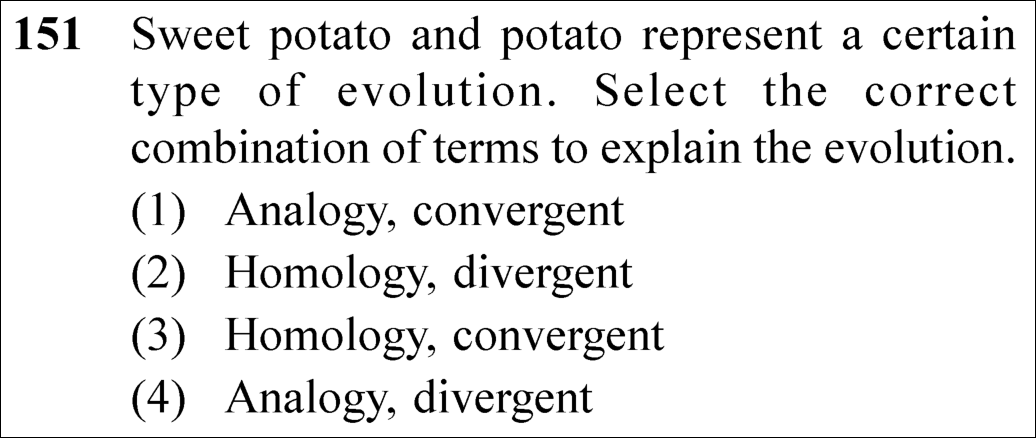
NEET 2025 Zoology Question 151: Analogous Organs and Convergent Evolution (Sweet Potato vs Potato)

Question

Sweet potato and potato represent a certain type of evolution. Select the correct combination of terms to explain the evolution.

  1. (1)Analogy, convergent
  2. (2)Homology, divergent
  3. (3)Homology, convergent
  4. (4)Analogy, divergent
✓
Verified Against NTA Final Answer Key
Option (1) : Analogy, convergent
📚 Evolution Easy
📋 Given Parameters & Problem Setup
Example Pair Sweet potato (Ipomoea batatas) and Potato (Solanum tuberosum)
Target Combination Type of anatomical relationship and evolutionary pattern
⚡

The 30-Second Exam Hall Shortcut: ⚡ Analogy vs Homology Fingerprint

⏱️ Save ~25 seconds

Sweet potato (ROOT modification) and Potato (STEM tuber) perform the SAME function (food storage) from DIFFERENT anatomical origins -> ANALOGY via CONVERGENT evolution!

1 Examine anatomical origins and functions from NCERT Section 7.3:
2 - Sweet potato: Modified adventitious ROOT specialized for storage.
3 - Potato: Modified underground STEM (tuber) specialized for storage.
4 - Different anatomical origins + Same function (storage of starch) = ANALOGOUS organs.
5 - Analogous structures arise due to adaptation to similar environmental needs = CONVERGENT evolution.
6 Pair: Analogy, convergent (Option 1)!
7 Solved in under 5 seconds!
🛡️
Why You Can 100% Trust This Shortcut: Homologous vs Analogous Organs & Divergent Evolution (NCERT Biology · Evolution: Forelimbs of vertebrates share common ancestry).
📐

Step-by-Step Rigorous Workflow & Mathematical Proof

Step 1

Morphological and Anatomical Origins of the Tubers

Examining the developmental genesis of both storage organs:

  • • Potato (*Solanum tuberosum*): An underground modified stem (stem tuber). It bears nodes ("eyes" with scale leaves and axillary buds) and internodes, characteristic of cauline anatomy.
  • • Sweet potato (*Ipomoea batatas*): A modified adventitious root (root tuber). It lacks nodes, internodes, and scale leaves.
Step 2

Evolutionary Significance: Analogy and Convergent Evolution

Relating structure and function to evolutionary trajectories:

  • • Analogy: Structures that are not anatomically similar (different embryonic origins) but perform similar biological functions (both store food/starch underground).
  • • Convergent Evolution: Different ancestral structures independently evolve similar phenotypic adaptations in response to similar selective pressures or habitats.
  • • NCERT states verbatim: "Sweet potato (root modification) and potato (stem modification) is another example for analogy... Analogous structures are a result of convergent evolution."
Step 3

Conclusion

The correct combination of terms is Analogy and Convergent evolution, corresponding to Option (1).

Root+Stem→Food StorageAnalogy (Convergent Evolution)\text{Root} + \text{Stem} \xrightarrow{\text{Food Storage}} \text{Analogy (Convergent Evolution)}
⭐

360° Option Elimination Engine Key Feature

Diagnose every choice: Know exactly why the right option works and why distractors fail.

4-Option Deep Scan
1 A
✓ 100% Correct
Verdict & Scientific Reason:

100% correct. Accurately links different anatomical origins performing similar storage functions to analogy and convergent evolution.

💡
Why this is airtight: None; textbook mastery.
2 B
✗ Incorrect
Verdict & Scientific Reason:

Incorrect. Homologous organs share a common anatomical origin (e.g., Bougainvillea thorn and Cucurbita tendril), which is not the case here.

⚠️
Student Fallacy (Why candidates pick this trap): Confusing similar function with common origin.
3 C
✗ Incorrect
Verdict & Scientific Reason:

Incorrect. Homology results from divergent evolution, not convergent evolution.

⚠️
Student Fallacy (Why candidates pick this trap): Mismatched evolutionary concepts.
4 D
✗ Incorrect
Verdict & Scientific Reason:

Incorrect. Analogy is driven by convergent evolution, never divergent evolution.

⚠️
Student Fallacy (Why candidates pick this trap): Failing to remember that analogy always pairs with convergence.
⚠️

NTA Trap Alert: HD vs AC Mnemonic Rule

Never mix up the pairs: Homology -> Divergent evolution (HD); Analogy -> Convergent evolution (AC). Sweet potato (root) and potato (stem) are AC!

🛡️ How to avoid the -1 mark: Remember: HD (High Definition = Homology Divergent) and AC (Air Conditioner = Analogy Convergent).
📖

Core NEET Syllabus Standard

NEET Biology Core Syllabus · Evolution Standard Benchmark
Core Scientific Principle Tested:

"Sweet potato (root) and potato (stem) are analogous organs resulting from convergent evolution."

Syllabus Focus: Evidences for Evolution · Comparative Anatomy and Morphology
✓ Core NEET UG Syllabus Anchor Syllabus & Academic Standards ↗
AC: Analogy = Convergent (Sweet Potato + Potato)!

Ready to attempt under real exam pressure?

Test your speed and accuracy in the authentic 180-minute timed NTA simulator.

Launch NEET 2025 CBT Test →

Spotted a mistake in this solution? Report an error ([email protected])

⚖️ Legal & Fair Dealing Notice: Sourced from publicly released NEET 2025 question papers and NEET answer keys for private study, research, and non-commercial educational practice under Fair Dealing (Section 52(1)(a) of the Indian Copyright Act, 1957). Not affiliated with or endorsed by NTA or NMC.

Solve 4 NEET Questions a Day — One per Subject

Cover all 1,140 official NEET questions in 285 days at your own pace. Progress is saved on your device. No login needed.