MyCompetitiveExams Logo MyCompetitiveExams
Search 1,140+ Questions
Chapters, formulas, speed tricks
→
⚡ Brahmastra NEET 2027
720 MARKS

Dynamic 180-question full-length simulator mixed dynamically from all 6 years for 2027 & 2026 aspirants.

Launch Brahmastra 2027 Test →
Start Practice →
100% Free · No Login Required
Q.141 Zoology ⭐ 360° Option Elimination Active
Vault ↗

NEET 2026 Zoology Question 141 Solution

Topic: Evolution · Official NTA Booklet Code 50
NEET 2026 Zoology Question 141: Modes and Outcomes of Natural Selection (Stabilising, Directional, Disruptive)

Question

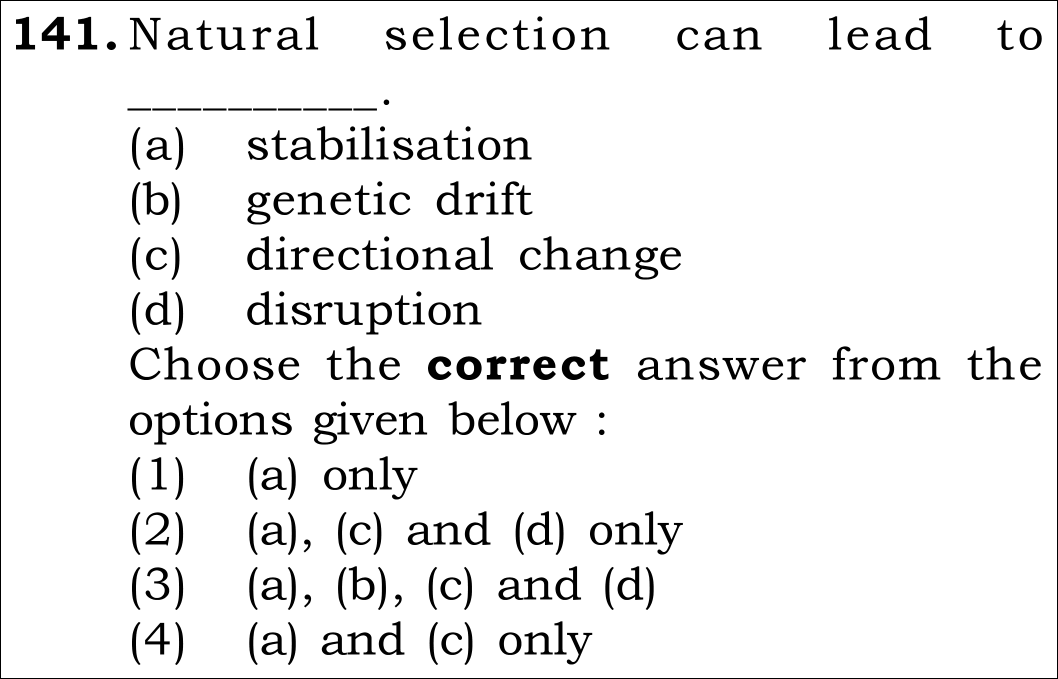
Natural selection can lead to (a) stabilisation (b) genetic drift (c) directional change (d) disruption Choose the correct answer from the options given below:

✓
Verified Against NTA Final Answer Key
Option (2) : (a), (c) and (d) only
📚 Evolution Medium
📋 Given Parameters & Problem Setup
Evolutionary Process Natural selection acting on phenotypic variation
Candidate Phenomena (a) stabilisation, (b) genetic drift, (c) directional change, (d) disruption
⚡

The 30-Second Exam Hall Shortcut: ⚡ Triad of Natural Selection Graphs

⏱️ Save ~45 seconds

Selection Curves = Stabilising, Directional, Disruptive! Genetic Drift is CHANCE, not Selection!

1 Recall the three graphical outcomes of natural selection in NCERT Figure 7.8:
2 Stabilisation: Peak gets higher and narrower (favors mean phenotype).
3 Directional change: Peak shifts in one direction (favors one extreme).
4 Disruption: Two peaks form (favors both extremes over the mean).
5 Genetic drift is Sewall Wright effect: random chance fluctuation in allele frequencies in small populations, NOT an outcome of natural selection!
6 Eliminate (b) -> Correct set is (a), (c) and (d) only.
7 Select Option (2) in under 10 seconds!
🛡️
Why You Can 100% Trust This Shortcut: NCERT Biology · Evolution (Natural Selection Types: Stabilizing, Directional, and Disruptive selection).
📐

Step-by-Step Rigorous Workflow & Mathematical Proof

Step 1

Review the Three Outcomes of Natural Selection

Based on which phenotypes are favored relative to environmental pressures, natural selection on continuous polygenic traits produces three distinct demographic patterns:

Natural Selection Outcomes={Stabilisation:More individuals acquire mean character valueDirectional Change:More individuals acquire value other than meanDisruption:Individuals acquire peripheral values at both ends\text{Natural Selection Outcomes} = \begin{cases} \mathbf{Stabilisation} &: \text{More individuals acquire mean character value} \\ \mathbf{Directional\text{ Change}} &: \text{More individuals acquire value other than mean} \\ \mathbf{Disruption} &: \text{Individuals acquire peripheral values at both ends} \end{cases}
  • • All three are depicted and explained in NCERT Figure 7.8.
Step 2

Evaluate Genetic Drift

Genetic drift refers to stochastic (random sampling) fluctuations in allele frequencies from generation to generation in small, isolated populations. It operates independently of natural selection (often fixing neutral or deleterious alleles purely by chance, such as in the founder effect or bottleneck effect). Therefore, natural selection does NOT lead to genetic drift.

Genetic Drift=Random stochastic sampling error≠Natural Selection outcome\text{Genetic Drift} = \text{Random stochastic sampling error} \neq \text{Natural Selection outcome}
  • • Statement (b) must be excluded.
Step 3

Select Matching Option

Statements (a), (c), and (d) are legitimate outcomes of natural selection, while (b) is an independent evolutionary mechanism. The matching combination is Option (2).

Correct Set=(a),(c) and (d) only  ⟹  Option (2)\text{Correct Set} = \mathbf{(a), (c) \text{ and } (d) \text{ only}} \implies \text{Option (2)}
  • • Matches official NTA final answer key Option B / (2).
⭐

360° Option Elimination Engine Key Feature

Diagnose every choice: Know exactly why the right option works and why distractors fail.

4-Option Deep Scan
1 A
✗ Incorrect
Verdict & Scientific Reason:

Incorrect. Directional change and disruption are also standard modes of natural selection.

⚠️
Student Fallacy (Why candidates pick this trap): Restricting selection to stabilizing mode only.
2 B
✓ 100% Correct
Verdict & Scientific Reason:

100% accurate. Natural selection leads to stabilization, directional change, or disruption, but not genetic drift.

💡
Why this is airtight: None; rigorous conceptual demarcation between selection and drift.
3 C
✗ Incorrect
Verdict & Scientific Reason:

Incorrect. Erroneously includes genetic drift as an outcome of natural selection.

⚠️
Student Fallacy (Why candidates pick this trap): Lumping all evolutionary terms together into one basket.
4 D
✗ Incorrect
Verdict & Scientific Reason:

Incorrect. Omits disruptive selection.

⚠️
Student Fallacy (Why candidates pick this trap): Forgetting disruptive selection produces two peripheral peaks.
⚠️

NTA Trap Alert: Conflating Selection with Chance Drift

Students frequently view "evolution" as a single blur and assume natural selection causes genetic drift. Natural selection is deterministic (survival of the fittest); genetic drift is purely random chance!

🛡️ How to avoid the -1 mark: Selection selects; Drift drifts by chance!
📖

Core NEET Syllabus Standard

NEET Biology Core Syllabus · Evolution Standard Benchmark
Core Scientific Principle Tested:

"Natural selection operates through three primary modes: stabilizing selection, directional selection, and disruptive selection. Genetic drift is an independent stochastic process."

Syllabus Focus: Mechanism of Evolution - Natural Selection
✓ Core NEET UG Syllabus Anchor Syllabus & Academic Standards ↗
Natural Selection acts in Three: Stabilize, Direct, or Disrupt the tree; Drift is Chance, so set it free!

Ready to attempt under real exam pressure?

Test your speed and accuracy in the authentic 180-minute timed NTA simulator.

Launch NEET 2026 CBT Test →

Spotted a mistake in this solution? Report an error ([email protected])

⚖️ Legal & Fair Dealing Notice: Sourced from publicly released NEET 2026 question papers and NEET answer keys for private study, research, and non-commercial educational practice under Fair Dealing (Section 52(1)(a) of the Indian Copyright Act, 1957). Not affiliated with or endorsed by NTA or NMC.

Solve 4 NEET Questions a Day — One per Subject

Cover all 1,140 official NEET questions in 285 days at your own pace. Progress is saved on your device. No login needed.