NEET 2026 Zoology Question 140 Solution
Question
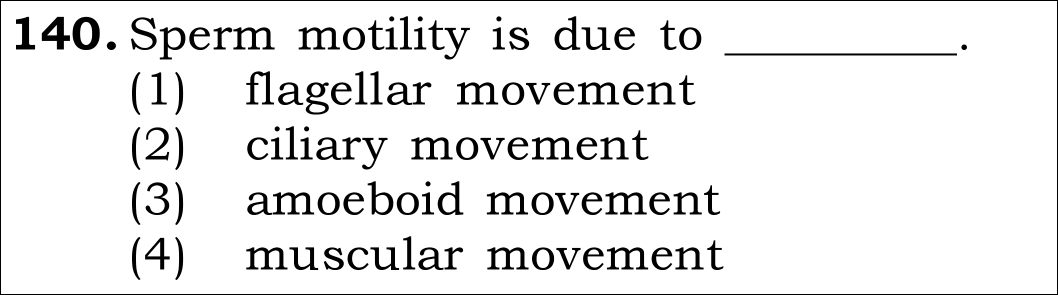
Sperm motility is due to.
- (1)flagellar movement
- (2)ciliary movement
- (3)amoeboid movement
- (4)muscular movement
Dynamic 180-question full-length simulator mixed dynamically from all 6 years for 2027 & 2026 aspirants.
Sperm motility is due to.
Sperm tail is a Flagellum -> Motility is FLAGELLAR movement!
Cells of the human body exhibit three main types of movements: amoeboid, ciliary, and muscular, along with flagellar movement exhibited by specialized cells.
The sperm tail consists of an axoneme comprising a classical "9+2" microtubule doublet arrangement powered by dynein motor arms. ATP generated by the mitochondrial spiral of the middle piece drives sinusoidal wave propagation along the flagellum, propelling the sperm forward through the female genital tract.
Option (1) flagellar movement is the exact mechanism. Option (2) ciliary movement is in oviducts/trachea. Option (3) amoeboid is in phagocytes. Option (4) muscular is in tissues.
Diagnose every choice: Know exactly why the right option works and why distractors fail.
100% accurate. Sperm propulsion is driven by the undulatory beating of its flagellar tail.
Incorrect. Cilia line the Fallopian tubes and trachea, but the sperm itself moves via a single flagellum.
Incorrect. Amoeboid movement occurs in macrophages and leukocytes via pseudopodia.
Incorrect. Muscle tissue contracts using actin-myosin cross-bridges, not flagellar axonemes.
The ovum is non-motile and transported by ciliated epithelial cells lining the Fallopian tube, whereas the sperm moves under its own power via its flagellum.
"Flagellar movement enables the swimming of spermatozoa toward the ovum, driven by the axoneme of the sperm tail."
Test your speed and accuracy in the authentic 180-minute timed NTA simulator.
Spotted a mistake in this solution? Report an error ([email protected])
Cover all 1,140 official NEET questions in 285 days at your own pace. Progress is saved on your device. No login needed.