MyCompetitiveExams Logo MyCompetitiveExams
Search 1,140+ Questions
Chapters, formulas, speed tricks
→
⚡ Brahmastra NEET 2027
720 MARKS

Dynamic 180-question full-length simulator mixed dynamically from all 6 years for 2027 & 2026 aspirants.

Launch Brahmastra 2027 Test →
Start Practice →
100% Free · No Login Required
Q.23 Physics ⭐ 360° Option Elimination Active
Vault ↗

NEET 2025 Physics Question 23 Solution

Topic: Oscillations · Official NTA Booklet Code 45
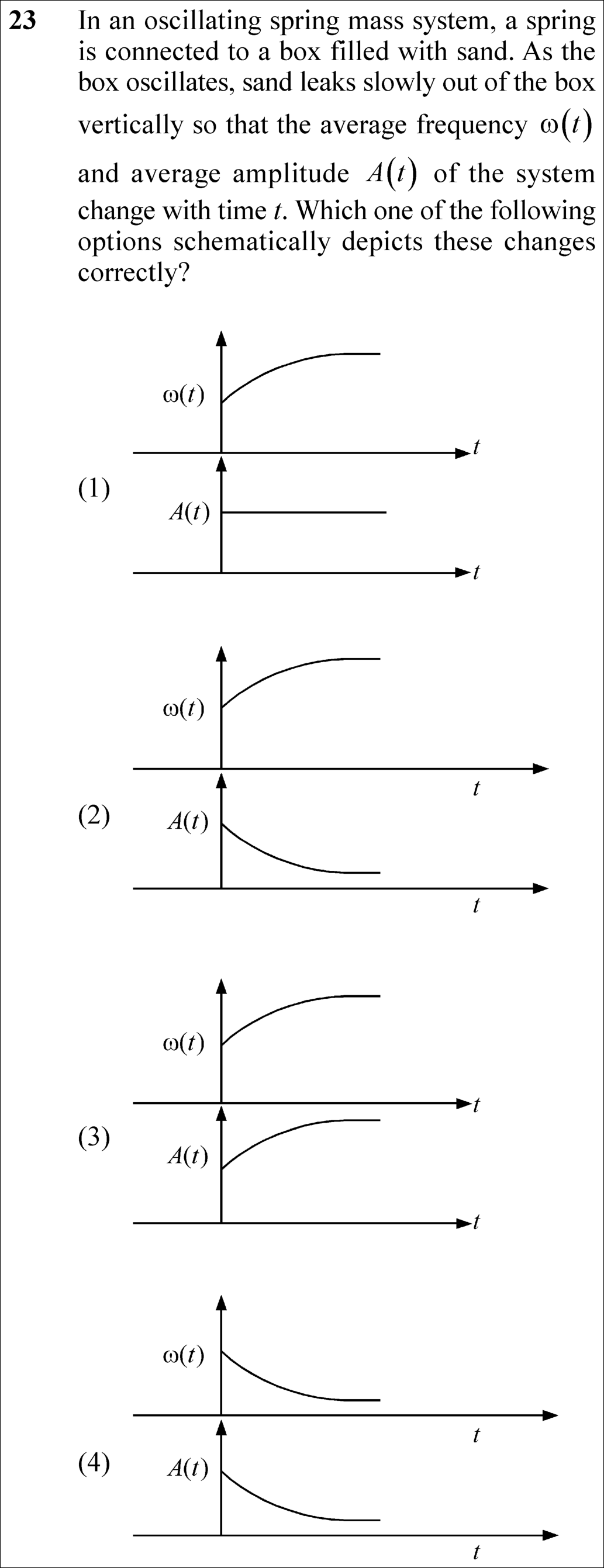
NEET 2025 Physics Question 23: Spring-Mass System with Slowly Leaking Mass (Variable Mass SHM)

Question

In an oscillating spring mass system, a spring is connected to a box filled with sand. As the box oscillates, sand leaks slowly out of the box vertically so that the average frequency ω(t) and average amplitude A(t) of the system change with time t. Which one of the following options schematically depicts these changes correctly?

✓
Verified Against NTA Final Answer Key
Option (2) : ω(t) curves upward (increases) and A(t) curves downward (decreases)
📚 Oscillations Medium
📋 Given Parameters & Problem Setup
System Horizontal oscillating spring-mass system with sand-filled box
Perturbation Sand leaks slowly vertically downwards out of the box
Observed Variables Average angular frequency ω(t) and average amplitude A(t) vs time t
⚡

The 30-Second Exam Hall Shortcut: ⚡ Mass Loss Dynamics Rule

⏱️ Save ~45 seconds

Mass M decreases ⟹ ω = √(k/M) INCREASES! Sand falls out carrying kinetic energy ⟹ Total Energy E decreases ⟹ Amplitude A = √(2E/k) DECREASES!

1 Analyze angular frequency: ω(t) = √(k / M(t)).
2 As sand leaks out, total mass M(t) decreases continuously.
3 Since M is in the denominator, ω(t) must INCREASE with time.
4 This immediately eliminates Option (4) where ω decreases!
5 Analyze amplitude: Leaking sand drops vertically with instantaneous horizontal speed v.
6 Each grain carries away kinetic energy dE = (1/2) dm v² from the system.
7 Because total mechanical energy E = (1/2) k A² decreases, amplitude A(t) must DECREASE with time.
8 Match Option (2): ω(t) increases, A(t) decreases!
9 Select Option (2) in under 15 seconds!
🛡️
Why You Can 100% Trust This Shortcut: Simple Harmonic Motion Dynamics (NCERT Physics · Oscillations: T = 2π√(m/k)).
📐

Step-by-Step Rigorous Workflow & Mathematical Proof

Step 1

Behavior of Angular Frequency ω(t)

For a mass M attached to an ideal spring of stiffness k, the natural angular frequency of oscillation is:

ω(t)=kM(t)\omega(t) = \sqrt{\frac{k}{M(t)}}
  • • As sand leaks slowly out of the box, M(t) decreases monotonically over time towards the empty box mass M_box.
  • • Therefore, ω(t) increases monotonically, approaching a constant upper asymptote.
Step 2

Behavior of Amplitude A(t)

When sand leaks out vertically, the escaping grains have horizontal velocity equal to the instantaneous velocity v of the box at the moment of exit. The escaping sand exerts no horizontal force on the remaining box, but carries away its share of kinetic energy:

dE=−12(dm)v2<0  ⟹  dEdt<0dE = -\frac{1}{2} (dm) v^2 < 0 \implies \frac{dE}{dt} < 0
  • • The total mechanical energy E(t) of the oscillator continuously decreases.
  • • Since total energy is related to amplitude by E = (1/2) k A², we have A(t) = √(2 E(t) / k).
  • • Consequently, as E(t) decreases, the average amplitude A(t) decreases with time.
Step 3

Consolidate Graphical Representation

The correct schematic shows ω(t) starting from initial value and curving upwards towards an asymptote, while A(t) starts from initial amplitude and curves downwards:

ω(t)↑andA(t)↓  ⟹  Option (2)\omega(t) \uparrow \quad \text{and} \quad A(t) \downarrow \implies \text{Option (2)}
  • • Matches Option (2) unambiguously.
⭐

360° Option Elimination Engine Key Feature

Diagnose every choice: Know exactly why the right option works and why distractors fail.

4-Option Deep Scan
1 A
✗ Incorrect
Verdict & Scientific Reason:

Incorrect. Amplitude cannot remain constant because escaping sand carries away kinetic energy, depleting total mechanical energy.

⚠️
Student Fallacy (Why candidates pick this trap): Assuming mass loss does not affect the extreme turning point.
2 B
✓ 100% Correct
Verdict & Scientific Reason:

100% scientifically correct. ω ∝ 1/√M increases as mass drops; A decreases as kinetic energy is shed with the exiting sand.

💡
Why this is airtight: None; rigorous physics analysis.
3 C
✗ Incorrect
Verdict & Scientific Reason:

Incorrect. Amplitude can only increase if energy is pumped into the system, violating energy conservation.

⚠️
Student Fallacy (Why candidates pick this trap): Thinking lighter mass allows the spring to stretch farther without an energy source.
4 D
✗ Incorrect
Verdict & Scientific Reason:

Incorrect. Frequency cannot decrease when mass decreases; ω = √(k/M) is inversely related to mass.

⚠️
Student Fallacy (Why candidates pick this trap): Inverting the formula for frequency (thinking ω ∝ M).
⚠️

NTA Trap Alert: Constant Amplitude Misconception

Some students reason: "If sand drops out when the box is at the extreme position (where v = 0), no kinetic energy is lost, so amplitude might stay constant." But sand leaks continuously throughout the cycle, carrying away kinetic energy on average, which inexorably shrinks A(t).

🛡️ How to avoid the -1 mark: Continuous leak = Continuous energy loss ⟹ Amplitude drops.
📖

Core NEET Syllabus Standard

NEET Physics Core Syllabus · Oscillations Standard Benchmark
Core Scientific Principle Tested:

"Frequency ω = √(k/M) increases with mass reduction; energy leakage causes amplitude decay."

Syllabus Focus: Energy in Simple Harmonic Motion
✓ Core NEET UG Syllabus Anchor Syllabus & Academic Standards ↗
Lighter Box = Faster Rhythm (ω up), Sand Carries Energy Out (A down)!

Ready to attempt under real exam pressure?

Test your speed and accuracy in the authentic 180-minute timed NTA simulator.

Launch NEET 2025 CBT Test →

Spotted a mistake in this solution? Report an error ([email protected])

⚖️ Legal & Fair Dealing Notice: Sourced from publicly released NEET 2025 question papers and NEET answer keys for private study, research, and non-commercial educational practice under Fair Dealing (Section 52(1)(a) of the Indian Copyright Act, 1957). Not affiliated with or endorsed by NTA or NMC.

Solve 4 NEET Questions a Day — One per Subject

Cover all 1,140 official NEET questions in 285 days at your own pace. Progress is saved on your device. No login needed.