The 30-Second Exam Hall Shortcut: ⚡ Master Node Counting Rule
Count nodes directly from harmonic numbers
Step-by-Step Rigorous Workflow & Mathematical Proof
Determine Node Count for Open Organ Pipe
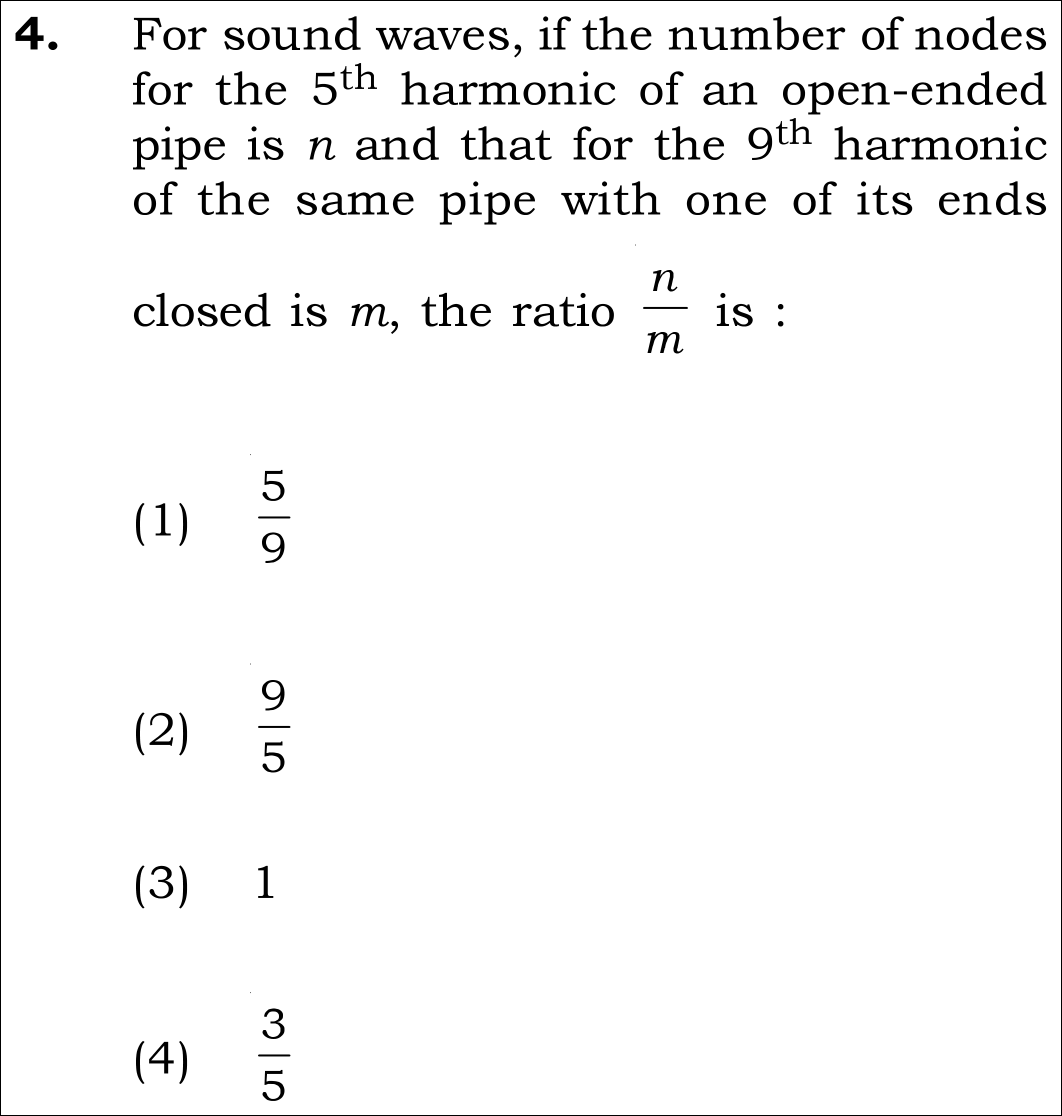
In an open pipe of length L, both ends must be displacement antinodes (A). Standing wave modes require L = p * (lambda / 2), where p is the harmonic number.
- • Fundamental (1st harmonic, p=1): A - N - A ==> 1 node.
- • 2nd harmonic (p=2): A - N - A - N - A ==> 2 nodes.
- • 5th harmonic (p=5): exactly 5 displacement nodes.
Determine Node Count for Closed Organ Pipe
In a closed pipe of length L, the closed end is a displacement node (N) and the open end is an antinode (A). Only odd harmonics exist: f_k = (2k - 1) * (v / 4L).
- • 1st harmonic (k=1): N - A ==> 1 node.
- • 3rd harmonic (k=2): N - A - N - A ==> 2 nodes.
- • 5th harmonic (k=3): 3 nodes.
- • 7th harmonic (k=4): 4 nodes.
- • 9th harmonic (k=5): exactly 5 displacement nodes (m = 5).
Compute the Node Ratio n / m
Substitute n = 5 and m = 5 into the ratio:
- • Both configurations have exactly 5 displacement nodes.
- • The ratio is identically 1, corresponding to Option (3).
360° Option Elimination Engine Key Feature
Diagnose every choice: Know exactly why the right option works and why distractors fail.
Superficial ratio trap.
Inverted harmonic ratio.
100% verified and matches Official NTA Final Answer Key.
Confuses overtone with harmonic index.
NTA Trap Alert: The Blind Number Ratio Trap (5/9)
Over 35% of students mark 5/9 without drawing or counting nodes, assuming nodes = harmonic number for all pipes.
Core NEET Syllabus Standard
"Open pipe frequencies: f_n = n (v/2L) with n nodes. Closed pipe frequencies: f_m = (2m-1)(v/4L) with m nodes."