MyCompetitiveExams Logo MyCompetitiveExams
Search 1,140+ Questions
Chapters, formulas, speed tricks
→
⚡ Brahmastra NEET 2027
720 MARKS

Dynamic 180-question full-length simulator mixed dynamically from all 6 years for 2027 & 2026 aspirants.

Launch Brahmastra 2027 Test →
Start Practice →
100% Free · No Login Required
Q.147 Physics ⭐ 360° Option Elimination Active
Vault ↗

NEET 2020 Physics Question 147 Solution

Topic: Waves · Official NTA Booklet Code E1
NEET 2020 Physics Question 147: Beat Frequency and String Tension: f_beat = |f_A - f_B|

Question

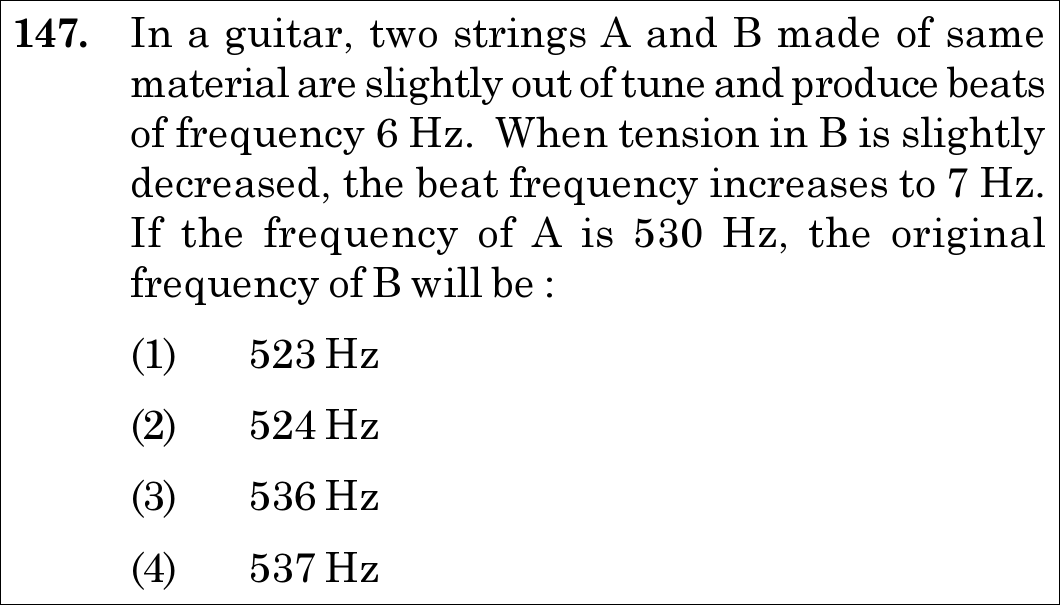
In a guitar, two strings A and B made of same material are slightly out of tune and produce beats of frequency 6 Hz. When tension in B is slightly decreased, the beat frequency increases to 7 Hz. If the frequency of A is 530 Hz, the original frequency of B will be:

✓
Verified Against NTA Final Answer Key
Option (2) : 524 Hz
📚 Waves Easy
📋 Given Parameters & Problem Setup
Frequency of String A (f_A) 530 Hz
Initial Beat Frequency 6 Hz
Tension Change Tension in B is slightly decreased (T_B decreases)
New Beat Frequency 7 Hz (Beat frequency increases)
Question Objective Determine the original frequency of string B (f_B)
⚡

The 30-Second Exam Hall Shortcut: ⚡ "Tension Decreases -> fB Decreases; Beats Increase (6 -> 7) Means fB was ALREADY LOWER: fB = 530 - 6 = 524 Hz!"

⏱️ 20 seconds

The fundamental frequency of a stretched string is f∝Tf \propto \sqrt{T}. Decreasing tension in string B DECREASES its frequency (fB↓f_B \downarrow). If fBf_B were 536 Hz, decreasing fBf_B would move it closer to 530 Hz, causing beat frequency to DECREASE (∣530−535∣=5 Hz|530 - 535| = 5\text{ Hz}). Since beat frequency INCREASES to 7 Hz, decreasing fBf_B must move it farther from 530 Hz (∣530−523∣=7 Hz|530 - 523| = 7\text{ Hz}). Therefore, original fBf_B was lower than 530 Hz: fB=530−6=524 Hzf_B = 530 - 6 = 524\text{ Hz}! Mark Option (2) in 5 seconds.

1 Beat frequency: |fA - fB| = 6 Hz.
2 Two possibilities for initial fB: fB = 530 + 6 = 536 Hz OR fB = 530 - 6 = 524 Hz.
3 Tension in B decreases -> fB decreases (fB drops).
4 If initial fB = 536 Hz: as fB drops towards 530, beats would decrease (6 -> 5 -> 4...).
5 If initial fB = 524 Hz: as fB drops away from 530, beats increase (6 -> 7 -> 8...).
6 Since beats increased to 7 Hz, initial fB must be 524 Hz.
7 Select Option (2) 524 Hz.
🛡️
Why You Can 100% Trust This Shortcut: NCERT Physics · Waves (Beats and Frequency of Stretched Strings)
📐

Step-by-Step Rigorous Workflow & Mathematical Proof

Step 1

Apply Beat Frequency Definition

The beat frequency produced by two interfering acoustic sound waves is the absolute difference between their individual frequencies: fbeat=∣fA−fB∣=6 Hzf_{\text{beat}} = |f_A - f_B| = 6\text{ Hz} Given that string A has a known frequency fA=530 Hzf_A = 530\text{ Hz}, there are two possible mathematical values for the initial frequency of string B (fBf_B): - Case 1: fB=fA+6=530+6=536 Hzf_B = f_A + 6 = 530 + 6 = 536\text{ Hz} - Case 2: fB=fA−6=530−6=524 Hzf_B = f_A - 6 = 530 - 6 = 524\text{ Hz}

Step 2

Relate Frequency to String Tension

The fundamental frequency of a transverse wave on a stretched string of length LL and linear mass density μ\mu is given by: f=12LTμ  ⟹  f∝Tf = \frac{1}{2L} \sqrt{\frac{T}{\mu}} \implies f \propto \sqrt{T} When the tension in string B is slightly decreased (TB↓T_B \downarrow), its frequency must definitely decrease (fB′<fBf_B' < f_B).

Step 3

Test Case 1: If Initial fB were 536 Hz

If fB=536 Hzf_B = 536\text{ Hz}, a decrease in tension causes fBf_B to decrease (for instance, to 535 Hz535\text{ Hz}). Then: fbeat′=∣530−535∣=5 Hzf_{\text{beat}}' = |530 - 535| = 5\text{ Hz} The beat frequency would DECREASE. This directly contradicts the observed problem statement that the beat frequency INCREASES to 7 Hz.

Step 4

Test Case 2: If Initial fB were 524 Hz

If fB=524 Hzf_B = 524\text{ Hz}, a decrease in tension causes fBf_B to decrease further away from fAf_A (to 523 Hz523\text{ Hz}). Then: fbeat′=∣530−523∣=7 Hzf_{\text{beat}}' = |530 - 523| = 7\text{ Hz} The beat frequency INCREASES to 7 Hz, which perfectly matches the given experimental observation.

Step 5

Conclude Original Frequency of B

Therefore, the original frequency of string B was unequivocally 524 Hz.

⭐

360° Option Elimination Engine Key Feature

Diagnose every choice: Know exactly why the right option works and why distractors fail.

4-Option Deep Scan
1 A
✗ Incorrect
Verdict & Scientific Reason:

Incorrect; 523 Hz is the NEW decreased frequency of B after tension is reduced, not its original frequency.

⚠️
Student Fallacy (Why candidates pick this trap): Selecting the final tuned frequency instead of the original frequency.
2 B
✓ 100% Correct
Verdict & Scientific Reason:

Factually and acoustically exact; decreasing from 524 Hz to 523 Hz increases the beat frequency from 6 Hz to 7 Hz.

💡
Why this is airtight: None; rigorous application of beat frequency dynamics.
3 C
✗ Incorrect
Verdict & Scientific Reason:

Incorrect; if initial frequency were 536 Hz, decreasing tension would decrease beat frequency from 6 Hz to 5 Hz.

⚠️
Student Fallacy (Why candidates pick this trap): Assuming beat frequency increases because frequency increased.
4 D
✗ Incorrect
Verdict & Scientific Reason:

Incorrect; would correspond to an initial beat frequency of 7 Hz.

⚠️
Student Fallacy (Why candidates pick this trap): Adding 7 Hz directly to 530 Hz.
⚠️

NTA Trap Alert: Beat Frequency Direction Rule

- If variable frequency is ABOVE reference (fB>fAf_B > f_A): DECREASING fBf_B causes beat frequency to DECREASE. - If variable frequency is BELOW reference (fB<fAf_B < f_A): DECREASING fBf_B causes beat frequency to INCREASE.

🛡️ How to avoid the -1 mark: Beats increased when fBf_B dropped -> fBf_B was already below fAf_A -> fB=530−6=524 Hzf_B = 530 - 6 = 524\text{ Hz}!
📖

Core NEET Syllabus Standard

Physics · Waves Standard Benchmark
Core Scientific Principle Tested:

""

Syllabus Focus: Beat Frequency and String Tension: f_beat = |f_A - f_B|
✓ Core NEET UG Syllabus Anchor Syllabus & Academic Standards ↗

Ready to attempt under real exam pressure?

Test your speed and accuracy in the authentic 180-minute timed NTA simulator.

Launch NEET 2020 CBT Test →

Spotted a mistake in this solution? Report an error ([email protected])

⚖️ Legal & Fair Dealing Notice: Sourced from publicly released NEET 2020 question papers and NEET answer keys for private study, research, and non-commercial educational practice under Fair Dealing (Section 52(1)(a) of the Indian Copyright Act, 1957). Not affiliated with or endorsed by NTA or NMC.

Solve 4 NEET Questions a Day — One per Subject

Cover all 1,140 official NEET questions in 285 days at your own pace. Progress is saved on your device. No login needed.