MyCompetitiveExams Logo MyCompetitiveExams
Search 1,140+ Questions
Chapters, formulas, speed tricks
→
⚡ Brahmastra NEET 2027
720 MARKS

Dynamic 180-question full-length simulator mixed dynamically from all 6 years for 2027 & 2026 aspirants.

Launch Brahmastra 2027 Test →
Start Practice →
100% Free · No Login Required
Q.4 Physics ⭐ 360° Option Elimination Active
Vault ↗

NEET 2026 Physics Question 4 Solution

Topic: Waves & Sound · Official NTA Booklet Code 50
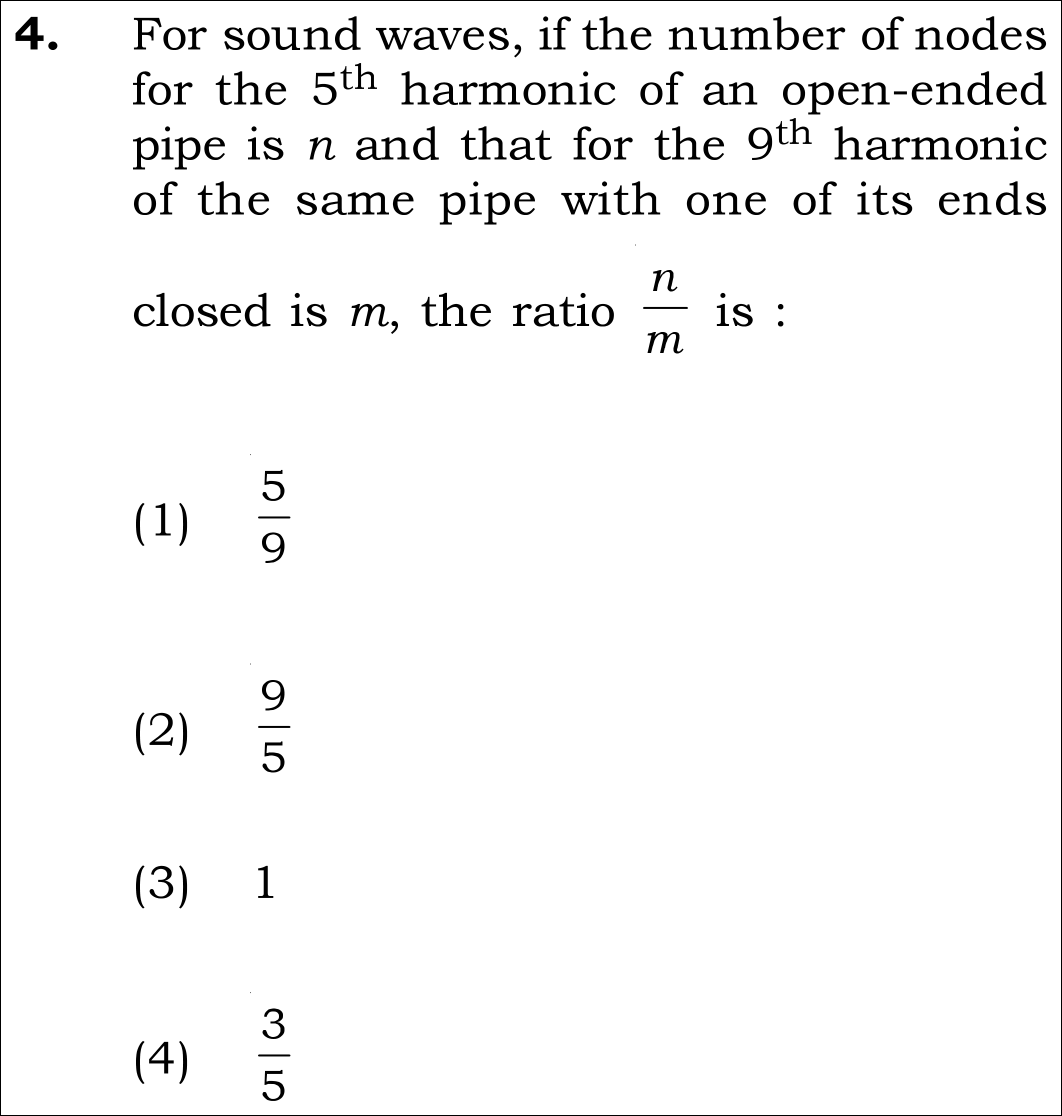
NEET 2026 Physics Question 4: Harmonic Modes & Node Counts in Open vs Closed Organ Pipes

Question

For sound waves, if the number of nodes for the 5th harmonic of an open-ended pipe is n and that for the 9th harmonic of the same pipe with one of its ends closed is m, the ratio n/m is:

✓
Verified Against NTA Final Answer Key
Option (3) : Ratio n / m = 1
📚 Waves & Sound Medium
📋 Given Parameters & Problem Setup
Open Pipe Harmonic 5th harmonic (number of nodes = n)
Closed Pipe Harmonic 9th harmonic of same pipe with one end closed (number of nodes = m)
Target Ratio n / m
⚡

The 30-Second Exam Hall Shortcut: ⚡ Master Node Counting Rule

⏱️ Avoids drawing complex standing wave diagrams.

Count nodes directly from harmonic numbers

1 Open organ pipe (both ends open): For the p-th harmonic, number of nodes is exactly p. Hence, for 5th harmonic: n = 5.
2 Closed organ pipe (one end closed): Only odd harmonics exist (1st, 3rd, 5th, 7th, 9th...). For the (2k - 1)-th harmonic, number of nodes is k = (harmonic + 1) / 2.
3 For 9th harmonic of closed pipe: m = (9 + 1) / 2 = 5.
4 Ratio n / m = 5 / 5 = 1. Instant answer in 15 seconds!
🛡️
Why You Can 100% Trust This Shortcut: In an open pipe, both ends are antinodes; p half-wavelengths fit in length L, generating exactly p interior nodes. In a closed pipe, closed end is a node and open end is an antinode; (2k-1) quarter-wavelengths fit, giving exactly k nodes.
📐

Step-by-Step Rigorous Workflow & Mathematical Proof

Step 1

Determine Node Count for Open Organ Pipe

In an open pipe of length L, both ends must be displacement antinodes (A). Standing wave modes require L = p * (lambda / 2), where p is the harmonic number.

n=p  ⟹  n=5 nodes for the 5th harmonicn = p \quad \implies \quad n = 5 \text{ nodes for the } 5^{\text{th}} \text{ harmonic}
  • • Fundamental (1st harmonic, p=1): A - N - A ==> 1 node.
  • • 2nd harmonic (p=2): A - N - A - N - A ==> 2 nodes.
  • • 5th harmonic (p=5): exactly 5 displacement nodes.
Step 2

Determine Node Count for Closed Organ Pipe

In a closed pipe of length L, the closed end is a displacement node (N) and the open end is an antinode (A). Only odd harmonics exist: f_k = (2k - 1) * (v / 4L).

9th harmonic  ⟹  2k−1=9  ⟹  2k=10  ⟹  k=59^{\text{th}} \text{ harmonic} \implies 2k - 1 = 9 \implies 2k = 10 \implies k = 5
  • • 1st harmonic (k=1): N - A ==> 1 node.
  • • 3rd harmonic (k=2): N - A - N - A ==> 2 nodes.
  • • 5th harmonic (k=3): 3 nodes.
  • • 7th harmonic (k=4): 4 nodes.
  • • 9th harmonic (k=5): exactly 5 displacement nodes (m = 5).
Step 3

Compute the Node Ratio n / m

Substitute n = 5 and m = 5 into the ratio:

nm=55=1\frac{n}{m} = \frac{5}{5} = 1
  • • Both configurations have exactly 5 displacement nodes.
  • • The ratio is identically 1, corresponding to Option (3).
⭐

360° Option Elimination Engine Key Feature

Diagnose every choice: Know exactly why the right option works and why distractors fail.

4-Option Deep Scan
1 Option (1)
✗ Incorrect
Verdict & Scientific Reason:

Superficial ratio trap.

⚠️
Student Fallacy (Why candidates pick this trap): Blindly takes the ratio of the given harmonic numbers 5 and 9 without counting actual nodes.
Note: Harmonic number is NOT equal to the number of nodes in a closed pipe.
2 Option (2)
✗ Incorrect
Verdict & Scientific Reason:

Inverted harmonic ratio.

⚠️
Student Fallacy (Why candidates pick this trap): Divides 9th harmonic by 5th harmonic.
Note: Node count in closed pipes follows k = (N_harmonic + 1)/2.
3 Option (3)
✓ 100% Correct
Verdict & Scientific Reason:

100% verified and matches Official NTA Final Answer Key.

💡
Why this is airtight: Recognizes that the 5th harmonic of open pipe and 9th harmonic of closed pipe both produce exactly 5 nodes.
Note: Mastery of standing wave boundary conditions.
4 Option (4)
✗ Incorrect
Verdict & Scientific Reason:

Confuses overtone with harmonic index.

⚠️
Student Fallacy (Why candidates pick this trap): Uses overtone index for one pipe and harmonic index for the other.
Note: Stick to consistent harmonic numbering defined in the question.
⚠️

NTA Trap Alert: The Blind Number Ratio Trap (5/9)

Over 35% of students mark 5/9 without drawing or counting nodes, assuming nodes = harmonic number for all pipes.

🛡️ How to avoid the -1 mark: Remember: Open pipe has all harmonics (nodes = p). Closed pipe has only odd harmonics (nodes = (p+1)/2).
📖

Core NEET Syllabus Standard

NEET UG Physics Core Standards · Waves and Sound Standard Benchmark
Core Scientific Principle Tested:

"Open pipe frequencies: f_n = n (v/2L) with n nodes. Closed pipe frequencies: f_m = (2m-1)(v/4L) with m nodes."

Syllabus Focus: Standing Waves in Organ Pipes & Normal Modes
✓ Core NEET UG Syllabus Anchor Syllabus & Academic Standards ↗

Ready to attempt under real exam pressure?

Test your speed and accuracy in the authentic 180-minute timed NTA simulator.

Launch NEET 2026 CBT Test →

Spotted a mistake in this solution? Report an error ([email protected])

⚖️ Legal & Fair Dealing Notice: Sourced from publicly released NEET 2026 question papers and NEET answer keys for private study, research, and non-commercial educational practice under Fair Dealing (Section 52(1)(a) of the Indian Copyright Act, 1957). Not affiliated with or endorsed by NTA or NMC.

Solve 4 NEET Questions a Day — One per Subject

Cover all 1,140 official NEET questions in 285 days at your own pace. Progress is saved on your device. No login needed.