MyCompetitiveExams Logo MyCompetitiveExams
Search 1,140+ Questions
Chapters, formulas, speed tricks
→
⚡ Brahmastra NEET 2027
720 MARKS

Dynamic 180-question full-length simulator mixed dynamically from all 6 years for 2027 & 2026 aspirants.

Launch Brahmastra 2027 Test →
Start Practice →
100% Free · No Login Required
🧪 Chemistry ⭐ High Weightage (~2–3 Qs/Year)

NEET Structure of Atom Previous Year Questions with Solutions

Complete repository of official NTA NEET questions for Structure of Atom from 2020 to 2026. Every question includes 30-second elimination tricks, step-by-step NCERT solutions, option-by-option traps, and official answer keys.

9 Questions 6 Exam Years (2026, 2025, 2024, 2023, 2021, 2020) 8 Easy · 1 Medium · 0 Challenging
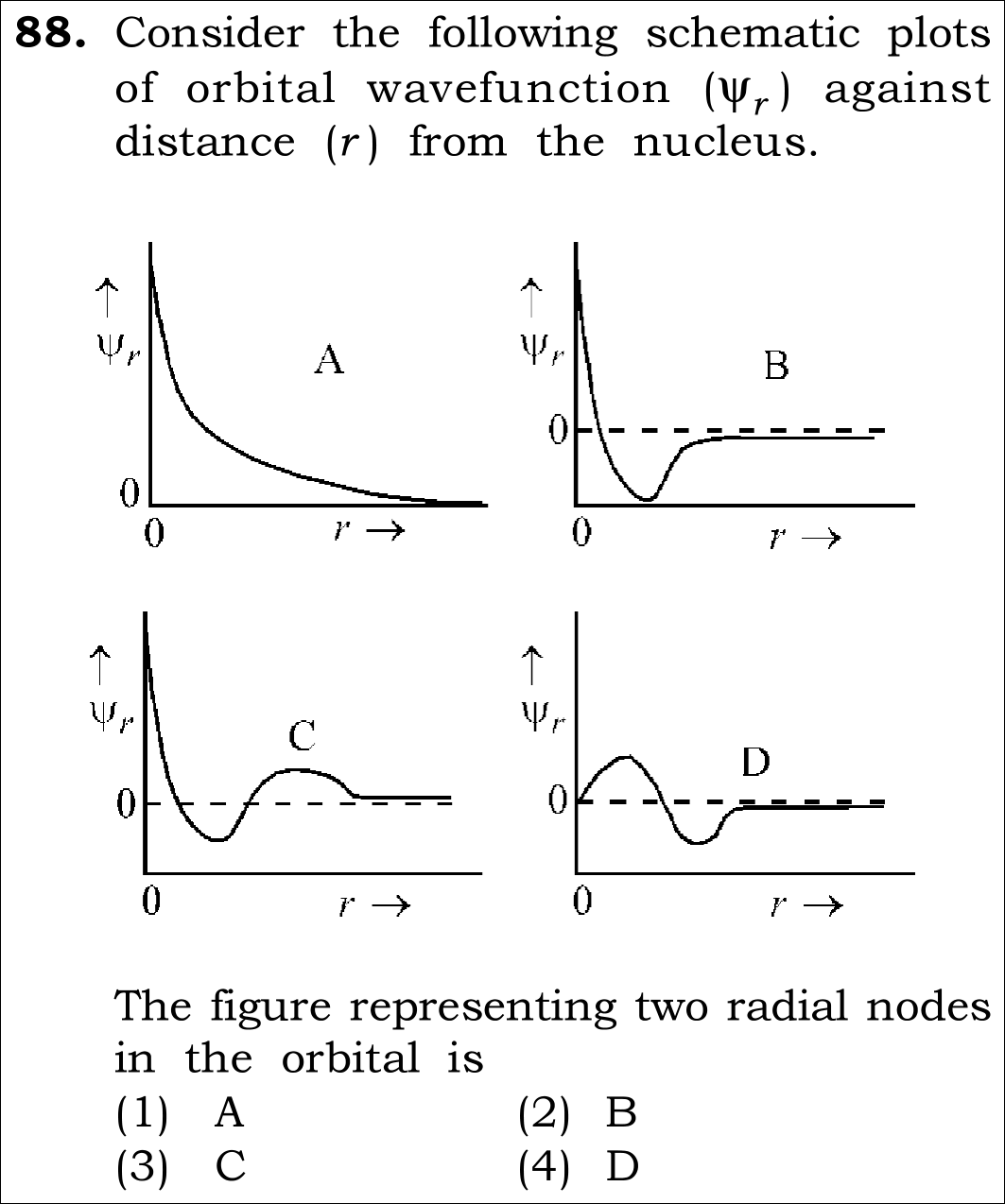
NEET 2026 · Q88 Medium
Official NEET 2026 Question 88 - Structure of Atom
1
2
3 ✓ Key
4
💡 Verified Solution & 30-Second Hack
✓
Verified Against NTA Final Answer Key
Option (3) : C
📚 Structure of Atom Medium
📋 Given Parameters & Problem Setup
Plots Orbital wavefunction (ψ_r) against distance (r) from nucleus
Plot A Monotonically decreasing from positive value to zero (0 radial nodes, 1s)
Plot B Starts positive, crosses zero once into negative region (1 radial node, 2s)
Plot C Starts positive, crosses zero twice (+ → - → +) (2 radial nodes, 3s)
Plot D Starts at zero at r=0, crosses zero once (1 radial node, 3p or 4d)
Target The figure representing two radial nodes
⚡

The 30-Second Exam Hall Shortcut: ⚡ Count Zero Crossings at r > 0

⏱️ Save ~50 seconds

A radial node is a point where the wavefunction ψ_r crosses zero at finite distance r > 0!

1 Examine Plot A: Never crosses zero (0 radial nodes).
2 Examine Plot B: Crosses the zero line once (1 radial node).
3 Examine Plot C: Drops below zero line (1st node), curves up and crosses zero line again (2nd node)! Exactly TWO radial nodes!
4 Examine Plot D: Starts at origin (r=0 is an angular node origin, not radial), crosses once (1 radial node).
5 Plot C is the unequivocal match for two radial nodes! Pick Option (3) in 10 seconds!
🛡️
Why You Can 100% Trust This Shortcut: Schrödinger wave mechanics: The number of radial nodes in an orbital equals (n - l - 1). A 3s orbital has n=3, l=0 ⇒ 3 - 0 - 1 = 2 radial nodes, perfectly matching curve C.
📐

Step-by-Step Rigorous Workflow & Mathematical Proof

Step 1

Define Radial Nodes in Quantum Mechanical Wavefunctions

A radial node is a spherical surface around the nucleus at a finite distance r > 0 where the radial wavefunction ψ_r (and consequently the radial probability density ψ_r²) passes through zero.

Number of Radial Nodes=n−l−1\text{Number of Radial Nodes} = n - l - 1
  • • Graphically, each radial node corresponds to the wavefunction curve crossing the r-axis (zero-line) at r > 0.
Step 2

Analyze Each Plot in the Question

1. Plot A: ψ_r has a non-zero maximum at r = 0 and decays asymptotically to zero without ever cutting the zero line. Number of radial nodes = 0 (Represents 1s orbital). 2. Plot B: ψ_r starts positive at r = 0, crosses the zero axis once, dips into a negative minimum, and approaches zero asymptotically. Number of radial nodes = 1 (Represents 2s orbital). 3. Plot C: ψ_r starts positive at r = 0, crosses the zero axis first into negative values, turns around and crosses the zero axis a second time into positive values, and then approaches zero asymptotically. Number of radial nodes = 2 (Represents 3s orbital). 4. Plot D: ψ_r starts at 0 at r = 0 (since l > 0), rises to a positive peak, crosses the zero axis once into negative, and approaches zero. Number of radial nodes = 1 (Represents 3p or 4d orbital).

Plot C has exactly 2 zero-crossings  ⟹  2 radial nodes\text{Plot C has exactly 2 zero-crossings} \implies 2\text{ radial nodes}
  • • Plot C represents 2 radial nodes.
Step 3

Conclusion

The figure representing two radial nodes is C.

Matches Option (3)\text{Matches Option (3)}
  • • Matches Option (3).
⭐

360° Option Elimination Engine Key Feature

Diagnose every choice: Know exactly why the right option works and why distractors fail.

4-Option Deep Scan
1 A
✗ Incorrect
Verdict & Scientific Reason:

Incorrect. Plot A has zero radial nodes (1s orbital).

⚠️
Student Fallacy (Why candidates pick this trap): Confusing asymptotic tail with a node.
2 B
✗ Incorrect
Verdict & Scientific Reason:

Incorrect. Plot B has only one radial node (2s orbital).

⚠️
Student Fallacy (Why candidates pick this trap): Counting the negative peak as a node.
3 C
✓ 100% Correct
Verdict & Scientific Reason:

Scientifically exact: Curve C crosses the zero axis at two distinct points, representing exactly two radial nodes (e.g. 3s orbital).

💡
Why this is airtight: None; precise graphical interpretation of radial wavefunctions.
4 D
✗ Incorrect
Verdict & Scientific Reason:

Incorrect. Plot D crosses zero only once at finite r (1 radial node for an orbital with l > 0).

⚠️
Student Fallacy (Why candidates pick this trap): Counting the origin r = 0 as a radial node.
⚠️

NTA Trap Alert: Counting the Origin (r = 0) as a Radial Node

For p, d, and f orbitals, the wavefunction starts at zero at the nucleus (r = 0). Students mistakenly count r = 0 as a radial node. By quantum mechanical definition, radial nodes are strictly located at finite, non-zero distances (r > 0)!

🛡️ How to avoid the -1 mark: Never count r = 0. Only count points where the curve CROSSES the zero line at r > 0.
📖

Core NEET Syllabus Standard

NEET Chemistry Core Syllabus · Structure of Atom Standard Benchmark
Core Scientific Principle Tested:

"Radial nodes correspond to points where the radial wavefunction ψ_r changes sign (crosses zero)."
Syllabus Focus: Radial wavefunctions and radial probability distribution curves
✓ Core NEET UG Syllabus Anchor Syllabus & Academic Standards ↗
Cross the line once = 1 node; Cross the line twice = 2 nodes on Curve C!
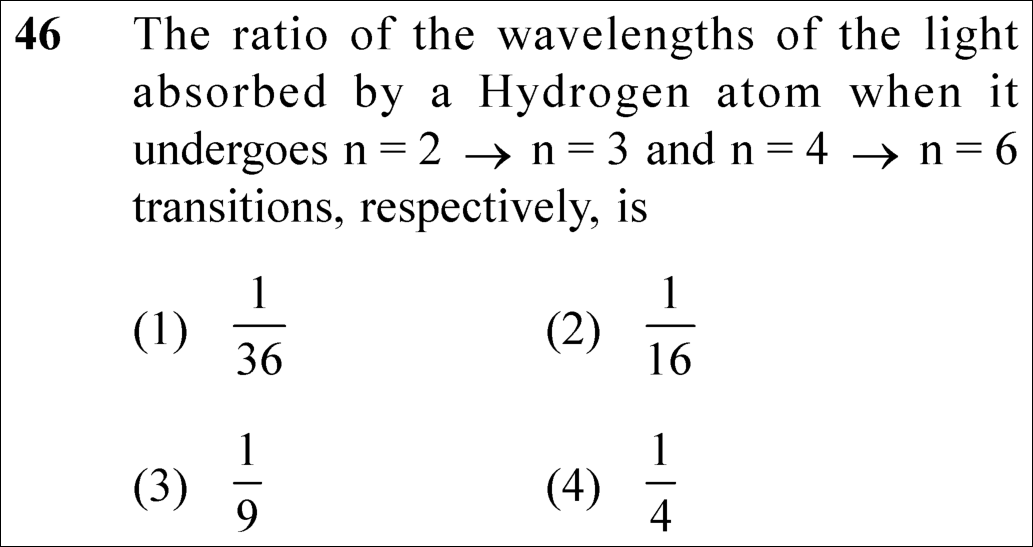
NEET 2025 · Q46 Easy
Official NEET 2025 Question 46 - Structure of Atom
1
2
3
4 ✓ Key
💡 Verified Solution & 30-Second Hack
✓
Verified Against NTA Final Answer Key
Option (4) : \frac{1}{4}
📚 Structure of Atom Easy
📋 Given Parameters & Problem Setup
Transition 1 n = 2 → n = 3
Transition 2 n = 4 → n = 6
Target Ratio λ₁ / λ₂ (wavelength of light absorbed in transition 1 to transition 2)
⚡

The 30-Second Exam Hall Shortcut: ⚡ Scaled Orbit Rydberg Shortcut

⏱️ Save ~40 seconds

Notice transition 2 has double the quantum numbers of transition 1: (4 = 2×2, 6 = 2×3). Since 1/λ ∝ 1/n², doubling all n values scales 1/λ by 1/2² = 1/4 ⟹ λ₂ = 4 λ₁ ⟹ λ₁ / λ₂ = 1/4!

1 Notice quantum scaling: n₁ = 2, n₂ = 3 for transition 1; n₁' = 4 = 2(2), n₂' = 6 = 2(3) for transition 2.
2 Wavenumber formula: 1/λ = R_H (1/n₁² - 1/n₂²).
3 When both quantum numbers are multiplied by a factor of 2: 1/λ₂ = R_H [1/(2×2)² - 1/(2×3)²] = (1/4) × R_H (1/2² - 1/3²) = (1/4) (1/λ₁).
4 Therefore: λ₁ / λ₂ = 1/4.
5 Select Option (4) in under 10 seconds without calculating full fractions!
🛡️
Why You Can 100% Trust This Shortcut: Rydberg Formula for Hydrogen Atom Transitions (NCERT Chemistry · Structure of Atom: 1/λ = R_H Z² (1/n₁² - 1/n₂²)).
📐

Step-by-Step Rigorous Workflow & Mathematical Proof

Step 1

Apply Rydberg Formula to Transition 1 (n = 2 → n = 3)

According to the Rydberg formula, the reciprocal of the absorbed wavelength for hydrogen is:

1λ1=RH(122−132)=RH(14−19)=RH(9−436)=536RH\frac{1}{\lambda_1} = R_H \left(\frac{1}{2^2} - \frac{1}{3^2}\right) = R_H \left(\frac{1}{4} - \frac{1}{9}\right) = R_H \left(\frac{9 - 4}{36}\right) = \frac{5}{36} R_H
  • • Inverting gives: λ₁ = 36 / (5 R_H).
Step 2

Apply Rydberg Formula to Transition 2 (n = 4 → n = 6)

For the transition between n = 4 and n = 6:

1λ2=RH(142−162)=RH(116−136)=RH(9−4144)=5144RH\frac{1}{\lambda_2} = R_H \left(\frac{1}{4^2} - \frac{1}{6^2}\right) = R_H \left(\frac{1}{16} - \frac{1}{36}\right) = R_H \left(\frac{9 - 4}{144}\right) = \frac{5}{144} R_H
  • • Inverting gives: λ₂ = 144 / (5 R_H).
Step 3

Calculate the Wavelength Ratio

Divide the two wavelengths:

λ1λ2=365RH1445RH=36144=14\frac{\lambda_1}{\lambda_2} = \frac{\frac{36}{5 R_H}}{\frac{144}{5 R_H}} = \frac{36}{144} = \frac{1}{4}
  • • Matches Option (4) exactly.
⭐

360° Option Elimination Engine Key Feature

Diagnose every choice: Know exactly why the right option works and why distractors fail.

4-Option Deep Scan
1 A
✗ Incorrect
Verdict & Scientific Reason:

Incorrect. Forgets common factor 5/R_H or squares denominator.

⚠️
Student Fallacy (Why candidates pick this trap): Squaring the ratio 1/6.
2 B
✗ Incorrect
Verdict & Scientific Reason:

Incorrect. Squaring the 1/4 factor.

⚠️
Student Fallacy (Why candidates pick this trap): Squaring the scaling factor (1/4)² = 1/16.
3 C
✗ Incorrect
Verdict & Scientific Reason:

Incorrect. Ratio of 1/n² terms.

⚠️
Student Fallacy (Why candidates pick this trap): Dividing 4 by 36.
4 D
✓ 100% Correct
Verdict & Scientific Reason:

100% correct. λ₁ / λ₂ = 36 / 144 = 1/4.

💡
Why this is airtight: None; flawless Rydberg calculation.
⚠️

NTA Trap Alert: Inverting Wavenumber Ratio vs Wavelength Ratio

Calculating (1/λ₁) / (1/λ₂) = 144/36 = 4, then forgetting that λ₁/λ₂ is the reciprocal 1/4.

🛡️ How to avoid the -1 mark: Remember: 1/λ is wavenumber; wavelength λ is its inverse!
📖

Core NEET Syllabus Standard

NEET Chemistry Core Syllabus · Structure of Atom Standard Benchmark
Core Scientific Principle Tested:

"1/λ = R_H (1/n₁² - 1/n₂²)."

Syllabus Focus: Bohr’s Model & Rydberg Formula for Hydrogen Spectrum
✓ Core NEET UG Syllabus Anchor Syllabus & Academic Standards ↗
Doubled levels ⟹ 1/λ drops by 2² = 4 ⟹ λ quadruples ⟹ λ₁ / λ₂ = 1/4!
NEET 2025 · Q50 Easy
Official NEET 2025 Question 50 - Structure of Atom
1 ✓ Key
2
3
4
💡 Verified Solution & 30-Second Hack
✓
Verified Against NTA Final Answer Key
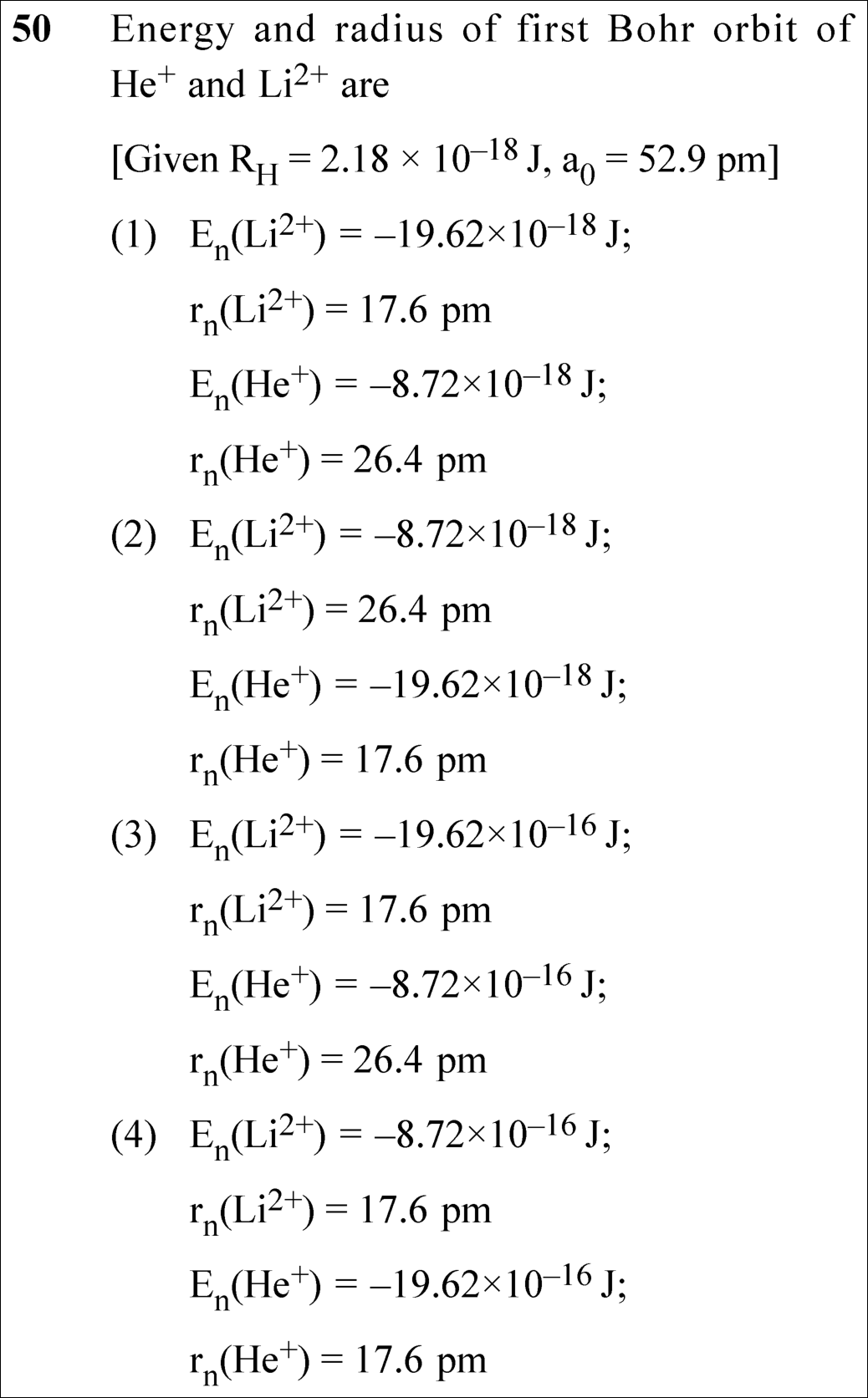
Option (1) : E_n(Li²⁺) = -19.62 × 10⁻¹⁸ J; r_n(Li²⁺) = 17.6 pm; E_n(He⁺) = -8.72 × 10⁻¹⁸ J; r_n(He⁺) = 26.4 pm
📚 Structure of Atom Easy
📋 Given Parameters & Problem Setup
Rydberg Constant (R_H) 2.18 × 10⁻¹⁸ J
Bohr Radius (a₀) 52.9 pm
Quantum Level First Bohr orbit (n = 1)
Species He⁺ (Z = 2) and Li²⁺ (Z = 3)
⚡

The 30-Second Exam Hall Shortcut: ⚡ Z² Energy and 1/Z Radius Shortcut

⏱️ Save ~40 seconds

E ∝ -Z² ⟹ He⁺ (Z=2) has -2.18 × 4 = -8.72 × 10⁻¹⁸ J; Li²⁺ (Z=3) has -2.18 × 9 = -19.62 × 10⁻¹⁸ J! Radius r = 52.9/Z ⟹ He⁺ is 52.9/2 = 26.45 pm; Li²⁺ is 52.9/3 = 17.6 pm!

1 Recall Bohr energy formula for single-electron species: E_n = -R_H (Z² / n²).
2 For n = 1: E(He⁺) = -2.18 × 10⁻¹⁸ × 2² = -2.18 × 4 = -8.72 × 10⁻¹⁸ J.
3 For n = 1: E(Li²⁺) = -2.18 × 10⁻¹⁸ × 3² = -2.18 × 9 = -19.62 × 10⁻¹⁸ J.
4 Notice energy exponent is 10⁻¹⁸ J, eliminating Options (3) and (4) which write 10⁻¹⁶ J.
5 Recall Bohr radius formula: r_n = a₀ (n² / Z) = 52.9 / Z pm.
6 For He⁺: r = 52.9 / 2 = 26.45 ≈ 26.4 pm.
7 For Li²⁺: r = 52.9 / 3 = 17.63 ≈ 17.6 pm.
8 Option (1) pairs Li²⁺ with 17.6 pm and He⁺ with 26.4 pm correctly.
9 Match Option (1) in under 15 seconds!
🛡️
Why You Can 100% Trust This Shortcut: Bohr’s Model of Hydrogen-like Atoms (NCERT Chemistry · Structure of Atom: r_n ∝ n²/Z).
📐

Step-by-Step Rigorous Workflow & Mathematical Proof

Step 1

Energy Calculation for First Bohr Orbit of He⁺ and Li²⁺

The energy of a stationary state in a hydrogen-like species is given by Bohr’s formula:

En=−RHZ2n2  ⟹  E1=−2.18×10⁻¹⁸×Z2 JE_n = -R_H \frac{Z^2}{n^2} \implies E_1 = -2.18 \times 10^{-18} \times Z^2\text{ J}
  • • For He⁺ (Z = 2): E₁(He⁺) = -2.18 × 10⁻¹⁸ × 4 = -8.72 × 10⁻¹⁸ J.
  • • For Li²⁺ (Z = 3): E₁(Li²⁺) = -2.18 × 10⁻¹⁸ × 9 = -19.62 × 10⁻¹⁸ J.
Step 2

Radius Calculation for First Bohr Orbit of He⁺ and Li²⁺

The radius of a Bohr orbit is inversely proportional to the atomic number Z:

rn=a0n2Z  ⟹  r1=52.9 pmZr_n = a_0 \frac{n^2}{Z} \implies r_1 = \frac{52.9\text{ pm}}{Z}
  • • For He⁺ (Z = 2): r₁(He⁺) = 52.9 / 2 = 26.45 pm ≈ 26.4 pm.
  • • For Li²⁺ (Z = 3): r₁(Li²⁺) = 52.9 / 3 = 17.63 pm ≈ 17.6 pm.
Step 3

Consolidate and Select Matching Option

Compare with the multiple choice options:

En(Li2+)=−19.62×10⁻¹⁸ J,  rn(Li2+)=17.6 pm;  En(He+)=−8.72×10⁻¹⁸ J,  rn(He+)=26.4 pmE_n(\text{Li}^{2+}) = -19.62 \times 10^{-18}\text{ J}, \; r_n(\text{Li}^{2+}) = 17.6\text{ pm}; \; E_n(\text{He}^+) = -8.72 \times 10^{-18}\text{ J}, \; r_n(\text{He}^+) = 26.4\text{ pm}
  • • Option (1) has the exact values and proper order of magnitude (10⁻¹⁸ J).
⭐

360° Option Elimination Engine Key Feature

Diagnose every choice: Know exactly why the right option works and why distractors fail.

4-Option Deep Scan
1 A
✓ 100% Correct
Verdict & Scientific Reason:

100% correct. Exact evaluation of E ∝ -Z² and r ∝ 1/Z with 10⁻¹⁸ J.

💡
Why this is airtight: None; flawless physical calculations.
2 B
✗ Incorrect
Verdict & Scientific Reason:

Incorrect. Assigns Z=3 values to He⁺ and Z=2 values to Li²⁺.

⚠️
Student Fallacy (Why candidates pick this trap): Swapping atomic numbers of He and Li.
3 C
✗ Incorrect
Verdict & Scientific Reason:

Incorrect. Order of magnitude error (10⁻¹⁶ J instead of 10⁻¹⁸ J).

⚠️
Student Fallacy (Why candidates pick this trap): Selecting wrong power of 10.
4 D
✗ Incorrect
Verdict & Scientific Reason:

Incorrect. Both values swapped and incorrect order of magnitude.

⚠️
Student Fallacy (Why candidates pick this trap): Multiple errors.
⚠️

NTA Trap Alert: Exponent Trap: 10⁻¹⁸ J vs 10⁻¹⁶ J

Options 3 and 4 feature identical digits (19.62 and 8.72) but with exponent 10⁻¹⁶ J instead of 10⁻¹⁸ J. Candidates working hastily often overlook the exponent!

🛡️ How to avoid the -1 mark: Always verify the exponent: R_H is 2.18 × 10⁻¹⁸ J, so energies must be on the scale of 10⁻¹⁸ J!
📖

Core NEET Syllabus Standard

NEET Chemistry Core Syllabus · Structure of Atom Standard Benchmark
Core Scientific Principle Tested:

"E_n = -R_H Z² / n² and r_n = a₀ n² / Z."

Syllabus Focus: Bohr’s Model of Hydrogen-Like Atoms
✓ Core NEET UG Syllabus Anchor Syllabus & Academic Standards ↗
He is Z=2 (×4, /2); Li is Z=3 (×9, /3) ⟹ Exponent 10⁻¹⁸ J (Option 1)!
NEET 2024 · Q55 Easy
Official NEET 2024 Question 55 - Structure of Atom
1
2
3
4 ✓ Key
💡 Verified Solution & 30-Second Hack
✓
Verified Against NTA Final Answer Key
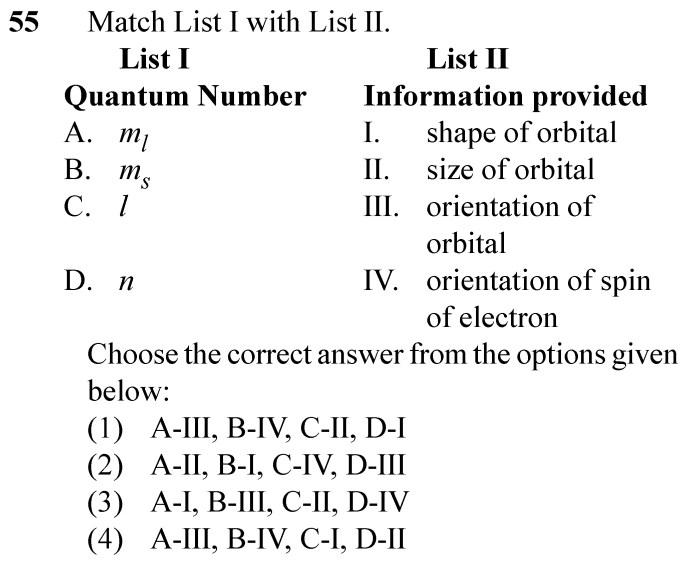
Option (4) : A-III, B-IV, C-I, D-II
📚 Structure of Atom Easy
📋 Given Parameters & Problem Setup
Quantum Number A m_l (magnetic quantum number)
Quantum Number B m_s (spin quantum number)
Quantum Number C l (azimuthal / orbital angular momentum quantum number)
Quantum Number D n (principal quantum number)
⚡

The 30-Second Exam Hall Shortcut: ⚡ Quantum Number Direct Definition Flashcard

⏱️ Save ~30 seconds

n = Size & energy (II); l = Shape of subshell (I); m_l = Spatial orientation of orbital (III); m_s = Electron spin direction (IV)!

1 Principal quantum number n determines shell size and primary energy level -> D-II.
2 Azimuthal quantum number l determines orbital angular momentum and three-dimensional shape (s=sphere, p=dumbbell, d=cloverleaf) -> C-I.
3 Magnetic quantum number m_l determines spatial orientation of the orbital in space relative to coordinate axes -> A-III.
4 Spin quantum number m_s determines the orientation of intrinsic electron spin (+1/2 or -1/2) -> B-IV.
5 Perfect match: A-III, B-IV, C-I, D-II -> Option (4) in 5 seconds!
🛡️
Why You Can 100% Trust This Shortcut: NCERT Chemistry · Structure of Atom (Quantum numbers and their physical significance).
📐

Step-by-Step Rigorous Workflow & Mathematical Proof

Step 1

Principal Quantum Number (n)

The principal quantum number n can be any positive integer (1, 2, 3, ...). It identifies the principal electron shell, governs the effective size of the electron cloud (radius r ∝ n²/Z), and predominantly determines the orbital energy:

n∈{1,2,3,… }  ⟹  Determines Size and Energy of Orbitaln \in \{1, 2, 3, \dots\} \implies \text{Determines Size and Energy of Orbital}
Step 2

Azimuthal / Orbital Angular Momentum Quantum Number (l)

For a given n, l takes integral values from 0 to (n - 1). It dictates the orbital angular momentum and defines the three-dimensional geometric shape of the orbital:

L=l(l+1)ℏ,l=0(s),1(p),2(d),3(f)  ⟹  Determines ShapeL = \sqrt{l(l + 1)}\hbar, \quad l = 0(s), 1(p), 2(d), 3(f) \implies \text{Determines Shape}
Step 3

Magnetic Quantum Number (m_l)

For a given l, m_l ranges from -l to +l through zero (total 2l + 1 values). It specifies the spatial orientation of the orbital with respect to an external magnetic field:

ml∈{−l,…,0,…,+l}  ⟹  Determines Spatial Orientation of Orbitalm_l \in \{-l, \dots, 0, \dots, +l\} \implies \text{Determines Spatial Orientation of Orbital}
Step 4

Electron Spin Quantum Number (m_s)

The electron spin quantum number accounts for the intrinsic angular momentum of the electron, with two allowable spin orientations: +1/2 (spin-up) and -1/2 (spin-down):

ms=±12  ⟹  Determines Orientation of Spin of Electronm_s = \pm \frac{1}{2} \implies \text{Determines Orientation of Spin of Electron}
⭐

360° Option Elimination Engine Key Feature

Diagnose every choice: Know exactly why the right option works and why distractors fail.

4-Option Deep Scan
1 (1)
✗ Incorrect
Verdict & Scientific Reason:

Swaps the roles of l (shape) and n (size).

⚠️
Student Fallacy (Why candidates pick this trap): Confusing azimuthal quantum number with principal quantum number.
2 (2)
✗ Incorrect
Verdict & Scientific Reason:

Assigns size to magnetic quantum number.

⚠️
Student Fallacy (Why candidates pick this trap): Complete confusion of all quantum properties.
3 (3)
✗ Incorrect
Verdict & Scientific Reason:

Mismatches magnetic quantum number with shape.

⚠️
Student Fallacy (Why candidates pick this trap): Believing ml determines shape.
4 (4)
✓ 100% Correct
Verdict & Scientific Reason:

Unquestionable textbook alignment.

💡
Why this is airtight: None.
⚠️

NTA Trap Alert: Distinguishing Orbital Orientation (ml) from Spin Orientation (ms)

Both ml and ms use the word "orientation". ml is the orientation of the orbital in space, while ms is the orientation of the electron’s intrinsic spin axis.

🛡️ How to avoid the -1 mark: Check the object being oriented: orbital orientation = ml; electron spin orientation = ms.
📖

Core NEET Syllabus Standard

Chemistry Core Physical Chemistry · Structure of Atom Standard Benchmark
Core Scientific Principle Tested:

"The state of an electron in an atom is completely described by four quantum numbers: n (size/shell), l (shape/subshell), ml (spatial orientation), and ms (spin orientation)."

Syllabus Focus: Quantum Mechanical Model of the Atom: Quantum Numbers
✓ Core NEET UG Syllabus Anchor Syllabus & Academic Standards ↗
n = Number (Size), l = Lines (Shape), ml = Magnetic alignment (Orientation), ms = Spin!
NEET 2024 · Q58 Easy
Official NEET 2024 Question 58 - Structure of Atom
1
2
3 ✓ Key
4
💡 Verified Solution & 30-Second Hack
✓
Verified Against NTA Final Answer Key
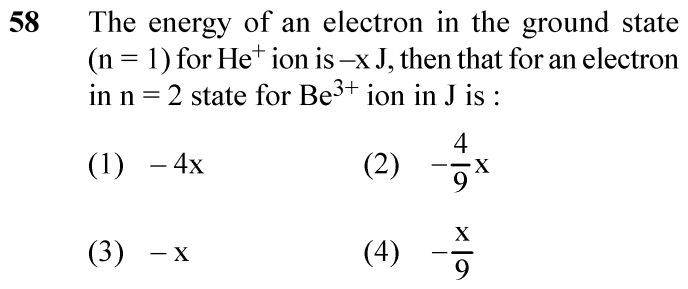
Option (3) : -x
📚 Structure of Atom Easy
📋 Given Parameters & Problem Setup
He+ ion (Z = 2) ground state (n = 1) energy -x J
Be3+ ion (Z = 4) target state n = 2 state
⚡

The 30-Second Exam Hall Shortcut: ⚡ (Z / n)² Ratio Cancellation Hack

⏱️ Save ~40 seconds

Energy E ∝ (Z / n)². For He+ (n=1): (2/1)² = 4 -> -x J. For Be3+ (n=2): (4/2)² = (2)² = 4 -> exactly -x J!

1 Bohr energy for any single-electron species: E_n = -R_H · (Z² / n²).
2 For He+ in ground state: Z = 2, n = 1 -> (Z/n)² = (2/1)² = 4 -> E_1 = -4 R_H = -x J.
3 For Be3+ in n = 2 state: Z = 4, n = 2 -> (Z/n)² = (4/2)² = 2² = 4 -> E_2 = -4 R_H.
4 Because both have the identical factor (Z/n)² = 4, their energies are identical: E_2(Be3+) = -x J.
5 Option (3) in 5 seconds!
🛡️
Why You Can 100% Trust This Shortcut: NCERT Chemistry · Structure of Atom (Bohr model formulation for hydrogen-like species: E_n = -2.18 × 10^-18 · Z²/n² J).
📐

Step-by-Step Rigorous Workflow & Mathematical Proof

Step 1

Bohr Energy Equation for Hydrogen-like Species

For any one-electron hydrogen-like ion of atomic number Z, the energy of the stationary electron state with principal quantum number n is given by:

En=−RHZ2n2E_n = -R_H \frac{Z^2}{n^2}
Step 2

Relating Given Energy of He+ Ground State to Constant RH

For helium ion He+, Z = 2. In the ground state, n = 1:

E1(He+)=−RH2212=−4RH=−x  ⟹  RH=x4E_1(\text{He}^+) = -R_H \frac{2^2}{1^2} = -4 R_H = -x \implies R_H = \frac{x}{4}
Step 3

Calculation for Be3+ in n = 2 State

For beryllium ion Be3+, Z = 4. For the n = 2 quantum level:

E2(Be3+)=−RHZ2n2=−RH4222=−RH(164)=−4RHE_2(\text{Be}^{3+}) = -R_H \frac{Z^2}{n^2} = -R_H \frac{4^2}{2^2} = -R_H \left(\frac{16}{4}\right) = -4 R_H
Step 4

Equating and Concluding

Substituting -4 RH = -x directly into the expression:

E2(Be3+)=−4RH=−x  JE_2(\text{Be}^{3+}) = -4 R_H = -x\;\text{J}
⭐

360° Option Elimination Engine Key Feature

Diagnose every choice: Know exactly why the right option works and why distractors fail.

4-Option Deep Scan
1 (1)
✗ Incorrect
Verdict & Scientific Reason:

Multiplies by (Z/n)² again instead of recognizing identical ratios.

⚠️
Student Fallacy (Why candidates pick this trap): Multiplying by 4² without dividing by n².
2 (2)
✗ Incorrect
Verdict & Scientific Reason:

Uses n = 3 in the denominator instead of n = 2.

⚠️
Student Fallacy (Why candidates pick this trap): Confusing the state index with n = 3.
3 (3)
✓ 100% Correct
Verdict & Scientific Reason:

Exact mathematical equality: (4/2)² = (2/1)² = 4.

💡
Why this is airtight: None.
4 (4)
✗ Incorrect
Verdict & Scientific Reason:

Unrelated scaling error.

⚠️
Student Fallacy (Why candidates pick this trap): Miscalculating squared quantum numbers.
⚠️

NTA Trap Alert: Squaring Only Z and Forgetting to Square n

Students frequently square the numerator Z² = 16 but forget to square the denominator (dividing by 2 instead of 4, obtaining 8 instead of 4).

🛡️ How to avoid the -1 mark: Always evaluate the grouped ratio (Z / n) first: for Be3+ at n=2, (4/2) = 2, so (Z/n)² = 4.
📖

Core NEET Syllabus Standard

Chemistry Core Physical Chemistry · Structure of Atom Standard Benchmark
Core Scientific Principle Tested:

"Energy of hydrogen-like species scales as Z²/n²: En = -RH · (Z/n)²"

Syllabus Focus: Bohr’s Model for Hydrogen Atom: Radii and Energy of Stationary States
✓ Core NEET UG Syllabus Anchor Syllabus & Academic Standards ↗
Z over n is two in both: square is four, identical growth (-x J)!
NEET 2023 · Q69 Easy
Official NEET 2023 Question 69 - Structure of Atom
1
2 ✓ Key
3
4
💡 Verified Solution & 30-Second Hack
✓
Verified Against NTA Final Answer Key
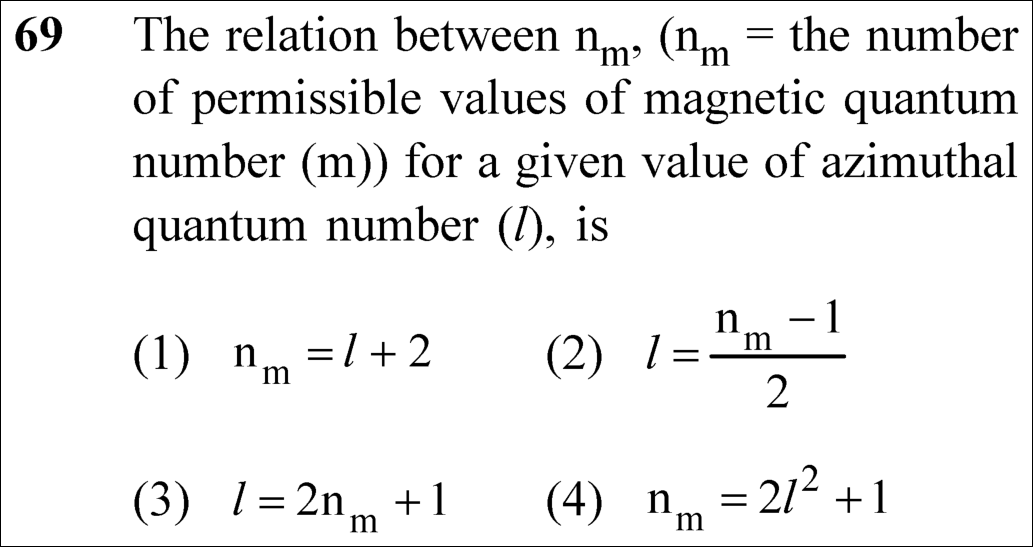
Option (2) : l = (n_m - 1) / 2
📚 Structure of Atom Easy
📋 Given Parameters & Problem Setup
Azimuthal quantum number l
Permissible values of magnetic quantum number m n_m
Standard relation n_m = 2l + 1
⚡

The 30-Second Exam Hall Shortcut: ⚡ Simple Algebraic Inversion: n_m = 2l + 1 ⟹ l = (n_m - 1) / 2

⏱️ Save ~25 seconds

For any subshell l, there are 2l + 1 magnetic values (e.g., p-subshell l=1 has 3 orbitals: 3 = 2(1)+1). Rearranging n_m = 2l + 1 gives l = (n_m - 1) / 2 in 5 seconds!

1 Recall the number of orbitals in a subshell: For a given value of l, magnetic quantum number m ranges from -l through 0 to +l.
2 The total count of permissible values is: n_m = 2l + 1.
3 Rearrange this linear equation to isolate l:
4 n_m - 1 = 2l ⟹ l = (n_m - 1) / 2.
5 Compare with the options: Option (2) exactly matches l = (n_m - 1) / 2.
6 Lock Option (2) immediately!
🛡️
Why You Can 100% Trust This Shortcut: Atomic Structure · Quantum Numbers (The number of spatial orientations of an orbital for a given azimuthal quantum number l is n_m = 2l + 1).
📐

Step-by-Step Rigorous Workflow & Mathematical Proof

Step 1

Definition and Range of Magnetic Quantum Number m

For an electron in an atom, the azimuthal (orbital angular momentum) quantum number l defines the subshell shape. For any given value of l, the magnetic orbital quantum number m_l designates the spatial orientation of the orbital and can take all integer values from -l to +l, including zero:

ml∈{−l,−(l−1),…,0,…,+(l−1),+l}m_l \in \{-l, -(l-1), \dots, 0, \dots, +(l-1), +l\}
Step 2

Counting the Number of Permissible Values (n_m)

The total number of permissible orientations n_m in a subshell of azimuthal quantum number l is given by counting all values in this range:

nm=l+1+l=2l+1n_m = l + 1 + l = 2l + 1
Step 3

Algebraic Inversion to Express l in Terms of n_m

The question asks for the relation expressing l in terms of n_m. Subtract 1 from both sides and divide by 2:

nm−1=2l  ⟹  l=nm−12n_m - 1 = 2l \implies l = \frac{n_m - 1}{2}
Step 4

Verification with Concrete Quantum Subshells

Check for s (l=0), p (l=1), and d (l=2) subshells:

s-subshell: l=0  ⟹  nm=1  ⟹  l=1−12=0(Matches)p-subshell: l=1  ⟹  nm=3  ⟹  l=3−12=1(Matches)d-subshell: l=2  ⟹  nm=5  ⟹  l=5−12=2(Matches)\begin{aligned} s\text{-subshell: } &l = 0 \implies n_m = 1 \implies l = \frac{1 - 1}{2} = 0 \quad (\text{Matches}) \\[4pt] p\text{-subshell: } &l = 1 \implies n_m = 3 \implies l = \frac{3 - 1}{2} = 1 \quad (\text{Matches}) \\[4pt] d\text{-subshell: } &l = 2 \implies n_m = 5 \implies l = \frac{5 - 1}{2} = 2 \quad (\text{Matches}) \end{aligned}
⭐

360° Option Elimination Engine Key Feature

Diagnose every choice: Know exactly why the right option works and why distractors fail.

4-Option Deep Scan
1 (1)
✗ Incorrect
Verdict & Scientific Reason:

Arbitrary linear formula that fails for all subshells.

⚠️
Student Fallacy (Why candidates pick this trap): Candidate guessed a linear relation without multiplying by 2.
2 (2)
✓ 100% Correct
Verdict & Scientific Reason:

Accurate algebraic inversion of the fundamental relation n_m = 2l + 1.

💡
Why this is airtight: None. Candidate performed correct algebraic transposition.
3 (3)
✗ Incorrect
Verdict & Scientific Reason:

Inverted variable positions (states l = 2n_m + 1 instead of n_m = 2l + 1).

⚠️
Student Fallacy (Why candidates pick this trap): Candidate swapped the dependent and independent variables.
4 (4)
✗ Incorrect
Verdict & Scientific Reason:

Erroneously introduces a quadratic term l².

⚠️
Student Fallacy (Why candidates pick this trap): Candidate confused number of orbitals with formulas for maximum electron capacity.
⚠️

NTA Trap Alert: Confusing n_m = 2l + 1 with l = 2n_m + 1 (Option 3)

Under exam pressure, students see "2" and "1" and hastily pick Option (3) l = 2n_m + 1, not realizing that l is the subject of the equation in the options, which requires (n_m - 1) / 2.

🛡️ How to avoid the -1 mark: Plug in numbers: For p-subshell, l = 1 and n_m = 3. Test Option 2: (3 - 1)/2 = 1 (Works!). Test Option 3: 2(3)+1 = 7 ≠ 1 (Fails!).
📖

Core NEET Syllabus Standard

National Eligibility cum Entrance Test (NEET UG) · Structure of Atom Standard Benchmark
Core Scientific Principle Tested:

"For a given value of l, there are (2l + 1) values of m_l, so n_m = 2l + 1, which inverts to l = (n_m - 1)/2."

Syllabus Focus: Quantum Mechanical Model of Atom – Quantum Numbers
Preserved in Rationalized Curriculum Syllabus & Academic Standards ↗
NEET 2023 · Q76 Easy
Official NEET 2023 Question 76 - Structure of Atom
1 ✓ Key
2
3
4
💡 Verified Solution & 30-Second Hack
✓
Verified Against NTA Final Answer Key
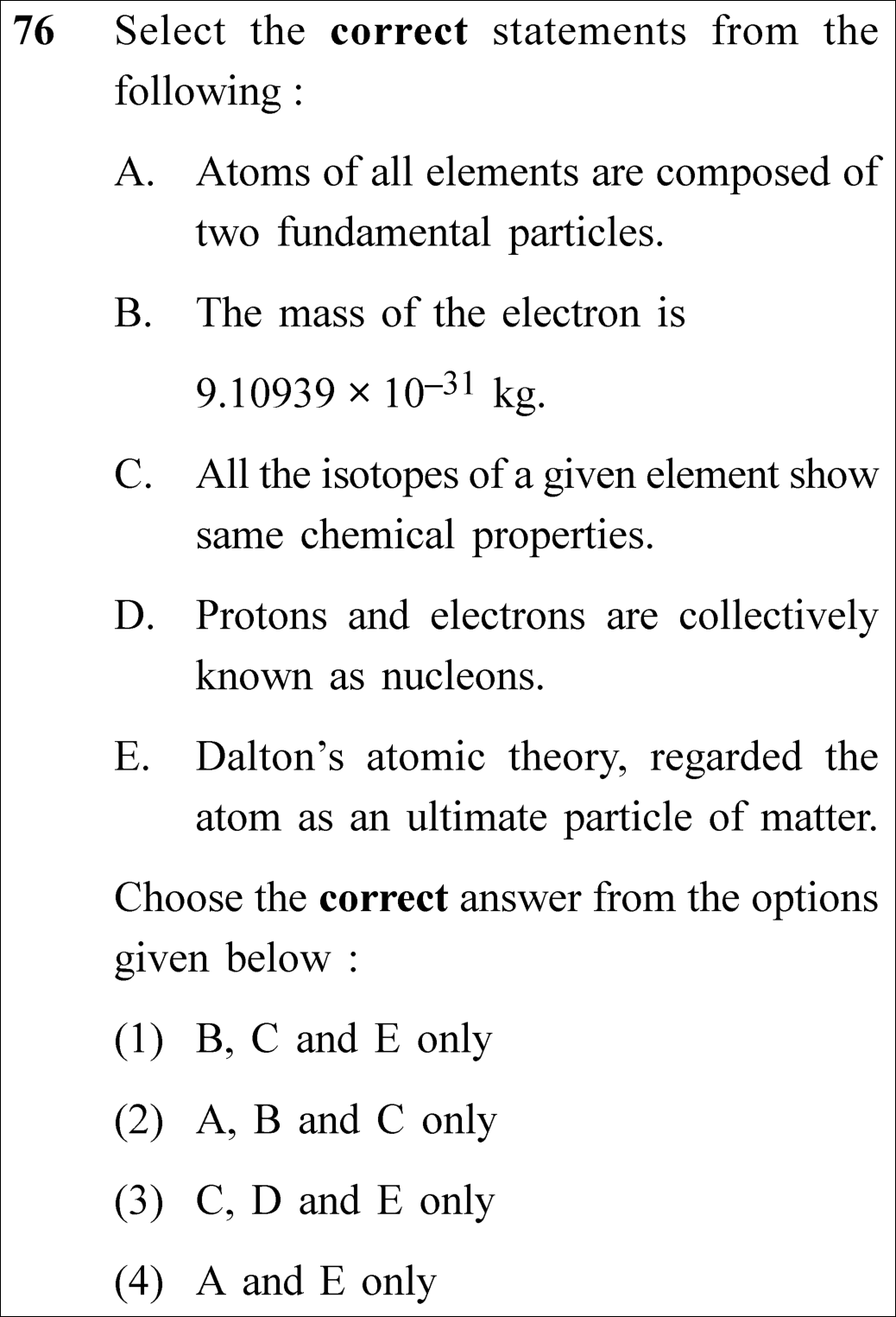
Option (1) : B, C and E only
📚 Structure of Atom Easy
📋 Given Parameters & Problem Setup
Statement A Atoms of all elements are composed of two fundamental particles.
Statement B Mass of the electron is 9.10939 × 10⁻³¹ kg.
Statement C All isotopes of a given element show same chemical properties.
Statement D Protons and electrons are collectively known as nucleons.
Statement E Dalton’s atomic theory regarded the atom as an ultimate particle of matter.
⚡

The 30-Second Exam Hall Shortcut: ⚡ False Statement Elimination Hack: D is FALSE (Nucleons = Protons + Neutrons)

⏱️ Save ~35 seconds

Nucleons are protons and NEUTRONS, not electrons ⟹ D is FALSE (eliminates Options 3). Most atoms have THREE particles (p, n, e), not two ⟹ A is FALSE (eliminates Options 2, 4). Thus B, C, and E only in 10 seconds! (Option 1)

1 Check Statement D: Nucleons are particles in the nucleus (protons + NEUTRONS). Calling protons and electrons nucleons is completely false. Eliminate any option containing D (eliminates Option 3).
2 Check Statement A: Atoms of all elements (except ordinary protium ¹H) contain THREE fundamental particles: protons, neutrons, and electrons. Statement A says "two fundamental particles" ⟶ FALSE. Eliminate any option containing A (eliminates Options 2 and 4).
3 Verify B: Mass of electron = 9.10939 × 10⁻³¹ kg (Exact NCERT value ⟶ TRUE).
4 Verify C: Isotopes have identical atomic numbers (same electron count and configuration), so they exhibit identical chemical properties (TRUE).
5 Verify E: Dalton’s atomic theory postulated the atom as indivisible and the ultimate particle of matter (TRUE).
6 Correct set: B, C, and E only.
7 Select Option (1) immediately!
🛡️
Why You Can 100% Trust This Shortcut: Atomic Structure · Subatomic Particle Fundamentals (Mass of electron = 9.10939 × 10⁻³¹ kg; isotopes share chemical identity; Dalton’s postulate defines indivisible ultimate particles).
📐

Step-by-Step Rigorous Workflow & Mathematical Proof

Step 1

Evaluation of Statement A (Particle Composition of Atoms)

Atoms of all elements (with the sole exception of the hydrogen isotope protium, ¹H, which lacks a neutron) are composed of three subatomic fundamental particles: electrons, protons, and neutrons. Stating that all elements are composed of "two" fundamental particles is false.

Fundamental particles in atoms=protons, neutrons, electrons (Three, not two)  ⟹  Statement A is False\text{Fundamental particles in atoms} = \text{protons, neutrons, electrons (Three, not two)} \implies \text{Statement A is False}
Step 2

Evaluation of Statement B (Mass of the Electron)

The rest mass of an electron measured to six significant figures in SI units is 9.10939 × 10⁻³¹ kg (or 9.10939 × 10⁻²⁸ g). This matches the official NCERT physical constant table verbatim.

me=9.10939×10⁻³¹ kg  ⟹  Statement B is Truem_e = 9.10939 \times 10^{-31}\text{ kg} \implies \text{Statement B is True}
Step 3

Evaluation of Statement C (Chemical Behavior of Isotopes)

Chemical properties of an atom are determined by the number of valence electrons and electronic configuration, which depends strictly on the atomic number Z. Because all isotopes of a given element have identical atomic numbers Z, they exhibit identical chemical properties (differing only in nuclear reactions and slight physical mass-dependent rate isotope effects).

Same Z  ⟹  Same electronic configuration  ⟹  Same chemical properties (Statement C is True)\text{Same } Z \implies \text{Same electronic configuration} \implies \text{Same chemical properties } (\text{Statement C is True})
Step 4

Evaluation of Statement D (Definition of Nucleons)

Protons and neutrons reside within the atomic nucleus and are collectively referred to as nucleons. Electrons orbit outside the nucleus and are not nucleons.

Nucleons=Protons+Neutrons (Not electrons)  ⟹  Statement D is False\text{Nucleons} = \text{Protons} + \text{Neutrons } (\text{Not electrons}) \implies \text{Statement D is False}
Step 5

Evaluation of Statement E (Dalton’s Atomic Hypothesis)

Dalton’s atomic theory (1808) postulated that all matter is composed of extremely small, indivisible particles called atoms, regarding the atom as the ultimate indivisible building block of matter.

Dalton’s postulate: Atom is the ultimate indivisible particle of matter   ⟹  Statement E is True\text{Dalton's postulate: Atom is the ultimate indivisible particle of matter } \implies \text{Statement E is True}
⭐

360° Option Elimination Engine Key Feature

Diagnose every choice: Know exactly why the right option works and why distractors fail.

4-Option Deep Scan
1 (1)
✓ 100% Correct
Verdict & Scientific Reason:

Accurate: B (electron mass), C (isotope chemical properties), and E (Dalton’s theory) are all factually correct.

💡
Why this is airtight: None. Candidate correctly eliminated the false statements A and D.
2 (2)
✗ Incorrect
Verdict & Scientific Reason:

Includes false statement A (atoms contain three particles, not two).

⚠️
Student Fallacy (Why candidates pick this trap): Candidate thought atoms consist only of protons and electrons.
3 (3)
✗ Incorrect
Verdict & Scientific Reason:

Includes false statement D (nucleons are protons and neutrons, not electrons).

⚠️
Student Fallacy (Why candidates pick this trap): Candidate confused the definition of nucleons.
4 (4)
✗ Incorrect
Verdict & Scientific Reason:

Includes false statement A and omits true statements B and C.

⚠️
Student Fallacy (Why candidates pick this trap): Candidate overlooked the precise mass of electron and isotopic properties.
⚠️

NTA Trap Alert: Confusing Nucleons (Protons + Neutrons) with Atomic Particles

Statement D asserts that protons and electrons are called nucleons. Nucleons are the particles in the NUCLEUS (protons and neutrons). Electrons are extranuclear.

🛡️ How to avoid the -1 mark: Etymology Check: "Nucleon" comes from "Nucleus". Only particles inside the nucleus (protons + neutrons) are nucleons.
📖

Core NEET Syllabus Standard

National Eligibility cum Entrance Test (NEET UG) · Structure of Atom Standard Benchmark
Core Scientific Principle Tested:

"Protons and neutrons are nucleons; electron mass is 9.10939 × 10⁻³¹ kg; isotopes have identical chemical properties; Dalton viewed atoms as ultimate particles."

Syllabus Focus: Sub-atomic Particles and Atomic Models
Preserved in Rationalized Curriculum Syllabus & Academic Standards ↗
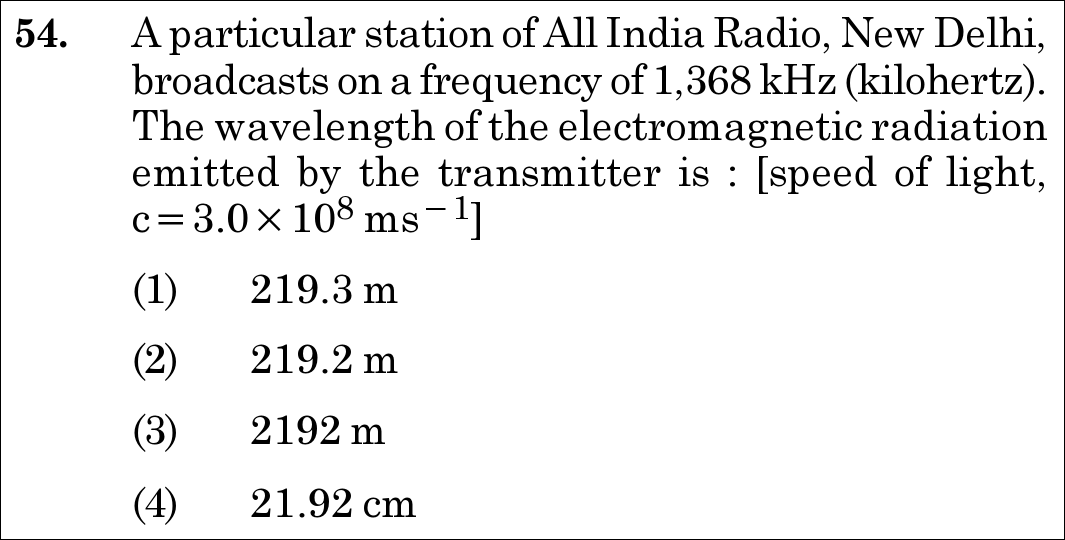
NEET 2021 · Q54 Easy
Official NEET 2021 Question 54 - Structure of Atom
1 ✓ Key
2
3
4
💡 Verified Solution & 30-Second Hack
✓
Verified Against NTA Final Answer Key
Option (1) : 219.3 m
📚 Structure of Atom Easy
📋 Given Parameters & Problem Setup
Broadcasting Frequency (ν) 1,368 kHz = 1,368 × 10^3 Hz
Speed of Light (c) 3.0 × 10^8 m/s
⚡

The 30-Second Exam Hall Shortcut: ⚡ Fast Wave Formula: λ = c / ν

⏱️ Save ~20 seconds

λ=3.0×1081368×103=300,0001368=219.298 m≈219.3 m\lambda = \frac{3.0 \times 10^8}{1368 \times 10^3} = \frac{300,000}{1368} = 219.298\text{ m} \approx 219.3\text{ m}! Direct 10-second division matching Option (1)!

1 Convert frequency to SI base units: ν=1368 kHz=1.368×10⁶ s−1\nu = 1368\text{ kHz} = 1.368 \times 10^6\text{ s}^{-1}.
2 Wave equation: c=νλ  ⟹  λ=cνc = \nu \lambda \implies \lambda = \frac{c}{\nu}.
3 Substitute: λ=3.0×10⁸ m/s1368×103 s−1=300013.68=219.298 m\lambda = \frac{3.0 \times 10^8\text{ m/s}}{1368 \times 10^3\text{ s}^{-1}} = \frac{3000}{13.68} = 219.298\text{ m}.
4 Round to 4 significant figures: 219.3 m219.3\text{ m}.
5 Match Option (1).
🛡️
Why You Can 100% Trust This Shortcut: Canonical wave mechanics velocity-frequency-wavelength relation (c=νλc = \nu \lambda).
📐

Step-by-Step Rigorous Workflow & Mathematical Proof

Step 1

Stating the Fundamental Wave Equation

For any electromagnetic radiation propagating in vacuum or air, the speed of light cc is related to frequency ν\nu and wavelength λ\lambda by:

c=ν⋅λ  ⟹  λ=cνc = \nu \cdot \lambda \implies \lambda = \frac{c}{\nu}
Step 2

Converting Frequency to Standard SI Units

The given frequency is in kilohertz (1 kHz=103 Hz=103 s−11\text{ kHz} = 10^3\text{ Hz} = 10^3\text{ s}^{-1}):

ν=1368 kHz=1368×103 Hz=1.368×10⁶ s−1\nu = 1368\text{ kHz} = 1368 \times 10^3\text{ Hz} = 1.368 \times 10^6\text{ s}^{-1}
Step 3

Computing the Wavelength

Substitute c=3.0×10⁸ m/sc = 3.0 \times 10^8\text{ m/s} and ν=1.368×10⁶ s−1\nu = 1.368 \times 10^6\text{ s}^{-1}:

λ=3.0×10⁸ m/s1.368×106 s−1=3001.368 m=219.298 m≈219.3 m\lambda = \frac{3.0 \times 10^8\text{ m/s}}{1.368 \times 10^6\text{ s}^{-1}} = \frac{300}{1.368}\text{ m} = 219.298\text{ m} \approx 219.3\text{ m}
⭐

360° Option Elimination Engine Key Feature

Diagnose every choice: Know exactly why the right option works and why distractors fail.

4-Option Deep Scan
1 1
✓ 100% Correct
Verdict & Scientific Reason:

Exact wavelength: 3.0×10⁸/(1368×103)=219.298 m≈219.3 m3.0 \times 10^8 / (1368 \times 10^3) = 219.298\text{ m} \approx 219.3\text{ m}.

💡
Why this is airtight: None; precise arithmetic calculation.
2 2
✗ Incorrect
Verdict & Scientific Reason:

Truncates without rounding up (219.298219.298 rounds up to 219.3219.3, not 219.2219.2).

⚠️
Student Fallacy (Why candidates pick this trap): Truncation error rather than proper mathematical rounding.
3 3
✗ Incorrect
Verdict & Scientific Reason:

Off by a factor of 10 from mishandling powers of ten (108/10310^8 / 10^3).

⚠️
Student Fallacy (Why candidates pick this trap): Order of magnitude exponent subtraction error.
4 4
✗ Incorrect
Verdict & Scientific Reason:

Gross unit mismatch (centimeters instead of meters).

⚠️
Student Fallacy (Why candidates pick this trap): Unit confusion.
⚠️

NTA Trap Alert: Rounding vs. Truncation Trap (Option 1 vs. Option 2)

The raw division gives 219.298 m219.298\text{ m}. Candidates who truncate to 4 digits get 219.2 m219.2\text{ m} (Option 2). Applying correct significant figure rounding rules to the next digit (9) requires rounding UP to 219.3 m219.3\text{ m} (Option 1).

🛡️ How to avoid the -1 mark: Since 0.298>0.250.298 > 0.25, round UP to 0.30.3: 219.3 m219.3\text{ m}.
📖

Core NEET Syllabus Standard

NCERT Chemistry · Structure of Atom Standard Benchmark
Core Scientific Principle Tested:

"The wavelength of electromagnetic radiation is λ=c/ν\lambda = c / \nu."

Syllabus Focus: Wave Nature of Electromagnetic Radiation
✓ Core NEET UG Syllabus Anchor Syllabus & Academic Standards ↗
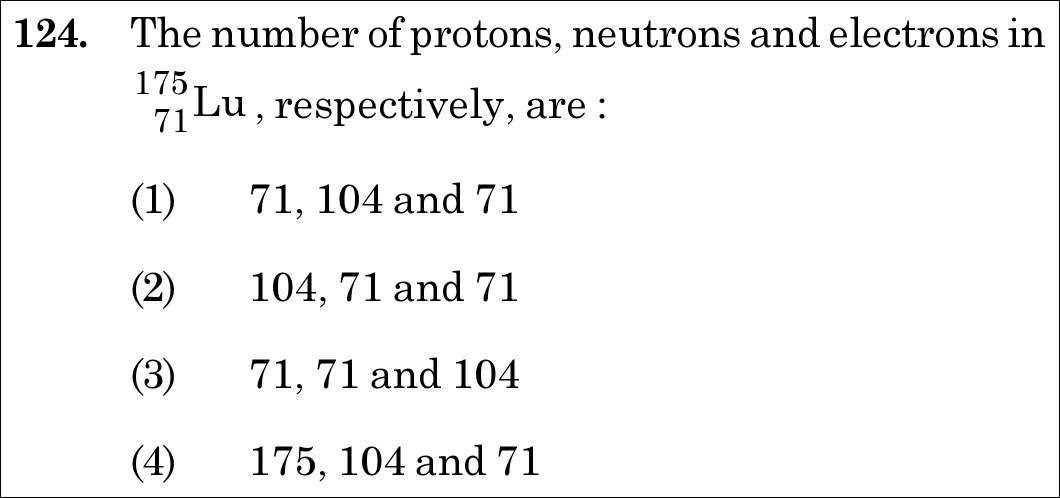
NEET 2020 · Q124 Easy
Official NEET 2020 Question 124 - Structure of Atom
1 ✓ Key
2
3
4
💡 Verified Solution & 30-Second Hack
✓
Verified Against NTA Final Answer Key
Option (1) : 71, 104 and 71
📚 Structure of Atom Easy
📋 Given Parameters & Problem Setup
Nuclide 175_71 Lu (Lutetium-175)
Atomic Number (Z) 71
Mass Number (A) 175
Charge Neutral atom (charge = 0)
Requested Sequence Protons, Neutrons, Electrons
⚡

The 30-Second Exam Hall Shortcut: ⚡ "Protons = Z = 71; Electrons = Z = 71; Neutrons = A - Z = 175 - 71 = 104 -> 71, 104, 71!"

⏱️ 20 seconds

In neutral atom ZAX^{A}_{Z}\text{X}: Number of protons = Z=71Z = 71. Number of electrons = Z=71Z = 71. Number of neutrons = A−Z=175−71=104A - Z = 175 - 71 = 104. The question asks for "protons, neutrons and electrons, respectively": sequence is 71, 104, and 71! Mark Option (1) in 5 seconds.

1 Atomic number Z = 71 -> Protons = 71.
2 Neutral atom -> Electrons = 71.
3 Mass number A = 175 -> Neutrons = A - Z = 175 - 71 = 104.
4 Order requested: Protons (71), Neutrons (104), Electrons (71).
5 Match: 71, 104 and 71 -> Option (1).
🛡️
Why You Can 100% Trust This Shortcut: NCERT Chemistry · Structure of Atom (Sub-atomic Particles: Atomic Number and Mass Number)
📐

Step-by-Step Rigorous Workflow & Mathematical Proof

Step 1

Define Nuclear Notation

For any nuclide represented as ZAX^{A}_{Z}\text{X}: - ZZ is the atomic number (subscript), which represents the number of protons in the nucleus. - AA is the mass number (superscript), which represents the total number of nucleons (protons + neutrons).

Step 2

Calculate Number of Protons and Electrons

For 71175Lu^{175}_{71}\text{Lu}: - Atomic number Z=71Z = 71. - Therefore, Number of protons=71\text{Number of protons} = 71. - Because the atom is neutral (net charge = 0), the number of electrons equals the number of protons: Number of electrons=71\text{Number of electrons} = 71

Step 3

Calculate Number of Neutrons

Number of neutrons=A−Z=175−71=104\text{Number of neutrons} = A - Z = 175 - 71 = 104

Step 4

Arrange in the Exact Requested Order

The question explicitly demands: "protons, neutrons and electrons, respectively": Protons=71,Neutrons=104,Electrons=71\text{Protons} = 71, \quad \text{Neutrons} = 104, \quad \text{Electrons} = 71 This sequence corresponds exactly to Option (1).

⭐

360° Option Elimination Engine Key Feature

Diagnose every choice: Know exactly why the right option works and why distractors fail.

4-Option Deep Scan
1 A
✓ 100% Correct
Verdict & Scientific Reason:

Factually and arithmetically exact; matches protons (71), neutrons (104), and electrons (71) in the specified sequence.

💡
Why this is airtight: None; straightforward atomic arithmetic.
2 B
✗ Incorrect
Verdict & Scientific Reason:

Incorrect; places neutrons first instead of protons.

⚠️
Student Fallacy (Why candidates pick this trap): Scrambling the requested sequence of subatomic particles.
3 C
✗ Incorrect
Verdict & Scientific Reason:

Incorrect; lists protons, electrons, and neutrons instead of protons, neutrons, and electrons.

⚠️
Student Fallacy (Why candidates pick this trap): Misreading the sequence order in the question prompt.
4 D
✗ Incorrect
Verdict & Scientific Reason:

Incorrect; uses mass number A (175) for the proton count.

⚠️
Student Fallacy (Why candidates pick this trap): Confusing mass number with atomic number.
⚠️

NTA Trap Alert: Watch the Order of Words in the Prompt!

The prompt specifies: "protons, neutrons and electrons, respectively". - Option 1 is: 71 (p), 104 (n), 71 (e) -> CORRECT. - Option 3 is: 71 (p), 71 (e), 104 (n) -> TRAP for hasty readers!

🛡️ How to avoid the -1 mark: Map each word to its value before looking at the options: p=71, n=104, e=71!
📖

Core NEET Syllabus Standard

Chemistry · Structure of Atom Standard Benchmark
Core Scientific Principle Tested:

""

Syllabus Focus: Atomic Composition: Protons, Neutrons and Electrons in 175_71 Lu
✓ Core NEET UG Syllabus Anchor Syllabus & Academic Standards ↗

Solve 4 NEET Questions a Day — One per Subject

Cover all 1,140 official NEET questions in 285 days at your own pace. Progress is saved on your device. No login needed.