The 30-Second Exam Hall Shortcut: ⚡ Inverse Power Law Scaling
Isolate number density n in terms of lambda and d
Step-by-Step Rigorous Workflow & Mathematical Proof
State the Clausius-Maxwell Mean Free Path Formula
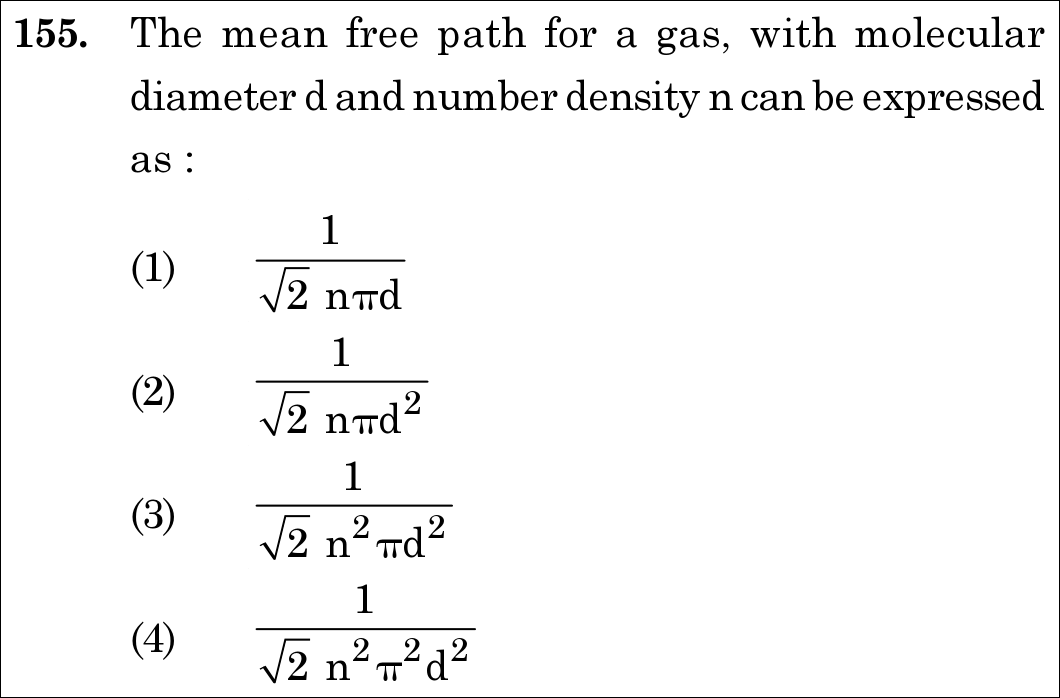
For an ideal gas with spherical molecules of diameter d and number density n, the mean free path lambda is given by:
- • The sqrt(2) factor accounts for the relative motion of colliding molecules.
- • pi * d^2 represents the effective spherical collision cross-section.
Express Number Density Explicitly
Rearranging the formula to isolate the number density n:
- • Number density is inversely proportional to the mean free path.
- • Number density is inversely proportional to the square of molecular diameter.
Substitute Ratios and Solve
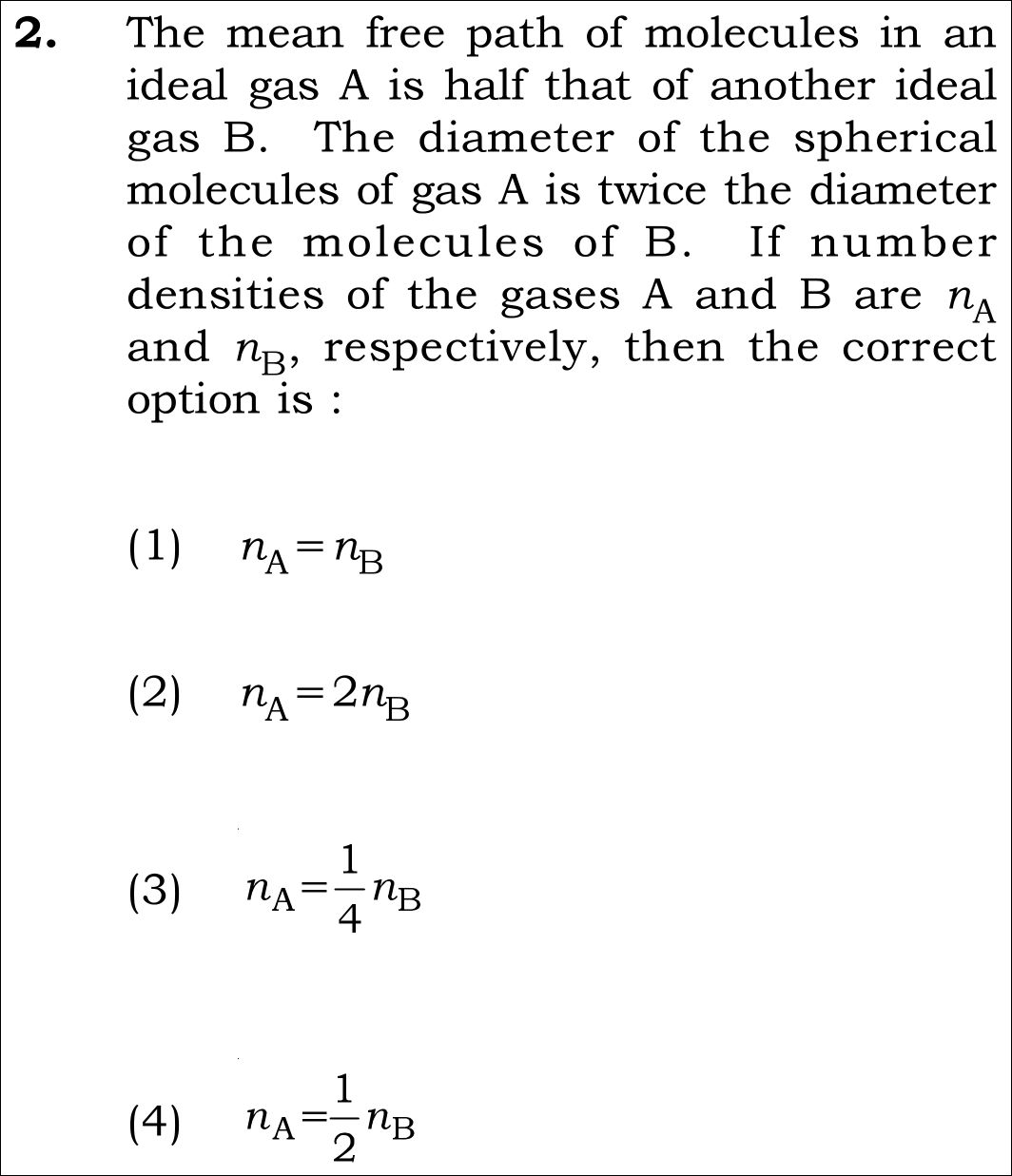
Calculate the ratio of number densities for Gas A relative to Gas B:
- • lambda_B / lambda_A = 2 (since lambda_A is half of lambda_B).
- • (d_B / d_A)^2 = (1/2)^2 = 1/4 (since d_A is twice d_B).
- • Multiplying gives n_A / n_B = 1/2 ==> n_A = (1/2) * n_B.
360° Option Elimination Engine Key Feature
Diagnose every choice: Know exactly why the right option works and why distractors fail.
Ignores the quadratic effect of molecular diameter on collision rate.
Inverts the inverse relationship.
Accounts for diameter squared but completely forgets the mean free path ratio.
100% scientifically accurate and confirmed by Official NTA Final Answer Key.
NTA Trap Alert: The Linear Diameter Trap
Many candidates mistakenly remember lambda ~ 1/(n*d) instead of lambda ~ 1/(n*d^2), leading them to mark Option (1).
Core NEET Syllabus Standard
"Mean free path is the average distance traversed between successive collisions: lambda = 1 / (sqrt(2) * pi * n * d^2)."