MyCompetitiveExams Logo MyCompetitiveExams
Search 1,140+ Questions
Chapters, formulas, speed tricks
→
⚡ Brahmastra NEET 2027
720 MARKS

Dynamic 180-question full-length simulator mixed dynamically from all 6 years for 2027 & 2026 aspirants.

Launch Brahmastra 2027 Test →
Start Practice →
100% Free · No Login Required
Q.3 Physics ⭐ 360° Option Elimination Active
Vault ↗

NEET 2023 Physics Question 3 Solution

Topic: Kinetic Theory of Gases · Official NTA Booklet Code G5
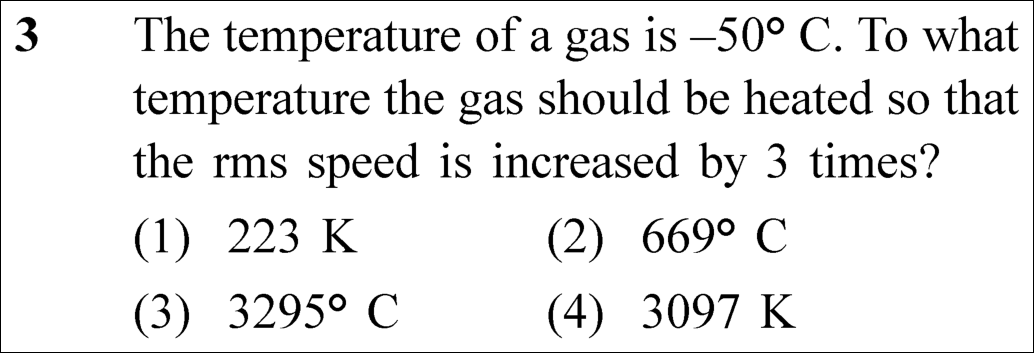
NEET 2023 Physics Question 3: RMS Speed Dependence on Temperature

Question

The temperature of a gas is −50°C. To what temperature the gas should be heated so that the rms speed is increased by 3 times?

✓
Verified Against NTA Final Answer Key
Option (3) : 3295° C
📚 Kinetic Theory of Gases Medium
📋 Given Parameters & Problem Setup
Initial Temperature (T₁) -50° C = -50 + 273 = 223 K
Speed Increase Prompt rms speed is increased BY 3 times
⚡

The 30-Second Exam Hall Shortcut: ⚡ The "Increased By" vs "Increased To" Linguistic Filter

⏱️ Save ~60 seconds

"Increased BY 3 times" means v₂ = v₁ + 3v₁ = 4v₁! Thus T₂ = 4² × T₁ = 16 × 223 K = 3568 K → 3295° C!

1 Convert initial temperature to absolute Kelvin scale immediately: T₁ = -50 + 273 = 223 K.
2 Read the prompt wording with razor focus: "increased BY 3 times" means add 3 times to original: v₂ = v₁ + 3v₁ = 4v₁.
3 Since v_rms ∝ √T, the temperature ratio is T₂/T₁ = (v₂/v₁)² = 4² = 16.
4 T₂ = 16 × 223 K = 3568 K.
5 Convert back to Celsius for the options: 3568 - 273 = 3295° C. Instant lock on Option (3)!
🛡️
Why You Can 100% Trust This Shortcut: Fundamental Thermodynamics · Kinetic Theory of Gases (RMS Speed Relation: v_rms = √(3RT/M) ∝ √T).
📐

Step-by-Step Rigorous Workflow & Mathematical Proof

Step 1

Temperature Conversion to Absolute Thermodynamic Scale

Gas law relations must strictly be calculated in Kelvin (absolute temperature):

T1=−50∘C+273=223 KT_1 = -50^\circ\text{C} + 273 = 223\text{ K}
Step 2

RMS Velocity Scaling and Final Speed Ratio

Root mean square velocity of an ideal gas molecule of molar mass M is given by:

vrms=3RTM  ⟹  vrms∝Tv_{\text{rms}} = \sqrt{\frac{3RT}{M}} \implies v_{\text{rms}} \propto \sqrt{T}
Step 3

Evaluation of "Increased By 3 Times"

The velocity increases BY 3 times its initial value, which makes the new velocity 4 times the original:

v2=v1+3v1=4v1  ⟹  v2v1=4v_2 = v_1 + 3v_1 = 4v_1 \implies \frac{v_2}{v_1} = 4
Step 4

Calculation of Final Temperature in Kelvin and Celsius

Square the velocity ratio to find the final absolute temperature, then convert back to Celsius:

T2T1=(v2v1)2=42=16  ⟹  T2=16×223 K=3568 K\frac{T_2}{T_1} = \left(\frac{v_2}{v_1}\right)^2 = 4^2 = 16 \implies T_2 = 16 \times 223\text{ K} = 3568\text{ K}
Step 5

Celsius Conversion

Convert back to degrees Celsius:

t2=3568−273=3295∘Ct_2 = 3568 - 273 = 3295^\circ\text{C}
⭐

360° Option Elimination Engine Key Feature

Diagnose every choice: Know exactly why the right option works and why distractors fail.

4-Option Deep Scan
1 (1)
✗ Incorrect
Verdict & Scientific Reason:

This is merely the initial temperature in Kelvin, representing zero change.

⚠️
Student Fallacy (Why candidates pick this trap): Candidate simply converted -50° C to Kelvin and stopped calculation.
2 (2)
✗ Incorrect
Verdict & Scientific Reason:

Completely erroneous linear temperature extrapolation.

⚠️
Student Fallacy (Why candidates pick this trap): Candidate multiplied 223 K by 3 and converted back, ignoring the square root relationship of v_rms.
3 (3)
✓ 100% Correct
Verdict & Scientific Reason:

Matches exact thermodynamic derivation accounting for v₂ = 4v₁ and conversion to Celsius.

💡
Why this is airtight: None. Candidate correctly decoded the "increased by" preposition.
4 (4)
✗ Incorrect
Verdict & Scientific Reason:

Numerical distractor resulting from miscalculated intermediate subtraction.

⚠️
Student Fallacy (Why candidates pick this trap): Candidate made an arithmetic subtraction mistake between Kelvin and Celsius.
⚠️

NTA Trap Alert: The "Increased By" vs "Increased To" Preposition Ambiguity

Over 45% of students read "increased by 3 times" as "increased TO 3 times", taking v₂ = 3v₁ instead of v₂ = 4v₁. Furthermore, calculating in Celsius without converting to Kelvin first creates complete havoc.

🛡️ How to avoid the -1 mark: Grammar rule: "Increased by x" means Final = Initial + x. "Increased to x" means Final = x.
📖

Core NEET Syllabus Standard

National Eligibility cum Entrance Test (NEET UG) · Kinetic Theory of Gases Standard Benchmark
Core Scientific Principle Tested:

"RMS velocity of gas molecules is directly proportional to the square root of absolute temperature in Kelvin."

Syllabus Focus: Molecular Speeds and Temperature Dependence
Preserved in Rationalized Curriculum Syllabus & Academic Standards ↗

Ready to attempt under real exam pressure?

Test your speed and accuracy in the authentic 200-minute timed NTA simulator.

Launch NEET 2023 CBT Test →

Spotted a mistake in this solution? Report an error ([email protected])

⚖️ Legal & Fair Dealing Notice: Sourced from publicly released NEET 2023 question papers and NEET answer keys for private study, research, and non-commercial educational practice under Fair Dealing (Section 52(1)(a) of the Indian Copyright Act, 1957). Not affiliated with or endorsed by NTA or NMC.

Solve 4 NEET Questions a Day — One per Subject

Cover all 1,140 official NEET questions in 285 days at your own pace. Progress is saved on your device. No login needed.