The 30-Second Exam Hall Shortcut: ⚡ Simple Diffusion in Lower Invertebrates
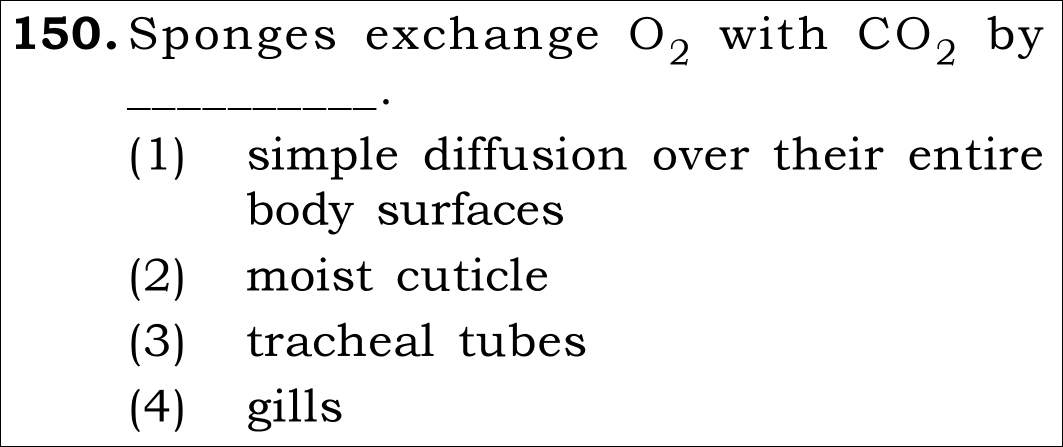
Sponges, Coelenterates, Flatworms lack specialized organs -> Simple Diffusion over entire body surface!
Step-by-Step Rigorous Workflow & Mathematical Proof
Respiratory Adaptations in Lower Invertebrates
Mechanisms of breathing vary among different groups of animals depending on their habitats and levels of organization. Lower invertebrates like sponges (Porifera), coelenterates (Cnidaria), and flatworms (Platyhelminthes) exhibit cellular or tissue levels of organization and lack specialized vascular or respiratory organs.
- • Water canal system circulates water past choanocytes and pinacocytes for direct gas exchange.
Compare with Higher Invertebrate Respiratory Organs
Earthworms use their moist cuticle (cutaneous respiration, Option 2). Insects have a network of tracheal tubes to transport atmospheric air within the body (Option 3). Aquatic arthropods, molluscs, and fishes use specialized vascularized structures called gills (branchial respiration, Option 4).
- • Option (1) is uniquely correct for sponges.
Conclusion
Sponges exchange O₂ with CO₂ by simple diffusion across their entire body surfaces.
- • Matches official NTA final answer key Option A / (1).
360° Option Elimination Engine Key Feature
Diagnose every choice: Know exactly why the right option works and why distractors fail.
100% accurate. Canonical NCERT mechanism of respiratory gas exchange in Porifera.
Incorrect. Cutaneous respiration using moist cuticle is characteristic of annelids (earthworms) and amphibians (frogs).
Incorrect. Tracheal respiratory systems are found in terrestrial arthropods (insects, centipedes).
Incorrect. Branchial respiration via gills occurs in crustaceans, molluscs, and fishes.
NTA Trap Alert: Assuming All Aquatic Creatures Have Gills
Students often generalize: "Sponges live in water, so they must use gills." Gills require complex tissues and circulatory capillaries. Sponges have simple cellular-grade organization and rely entirely on simple diffusion.
Core NEET Syllabus Standard
"Lower invertebrates like sponges exchange O₂ and CO₂ by simple diffusion across their entire body surfaces facilitated by the water canal system."