MyCompetitiveExams Logo MyCompetitiveExams
Search 1,140+ Questions
Chapters, formulas, speed tricks
→
⚡ Brahmastra NEET 2027
720 MARKS

Dynamic 180-question full-length simulator mixed dynamically from all 6 years for 2027 & 2026 aspirants.

Launch Brahmastra 2027 Test →
Start Practice →
100% Free · No Login Required
Q.24 Botany ⭐ 360° Option Elimination Active
Vault ↗

NEET 2020 Botany Question 24 Solution

Topic: Breathing and Exchange of Gases · Official NTA Booklet Code E1
NEET 2020 Botany Question 24: Mechanics of Inspiration: Diaphragm and External Intercostal Contraction

Question

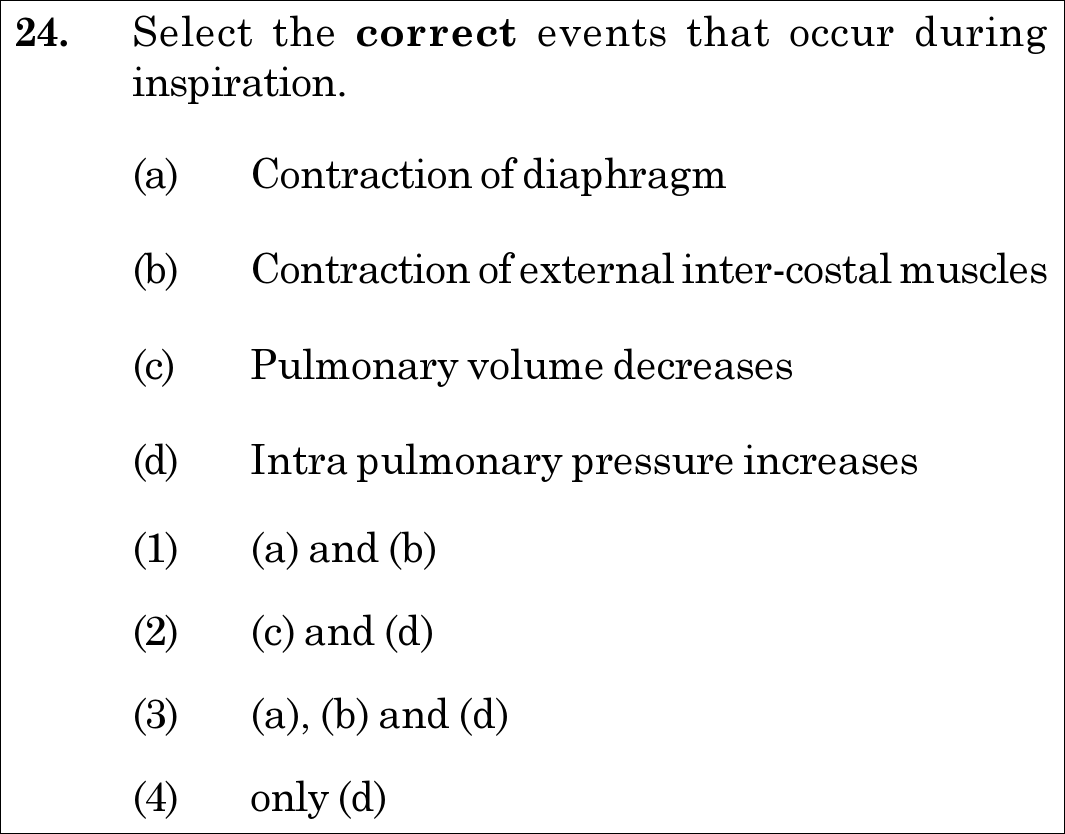
Select the correct events that occur during inspiration. (a) Contraction of diaphragm (b) Contraction of external inter-costal muscles (c) Pulmonary volume decreases (d) Intra pulmonary pressure increases

  1. (1)(a) and (b)
  2. (2)(c) and (d)
  3. (3)(a), (b) and (d)
  4. (4)only (d)
✓
Verified Against NTA Final Answer Key
Option (1) : (a) and (b)
📚 Breathing and Exchange of Gases Easy
📋 Given Parameters & Problem Setup
Event (a) Contraction of diaphragm
Event (b) Contraction of external inter-costal muscles
Event (c) Pulmonary volume decreases
Event (d) Intra pulmonary pressure increases
Question Objective Select the correct events that occur during inspiration
⚡

The 30-Second Exam Hall Shortcut: ⚡ "Inspiration = Diaphragm & External Intercostals Contract (Volume Rises, Pressure Drops!)"

⏱️ Save ~20 seconds

Inspiration is active: Contraction of diaphragm flattens it (increases antero-posterior thoracic volume), while contraction of external intercostals lifts ribs/sternum (increases dorso-ventral volume). Pulmonary volume INCREASES (c is false) and intra-pulmonary pressure DECREASES below atmospheric (d is false). Only (a) and (b) occur! Select Option (1).

1 Check mechanics of Inspiration: - (a) Contraction of diaphragm: Pulls downward, increasing thoracic volume antero-posteriorly -> TRUE. - (b) Contraction of external intercostal muscles: Lifts ribs and sternum, increasing dorso-ventral thoracic volume -> TRUE. - (c) Pulmonary volume: INCREASES (does not decrease) -> FALSE. - (d) Intra-pulmonary pressure: DECREASES below atmospheric pressure (creates negative pressure) -> FALSE.
2 Events occurring during inspiration: (a) and (b) only.
3 Select Option (1).
🛡️
Why You Can 100% Trust This Shortcut: NCERT Biology · Breathing and Exchange of Gases (Mechanism of Breathing: Inspiration is initiated by the contraction of diaphragm which increases the volume of thoracic chamber in antero-posterior axis. The contraction of external inter-costal muscles lifts up the ribs and sternum causing an increase in volume in dorso-ventral axis. An overall increase in thoracic volume causes a similar increase in pulmonary volume, decreasing intra-pulmonary pressure below atmospheric pressure).
📐

Step-by-Step Rigorous Workflow & Mathematical Proof

Step 1

Boyle's Law and the Muscular Dynamics of Inspiration

Inspiration is an active neuromuscular process driven by atmospheric-to-alveolar pressure gradients: - (a) Contraction of Diaphragm: The dome-shaped phrenic-innervated muscular diaphragm contracts and flattens downward, increasing the volume of the thoracic cavity along the antero-posterior axis. - (b) Contraction of External Intercostal Muscles: Intercostal-innervated muscles pull the ribs upward and outward while pushing the sternum ventrally, increasing thoracic volume along the dorso-ventral axis. - Pulmonary Volume Increase: Because the pleura adhere tightly to the thoracic wall via pleural fluid surface tension, any expansion of thoracic volume drives an obligatory increase in pulmonary volume (negating statement (c)). - Intra-Pulmonary Pressure Decrease: According to Boyle’s Law (P∝1/VP \propto 1/V), an expansion in pulmonary volume causes intra-pulmonary pressure to drop below atmospheric pressure (negative pressure of approx. −1 mm Hg-1\text{ mm Hg} to −3 mm Hg-3\text{ mm Hg}), drawing ambient air into the bronchial tree (negating statement (d)).

Contraction of Diaphragm+External Intercostals  ⟹  ↑Pulmonary Volume↑Pulmonary Volume  ⟹  ↓Intra-Pulmonary Pressure<Patm  ⟹  Inflow of Air\begin{aligned} \text{Contraction of Diaphragm} + \text{External Intercostals} &\implies \mathbf{\uparrow Pulmonary\,Volume} \\[4pt] \uparrow Pulmonary\,Volume &\implies \mathbf{\downarrow Intra\text{-}Pulmonary\,Pressure} < P_{\text{atm}} \implies \text{Inflow of Air} \end{aligned}
Step 2

Option Alignment

Only events (a) and (b) occur during inspiration. Statements (c) and (d) describe events occurring during expiration.

⭐

360° Option Elimination Engine Key Feature

Diagnose every choice: Know exactly why the right option works and why distractors fail.

4-Option Deep Scan
1 A
✓ 100% Correct
Verdict & Scientific Reason:

Correct. Both diaphragm and external intercostal contraction actively expand the thoracic cavity during inspiration.

💡
Why this is airtight: None. Direct recall of respiratory mechanics.
2 B
✗ Incorrect
Verdict & Scientific Reason:

Incorrect. Volume decrease and pressure increase occur during expiration, not inspiration.

⚠️
Student Fallacy (Why candidates pick this trap): Confusing inspiration with expiration.
3 C
✗ Incorrect
Verdict & Scientific Reason:

Incorrect because intra-pulmonary pressure drops below atmospheric during inspiration; it does not increase.

⚠️
Student Fallacy (Why candidates pick this trap): Forgetting that air inflow requires negative (sub-atmospheric) pressure.
4 D
✗ Incorrect
Verdict & Scientific Reason:

Incorrect because statement (d) is false.

⚠️
Student Fallacy (Why candidates pick this trap): Complete inversion of pulmonary pressures.
⚠️

NTA Trap Alert: Inspiration vs Expiration Pressure Gradient Trap

Many candidates think that filling the lungs with air means "pressure increases". Air can ONLY rush in if the internal pressure is LOWER than atmospheric pressure. Boyle's law dictates: Volume up = Pressure down.

🛡️ How to avoid the -1 mark: Remember: Inflow needs suction -> Volume expands, Pressure drops below atmosphere.
📖

Core NEET Syllabus Standard

NEET / NCERT Biology · Breathing and Exchange of Gases Standard Benchmark
Core Scientific Principle Tested:

"Inspiration is caused by contraction of the diaphragm and external intercostal muscles, which expands pulmonary volume and decreases intra-pulmonary pressure."

Syllabus Focus: Mechanics of Breathing
✓ Core NEET UG Syllabus Anchor Syllabus & Academic Standards ↗

Ready to attempt under real exam pressure?

Test your speed and accuracy in the authentic 180-minute timed NTA simulator.

Launch NEET 2020 CBT Test →

Spotted a mistake in this solution? Report an error ([email protected])

⚖️ Legal & Fair Dealing Notice: Sourced from publicly released NEET 2020 question papers and NEET answer keys for private study, research, and non-commercial educational practice under Fair Dealing (Section 52(1)(a) of the Indian Copyright Act, 1957). Not affiliated with or endorsed by NTA or NMC.

Solve 4 NEET Questions a Day — One per Subject

Cover all 1,140 official NEET questions in 285 days at your own pace. Progress is saved on your device. No login needed.