MyCompetitiveExams Logo MyCompetitiveExams
Search 1,140+ Questions
Chapters, formulas, speed tricks
→
⚡ Brahmastra NEET 2027
720 MARKS

Dynamic 180-question full-length simulator mixed dynamically from all 6 years for 2027 & 2026 aspirants.

Launch Brahmastra 2027 Test →
Start Practice →
100% Free · No Login Required
Q.23 Botany ⭐ 360° Option Elimination Active
Vault ↗

NEET 2020 Botany Question 23 Solution

Topic: Microbes in Human Welfare · Official NTA Booklet Code E1
NEET 2020 Botany Question 23: Anaerobic Sludge Digesters: Treatment of Activated Sludge

Question

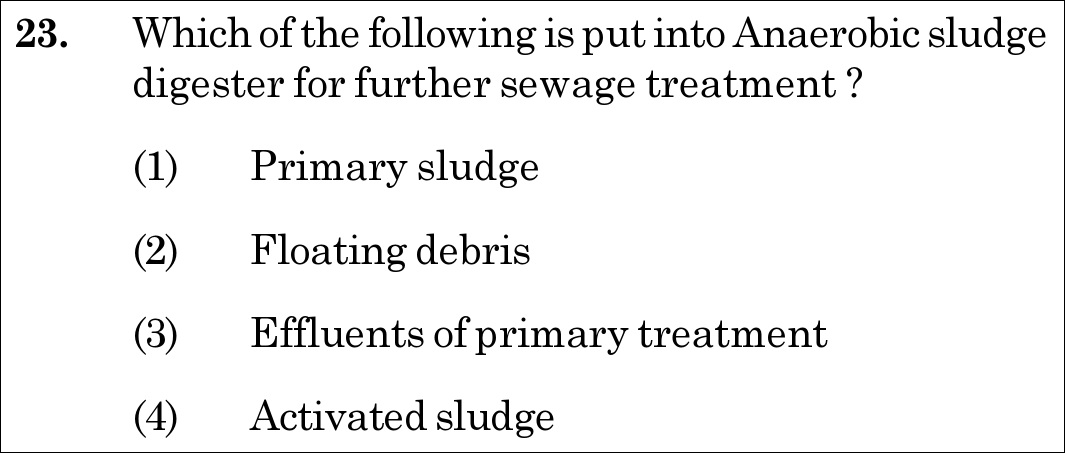
Which of the following is put into Anaerobic sludge digester for further sewage treatment?

  1. (1)Primary sludge
  2. (2)Floating debris
  3. (3)Effluents of primary treatment
  4. (4)Activated sludge
✓
Verified Against NTA Final Answer Key
Option (4) : Activated sludge
📚 Microbes in Human Welfare Easy
📋 Given Parameters & Problem Setup
Treatment Unit Anaerobic Sludge Digester
Process Secondary (Biological) Sewage Treatment
Question Objective Identify which sludge fraction is transferred into anaerobic digesters
⚡

The 30-Second Exam Hall Shortcut: ⚡ "Settling Tank Sediment = Activated Sludge → Pumped to Anaerobic Digesters!"

⏱️ Save ~20 seconds

In secondary sewage treatment, microbial flocs settle in the settling tank to form ACTIVATED SLUDGE. A small part is recycled as inoculum into the aeration tank, while the major remaining part is pumped into ANAEROBIC SLUDGE DIGESTERS to produce biogas! Mark Activated sludge (Option 4).

1 Trace sewage treatment sequence: - Primary treatment: Physical settling of floating debris & primary sludge. - Secondary (biological) treatment: Aeration tank with flocs reducing BOD →\to Settling tank where flocs sediment to form Activated Sludge.
2 Trace fate of Activated Sludge: - Small fraction →\to Inoculum for aeration tank. - Major remaining fraction →\to Pumped into Anaerobic Sludge Digesters.
3 Select Option (4): Activated sludge.
🛡️
Why You Can 100% Trust This Shortcut: NCERT Biology · Microbes in Human Welfare (Sewage Treatment: Once the BOD of sewage or waste water is reduced, the effluent is passed into a settling tank where bacterial flocs sediment. This sediment is called activated sludge. A small part is pumped back into aeration tank; remaining major part of sludge is pumped into large tanks called anaerobic sludge digesters).
📐

Step-by-Step Rigorous Workflow & Mathematical Proof

Step 1

Secondary (Biological) Sewage Treatment Flowsheet

Municipal wastewater undergoes sequential stages of purification: 1. Primary Treatment: Physical removal of large and small particles via sequential filtration (floating debris) and sedimentation (settled solids form primary sludge). 2. Aeration Tank (Secondary Treatment): Effluent from primary settling is vigorously agitated in aeration tanks where aerobic microbes form flocs (masses of bacteria associated with fungal filaments), dramatically consuming dissolved organic matter and slashing the Biochemical Oxygen Demand (BOD). 3. Settling Tank & Activated Sludge: Once BOD is sharply lowered, the effluent flows into a settling tank where the microbial flocs settle under gravity to form activated sludge. 4. Anaerobic Digestion: A minor aliquot of activated sludge is recycled back into the aeration tank as inoculum. The major bulk of activated sludge is pumped into large anaerobic sludge digesters.

Settling Tank Sediment  ⟹  Activated Sludge→Major PortionAnaerobic Sludge Digesters→MethanogensBiogas (CH4+CO2+H2S)\text{Settling Tank Sediment} \implies \mathbf{Activated\,Sludge} \xrightarrow{\text{Major Portion}} \mathbf{Anaerobic\,Sludge\,Digesters} \xrightarrow{\text{Methanogens}} \text{Biogas } (CH_4 + CO_2 + H_2S)
Step 2

Anaerobic Digestion and Biogas Generation

In the anaerobic digester, obligate and facultative anaerobic bacteria (including methanogens like *Methanobacterium*) digest the bacterial and fungal biomass of the activated sludge. This anaerobic decomposition generates a flammable gas mixture (biogas consisting predominantly of methane, carbon dioxide, and hydrogen sulphide).

⭐

360° Option Elimination Engine Key Feature

Diagnose every choice: Know exactly why the right option works and why distractors fail.

4-Option Deep Scan
1 A
✗ Incorrect
Verdict & Scientific Reason:

Incorrect. Primary sludge comprises raw settled solids from primary physical treatment, not the biological sediment fed to anaerobic digesters.

⚠️
Student Fallacy (Why candidates pick this trap): Confusing primary physical sludge with secondary biological activated sludge.
2 B
✗ Incorrect
Verdict & Scientific Reason:

Incorrect. Floating debris is removed by sequential filtration during the very first step of primary treatment.

⚠️
Student Fallacy (Why candidates pick this trap): Ignoring physical screening.
3 C
✗ Incorrect
Verdict & Scientific Reason:

Incorrect. Primary effluent is passed into the aeration tank for aerobic digestion, not anaerobic digesters.

⚠️
Student Fallacy (Why candidates pick this trap): Confusing the aeration tank feed with the digester feed.
4 D
✓ 100% Correct
Verdict & Scientific Reason:

Correct. Activated sludge sedimented in settling tanks is pumped into anaerobic sludge digesters for methane fermentation.

💡
Why this is airtight: None. Direct recall of wastewater treatment steps.
⚠️

NTA Trap Alert: Primary Sludge vs Activated Sludge Digestion Trap

Primary sludge is non-biological raw grit/settled solids. Activated sludge is the biomass-rich aerobic floc sediment formed after secondary treatment, which is specifically transferred to anaerobic digesters for biogas production.

🛡️ How to avoid the -1 mark: Remember: Flocs settle into Activated Sludge →\to Pumped into Anaerobic Digesters.
📖

Core NEET Syllabus Standard

NEET / NCERT Biology · Microbes in Human Welfare Standard Benchmark
Core Scientific Principle Tested:

"Activated sludge from secondary settling tanks is pumped into anaerobic sludge digesters for further treatment."

Syllabus Focus: Sewage Treatment
✓ Core NEET UG Syllabus Anchor Syllabus & Academic Standards ↗

Ready to attempt under real exam pressure?

Test your speed and accuracy in the authentic 180-minute timed NTA simulator.

Launch NEET 2020 CBT Test →

Spotted a mistake in this solution? Report an error ([email protected])

⚖️ Legal & Fair Dealing Notice: Sourced from publicly released NEET 2020 question papers and NEET answer keys for private study, research, and non-commercial educational practice under Fair Dealing (Section 52(1)(a) of the Indian Copyright Act, 1957). Not affiliated with or endorsed by NTA or NMC.

Solve 4 NEET Questions a Day — One per Subject

Cover all 1,140 official NEET questions in 285 days at your own pace. Progress is saved on your device. No login needed.