MyCompetitiveExams Logo MyCompetitiveExams
Search 1,140+ Questions
Chapters, formulas, speed tricks
→
⚡ Brahmastra NEET 2027
720 MARKS

Dynamic 180-question full-length simulator mixed dynamically from all 6 years for 2027 & 2026 aspirants.

Launch Brahmastra 2027 Test →
Start Practice →
100% Free · No Login Required
🌿 Botany ⭐ High Weightage (~2–3 Qs/Year)

NEET Microbes in Human Welfare Previous Year Questions with Solutions

Complete repository of official NTA NEET questions for Microbes in Human Welfare from 2020 to 2026. Every question includes 30-second elimination tricks, step-by-step NCERT solutions, option-by-option traps, and official answer keys.

8 Questions 5 Exam Years (2026, 2025, 2024, 2021, 2020) 8 Easy · 0 Medium · 0 Challenging
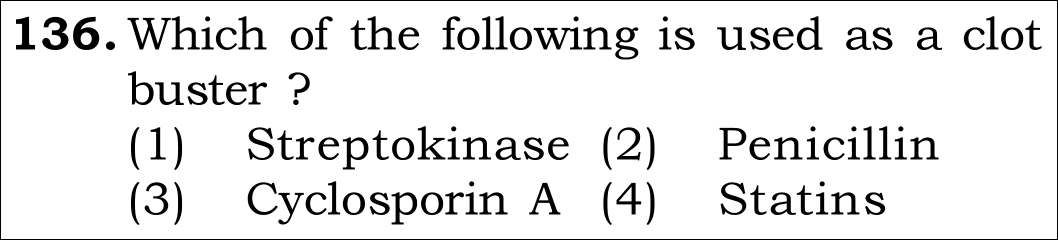
NEET 2026 · Q136 Easy
Official NEET 2026 Question 136 - Microbes in Human Welfare
1 Streptokinase ✓ Key
2 Penicillin
3 Cyclosporin A
4 Statins
💡 Verified Solution & 30-Second Hack
✓
Verified Against NTA Final Answer Key
Option (1) : Streptokinase
📚 Microbes in Human Welfare Easy
📋 Given Parameters & Problem Setup
Therapeutic Function Clot Buster (Thrombolytic Agent)
Clinical Indication Emergency removal of intravascular clots in myocardial infarction
Given Options Streptokinase, Penicillin, Cyclosporin A, Statins
⚡

The 30-Second Exam Hall Shortcut: ⚡ Bioactive Molecules Quad-Rule

⏱️ Save ~45 seconds

Streptokinase = Clot Buster; Cyclosporin A = Immunosuppressant; Statins = Cholesterol Lowering!

1 Recognize target clinical hallmark: "Clot buster" for clearing intravascular blood clots.
2 Recall: Streptokinase (produced by Streptococcus) is the medical clot buster.
3 Cyclosporin A (Trichoderma) is for organ transplant immunosuppression; Statins (Monascus) lower cholesterol.
4 Scan options: Option (1) is Streptokinase.
5 Pick Option (1) in under 5 seconds!
🛡️
Why You Can 100% Trust This Shortcut: NCERT Biology · Microbes in Human Welfare (Streptokinase produced by Streptococcus acts as a clot buster).
📐

Step-by-Step Rigorous Workflow & Mathematical Proof

Step 1

Microbial Source of Streptokinase

Streptokinase is an enzyme produced by the bacterium Streptococcus and modified by genetic engineering to improve its clinical efficacy and reduce allergic adverse reactions.

Streptococcus (Bacterium)→Genetic EngineeringStreptokinase (Enzyme)\text{Streptococcus (Bacterium)} \xrightarrow{\text{Genetic Engineering}} \text{Streptokinase (Enzyme)}
  • • Engineered for intravenous thrombolytic therapy.
Step 2

Physiological Mechanism as a Clot Buster

In the bloodstream, streptokinase binds to human plasminogen, activating it into active plasmin. Plasmin is a proteolytic enzyme that cleaves insoluble fibrin meshes holding intravascular thrombi together, dissolving the clot and reperfusing ischemic myocardium.

Plasminogen→StreptokinasePlasmin→FibrinolysisDissolution of Blood Clot\text{Plasminogen} \xrightarrow{\text{Streptokinase}} \text{Plasmin} \xrightarrow{\text{Fibrinolysis}} \text{Dissolution of Blood Clot}
  • • Used clinically within the first few hours following acute myocardial infarction.
Step 3

Differentiate from Other Microbially Derived Agents

Penicillin is an antibiotic that inhibits bacterial peptidoglycan transpeptidation. Cyclosporin A is an immunosuppressive cyclic peptide from the fungus Trichoderma polysporum. Statins (from yeast Monascus purpureus) competitively inhibit HMG-CoA reductase to lower blood cholesterol.

Clot Buster≡Streptokinase  ⟹  Option (1)\text{Clot Buster} \equiv \mathbf{Streptokinase} \implies \text{Option (1)}
  • • Matches official NTA final answer key Option A / (1).
⭐

360° Option Elimination Engine Key Feature

Diagnose every choice: Know exactly why the right option works and why distractors fail.

4-Option Deep Scan
1 A
✓ 100% Correct
Verdict & Scientific Reason:

100% accurate. Canonical microbial enzyme used as a clot buster in myocardial infarction.

💡
Why this is airtight: None; direct NCERT recall.
2 B
✗ Incorrect
Verdict & Scientific Reason:

Incorrect. Penicillin is an antibiotic derived from Penicillium notatum that kills bacteria, not a clot dissolver.

⚠️
Student Fallacy (Why candidates pick this trap): Confusing antimicrobial therapeutics with cardiovascular thrombolytics.
3 C
✗ Incorrect
Verdict & Scientific Reason:

Incorrect. Cyclosporin A is an immunosuppressant used in organ transplantation, not a clot buster.

⚠️
Student Fallacy (Why candidates pick this trap): Conflating different high-yield bioactive molecules from Table 10.1.
4 D
✗ Incorrect
Verdict & Scientific Reason:

Incorrect. Statins competitively inhibit HMG-CoA reductase to lower blood cholesterol, but do not dissolve acute fibrin clots.

⚠️
Student Fallacy (Why candidates pick this trap): Confusing long-term cholesterol reduction with emergency thrombolysis.
⚠️

NTA Trap Alert: Confusing Streptokinase with Statins

Both relate to cardiovascular therapy, leading students to confuse statins (cholesterol-lowering agents) with streptokinase (acute clot-busting enzymes).

🛡️ How to avoid the -1 mark: Remember: Streptokinase KILLS the clot; Statins SLOW cholesterol synthesis.
📖

Core NEET Syllabus Standard

NEET Biology Core Syllabus · Microbes in Human Welfare Standard Benchmark
Core Scientific Principle Tested:

"Streptokinase produced by Streptococcus functions as a clot buster for removing clots from blood vessels of patients suffering from myocardial infarction."
Syllabus Focus: Chemicals, Enzymes and other Bioactive Molecules
✓ Core NEET UG Syllabus Anchor Syllabus & Academic Standards ↗
Strepto-Kinase Kills the Clot; Monascus-Statin Stops Cholesterol on the spot!
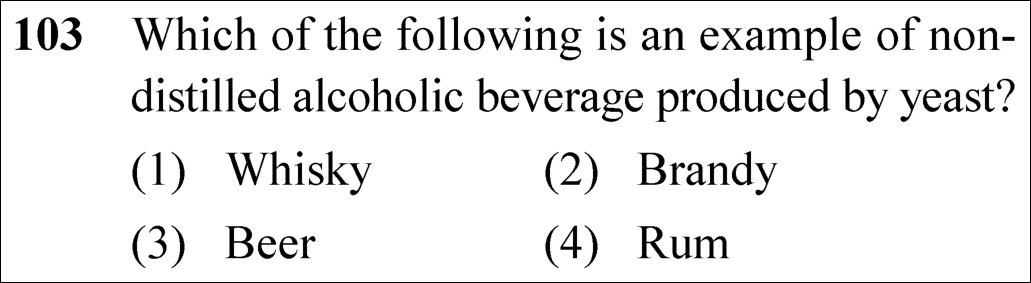
NEET 2025 · Q103 Easy
Official NEET 2025 Question 103 - Microbes in Human Welfare
1
2
3 ✓ Key
4
💡 Verified Solution & 30-Second Hack
✓
Verified Against NTA Final Answer Key
Option (3) : Beer
📚 Microbes in Human Welfare Easy
📋 Given Parameters & Problem Setup
Category Non-distilled alcoholic beverage
Microorganism Yeast (Saccharomyces cerevisiae / Brewer’s yeast)
⚡

The 30-Second Exam Hall Shortcut: ⚡ Wine & Beer = Without Distillation Rule

⏱️ Save ~20 seconds

Wine and Beer are produced WITHOUT distillation (low alcohol content ~3-12%)! Whisky, Brandy, and Rum are produced WITH distillation of fermented broth (high alcohol ~40%)! ⟹ Beer is the non-distilled beverage!

1 Recall NCERT Microbes in Human Welfare classification of fermented beverages:
2 - Without distillation (Non-distilled): Wine and Beer.
3 - With distillation (Distilled spirits): Whisky, Brandy, Rum, Gin, Vodka.
4 Options (1) Whisky, (2) Brandy, and (4) Rum are all distilled beverages.
5 Option (3) Beer is produced without distillation.
6 Select Option (3) in under 5 seconds!
🛡️
Why You Can 100% Trust This Shortcut: Industrial Microbes & Fermentation (NCERT Biology · Microbes in Human Welfare: Saccharomyces cerevisiae / Brewer’s yeast).
📐

Step-by-Step Rigorous Workflow & Mathematical Proof

Step 1

Biological Fermentation by Brewer’s Yeast

Saccharomyces cerevisiae ferments malted cereals and fruit juices into ethanol and carbon dioxide:

C6H12O6→Yeast (Zymase)2C2H5OH+2CO2\text{C}_6\text{H}_{12}\text{O}_6 \xrightarrow{\text{Yeast (Zymase)}} 2\text{C}_2\text{H}_5\text{OH} + 2\text{CO}_2
  • • Natural yeast fermentation ceases when alcohol concentration reaches ~13% due to ethanol toxicity.
Step 2

Processing: Distillation vs. Non-Distillation

Fermented products are processed in two ways to achieve different alcohol concentrations:

Non-distilled: Wine and Beer,Distilled: Whisky, Brandy, and Rum\text{Non-distilled: Wine and Beer}, \quad \text{Distilled: Whisky, Brandy, and Rum}
  • • Wine and Beer: Filtered and bottled without distillation, maintaining lower alcohol percentages (3–6% in beer, 9–12% in wine).
  • • Whisky, Brandy, and Rum: Distilled to concentrate alcohol content to 40% or higher.
  • • Therefore, Beer is the correct non-distilled alcoholic beverage, matching Option (3).
⭐

360° Option Elimination Engine Key Feature

Diagnose every choice: Know exactly why the right option works and why distractors fail.

4-Option Deep Scan
1 A
✗ Incorrect
Verdict & Scientific Reason:

Incorrect. Whisky is a distilled beverage prepared from fermented grain mash.

⚠️
Student Fallacy (Why candidates pick this trap): Thinking whisky is non-distilled.
2 B
✗ Incorrect
Verdict & Scientific Reason:

Incorrect. Brandy is a distilled beverage prepared from fermented fruit juice (wine).

⚠️
Student Fallacy (Why candidates pick this trap): Confusing brandy with wine.
3 C
✓ 100% Correct
Verdict & Scientific Reason:

100% correct. Beer is produced without distillation from malted barley.

💡
Why this is airtight: None; verbatim NCERT recall.
4 D
✗ Incorrect
Verdict & Scientific Reason:

Incorrect. Rum is a distilled beverage made from fermented sugarcane byproducts (molasses).

⚠️
Student Fallacy (Why candidates pick this trap): Thinking rum is un-distilled.
⚠️

NTA Trap Alert: Confusing Raw Material with Distillation Processing

Students often memorize the raw materials (malt, molasses, fruit) but forget the distillation status. NCERT makes a very sharp distinction: "Wine and beer are produced without distillation whereas whisky, brandy and rum are produced by distillation"!

🛡️ How to avoid the -1 mark: Mnemonic: "WB" (Wine & Beer) = Without Boiling (Without distillation)!
📖

Core NEET Syllabus Standard

NEET Biology Core Syllabus · Microbes in Human Welfare Standard Benchmark
Core Scientific Principle Tested:

"Wine and beer are non-distilled alcoholic beverages; whisky, brandy, and rum are distilled."

Syllabus Focus: Fermented Beverages by Saccharomyces cerevisiae
✓ Core NEET UG Syllabus Anchor Syllabus & Academic Standards ↗
WB = Without Boiling (Without Distillation) = Wine & Beer (Option 3)!
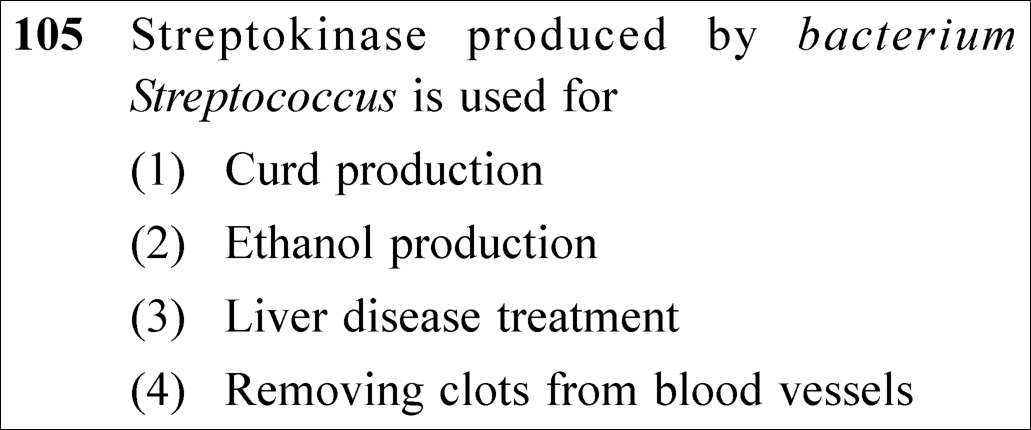
NEET 2025 · Q105 Easy
Official NEET 2025 Question 105 - Microbes in Human Welfare
1 Curd production
2 Ethanol production
3 Liver disease treatment
4 Removing clots from blood vessels ✓ Key
💡 Verified Solution & 30-Second Hack
✓
Verified Against NTA Final Answer Key
Option (4) : Removing clots from blood vessels
📚 Microbes in Human Welfare Easy
📋 Given Parameters & Problem Setup
Bioactive Product Streptokinase
Microbial Source Bacterium Streptococcus (modified by genetic engineering)
⚡

The 30-Second Exam Hall Shortcut: ⚡ Clot Buster Streptokinase Recall

⏱️ Save ~20 seconds

Streptokinase from Streptococcus is the textbook "CLOT BUSTER" used clinically to dissolve intravascular thrombi in myocardial infarction patients! ⟹ Removing clots from blood vessels!

1 Recall bioactive molecules from NCERT Chapter 10 Section 10.2.3:
2 - Streptokinase (from Streptococcus): "Clot buster" for dissolving blood clots in blood vessels of patients suffering myocardial infarction.
3 - Cyclosporin A (from Trichoderma polysporum): Immunosuppressive agent in organ transplants.
4 - Statins (from Monascus purpureus): Blood cholesterol lowering agents.
5 - LAB (Lactobacillus): Curd production.
6 Streptokinase is specifically used for removing clots from blood vessels.
7 Select Option (4) in under 5 seconds!
🛡️
Why You Can 100% Trust This Shortcut: Bioactive Microbe Metabolites (NCERT Biology · Microbes in Human Welfare: Cyclosporin A, Statins, Streptokinase).
📐

Step-by-Step Rigorous Workflow & Mathematical Proof

Step 1

Microbial Source and Function of Streptokinase

Streptokinase is a bacterial protein secreted by various strains of hemolytic Streptococcus bacteria and modified through recombinant DNA technology:

Streptococcus→Genetic EngineeringStreptokinase (Fibrinolytic Enzyme / Clot Buster)\text{Streptococcus} \xrightarrow{\text{Genetic Engineering}} \text{Streptokinase (Fibrinolytic Enzyme / Clot Buster)}
  • • It complexes with plasminogen to activate plasmin, which enzymatic breaks down fibrin networks holding blood clots together.
Step 2

Clinical Indications and Applications

Examine medical utility described in NCERT:

Clinical Use: Dissolving thrombi in coronary vessels during acute myocardial infarction\text{Clinical Use: Dissolving thrombi in coronary vessels during acute myocardial infarction}
  • • Administered intravenously to restore blood perfusion to ischemic cardiac tissue.
  • • Used explicitly for "removing clots from blood vessels", matching Option (4).
⭐

360° Option Elimination Engine Key Feature

Diagnose every choice: Know exactly why the right option works and why distractors fail.

4-Option Deep Scan
1 A
✗ Incorrect
Verdict & Scientific Reason:

Incorrect. Curd is produced by Lactic Acid Bacteria (Lactobacillus).

⚠️
Student Fallacy (Why candidates pick this trap): Confusing Streptococcus with Lactobacillus.
2 B
✗ Incorrect
Verdict & Scientific Reason:

Incorrect. Ethanol is produced by yeast (Saccharomyces cerevisiae).

⚠️
Student Fallacy (Why candidates pick this trap): Confusing bacteria with yeast.
3 C
✗ Incorrect
Verdict & Scientific Reason:

Incorrect. Unrelated clinical condition.

⚠️
Student Fallacy (Why candidates pick this trap): Guessing.
4 D
✓ 100% Correct
Verdict & Scientific Reason:

100% correct. Streptokinase acts as a clot buster for clearing thrombi in blood vessels.

💡
Why this is airtight: None; verbatim NCERT knowledge.
⚠️

NTA Trap Alert: Confusing Streptokinase with Statins or Cyclosporin A

NCERT lists three famous microbial bioactive molecules in the same paragraph: Streptokinase (clot buster), Cyclosporin A (immunosuppressant), and Statins (cholesterol lowering). Always keep their distinct clinical targets crystal clear!

🛡️ How to avoid the -1 mark: Streptokinase = Clot buster; Statin = Cholesterol; Cyclosporin = Organ transplant!
📖

Core NEET Syllabus Standard

NEET Biology Core Syllabus · Microbes in Human Welfare Standard Benchmark
Core Scientific Principle Tested:

"Streptokinase produced by Streptococcus is used as a clot buster to remove clots from blood vessels."

Syllabus Focus: Chemicals, Enzymes and other Bioactive Molecules
✓ Core NEET UG Syllabus Anchor Syllabus & Academic Standards ↗
Strepto-KINASE = Kills Clots (Clot Buster in blood vessels, Option 4)!
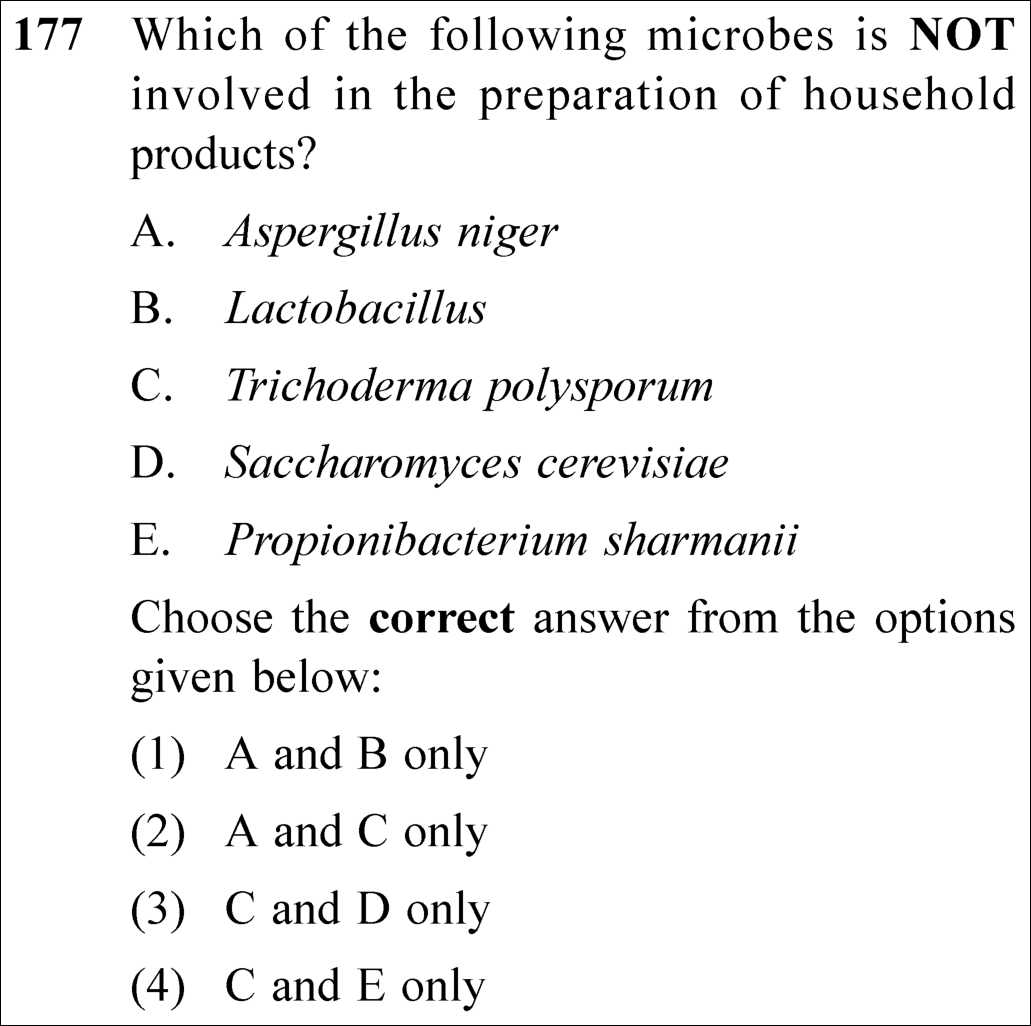
NEET 2025 · Q177 Easy
Official NEET 2025 Question 177 - Microbes in Human Welfare
1
2 ✓ Key
3
4
💡 Verified Solution & 30-Second Hack
✓
Verified Against NTA Final Answer Key
Option (2) : A and C only
📚 Microbes in Human Welfare Easy
📋 Given Parameters & Problem Setup
Candidates A. Aspergillus niger, B. Lactobacillus, C. Trichoderma polysporum, D. Saccharomyces cerevisiae, E. Propionibacterium sharmanii
Target Classification Microbes NOT involved in household products
⚡

The 30-Second Exam Hall Shortcut: ⚡ Household vs Industrial Microbes Fingerprint

⏱️ Save ~20 seconds

Household = Lactobacillus (curd, B), Saccharomyces (bread dough, D), Propionibacterium (Swiss cheese, E)! Industrial = Aspergillus niger (citric acid, A) & Trichoderma polysporum (cyclosporin A, C)! A and C only are NOT household!

1 Check NCERT Chapter 10 headings and sections:
2 - Section 10.1: Microbes in Household Products:
3 * Lactobacillus (LAB): Curd preparation (B). [Household]
4 * Saccharomyces cerevisiae: Dough for bread/idli (D). [Household]
5 * Propionibacterium sharmanii: Large holes in Swiss cheese (E). [Household]
6 - Section 10.2: Microbes in Industrial Products:
7 * Aspergillus niger (fungus): Industrial synthesis of Citric acid (A). [Industrial]
8 * Trichoderma polysporum (fungus): Production of Cyclosporin A (immunosuppressant drug) (C). [Industrial/Medical]
9 Microbes NOT involved in household products = A and C only (Option 2)!
10 Select Option (2)!
🛡️
Why You Can 100% Trust This Shortcut: Microbes in Household Food Processing (NCERT Biology · Microbes in Human Welfare: LAB curdling milk & Propionibacterium swiss cheese).
📐

Step-by-Step Rigorous Workflow & Mathematical Proof

Step 1

Microbes in Household Products (NCERT Section 10.1)

Microorganisms utilized daily in home kitchens and traditional dairy/culinary fermentations:

  • • B. *Lactobacillus* and other Lactic Acid Bacteria (LAB): Convert milk into curd by producing acids that coagulate and partially digest milk proteins, enriching nutritional value with vitamin B₁₂.
  • • D. *Saccharomyces cerevisiae* (Baker's yeast): Ferments dough used for making bread, releasing CO2\text{CO}_2 to give puffed-up appearance.
  • • E. *Propionibacterium sharmanii*: Bacterium used in the ripening of Swiss cheese; generates large amounts of CO2\text{CO}_2 creating characteristic large holes.
  • • Thus, B, D, and E are classical household microbes.
Step 2

Microbes in Industrial and Pharmaceutical Production (NCERT Section 10.2)

Microorganisms cultured in massive fermentors for commercial chemicals and pharmaceuticals:

  • • A. *Aspergillus niger*: A filamentous fungus used for the commercial, industrial-scale aerobic fermentation of citric acid.
  • • C. *Trichoderma polysporum*: An ascomycete fungus used in industrial biotechnology to biosynthesize Cyclosporin A, a vital bioactive peptide used as an immunosuppressive agent in organ-transplant patients.
  • • Neither *Aspergillus niger* nor *Trichoderma polysporum* is utilized in domestic household food preparation.
Step 3

Conclusion

The microbes NOT involved in the preparation of household products are A and C only, corresponding to Option (2).

Non-Household Microbes={A (Aspergillus),  C (Trichoderma)}\text{Non-Household Microbes} = \{A\text{ (Aspergillus)}, \; C\text{ (Trichoderma)}\}
⭐

360° Option Elimination Engine Key Feature

Diagnose every choice: Know exactly why the right option works and why distractors fail.

4-Option Deep Scan
1 A
✗ Incorrect
Verdict & Scientific Reason:

Incorrect. Lactobacillus (B) is the most famous household microbe (curd).

⚠️
Student Fallacy (Why candidates pick this trap): Thinking Lactobacillus is an industrial-only microbe.
2 B
✓ 100% Correct
Verdict & Scientific Reason:

100% correct. Accurately segregates industrial acid producer (A) and immunosuppressant drug fungus (C) from domestic food microbes.

💡
Why this is airtight: None; pristine knowledge of applied microbiology.
3 C
✗ Incorrect
Verdict & Scientific Reason:

Incorrect. Saccharomyces cerevisiae (D) is baker's yeast used in household bread.

⚠️
Student Fallacy (Why candidates pick this trap): Believing baker's yeast is not a household organism.
4 D
✗ Incorrect
Verdict & Scientific Reason:

Incorrect. Propionibacterium sharmanii (E) is used for Swiss cheese in household products.

⚠️
Student Fallacy (Why candidates pick this trap): Confusing cheese bacteria with industrial fermentation.
⚠️

NTA Trap Alert: NCERT Section 10.1 vs 10.2 Grouping

NCERT divides microbes by application: 10.1 Household (Curd, Bread, Toddy, Cheese). 10.2 Industrial (Beverages, Antibiotics, Chemicals like Citric acid, and Bioactive molecules like Cyclosporin A).

🛡️ How to avoid the -1 mark: Citric acid (Aspergillus) & Cyclosporin A (Trichoderma) = Industrial, NOT Household.
📖

Core NEET Syllabus Standard

NEET Biology Core Syllabus · Microbes in Human Welfare Standard Benchmark
Core Scientific Principle Tested:

"Lactobacillus, Saccharomyces, and Propionibacterium are used in household products; Aspergillus and Trichoderma are used industrially."

Syllabus Focus: Microbes in Household Products vs Industrial Products
✓ Core NEET UG Syllabus Anchor Syllabus & Academic Standards ↗
Home = Milk, Bread, Cheese (B, D, E); Factory = Acid & Drugs (A & C)!
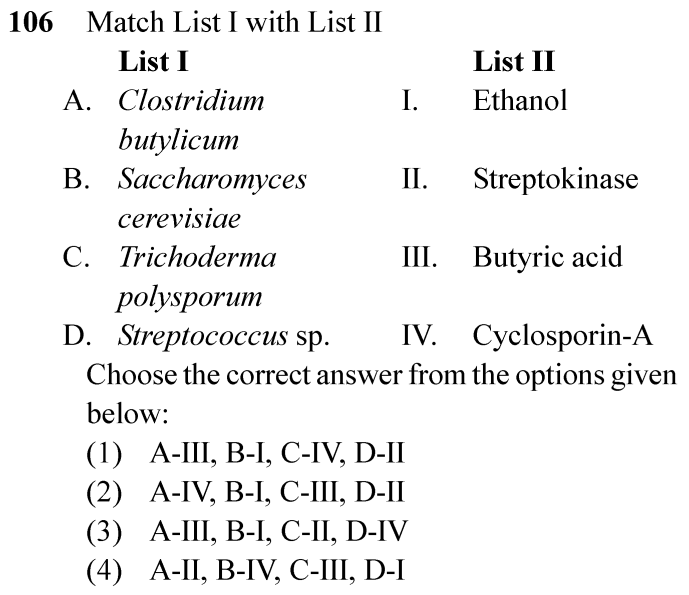
NEET 2024 · Q106 Easy
Official NEET 2024 Question 106 - Microbes in Human Welfare
1 ✓ Key
2
3
4
💡 Verified Solution & 30-Second Hack
✓
Verified Against NTA Final Answer Key
Option (1) : A-III, B-I, C-IV, D-II
📚 Microbes in Human Welfare Easy
📋 Given Parameters & Problem Setup
List I (Microorganisms) A: Clostridium butylicum; B: Saccharomyces cerevisiae; C: Trichoderma polysporum; D: Streptococcus
List II (Commercial Products) I: Ethanol; II: Streptokinase; III: Butyric acid; IV: Cyclosporin-A
⚡

The 30-Second Exam Hall Shortcut: ⚡ Instant Biological Match Trick

⏱️ Save ~30 seconds

Clostridium butylicum -> Butyric acid (III). Streptococcus -> Streptokinase (II). Direct two-point confirmation locks Option (1)!

1 A. Clostridium butylicum -> III. Butyric acid (name gives it away!).
2 B. Saccharomyces cerevisiae -> I. Ethanol (Brewer’s yeast).
3 C. Trichoderma polysporum -> IV. Cyclosporin-A (immunosuppressive agent).
4 D. Streptococcus -> II. Streptokinase ("clot buster").
5 Matching order: A-III, B-I, C-IV, D-II -> Option (1) / A.
🛡️
Why You Can 100% Trust This Shortcut: NCERT Biology · Microbes in Human Welfare (Microbes in Industrial Products)
📐

Step-by-Step Rigorous Workflow & Mathematical Proof

Step 1

Match Industrial Fermentation Products

Clostridium butylicum is a bacterium that ferments substrates to produce butyric acid (A -> III). Saccharomyces cerevisiae (Brewer’s yeast) ferments malted cereals and fruit juices to produce ethanol (B -> I).

Step 2

Match Bioactive Molecules and Enzymes

Trichoderma polysporum (fungus) produces Cyclosporin-A, an immunosuppressive agent used in organ-transplant patients (C -> IV). Streptococcus produces streptokinase, modified by genetic engineering and used as a "clot buster" to remove clots from blood vessels of patients suffering from myocardial infarction (D -> II).

Step 3

Assemble Combination

The unique valid combination is A-III, B-I, C-IV, D-II, corresponding to Option (1).

⭐

360° Option Elimination Engine Key Feature

Diagnose every choice: Know exactly why the right option works and why distractors fail.

4-Option Deep Scan
1 (1)
✓ 100% Correct
Verdict & Scientific Reason:

Accurately pairs all four microbes with their corresponding commercial or medicinal products.

💡
Why this is airtight: None.
2 (2)
✗ Incorrect
Verdict & Scientific Reason:

Mismatches Clostridium with Streptokinase and Saccharomyces with Cyclosporin-A.

⚠️
Student Fallacy (Why candidates pick this trap): Mismatches Clostridium with Streptokinase and Saccharomyces with Cyclosporin-A.
3 (3)
✗ Incorrect
Verdict & Scientific Reason:

Mismatches Clostridium with Cyclosporin-A and Trichoderma with Butyric acid.

⚠️
Student Fallacy (Why candidates pick this trap): Mismatches Clostridium with Cyclosporin-A and Trichoderma with Butyric acid.
4 (4)
✗ Incorrect
Verdict & Scientific Reason:

Mismatches Saccharomyces with Cyclosporin-A and Streptococcus with Ethanol.

⚠️
Student Fallacy (Why candidates pick this trap): Mismatches Saccharomyces with Cyclosporin-A and Streptococcus with Ethanol.
⚠️

NTA Trap Alert: Cyclosporin-A vs Statins Producer

Confusing Trichoderma polysporum (Cyclosporin-A) with Monascus purpureus (Statins).

🛡️ How to avoid the -1 mark: Remember: Trichoderma = Cyclosporin-A; Monascus = Statin.
📖

Core NEET Syllabus Standard

Biology Core Botany · Microbes in Human Welfare Standard Benchmark
Core Scientific Principle Tested:

"Examples of acid producers are Aspergillus niger of citric acid, Acetobacter aceti of acetic acid; Clostridium butylicum of butyric acid. Trichoderma polysporum produces cyclosporin A and Streptococcus produces streptokinase."

Syllabus Focus: Microbial Production of Organic Acids, Ethanol, and Bioactive Molecules
✓ Core NEET UG Syllabus Anchor Syllabus & Academic Standards ↗
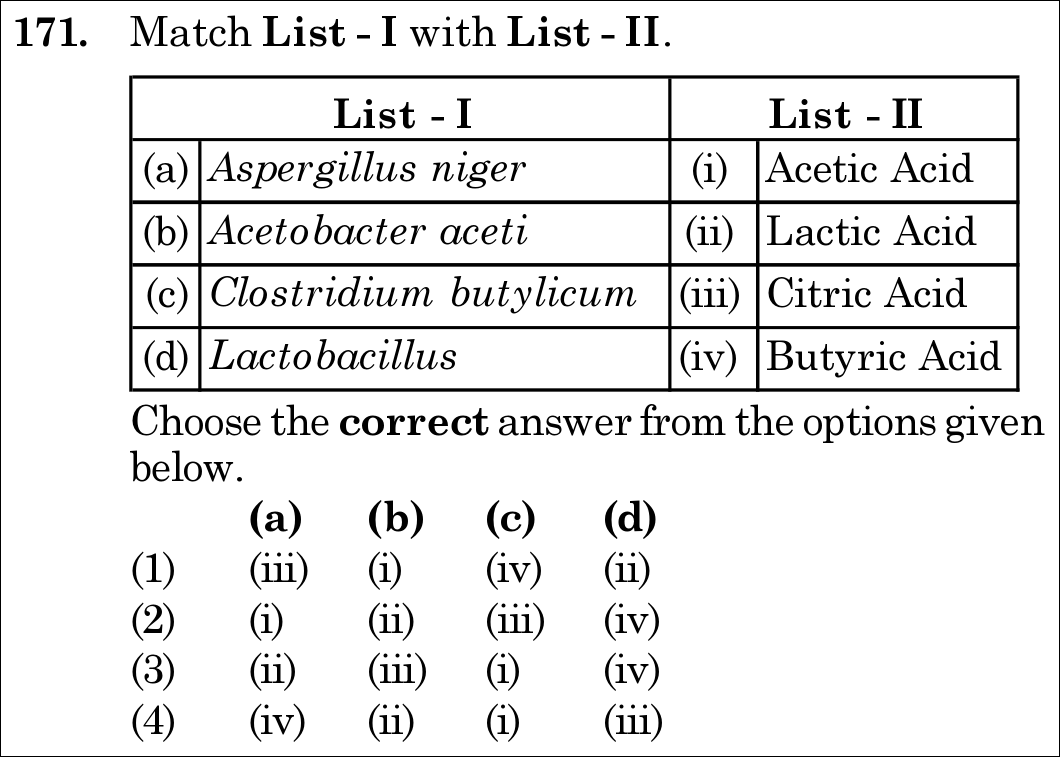
NEET 2021 · Q171 Easy
Official NEET 2021 Question 171 - Microbes in Human Welfare
1 (iii) (i) (iv) (ii) ✓ Key
2 (i) (ii) (iii) (iv)
3 (ii) (iii) (i) (iv)
4 (iv) (ii) (i) (iii)
💡 Verified Solution & 30-Second Hack
✓
Verified Against NTA Final Answer Key
Option (1) : (a)-(iii), (b)-(i), (c)-(iv), (d)-(ii)
📚 Microbes in Human Welfare Easy
📋 Given Parameters & Problem Setup
List I (Microorganisms) (a) Aspergillus niger, (b) Acetobacter aceti, (c) Clostridium butylicum, (d) Lactobacillus
List II (Organic Acids) (i) Acetic Acid, (ii) Lactic Acid, (iii) Citric Acid, (iv) Butyric Acid
⚡

The 30-Second Exam Hall Shortcut: ⚡ "Match Root Names: Acetobacter → Acetic, Clostridium butylicum → Butyric"

⏱️ Save ~25 seconds

The organism names directly reveal their acids: Acetobacter aceti -> Acetic acid ((b)-(i)), Clostridium butylicum -> Butyric acid ((c)-(iv)), and Aspergillus niger -> Citric acid ((a)-(iii)). Looking at options, only Option (1) matches!

1 Match by name: Acetobacter aceti -> Acetic acid ((b) -> (i)).
2 Match by name: Clostridium butylicum -> Butyric acid ((c) -> (iv)).
3 Match Lactobacillus -> Lactic acid ((d) -> (ii)).
4 Match Aspergillus niger (fungus) -> Citric acid ((a) -> (iii)).
5 Match pattern (iii), (i), (iv), (ii) -> Option (1).
🛡️
Why You Can 100% Trust This Shortcut: NCERT Biology · Microbes in Human Welfare (Chemicals, Enzymes and other Bioactive Molecules: Aspergillus niger (a fungus) of citric acid, Acetobacter aceti (a bacterium) of acetic acid, Clostridium butylicum (a bacterium) of butyric acid and Lactobacillus (a bacterium) of lactic acid).
📐

Step-by-Step Rigorous Workflow & Mathematical Proof

Step 1

Microbial Organic Acid Producers in Industrial Biotechnology

Microbes are utilized commercially for the aerobic and anaerobic fermentation of organic acids: - (a) *Aspergillus niger*: A filamentous ascomycete fungus; primary industrial producer of Citric Acid (used as an acidifier and preservative in food/beverages). - (b) *Acetobacter aceti*: An obligate aerobic bacterium; oxidizes ethanol into Acetic Acid (vinegar). - (c) *Clostridium butylicum*: An obligate anaerobic endospore-forming bacterium; ferments carbohydrates to produce Butyric Acid. - (d) *Lactobacillus*: Lactic acid bacteria (LAB); converts lactose/glucose into Lactic Acid.

Aspergillus niger⟶Citric Acid[(a)→(iii)]Acetobacter aceti⟶Acetic Acid[(b)→(i)]Clostridium butylicum⟶Butyric Acid[(c)→(iv)]Lactobacillus⟶Lactic Acid[(d)→(ii)]\begin{aligned} \textit{Aspergillus niger} &\longrightarrow \textbf{Citric Acid} \quad [\text{(a)} \to \text{(iii)}] \\ \textit{Acetobacter aceti} &\longrightarrow \textbf{Acetic Acid} \quad [\text{(b)} \to \text{(i)}] \\ \textit{Clostridium butylicum} &\longrightarrow \textbf{Butyric Acid} \quad [\text{(c)} \to \text{(iv)}] \\ \textit{Lactobacillus} &\longrightarrow \textbf{Lactic Acid} \quad [\text{(d)} \to \text{(ii)}] \end{aligned}
Step 2

Option Alignment

The combined match is (a)-(iii), (b)-(i), (c)-(iv), (d)-(ii). This corresponds precisely to Option (1).

⭐

360° Option Elimination Engine Key Feature

Diagnose every choice: Know exactly why the right option works and why distractors fail.

4-Option Deep Scan
1 1
✓ 100% Correct
Verdict & Scientific Reason:

Correct. Perfectly aligns every microbe with its corresponding organic acid product.

💡
Why this is airtight: None. Candidate recognizes the classical microbial fermentation pairs.
2 2
✗ Incorrect
Verdict & Scientific Reason:

Incorrect. Assigns acetic acid to Aspergillus niger and lactic acid to Acetobacter aceti.

⚠️
Student Fallacy (Why candidates pick this trap): Reading list entries sequentially without matching.
3 3
✗ Incorrect
Verdict & Scientific Reason:

Incorrect. Misattributes lactic acid to Aspergillus and citric acid to Acetobacter.

⚠️
Student Fallacy (Why candidates pick this trap): Confusing fungal citric acid production with bacterial lactic fermentation.
4 4
✗ Incorrect
Verdict & Scientific Reason:

Incorrect. Links Aspergillus niger to butyric acid.

⚠️
Student Fallacy (Why candidates pick this trap): Complete confusion of microbial taxonomy.
⚠️

NTA Trap Alert: Fungus vs Bacterium Identity Trap

Aspergillus niger is the sole fungus in this list, producing citric acid. Candidates sometimes confuse Aspergillus with bacteria and match it with butyric acid.

🛡️ How to avoid the -1 mark: Remember: Aspergillus niger = Citric acid fungus; the other three are bacteria with names reflecting their products (aceti = acetic, butylicum = butyric, lacto = lactic).
📖

Core NEET Syllabus Standard

NEET / NCERT Biology · Microbes in Human Welfare Standard Benchmark
Core Scientific Principle Tested:

"Aspergillus niger produces citric acid; Acetobacter aceti produces acetic acid; Clostridium butylicum produces butyric acid; Lactobacillus produces lactic acid."

Syllabus Focus: Chemicals, Enzymes and other Bioactive Molecules
✓ Core NEET UG Syllabus Anchor Syllabus & Academic Standards ↗
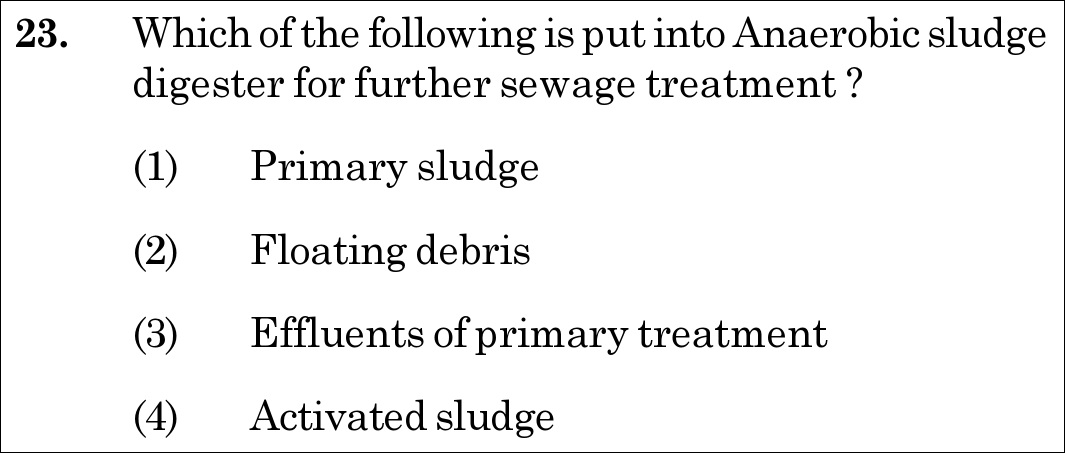
NEET 2020 · Q23 Easy
Official NEET 2020 Question 23 - Microbes in Human Welfare
1 Primary sludge
2 Floating debris
3 Effluents of primary treatment
4 Activated sludge ✓ Key
💡 Verified Solution & 30-Second Hack
✓
Verified Against NTA Final Answer Key
Option (4) : Activated sludge
📚 Microbes in Human Welfare Easy
📋 Given Parameters & Problem Setup
Treatment Unit Anaerobic Sludge Digester
Process Secondary (Biological) Sewage Treatment
Question Objective Identify which sludge fraction is transferred into anaerobic digesters
⚡

The 30-Second Exam Hall Shortcut: ⚡ "Settling Tank Sediment = Activated Sludge → Pumped to Anaerobic Digesters!"

⏱️ Save ~20 seconds

In secondary sewage treatment, microbial flocs settle in the settling tank to form ACTIVATED SLUDGE. A small part is recycled as inoculum into the aeration tank, while the major remaining part is pumped into ANAEROBIC SLUDGE DIGESTERS to produce biogas! Mark Activated sludge (Option 4).

1 Trace sewage treatment sequence: - Primary treatment: Physical settling of floating debris & primary sludge. - Secondary (biological) treatment: Aeration tank with flocs reducing BOD →\to Settling tank where flocs sediment to form Activated Sludge.
2 Trace fate of Activated Sludge: - Small fraction →\to Inoculum for aeration tank. - Major remaining fraction →\to Pumped into Anaerobic Sludge Digesters.
3 Select Option (4): Activated sludge.
🛡️
Why You Can 100% Trust This Shortcut: NCERT Biology · Microbes in Human Welfare (Sewage Treatment: Once the BOD of sewage or waste water is reduced, the effluent is passed into a settling tank where bacterial flocs sediment. This sediment is called activated sludge. A small part is pumped back into aeration tank; remaining major part of sludge is pumped into large tanks called anaerobic sludge digesters).
📐

Step-by-Step Rigorous Workflow & Mathematical Proof

Step 1

Secondary (Biological) Sewage Treatment Flowsheet

Municipal wastewater undergoes sequential stages of purification: 1. Primary Treatment: Physical removal of large and small particles via sequential filtration (floating debris) and sedimentation (settled solids form primary sludge). 2. Aeration Tank (Secondary Treatment): Effluent from primary settling is vigorously agitated in aeration tanks where aerobic microbes form flocs (masses of bacteria associated with fungal filaments), dramatically consuming dissolved organic matter and slashing the Biochemical Oxygen Demand (BOD). 3. Settling Tank & Activated Sludge: Once BOD is sharply lowered, the effluent flows into a settling tank where the microbial flocs settle under gravity to form activated sludge. 4. Anaerobic Digestion: A minor aliquot of activated sludge is recycled back into the aeration tank as inoculum. The major bulk of activated sludge is pumped into large anaerobic sludge digesters.

Settling Tank Sediment  ⟹  Activated Sludge→Major PortionAnaerobic Sludge Digesters→MethanogensBiogas (CH4+CO2+H2S)\text{Settling Tank Sediment} \implies \mathbf{Activated\,Sludge} \xrightarrow{\text{Major Portion}} \mathbf{Anaerobic\,Sludge\,Digesters} \xrightarrow{\text{Methanogens}} \text{Biogas } (CH_4 + CO_2 + H_2S)
Step 2

Anaerobic Digestion and Biogas Generation

In the anaerobic digester, obligate and facultative anaerobic bacteria (including methanogens like *Methanobacterium*) digest the bacterial and fungal biomass of the activated sludge. This anaerobic decomposition generates a flammable gas mixture (biogas consisting predominantly of methane, carbon dioxide, and hydrogen sulphide).

⭐

360° Option Elimination Engine Key Feature

Diagnose every choice: Know exactly why the right option works and why distractors fail.

4-Option Deep Scan
1 A
✗ Incorrect
Verdict & Scientific Reason:

Incorrect. Primary sludge comprises raw settled solids from primary physical treatment, not the biological sediment fed to anaerobic digesters.

⚠️
Student Fallacy (Why candidates pick this trap): Confusing primary physical sludge with secondary biological activated sludge.
2 B
✗ Incorrect
Verdict & Scientific Reason:

Incorrect. Floating debris is removed by sequential filtration during the very first step of primary treatment.

⚠️
Student Fallacy (Why candidates pick this trap): Ignoring physical screening.
3 C
✗ Incorrect
Verdict & Scientific Reason:

Incorrect. Primary effluent is passed into the aeration tank for aerobic digestion, not anaerobic digesters.

⚠️
Student Fallacy (Why candidates pick this trap): Confusing the aeration tank feed with the digester feed.
4 D
✓ 100% Correct
Verdict & Scientific Reason:

Correct. Activated sludge sedimented in settling tanks is pumped into anaerobic sludge digesters for methane fermentation.

💡
Why this is airtight: None. Direct recall of wastewater treatment steps.
⚠️

NTA Trap Alert: Primary Sludge vs Activated Sludge Digestion Trap

Primary sludge is non-biological raw grit/settled solids. Activated sludge is the biomass-rich aerobic floc sediment formed after secondary treatment, which is specifically transferred to anaerobic digesters for biogas production.

🛡️ How to avoid the -1 mark: Remember: Flocs settle into Activated Sludge →\to Pumped into Anaerobic Digesters.
📖

Core NEET Syllabus Standard

NEET / NCERT Biology · Microbes in Human Welfare Standard Benchmark
Core Scientific Principle Tested:

"Activated sludge from secondary settling tanks is pumped into anaerobic sludge digesters for further treatment."

Syllabus Focus: Sewage Treatment
✓ Core NEET UG Syllabus Anchor Syllabus & Academic Standards ↗
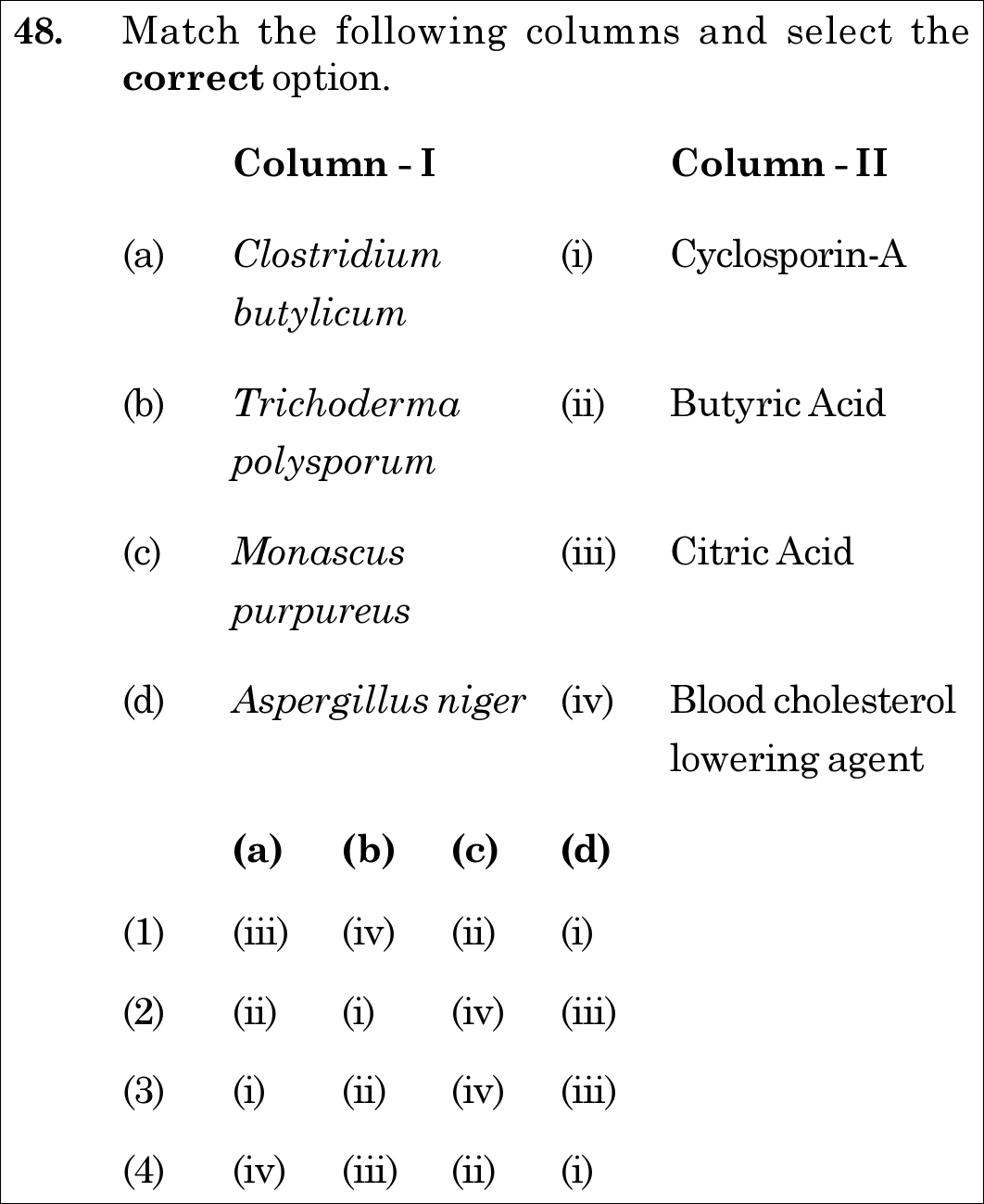
NEET 2020 · Q48 Easy
Official NEET 2020 Question 48 - Microbes in Human Welfare
1 (iii) (iv) (ii) (i)
2 (ii) (i) (iv) (iii) ✓ Key
3 (i) (ii) (iv) (iii)
4 (iv) (iii) (ii) (i)
💡 Verified Solution & 30-Second Hack
✓
Verified Against NTA Final Answer Key
Option (2) : (a)-(ii), (b)-(i), (c)-(iv), (d)-(iii)
📚 Microbes in Human Welfare Easy
📋 Given Parameters & Problem Setup
Column I (Microbes) (a) Clostridium butylicum, (b) Trichoderma polysporum, (c) Monascus purpureus, (d) Aspergillus niger
Column II (Products) (i) Cyclosporin-A, (ii) Butyric Acid, (iii) Citric Acid, (iv) Blood cholesterol lowering agent
⚡

The 30-Second Exam Hall Shortcut: ⚡ "Clostridium = Butyric; Trichoderma = Cyclosporin-A; Monascus = Statin"

⏱️ 30 seconds

Clostridium butylicum produces Butyric acid (a->ii). Trichoderma polysporum yields immunosuppressive Cyclosporin-A (b->i). Monascus purpureus yeast yields statins (blood cholesterol lowering agent, c->iv). Aspergillus niger produces Citric acid (d->iii). Match gives Option (2) in 10 seconds!

1 Clostridium butylicum -> (ii) Butyric acid.
2 Trichoderma polysporum -> (i) Cyclosporin-A.
3 Monascus purpureus -> (iv) Blood cholesterol lowering agent (statins).
4 Aspergillus niger -> (iii) Citric acid.
5 Mapping: (a)-(ii), (b)-(i), (c)-(iv), (d)-(iii) -> Option 2.
🛡️
Why You Can 100% Trust This Shortcut: NCERT Biology · Microbes in Human Welfare (Microbes in Industrial Products)
📐

Step-by-Step Rigorous Workflow & Mathematical Proof

Step 1

Match Clostridium butylicum

Clostridium butylicum is a bacterium that produces butyric acid (organic acid) industrially. Thus, (a) matches (ii).

Step 2

Match Trichoderma polysporum

Trichoderma polysporum is a fungus that produces Cyclosporin A, an important bioactive molecule used as an immunosuppressive agent in organ-transplant patients. Thus, (b) matches (i).

Step 3

Match Monascus purpureus

Monascus purpureus is a yeast that produces statins, which act as competitive inhibitors of HMG-CoA reductase to lower blood cholesterol levels. Thus, (c) matches (iv).

Step 4

Match Aspergillus niger

Aspergillus niger is a fungus that produces citric acid industrially. Thus, (d) matches (iii).

⭐

360° Option Elimination Engine Key Feature

Diagnose every choice: Know exactly why the right option works and why distractors fail.

4-Option Deep Scan
1 A
✗ Incorrect
Verdict & Scientific Reason:

Incorrect; mispairs Clostridium with citric acid and Trichoderma with statins.

⚠️
Student Fallacy (Why candidates pick this trap): Swapping industrial microbes and their products.
2 B
✓ 100% Correct
Verdict & Scientific Reason:

Accurate pairing across all four industrial microbial products.

💡
Why this is airtight: None; canonical industrial microbiology pairing.
3 C
✗ Incorrect
Verdict & Scientific Reason:

Incorrect; Clostridium butylicum produces butyric acid, not Cyclosporin-A.

⚠️
Student Fallacy (Why candidates pick this trap): Flipping Clostridium and Trichoderma.
4 D
✗ Incorrect
Verdict & Scientific Reason:

Incorrect; completely jumbled assignments.

⚠️
Student Fallacy (Why candidates pick this trap): Guessing without verifying organic acid and bioactive molecule matching.
⚠️

NTA Trap Alert: Bioactive Molecules vs Organic Acids

Trichoderma polysporum = Cyclosporin A (immunosuppressant). Monascus purpureus = Statins (cholesterol lowering). Clostridium butylicum = Butyric acid.

🛡️ How to avoid the -1 mark: Clostridium "butylicum" has "butyric" right in its scientific name!
📖

Core NEET Syllabus Standard

Zoology · Microbes in Human Welfare Standard Benchmark
Core Scientific Principle Tested:

""

Syllabus Focus: Industrial Microbes and Their Bioactive / Organic Acid Products
✓ Core NEET UG Syllabus Anchor Syllabus & Academic Standards ↗

Solve 4 NEET Questions a Day — One per Subject

Cover all 1,140 official NEET questions in 285 days at your own pace. Progress is saved on your device. No login needed.