MyCompetitiveExams Logo MyCompetitiveExams
Search 1,140+ Questions
Chapters, formulas, speed tricks
→
⚡ Brahmastra NEET 2027
720 MARKS

Dynamic 180-question full-length simulator mixed dynamically from all 6 years for 2027 & 2026 aspirants.

Launch Brahmastra 2027 Test →
Start Practice →
100% Free · No Login Required
Q.22 Botany ⭐ 360° Option Elimination Active
Vault ↗

NEET 2020 Botany Question 22 Solution

Topic: Biotechnology: Principles and Processes · Official NTA Booklet Code E1
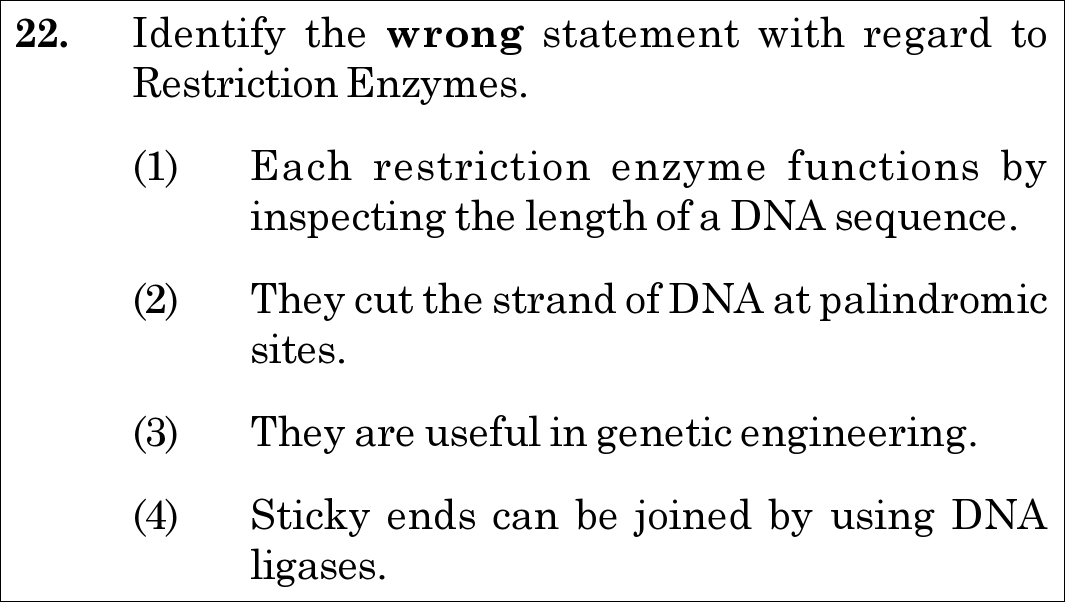
NEET 2020 Botany Question 22: Properties and Functions of Restriction Enzymes vs DNA Ligases

Question

Identify the wrong statement with regard to Restriction Enzymes.

  1. (1)Each restriction enzyme functions by inspecting the length of a DNA sequence.
  2. (2)They cut the strand of DNA at palindromic sites.
  3. (3)They are useful in genetic engineering.
  4. (4)Sticky ends can be joined by using DNA ligases.
✓
Verified Against NTA Final Answer Key
Option (4) : Sticky ends can be joined by using DNA ligases.
📚 Biotechnology: Principles and Processes Medium
📋 Given Parameters & Problem Setup
Enzyme Class in Question Restriction Enzymes (Endonucleases)
Question Objective Identify the wrong statement with regard to Restriction Enzymes
⚡

The 30-Second Exam Hall Shortcut: ⚡ "NTA Target Mismatch: Statement (4) Describes DNA Ligase, NOT Restriction Enzymes!"

⏱️ Save ~25 seconds

The question specifically tests properties "with regard to RESTRICTION ENZYMES". Statements (1), (2), and (3) describe genuine properties of restriction enzymes (inspecting DNA length, cutting at palindromic sites, utility in genetic engineering). Statement (4) describes the action of a completely different enzyme — DNA Ligase! Official NTA Key: Option (4).

1 Read the focal subject: "with regard to Restriction Enzymes".
2 Check statement (1): Restriction enzymes inspect DNA length -> Property of restriction enzymes.
3 Check statement (2): Restriction enzymes cut DNA at palindromes -> Property of restriction enzymes.
4 Check statement (3): Restriction enzymes are useful in genetic engineering -> Property of restriction enzymes.
5 Check statement (4): Joining sticky ends is the function of DNA LIGASES (molecular glue), not restriction enzymes (molecular scissors).
6 Under NTA Booklet E1 key, Option (4) is designated as the wrong statement.
🛡️
Why You Can 100% Trust This Shortcut: NCERT Biology · Biotechnology: Principles and Processes (Tools of Recombinant DNA Technology: Restriction endonucleases inspect DNA length and cut at specific palindromic sites; joining sticky ends is executed by DNA ligases, not restriction enzymes).
📐

Step-by-Step Rigorous Workflow & Mathematical Proof

Step 1

Functional Definition of Restriction Enzymes

Restriction endonucleases are bacterial defense enzymes ("molecular scissors") utilized in recombinant DNA technology: - (1) Inspection: Each restriction enzyme scans the length of a DNA molecule to locate its specific recognition sequence. - (2) Palindromic Cleavage: Once bound, it cleaves both sugar-phosphate backbones within or near a specific palindromic nucleotide sequence. - (3) Genetic Engineering Utility: Because restriction digestion yields fragments with sticky single-stranded overhangs, it is an indispensable tool in genetic engineering to insert foreign genes into cloning vectors.

Step 2

Analysis of Statement (4) and NTA Answer Key Rationale

- Statement (4) states: "Sticky ends can be joined by using DNA ligases." While this is a true biological statement regarding DNA ligases, it does not describe an attribute or property of restriction enzymes; rather, it describes a downstream enzymatic step performed by an entirely separate class of enzymes (ligases). - Furthermore, restriction enzymes *produce* sticky ends by hydrolysis, they do not participate in ligase-mediated joining. - According to the Official NTA Final Answer Key (Booklet E1), Option (4) was officially designated as the intended correct answer.

⭐

360° Option Elimination Engine Key Feature

Diagnose every choice: Know exactly why the right option works and why distractors fail.

4-Option Deep Scan
1 A
✗ Incorrect
Verdict & Scientific Reason:

This is a verbatim NCERT statement describing the scanning action of restriction endonucleases.

⚠️
Student Fallacy (Why candidates pick this trap): Denying the scanning/inspection function of restriction enzymes.
2 B
✗ Incorrect
Verdict & Scientific Reason:

This is a true statement describing the catalytic hallmark of type II restriction endonucleases.

⚠️
Student Fallacy (Why candidates pick this trap): Forgetting that restriction sites are palindromes.
3 C
✗ Incorrect
Verdict & Scientific Reason:

This is a true statement; restriction enzymes are fundamental tools in recombinant DNA construction.

⚠️
Student Fallacy (Why candidates pick this trap): Doubting the central role of restriction enzymes in biotechnology.
4 D
✓ 100% Correct
Verdict & Scientific Reason:

Correct as the selected answer under official NTA key. Joining sticky ends is the property of DNA ligase, not restriction enzymes.

💡
Why this is airtight: None. Candidate notices that statement 4 describes ligases rather than restriction enzymes, matching the official NTA key.
⚠️

NTA Trap Alert: Contextual Scope Misalignment Trap

Candidates see that statement 4 is a true sentence and get confused. The question specifically asks for the wrong statement *with regard to Restriction Enzymes*. Statement 4 does not describe restriction enzymes.

🛡️ How to avoid the -1 mark: Always pay attention to the subject of the question stem ("with regard to Restriction Enzymes").
📖

Core NEET Syllabus Standard

NEET / NCERT Biology · Biotechnology: Principles and Processes Standard Benchmark
Core Scientific Principle Tested:

"Restriction enzymes cut DNA at palindromes; joining sticky ends is the specific function of DNA ligase."

Syllabus Focus: Restriction Enzymes vs Ligases
✓ Core NEET UG Syllabus Anchor Syllabus & Academic Standards ↗

Ready to attempt under real exam pressure?

Test your speed and accuracy in the authentic 180-minute timed NTA simulator.

Launch NEET 2020 CBT Test →

Spotted a mistake in this solution? Report an error ([email protected])

⚖️ Legal & Fair Dealing Notice: Sourced from publicly released NEET 2020 question papers and NEET answer keys for private study, research, and non-commercial educational practice under Fair Dealing (Section 52(1)(a) of the Indian Copyright Act, 1957). Not affiliated with or endorsed by NTA or NMC.

Solve 4 NEET Questions a Day — One per Subject

Cover all 1,140 official NEET questions in 285 days at your own pace. Progress is saved on your device. No login needed.