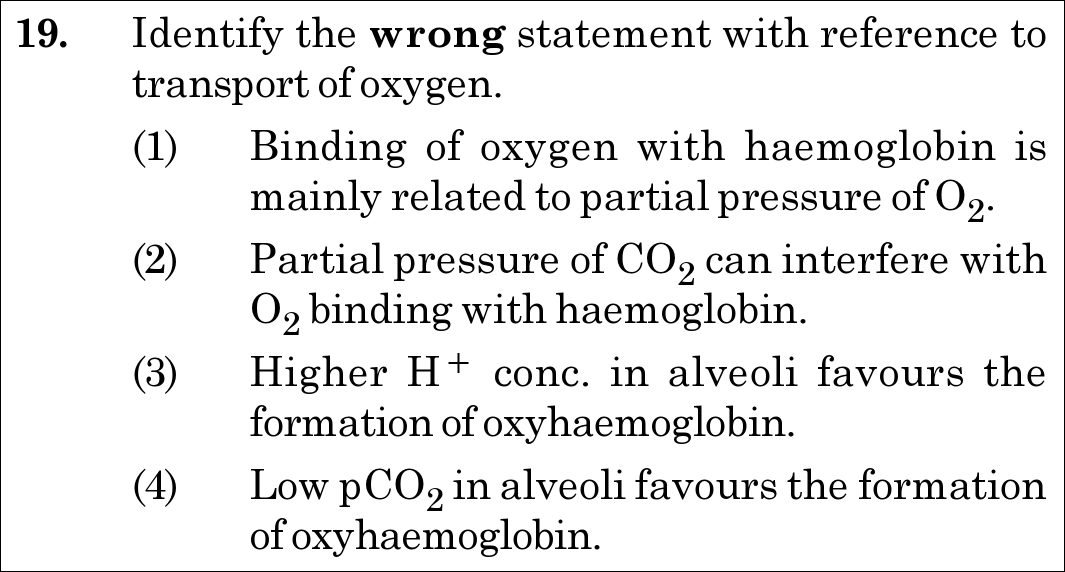
At the alveoli, loading oxygen requires high pO₂, low pCO₂, LESS H⁺ concentration (alkaline pH), and lower temperature. Higher H⁺ (acidity) shifts the curve to the RIGHT and promotes DISSOCIATION (Bohr effect). Statement (3) claims higher H⁺ favours formation — which is completely WRONG! Select Option (3).
1 Recall alveolar conditions for oxyhaemoglobin formation: High pO2, low pCO2, LESS H+ conc. (high pH), and lower temperature. 2 Recall Bohr effect: Elevated [H+] (acidity) weakens oxygen binding and causes O₂ dissociation in tissues. 3 Analyze Statement (3): Claims "Higher H+ conc. in alveoli favours the formation" -> Blatantly false!
4 Option (3) is the wrong statement and therefore the correct answer.
🛡️ Why You Can 100% Trust This Shortcut: NCERT Biology · Breathing and Exchange of Gases (Transport of Gases: In the alveoli, where there is high pO2, low pCO2, lesser H+ concentration and lower temperature, the factors are all favourable for the formation of oxyhaemoglobin, whereas in the tissues, low pO2, high pCO2, high H+ concentration and higher temperature exist, the conditions are favourable for dissociation of oxygen from the oxyhaemoglobin).