MyCompetitiveExams Logo MyCompetitiveExams
Search 1,140+ Questions
Chapters, formulas, speed tricks
→
⚡ Brahmastra NEET 2027
720 MARKS

Dynamic 180-question full-length simulator mixed dynamically from all 6 years for 2027 & 2026 aspirants.

Launch Brahmastra 2027 Test →
Start Practice →
100% Free · No Login Required
🌿 Botany 📌 Standard Frequency (~1–2 Qs/Year)

NEET Transport in Plants Previous Year Questions with Solutions

Complete repository of official NTA NEET questions for Transport in Plants from 2020 to 2026. Every question includes 30-second elimination tricks, step-by-step NCERT solutions, option-by-option traps, and official answer keys.

5 Questions 3 Exam Years (2023, 2021, 2020) 5 Easy · 0 Medium · 0 Challenging
NEET 2023 · Q122 Easy
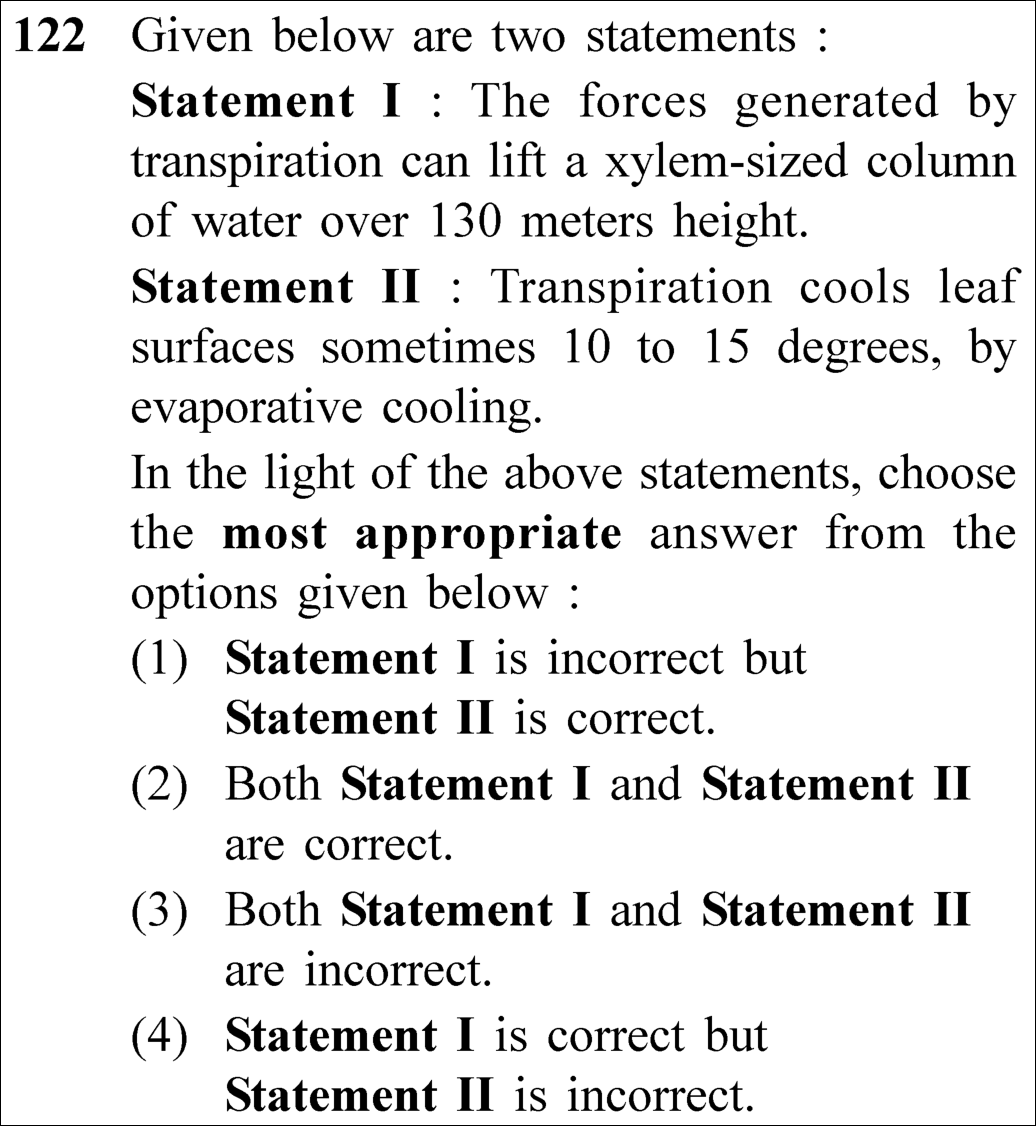
Official NEET 2023 Question 122 - Transport in Plants
1 Statement I is incorrect but Statement II is correct.
2 Both Statement I and Statement II are correct. ✓ Key
3 Both Statement I and Statement II are incorrect.
4 Statement I is correct but Statement II is incorrect.
💡 Verified Solution & 30-Second Hack
✓
Verified Against NTA Final Answer Key
Option (2) : Both Statement I and Statement II are correct.
📚 Transport in Plants Easy
📋 Given Parameters & Problem Setup
Statement I Forces generated by transpiration can lift xylem-sized column over 130 meters height.
Statement II Transpiration cools leaf surfaces sometimes 10 to 15 degrees by evaporative cooling.
⚡

The 30-Second Exam Hall Shortcut: ⚡ NCERT Transpiration Numbers: 130 meters & 10–15 °C

⏱️ Save ~20 seconds

Both statements are verbatim sentences from NCERT Transport in Plants! Transpiration pull can generate over 130 m lift and evaporative cooling reduces leaf temperatures by 10 to 15 °C. Both statements are correct!

1 Check Statement I: Transpiration pull can lift water column over 130 meters -> Verbatim NCERT, Correct.
2 Check Statement II: Evaporative cooling cools leaves 10 to 15 degrees Celsius -> Verbatim NCERT, Correct.
3 Both statements are factually true.
4 Match Option (2) Both Statement I and Statement II are correct.
🛡️
Why You Can 100% Trust This Shortcut: Canonical NCERT Plant Physiology water relations quantitative values.
📐

Step-by-Step Rigorous Workflow & Mathematical Proof

Step 1

Evaluation of Statement I (Transpiration Pull Magnitude)

The cohesion-tension-transpiration pull model explains the ascent of sap through tall trees. Transpiration generates negative suction pressures in xylem conduits up to −2 MPa-2\text{ MPa} to −3 MPa-3\text{ MPa}:

Transpiration Suction Force  ⟹  Lifts water column >130 metres high\text{Transpiration Suction Force} \implies \text{Lifts water column } > \mathbf{130\text{ metres high}}
Step 2

Evaluation of Statement II (Evaporative Cooling Effect)

Water has a high latent heat of vaporization ( 2.44 kJ/g~2.44\text{ kJ/g}). As water evaporates through open stomata into the atmosphere, it dissipates excess thermal energy from insolation:

Evaporative Cooling  ⟹  Cools leaf surfaces by 10 to 15∘C\text{Evaporative Cooling} \implies \text{Cools leaf surfaces by } \mathbf{10\text{ to } 15^\circ\text{C}}
Step 3

Verbatim NCERT Confirmation

NCERT Transport in Plants states under "Transpiration and Photosynthesis - a Compromise": - "Measurements reveal that the forces generated by transpiration can create pressures sufficient to lift a xylem sized column of water over 130 metres high." - "It cools leaf surfaces, sometimes 10 to 15 degrees, by evaporative cooling." Both statements are fully correct.

⭐

360° Option Elimination Engine Key Feature

Diagnose every choice: Know exactly why the right option works and why distractors fail.

4-Option Deep Scan
1 1
✗ Incorrect
Verdict & Scientific Reason:

Statement I is factually correct: transpiration pull exceeds 130 meters.

⚠️
Student Fallacy (Why candidates pick this trap): Doubting that capillary/cohesion forces can achieve a 130-meter column lift.
2 2
✓ 100% Correct
Verdict & Scientific Reason:

Both statements are verbatim excerpts from NCERT Biology.

💡
Why this is airtight: None; exact textbook recall.
3 3
✗ Incorrect
Verdict & Scientific Reason:

Both statements are true physiological facts.

⚠️
Student Fallacy (Why candidates pick this trap): Assuming physiological numerical values in NEET are intentionally fabricated.
4 4
✗ Incorrect
Verdict & Scientific Reason:

Statement II is factually correct: cooling magnitude is 10 to 15 degrees Celsius.

⚠️
Student Fallacy (Why candidates pick this trap): Believing that 10 to 15 degrees cooling is physiologically too large.
⚠️

NTA Trap Alert: Numerical Skepticism Trap

Students frequently mistrust specific numerical data in statements (130 meters, 10 to 15 degrees), suspecting a deceptive modification.

🛡️ How to avoid the -1 mark: Memorize canonical NCERT constants: Transpiration pull = 130 meters; Leaf cooling = 10 to 15 °C.
📖

Core NEET Syllabus Standard

NCERT Biology · Transport in Plants Standard Benchmark
Core Scientific Principle Tested:

"Forces generated by transpiration can lift a xylem-sized column of water over 130 metres high, and evaporative cooling cools leaf surfaces 10 to 15 degrees."
Syllabus Focus: Transpiration - A Compromise
✓ Core NEET UG Syllabus Anchor Syllabus & Academic Standards ↗
NEET 2023 · Q123 Easy
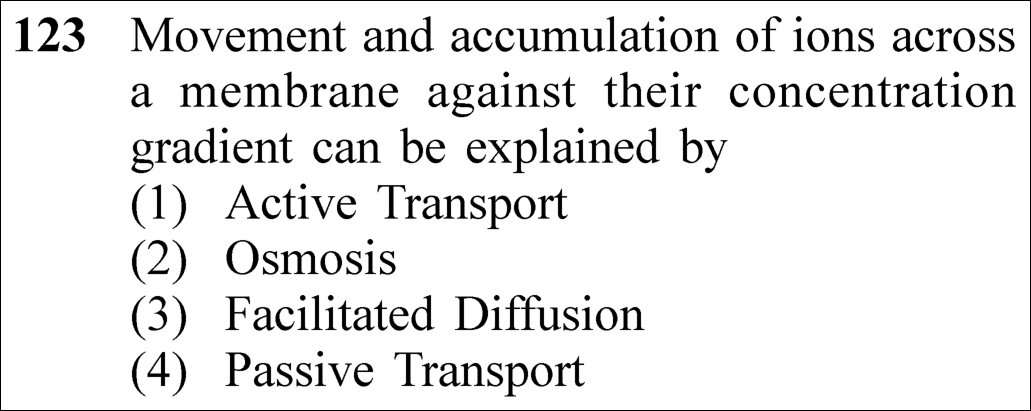
Official NEET 2023 Question 123 - Transport in Plants
1 Active Transport ✓ Key
2 Osmosis
3 Facilitated Diffusion
4 Passive Transport
💡 Verified Solution & 30-Second Hack
✓
Verified Against NTA Final Answer Key
Option (1) : Active Transport
📚 Transport in Plants Easy
📋 Given Parameters & Problem Setup
Transported Entities Ions / Mineral solutes
Direction Against concentration gradient (uphill)
Result Accumulation across membrane
⚡

The 30-Second Exam Hall Shortcut: ⚡ Uphill Transport Anchor: Against Gradient = Active Transport

⏱️ Save ~20 seconds

Whenever solute transport occurs "against concentration gradient" (uphill) leading to accumulation inside the cell, it strictly requires metabolic energy (ATP) through Active Transport!

1 Passive transport (diffusion): Moves solutes downhill (along concentration gradient), no energy.
2 Osmosis: Special case of water diffusion across semipermeable membrane along chemical potential gradient.
3 Facilitated diffusion: Moves solutes along gradient using permease proteins, no ATP.
4 Active transport: Uses pump proteins and ATP energy to move solutes uphill AGAINST concentration gradient.
5 Match Option (1) Active Transport.
🛡️
Why You Can 100% Trust This Shortcut: Canonical NCERT Membrane Transport thermodynamic classifications.
📐

Step-by-Step Rigorous Workflow & Mathematical Proof

Step 1

Thermodynamic Classification of Membrane Transport

Transport mechanisms across biological membranes are categorized based on energetics and electrochemical directionality:

Passive Transport:Along concentration gradient (Δμ<0), No ATP requiredActive Transport:Against concentration gradient (Δμ>0),Consumes ATP (Uphill)\begin{aligned} \text{\textbf{Passive Transport:}} & \quad \text{Along concentration gradient } (\Delta \mu < 0), \text{ No ATP required} \\[4pt] \text{\textbf{Active Transport:}} & \quad \text{Against concentration gradient } (\Delta \mu > 0), \mathbf{\text{Consumes ATP (Uphill)}} \end{aligned}
Step 2

Ion Accumulation in Plant Roots

Because the concentration of essential mineral ions in root cortical cells is often 100 to 1000 times higher than in the surrounding soil solution, plants must actively pump ions inward across root cell membranes via membrane carrier proteins (proton-pumping ATPases).

[Ion]inside≫[Ion]outside  ⟹  Movement requires Active Transport[\text{Ion}]_{\text{inside}} \gg [\text{Ion}]_{\text{outside}} \implies \text{Movement requires } \mathbf{\text{Active Transport}}
Step 3

Verbatim NCERT Reference

NCERT states: "Active transport uses energy to pump molecules against a concentration gradient. Active transport is carried out by membrane-proteins... Active transport uses ATP."

⭐

360° Option Elimination Engine Key Feature

Diagnose every choice: Know exactly why the right option works and why distractors fail.

4-Option Deep Scan
1 1
✓ 100% Correct
Verdict & Scientific Reason:

Accurate NCERT definition: movement against a concentration gradient requiring ATP is active transport.

💡
Why this is airtight: None; fundamental physiological principle.
2 2
✗ Incorrect
Verdict & Scientific Reason:

Osmosis describes the passive diffusion of solvent (water) along its chemical potential gradient, not ion accumulation against a gradient.

⚠️
Student Fallacy (Why candidates pick this trap): Confusing solvent osmosis with solute active pumping.
3 3
✗ Incorrect
Verdict & Scientific Reason:

Facilitated diffusion is passive; transport proteins move solutes downhill along concentration gradients without ATP.

⚠️
Student Fallacy (Why candidates pick this trap): Assuming involvement of carrier proteins automatically implies active uphill movement.
4 4
✗ Incorrect
Verdict & Scientific Reason:

Passive transport only proceeds down a chemical gradient from higher to lower concentration.

⚠️
Student Fallacy (Why candidates pick this trap): Ignoring the explicit condition "against concentration gradient".
⚠️

NTA Trap Alert: Facilitated Diffusion vs. Active Transport Trap

Both facilitated diffusion and active transport require specific membrane proteins. However, only active transport can move molecules uphill against a gradient.

🛡️ How to avoid the -1 mark: Check the gradient: "Downhill" = Facilitated diffusion. "Uphill / Against gradient" = Active transport.
📖

Core NEET Syllabus Standard

NCERT Biology · Transport in Plants Standard Benchmark
Core Scientific Principle Tested:

"Active transport uses energy to pump molecules against a concentration gradient. It is carried out by specific membrane proteins."

Syllabus Focus: Active Transport
✓ Core NEET UG Syllabus Anchor Syllabus & Academic Standards ↗
NEET 2023 · Q138 Easy
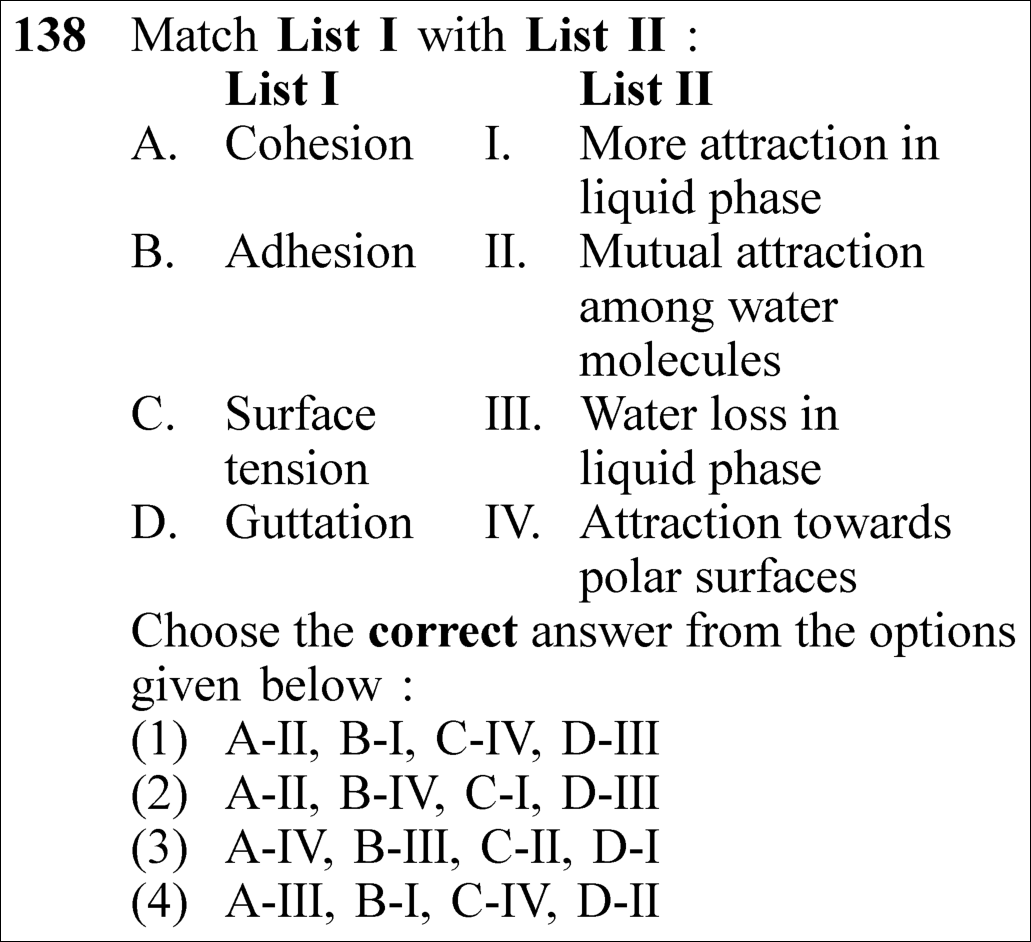
Official NEET 2023 Question 138 - Transport in Plants
1
2 ✓ Key
3
4
💡 Verified Solution & 30-Second Hack
✓
Verified Against NTA Final Answer Key
Option (2) : A-II, B-IV, C-I, D-III
📚 Transport in Plants Easy
📋 Given Parameters & Problem Setup
Phenomena Cohesion, Adhesion, Surface tension, Guttation
⚡

The 30-Second Exam Hall Shortcut: ⚡ Cohesion-Tension & Guttation Definitions Match

⏱️ Save ~25 seconds

Cohesion = Mutual attraction between water molecules (II). Adhesion = Attraction to polar surfaces like tracheids (IV). Surface tension = Greater attraction in liquid phase than gas (I). Guttation = Loss of liquid water droplets through hydathodes (III)!

1 Cohesion: Mutual attraction among water molecules -> A-II.
2 Adhesion: Attraction towards polar surfaces (tracheary walls) -> B-IV.
3 Surface tension: More attraction in liquid phase -> C-I.
4 Guttation: Water loss in liquid phase -> D-III.
5 Match combination: A-II, B-IV, C-I, D-III -> Option (2).
🛡️
Why You Can 100% Trust This Shortcut: Canonical NCERT Transport in Plants physical properties of water table.
📐

Step-by-Step Rigorous Workflow & Mathematical Proof

Step 1

Physical Properties of Water Mediating Ascent of Sap

Transpiration pull depends on three fundamental intermolecular properties of water:

Cohesion:Mutual attraction among water molecules  ⟹  IIAdhesion:Attraction of water molecules to polar surfaces (tracheary elements)  ⟹  IVSurface tension:Water molecules attracted to each other more in liquid phase than gas  ⟹  I\begin{aligned} \text{\textbf{Cohesion:}} & \quad \text{Mutual attraction among water molecules} \implies \mathbf{\text{II}} \\[3pt] \text{\textbf{Adhesion:}} & \quad \text{Attraction of water molecules to polar surfaces (tracheary elements)} \implies \mathbf{\text{IV}} \\[3pt] \text{\textbf{Surface tension:}} & \quad \text{Water molecules attracted to each other more in liquid phase than gas} \implies \mathbf{\text{I}} \end{aligned}
Step 2

Definition of Guttation

Root pressure drives the exudation of water in the liquid phase through specialized hydathode pores at vein endings of leaves during nights or early mornings when transpiration is low:

Guttation:Water loss in liquid phase  ⟹  III\text{\textbf{Guttation:}} \quad \text{Water loss in liquid phase} \implies \mathbf{\text{III}}
Step 3

Option Verification

Pairing A-II, B-IV, C-I, D-III perfectly matches Option (2).

⭐

360° Option Elimination Engine Key Feature

Diagnose every choice: Know exactly why the right option works and why distractors fail.

4-Option Deep Scan
1 1
✗ Incorrect
Verdict & Scientific Reason:

Mismatches Adhesion with surface tension properties.

⚠️
Student Fallacy (Why candidates pick this trap): Confusing adhesion to surfaces with liquid phase intermolecular tension.
2 2
✓ 100% Correct
Verdict & Scientific Reason:

Verbatim alignment with NCERT physical definitions of cohesion, adhesion, surface tension, and guttation.

💡
Why this is airtight: None; precise physical chemistry and plant physiology recall.
3 3
✗ Incorrect
Verdict & Scientific Reason:

Scrambles all associations.

⚠️
Student Fallacy (Why candidates pick this trap): Confusing cohesion with adhesion.
4 4
✗ Incorrect
Verdict & Scientific Reason:

Mismatches cohesion with liquid loss.

⚠️
Student Fallacy (Why candidates pick this trap): Assigning water loss to cohesion.
⚠️

NTA Trap Alert: Cohesion vs. Adhesion Distinction Trap

Cohesion is attraction between like molecules (water-to-water). Adhesion is attraction between unlike molecules (water-to-polar cell wall surfaces).

🛡️ How to avoid the -1 mark: Cohesion = "Co-" means together (water-water). Adhesion = "Adhere" to a different surface (water-wall).
📖

Core NEET Syllabus Standard

NCERT Biology · Transport in Plants Standard Benchmark
Core Scientific Principle Tested:

"Cohesion is mutual attraction between water molecules; Adhesion is attraction to polar surfaces; Surface tension is greater attraction in liquid phase; Guttation is water loss in liquid phase."

Syllabus Focus: Transpiration Pull & Guttation
✓ Core NEET UG Syllabus Anchor Syllabus & Academic Standards ↗
NEET 2021 · Q117 Easy
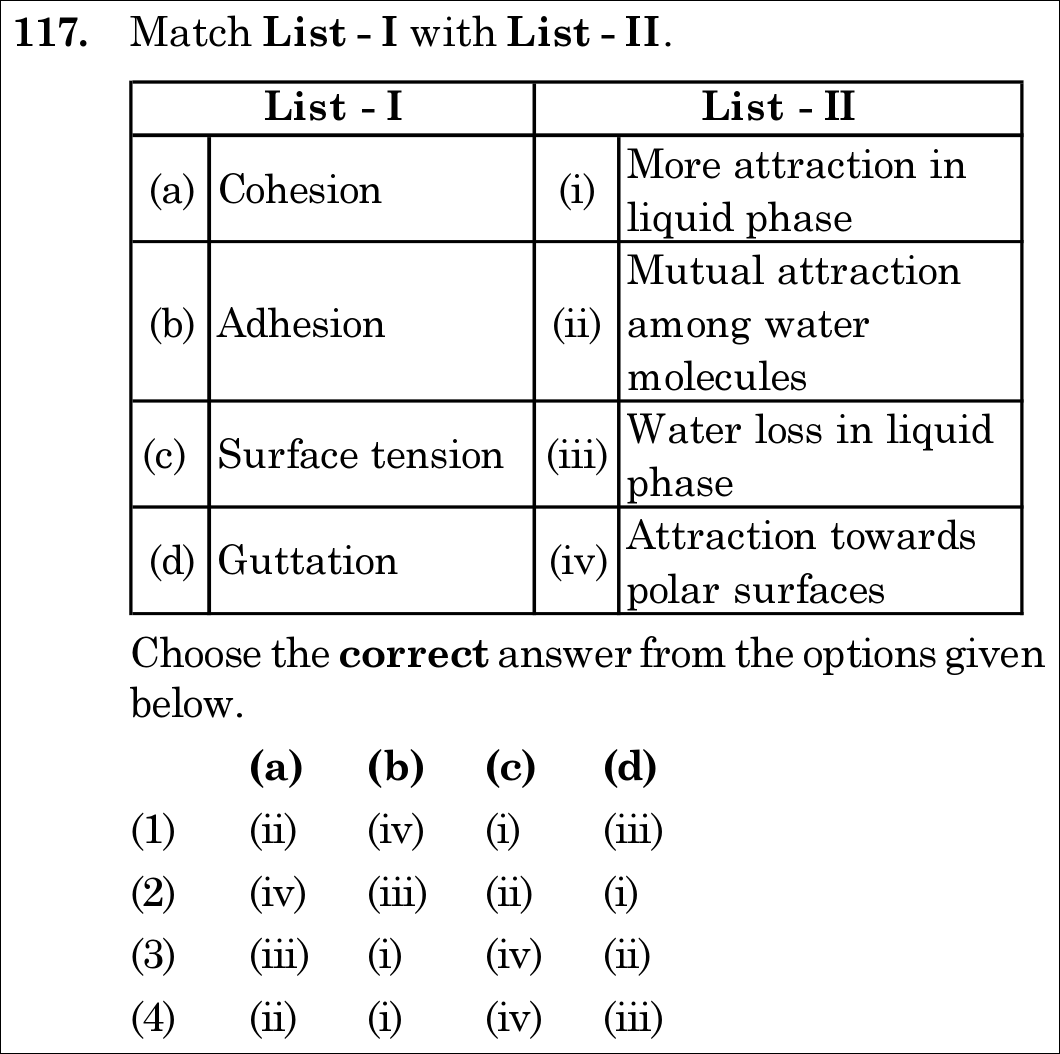
Official NEET 2021 Question 117 - Transport in Plants
1 (ii) (iv) (i) (iii) ✓ Key
2 (iv) (iii) (ii) (i)
3 (iii) (i) (iv) (ii)
4 (ii) (i) (iv) (iii)
💡 Verified Solution & 30-Second Hack
✓
Verified Against NTA Final Answer Key
Option (1) : (a)-(ii), (b)-(iv), (c)-(i), (d)-(iii)
📚 Transport in Plants Easy
📋 Given Parameters & Problem Setup
List I (a) Cohesion, (b) Adhesion, (c) Surface tension, (d) Guttation
List II (i) More attraction in liquid phase, (ii) Mutual attraction among water molecules, (iii) Water loss in liquid phase, (iv) Attraction towards polar surfaces
⚡

The 30-Second Exam Hall Shortcut: ⚡ Cohesion = Water-Water (ii) & Adhesion = Water-Polar Surface (iv)

⏱️ Save ~20 seconds

Cohesion is mutual attraction between water molecules (a-ii); Adhesion is attraction of water to tracheary polar wall surfaces (b-iv); Surface tension is higher attraction in liquid vs gas phase (c-i); Guttation is liquid water exudation via hydathodes (d-iii). Matches Option (1)!

1 Cohesion: Mutual attraction among like water molecules   ⟹  \implies (a)-(ii).
2 Adhesion: Attraction of water molecules to polar tracheary surfaces   ⟹  \implies (b)-(iv).
3 Surface tension: Water molecules are attracted to each other more in the liquid phase than in the gaseous phase   ⟹  \implies (c)-(i).
4 Guttation: Loss of water in liquid phase from hydathodes   ⟹  \implies (d)-(iii).
5 Match Option (1).
🛡️
Why You Can 100% Trust This Shortcut: Canonical NCERT Transport in Plants on Water Properties and Transpiration Pull.
📐

Step-by-Step Rigorous Workflow & Mathematical Proof

Step 1

Definition of Physical Forces in Sap Ascent

The cohesion-tension-transpiration pull model relies on three fundamental physical properties of water plus root pressure exudation:

(a) Cohesion⟷(ii) Mutual attraction among water molecules(b) Adhesion⟷(iv) Attraction of water molecules towards polar surfaces(c) Surface tension⟷(i) More mutual attraction in liquid phase than in gas phase(d) Guttation⟷(iii) Water loss in liquid phase through hydathodes due to root pressure\begin{aligned} \text{(a) Cohesion} & \longleftrightarrow \text{(ii) Mutual attraction among water molecules} \\[3pt] \text{(b) Adhesion} & \longleftrightarrow \text{(iv) Attraction of water molecules towards polar surfaces} \\[3pt] \text{(c) Surface tension} & \longleftrightarrow \text{(i) More mutual attraction in liquid phase than in gas phase} \\[3pt] \text{(d) Guttation} & \longleftrightarrow \text{(iii) Water loss in liquid phase through hydathodes due to root pressure} \end{aligned}
Step 2

Verification of Option Key

Evaluating the match: (a)-(ii), (b)-(iv), (c)-(i), (d)-(iii) aligns precisely with Option (1).

⭐

360° Option Elimination Engine Key Feature

Diagnose every choice: Know exactly why the right option works and why distractors fail.

4-Option Deep Scan
1 1
✓ 100% Correct
Verdict & Scientific Reason:

Completely accurate textbook mapping for all 4 water relation properties.

💡
Why this is airtight: None. Clear first-principles match.
2 2
✗ Incorrect
Verdict & Scientific Reason:

Mismatches Cohesion with polar surfaces (which is adhesion) and Adhesion with guttation.

⚠️
Student Fallacy (Why candidates pick this trap): Swapping Cohesion and Adhesion definitions.
3 3
✗ Incorrect
Verdict & Scientific Reason:

Incorrectly assigns liquid loss (guttation) to cohesion.

⚠️
Student Fallacy (Why candidates pick this trap): Gross misalignment of water properties.
4 4
✗ Incorrect
Verdict & Scientific Reason:

Mismatches Adhesion with surface tension and Surface tension with adhesion.

⚠️
Student Fallacy (Why candidates pick this trap): Inverting adhesion and surface tension.
⚠️

NTA Trap Alert: Cohesion vs Adhesion Target Distinction

Cohesion is attraction between identical molecules (water-water); Adhesion is attraction between dissimilar substances (water-xylem cell wall).

🛡️ How to avoid the -1 mark: Remember: Cohesion = Together (water to water); Adhesion = Adhesive tape sticking to other surfaces (water to polar walls).
📖

Core NEET Syllabus Standard

NEET / NCERT Biology · Transport in Plants Standard Benchmark
Core Scientific Principle Tested:

"Cohesion is mutual attraction between water molecules; Adhesion is attraction to polar surfaces; Surface tension is greater attraction in liquid phase; Guttation is liquid water loss."

Syllabus Focus: Transpiration Pull & Properties of Water
✓ Core NEET UG Syllabus Anchor Syllabus & Academic Standards ↗
NEET 2020 · Q40 Easy
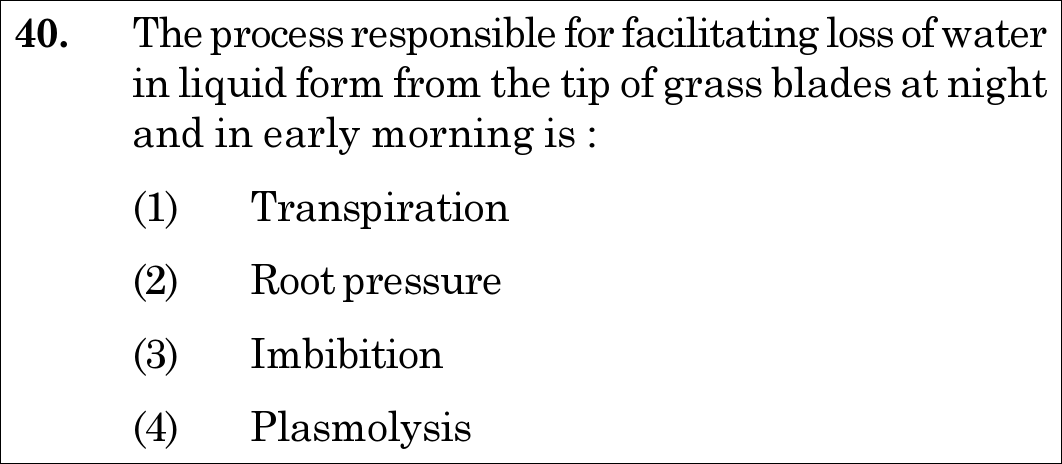
Official NEET 2020 Question 40 - Transport in Plants
1 Transpiration
2 Root pressure ✓ Key
3 Imbibition
4 Plasmolysis
💡 Verified Solution & 30-Second Hack
✓
Verified Against NTA Final Answer Key
Option (2) : Root pressure
📚 Transport in Plants Easy
📋 Given Parameters & Problem Setup
Phenomenon Loss of water in liquid form from tip of grass blades at night and early morning
Question Objective Identify the driving physiological process responsible
⚡

The 30-Second Exam Hall Shortcut: ⚡ "Liquid Water Loss at Leaf Tips (Guttation) = ROOT PRESSURE!"

⏱️ 30 seconds

Water loss as vapor through stomata is Transpiration (pull). Water loss as liquid droplets through hydathodes at night/dawn is Guttation, driven entirely by positive hydrostatic ROOT PRESSURE. Mark Root pressure (Option 2) in 5 seconds!

1 Loss of liquid droplets from leaf tips = Guttation.
2 At night, transpiration is negligible; positive pressure develops in xylem due to active ion uptake.
3 This hydrostatic push is Root Pressure.
4 Select Option (2) Root pressure.
🛡️
Why You Can 100% Trust This Shortcut: NCERT Biology · Plant Physiology: Transport in Plants (Root Pressure & Guttation)
📐

Step-by-Step Rigorous Workflow & Mathematical Proof

Step 1

Define Guttation

The loss of water in liquid form (as droplets) through specialized unclosable pores called hydathodes situated at the margins and vein-endings of leaves is termed guttation.

Step 2

Timing and Environmental Conditions

Guttation typically occurs during the night and early morning when transpiration is virtually nil (high atmospheric humidity, closed stomata), but active mineral absorption by root cells continues unabated.

Step 3

Role of Root Pressure

Active transport of mineral ions into the root vascular bundle lowers water potential, causing water to flow into xylem by osmosis. This builds up a positive hydrostatic pressure termed root pressure, which pushes water columns upwards and forces liquid droplets out of hydathodes.

Step 4

Eliminate Other Options

Transpiration is loss of water vapor driven by negative suction pull; Imbibition is adsorption by dry colloids; Plasmolysis is cell shrinkage in hypertonic medium. Only root pressure facilitates guttation.

⭐

360° Option Elimination Engine Key Feature

Diagnose every choice: Know exactly why the right option works and why distractors fail.

4-Option Deep Scan
1 A
✗ Incorrect
Verdict & Scientific Reason:

Incorrect; transpiration involves water loss in the form of water vapor through stomata driven by a negative tension pull, not liquid droplets.

⚠️
Student Fallacy (Why candidates pick this trap): Students conflating liquid water loss (guttation) with vapor water loss (transpiration).
2 B
✓ 100% Correct
Verdict & Scientific Reason:

Factually exact; positive root pressure pushes water out through hydathodes as liquid droplets when transpiration is absent.

💡
Why this is airtight: None; direct NCERT physiological concept.
3 C
✗ Incorrect
Verdict & Scientific Reason:

Incorrect; imbibition is water adsorption by dry seed coats and cell walls without forming a solution.

⚠️
Student Fallacy (Why candidates pick this trap): Confusing capillary surface uptake with active pressure sap exudation.
4 D
✗ Incorrect
Verdict & Scientific Reason:

Incorrect; plasmolysis is the shrinkage of protoplast from cell wall in hypertonic external solutions.

⚠️
Student Fallacy (Why candidates pick this trap): Mixing cellular osmotic response with organismal water transport.
⚠️

NTA Trap Alert: Dew vs Guttation vs Transpiration

Transpiration = Vapor loss (negative pull). Dew = Condensation of atmospheric moisture. Guttation = Liquid water exudation from hydathodes driven by positive ROOT PRESSURE.

🛡️ How to avoid the -1 mark: Remember: Liquid water droplets exuded from veins = GUTTATION = ROOT PRESSURE!
📖

Core NEET Syllabus Standard

Botany · Transport in Plants Standard Benchmark
Core Scientific Principle Tested:

""

Syllabus Focus: Root Pressure and Guttation via Hydathodes
✓ Core NEET UG Syllabus Anchor Syllabus & Academic Standards ↗

Solve 4 NEET Questions a Day — One per Subject

Cover all 1,140 official NEET questions in 285 days at your own pace. Progress is saved on your device. No login needed.