MyCompetitiveExams Logo MyCompetitiveExams
Search 1,140+ Questions
Chapters, formulas, speed tricks
→
⚡ Brahmastra NEET 2027
720 MARKS

Dynamic 180-question full-length simulator mixed dynamically from all 6 years for 2027 & 2026 aspirants.

Launch Brahmastra 2027 Test →
Start Practice →
100% Free · No Login Required
Q.122 Botany ⭐ 360° Option Elimination Active
Vault ↗

NEET 2023 Botany Question 122 Solution

Topic: Transport in Plants · Official NTA Booklet Code G5
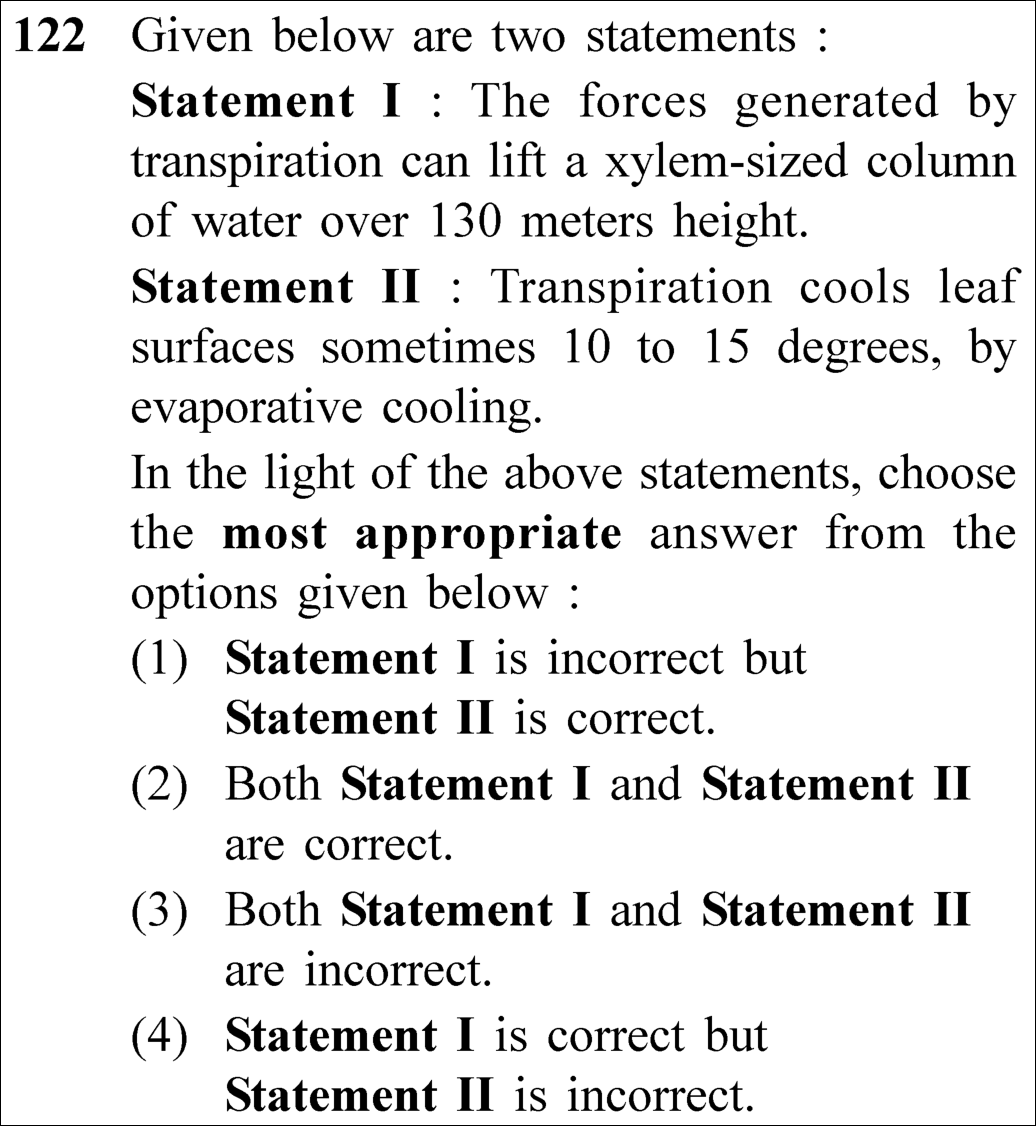
NEET 2023 Botany Question 122: Transpiration Pull Physics and Evaporative Cooling

Question

Given below are two statements: Statement I: The forces generated by transpiration can lift a xylem-sized column of water over 130 meters height. Statement II: Transpiration cools leaf surfaces sometimes 10 to 15 degrees, by evaporative cooling. In the light of the above statements, choose the most appropriate answer from the options given below:

  1. (1)Statement I is incorrect but Statement II is correct.
  2. (2)Both Statement I and Statement II are correct.
  3. (3)Both Statement I and Statement II are incorrect.
  4. (4)Statement I is correct but Statement II is incorrect.
✓
Verified Against NTA Final Answer Key
Option (2) : Both Statement I and Statement II are correct.
📚 Transport in Plants Easy
📋 Given Parameters & Problem Setup
Statement I Forces generated by transpiration can lift xylem-sized column over 130 meters height.
Statement II Transpiration cools leaf surfaces sometimes 10 to 15 degrees by evaporative cooling.
⚡

The 30-Second Exam Hall Shortcut: ⚡ NCERT Transpiration Numbers: 130 meters & 10–15 °C

⏱️ Save ~20 seconds

Both statements are verbatim sentences from NCERT Transport in Plants! Transpiration pull can generate over 130 m lift and evaporative cooling reduces leaf temperatures by 10 to 15 °C. Both statements are correct!

1 Check Statement I: Transpiration pull can lift water column over 130 meters -> Verbatim NCERT, Correct.
2 Check Statement II: Evaporative cooling cools leaves 10 to 15 degrees Celsius -> Verbatim NCERT, Correct.
3 Both statements are factually true.
4 Match Option (2) Both Statement I and Statement II are correct.
🛡️
Why You Can 100% Trust This Shortcut: Canonical NCERT Plant Physiology water relations quantitative values.
📐

Step-by-Step Rigorous Workflow & Mathematical Proof

Step 1

Evaluation of Statement I (Transpiration Pull Magnitude)

The cohesion-tension-transpiration pull model explains the ascent of sap through tall trees. Transpiration generates negative suction pressures in xylem conduits up to −2 MPa-2\text{ MPa} to −3 MPa-3\text{ MPa}:

Transpiration Suction Force  ⟹  Lifts water column >130 metres high\text{Transpiration Suction Force} \implies \text{Lifts water column } > \mathbf{130\text{ metres high}}
Step 2

Evaluation of Statement II (Evaporative Cooling Effect)

Water has a high latent heat of vaporization ( 2.44 kJ/g~2.44\text{ kJ/g}). As water evaporates through open stomata into the atmosphere, it dissipates excess thermal energy from insolation:

Evaporative Cooling  ⟹  Cools leaf surfaces by 10 to 15∘C\text{Evaporative Cooling} \implies \text{Cools leaf surfaces by } \mathbf{10\text{ to } 15^\circ\text{C}}
Step 3

Verbatim NCERT Confirmation

NCERT Transport in Plants states under "Transpiration and Photosynthesis - a Compromise": - "Measurements reveal that the forces generated by transpiration can create pressures sufficient to lift a xylem sized column of water over 130 metres high." - "It cools leaf surfaces, sometimes 10 to 15 degrees, by evaporative cooling." Both statements are fully correct.

⭐

360° Option Elimination Engine Key Feature

Diagnose every choice: Know exactly why the right option works and why distractors fail.

4-Option Deep Scan
1 1
✗ Incorrect
Verdict & Scientific Reason:

Statement I is factually correct: transpiration pull exceeds 130 meters.

⚠️
Student Fallacy (Why candidates pick this trap): Doubting that capillary/cohesion forces can achieve a 130-meter column lift.
2 2
✓ 100% Correct
Verdict & Scientific Reason:

Both statements are verbatim excerpts from NCERT Biology.

💡
Why this is airtight: None; exact textbook recall.
3 3
✗ Incorrect
Verdict & Scientific Reason:

Both statements are true physiological facts.

⚠️
Student Fallacy (Why candidates pick this trap): Assuming physiological numerical values in NEET are intentionally fabricated.
4 4
✗ Incorrect
Verdict & Scientific Reason:

Statement II is factually correct: cooling magnitude is 10 to 15 degrees Celsius.

⚠️
Student Fallacy (Why candidates pick this trap): Believing that 10 to 15 degrees cooling is physiologically too large.
⚠️

NTA Trap Alert: Numerical Skepticism Trap

Students frequently mistrust specific numerical data in statements (130 meters, 10 to 15 degrees), suspecting a deceptive modification.

🛡️ How to avoid the -1 mark: Memorize canonical NCERT constants: Transpiration pull = 130 meters; Leaf cooling = 10 to 15 °C.
📖

Core NEET Syllabus Standard

NCERT Biology · Transport in Plants Standard Benchmark
Core Scientific Principle Tested:

"Forces generated by transpiration can lift a xylem-sized column of water over 130 metres high, and evaporative cooling cools leaf surfaces 10 to 15 degrees."

Syllabus Focus: Transpiration - A Compromise
✓ Core NEET UG Syllabus Anchor Syllabus & Academic Standards ↗

Ready to attempt under real exam pressure?

Test your speed and accuracy in the authentic 200-minute timed NTA simulator.

Launch NEET 2023 CBT Test →

Spotted a mistake in this solution? Report an error ([email protected])

⚖️ Legal & Fair Dealing Notice: Sourced from publicly released NEET 2023 question papers and NEET answer keys for private study, research, and non-commercial educational practice under Fair Dealing (Section 52(1)(a) of the Indian Copyright Act, 1957). Not affiliated with or endorsed by NTA or NMC.

Solve 4 NEET Questions a Day — One per Subject

Cover all 1,140 official NEET questions in 285 days at your own pace. Progress is saved on your device. No login needed.