MyCompetitiveExams Logo MyCompetitiveExams
Search 1,140+ Questions
Chapters, formulas, speed tricks
→
⚡ Brahmastra NEET 2027
720 MARKS

Dynamic 180-question full-length simulator mixed dynamically from all 6 years for 2027 & 2026 aspirants.

Launch Brahmastra 2027 Test →
Start Practice →
100% Free · No Login Required
Q.40 Botany ⭐ 360° Option Elimination Active
Vault ↗

NEET 2020 Botany Question 40 Solution

Topic: Transport in Plants · Official NTA Booklet Code E1
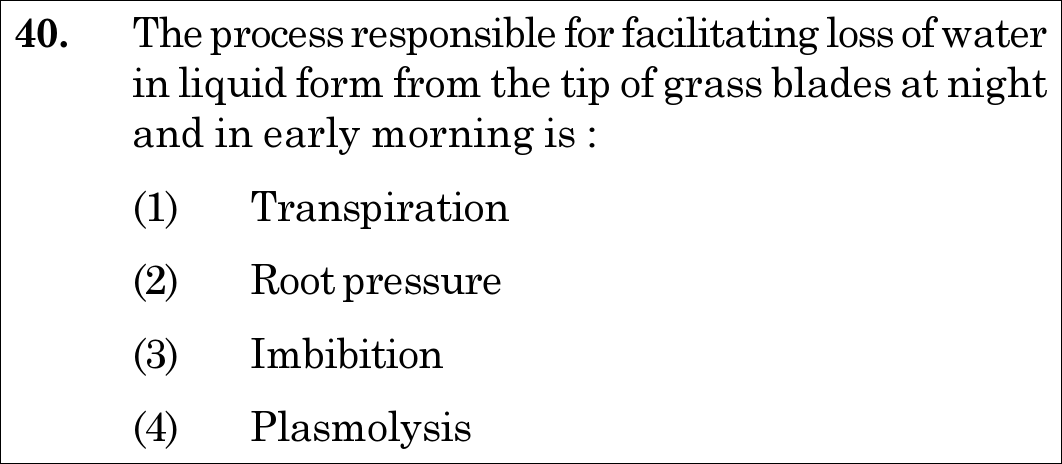
NEET 2020 Botany Question 40: Root Pressure and Guttation via Hydathodes

Question

The process responsible for facilitating loss of water in liquid form from the tip of grass blades at night and in early morning is:

  1. (1)Transpiration
  2. (2)Root pressure
  3. (3)Imbibition
  4. (4)Plasmolysis
✓
Verified Against NTA Final Answer Key
Option (2) : Root pressure
📚 Transport in Plants Easy
📋 Given Parameters & Problem Setup
Phenomenon Loss of water in liquid form from tip of grass blades at night and early morning
Question Objective Identify the driving physiological process responsible
⚡

The 30-Second Exam Hall Shortcut: ⚡ "Liquid Water Loss at Leaf Tips (Guttation) = ROOT PRESSURE!"

⏱️ 30 seconds

Water loss as vapor through stomata is Transpiration (pull). Water loss as liquid droplets through hydathodes at night/dawn is Guttation, driven entirely by positive hydrostatic ROOT PRESSURE. Mark Root pressure (Option 2) in 5 seconds!

1 Loss of liquid droplets from leaf tips = Guttation.
2 At night, transpiration is negligible; positive pressure develops in xylem due to active ion uptake.
3 This hydrostatic push is Root Pressure.
4 Select Option (2) Root pressure.
🛡️
Why You Can 100% Trust This Shortcut: NCERT Biology · Plant Physiology: Transport in Plants (Root Pressure & Guttation)
📐

Step-by-Step Rigorous Workflow & Mathematical Proof

Step 1

Define Guttation

The loss of water in liquid form (as droplets) through specialized unclosable pores called hydathodes situated at the margins and vein-endings of leaves is termed guttation.

Step 2

Timing and Environmental Conditions

Guttation typically occurs during the night and early morning when transpiration is virtually nil (high atmospheric humidity, closed stomata), but active mineral absorption by root cells continues unabated.

Step 3

Role of Root Pressure

Active transport of mineral ions into the root vascular bundle lowers water potential, causing water to flow into xylem by osmosis. This builds up a positive hydrostatic pressure termed root pressure, which pushes water columns upwards and forces liquid droplets out of hydathodes.

Step 4

Eliminate Other Options

Transpiration is loss of water vapor driven by negative suction pull; Imbibition is adsorption by dry colloids; Plasmolysis is cell shrinkage in hypertonic medium. Only root pressure facilitates guttation.

⭐

360° Option Elimination Engine Key Feature

Diagnose every choice: Know exactly why the right option works and why distractors fail.

4-Option Deep Scan
1 A
✗ Incorrect
Verdict & Scientific Reason:

Incorrect; transpiration involves water loss in the form of water vapor through stomata driven by a negative tension pull, not liquid droplets.

⚠️
Student Fallacy (Why candidates pick this trap): Students conflating liquid water loss (guttation) with vapor water loss (transpiration).
2 B
✓ 100% Correct
Verdict & Scientific Reason:

Factually exact; positive root pressure pushes water out through hydathodes as liquid droplets when transpiration is absent.

💡
Why this is airtight: None; direct NCERT physiological concept.
3 C
✗ Incorrect
Verdict & Scientific Reason:

Incorrect; imbibition is water adsorption by dry seed coats and cell walls without forming a solution.

⚠️
Student Fallacy (Why candidates pick this trap): Confusing capillary surface uptake with active pressure sap exudation.
4 D
✗ Incorrect
Verdict & Scientific Reason:

Incorrect; plasmolysis is the shrinkage of protoplast from cell wall in hypertonic external solutions.

⚠️
Student Fallacy (Why candidates pick this trap): Mixing cellular osmotic response with organismal water transport.
⚠️

NTA Trap Alert: Dew vs Guttation vs Transpiration

Transpiration = Vapor loss (negative pull). Dew = Condensation of atmospheric moisture. Guttation = Liquid water exudation from hydathodes driven by positive ROOT PRESSURE.

🛡️ How to avoid the -1 mark: Remember: Liquid water droplets exuded from veins = GUTTATION = ROOT PRESSURE!
📖

Core NEET Syllabus Standard

Botany · Transport in Plants Standard Benchmark
Core Scientific Principle Tested:

""

Syllabus Focus: Root Pressure and Guttation via Hydathodes
✓ Core NEET UG Syllabus Anchor Syllabus & Academic Standards ↗

Ready to attempt under real exam pressure?

Test your speed and accuracy in the authentic 180-minute timed NTA simulator.

Launch NEET 2020 CBT Test →

Spotted a mistake in this solution? Report an error ([email protected])

⚖️ Legal & Fair Dealing Notice: Sourced from publicly released NEET 2020 question papers and NEET answer keys for private study, research, and non-commercial educational practice under Fair Dealing (Section 52(1)(a) of the Indian Copyright Act, 1957). Not affiliated with or endorsed by NTA or NMC.

Solve 4 NEET Questions a Day — One per Subject

Cover all 1,140 official NEET questions in 285 days at your own pace. Progress is saved on your device. No login needed.