MyCompetitiveExams Logo MyCompetitiveExams
Search 1,140+ Questions
Chapters, formulas, speed tricks
→
⚡ Brahmastra NEET 2027
720 MARKS

Dynamic 180-question full-length simulator mixed dynamically from all 6 years for 2027 & 2026 aspirants.

Launch Brahmastra 2027 Test →
Start Practice →
100% Free · No Login Required
🌿 Botany 🔥 High-Yield Core Topic (~3–4 Qs/Year)

NEET Cell Cycle and Cell Division Previous Year Questions with Solutions

Complete repository of official NTA NEET questions for Cell Cycle and Cell Division from 2020 to 2026. Every question includes 30-second elimination tricks, step-by-step NCERT solutions, option-by-option traps, and official answer keys.

22 Questions 6 Exam Years (2026, 2025, 2024, 2023, 2021, 2020) 20 Easy · 2 Medium · 0 Challenging
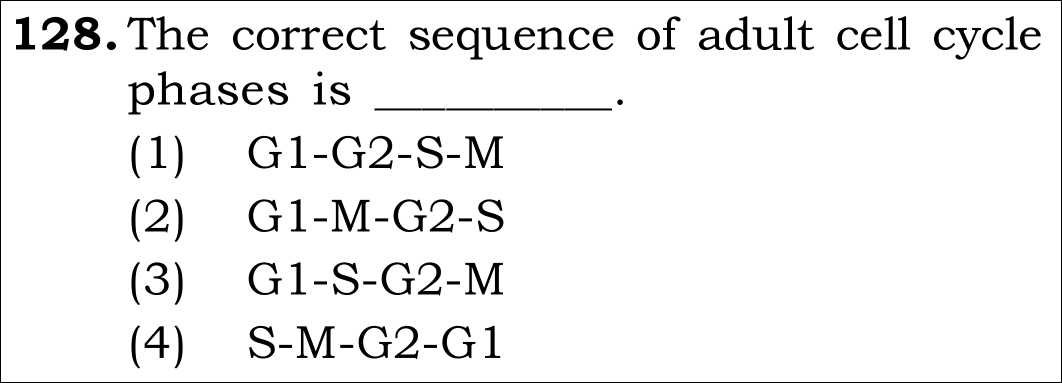
NEET 2026 · Q128 Easy
Official NEET 2026 Question 128 - Cell Cycle and Cell Division
1
2
3 ✓ Key
4
💡 Verified Solution & 30-Second Hack
✓
Verified Against NTA Final Answer Key
Option (3) : G1-S-G2-M
📚 Cell Cycle and Cell Division Easy
📋 Given Parameters & Problem Setup
Process Adult eukaryotic cell cycle
Constituent Phases Gap 1 (G₁), Synthesis (S), Gap 2 (G₂), Mitosis (M)
⚡

The 30-Second Exam Hall Shortcut: ⚡ Cell Cycle Order Rule

⏱️ Save ~40 seconds

Interphase (G₁ -> S -> G₂) followed by Division (M)!

1 Recall canonical order of the cell cycle:
2 G₁ phase (post-mitotic gap, cell metabolically active and growing).
3 S phase (DNA replication and centriole duplication).
4 G₂ phase (protein synthesis for spindle assembly).
5 M phase (karyokinesis and cytokinesis).
6 Correct chronological order: G1-S-G2-M.
7 Option (3) is G1-S-G2-M. Pick Option (3) in 3 seconds!
🛡️
Why You Can 100% Trust This Shortcut: NCERT Biology · Cell Cycle and Cell Division (Interphase G1, S, G2 phases: DNA replication occurs strictly in S phase).
📐

Step-by-Step Rigorous Workflow & Mathematical Proof

Step 1

Interphase and its Sub-phases

The cell cycle is divided into two basic phases: Interphase (which occupies over 95% of cycle duration) and M Phase (mitosis). Interphase is divided into three sequential periods: G₁ phase, S phase, and G₂ phase.

Interphase=G1→S→G2\text{Interphase} = G_1 \rightarrow S \rightarrow G_2
  • • G₁ (Gap 1): Interval between mitosis and initiation of DNA replication.
  • • S (Synthesis): DNA replication doubles DNA content from 2C to 4C while chromosome number remains 2n.
  • • G₂ (Gap 2): Proteins are synthesized in preparation for mitosis while cell growth continues.
Step 2

Transition to M Phase

Following G₂, the cell enters the M phase (mitosis), where sister chromatids are partitioned equally into two daughter cells through prophase, metaphase, anaphase, telophase, and cytokinesis.

Complete Sequence=G1→S→G2→M\text{Complete Sequence} = \mathbf{G_1 \rightarrow S \rightarrow G_2 \rightarrow M}
  • • Matches Option (3).
Step 3

Eliminate Other Sequences

Option (1) places G₂ before S (physically impossible as DNA must be copied in S before G₂). Option (2) places M between G₁ and G₂. Option (4) scrambles the sequence completely.

Correct Option=G1-S-G2-M  [Option (3)]\text{Correct Option} = \mathbf{G1\text{-}S\text{-}G2\text{-}M} \; [\text{Option (3)}]
  • • Matches official NTA final answer key Option C / (3).
⭐

360° Option Elimination Engine Key Feature

Diagnose every choice: Know exactly why the right option works and why distractors fail.

4-Option Deep Scan
1 A
✗ Incorrect
Verdict & Scientific Reason:

Incorrect. Swaps G₂ and S phases.

⚠️
Student Fallacy (Why candidates pick this trap): Assuming gap phases occur consecutively before synthesis.
2 B
✗ Incorrect
Verdict & Scientific Reason:

Incorrect. Places M phase right after G₁ before DNA synthesis.

⚠️
Student Fallacy (Why candidates pick this trap): Scrambled order.
3 C
✓ 100% Correct
Verdict & Scientific Reason:

100% accurate. Canonical sequential progression of the eukaryotic cell cycle.

💡
Why this is airtight: None; fundamental cell biology mastery.
4 D
✗ Incorrect
Verdict & Scientific Reason:

Incorrect. Places M directly after S without G₂ preparation.

⚠️
Student Fallacy (Why candidates pick this trap): Confusing cell cycle checkpoints.
⚠️

NTA Trap Alert: Gap Phase Grouping Fallacy

Beginners sometimes imagine that "Gap 1" and "Gap 2" must happen together (G1-G2-S-M). S phase is the indispensable middle bridge where DNA replicates.

🛡️ How to avoid the -1 mark: Remember: G1 prepares the stage, S copies the page, G2 checks the gauge, M divides the cage!
📖

Core NEET Syllabus Standard

NEET Biology Core Syllabus · Cell Cycle and Cell Division Standard Benchmark
Core Scientific Principle Tested:

"The eukaryotic cell cycle progresses in an invariant unidirectional sequence: G₁ phase -> S phase -> G₂ phase -> M phase."
Syllabus Focus: Phases of Cell Cycle
✓ Core NEET UG Syllabus Anchor Syllabus & Academic Standards ↗
Go Sing Gently, Mother: G1, S, G2, M!
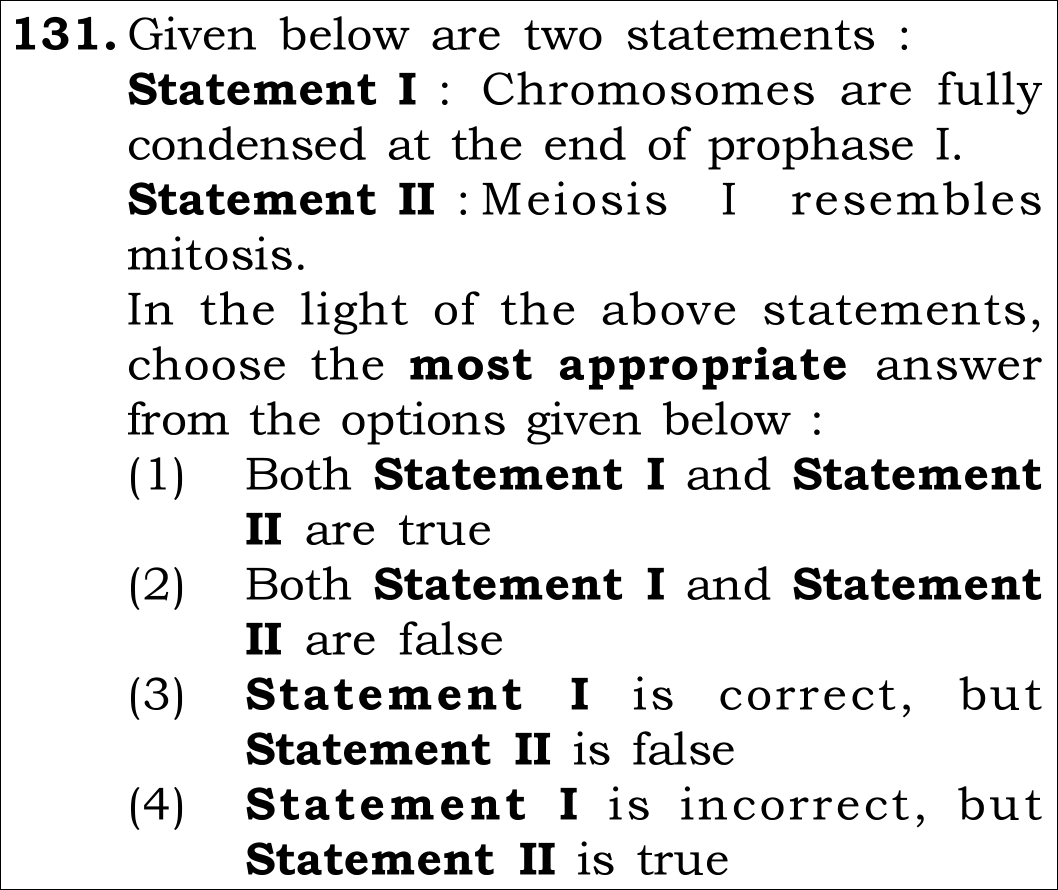
NEET 2026 · Q131 Medium
Official NEET 2026 Question 131 - Cell Cycle and Cell Division
1 Both Statement I and Statement II are true
2 Both Statement I and Statement II are false
3 Statement I is correct, but Statement II is false ✓ Key
4 Statement I is incorrect, but Statement II is true
💡 Verified Solution & 30-Second Hack
✓
Verified Against NTA Final Answer Key
Option (3) : Statement I is correct, but Statement II is false
📚 Cell Cycle and Cell Division Medium
📋 Given Parameters & Problem Setup
Statement I Chromosomes are fully condensed at the end of prophase I.
Statement II Meiosis I resembles mitosis.
⚡

The 30-Second Exam Hall Shortcut: ⚡ Meiosis II Resembles Mitosis (NOT Meiosis I)

⏱️ Save ~40 seconds

Meiosis I is Reductional; Meiosis II is Equational (Resembles Mitosis)! Statement II is FALSE!

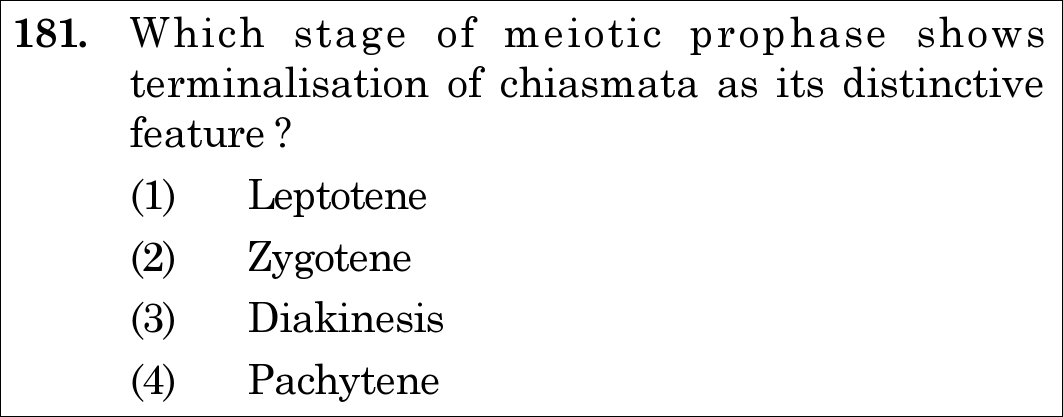
1 Evaluate Statement I: In prophase I, the final stage is Diakinesis, where terminalisation of chiasmata is completed and chromosomes are fully condensed. -> Statement I is TRUE.
2 Evaluate Statement II: Claims "Meiosis I resembles mitosis". Meiosis I involves homologous pairing (synapsis), crossing over, and separation of homologous chromosomes (reduction division: 2n -> n). It is MEIOSIS II that resembles normal mitosis (equational division)!
3 Therefore, Statement II is definitively FALSE.
4 Statement I is correct, but Statement II is false -> Option (3)!
5 Mark Option (3) in under 10 seconds.
🛡️
Why You Can 100% Trust This Shortcut: NCERT Biology · Cell Cycle and Cell Division (Meiosis II: Equational division preserving haploid chromosome number).
📐

Step-by-Step Rigorous Workflow & Mathematical Proof

Step 1

Evaluate Statement I (Diakinesis & Chromosome Condensation)

Prophase I of Meiosis I is divided into five substages: Leptotene, Zygotene, Pachytene, Diplotene, and Diakinesis. During Diakinesis, chiasmata undergo terminalisation, the chromosomes achieve full condensation, the nucleolus disappears, and the nuclear envelope breaks down.

End of Prophase I (Diakinesis)  ⟹  Chromosomes are fully condensed [Statement I is TRUE]\text{End of Prophase I (Diakinesis)} \implies \mathbf{Chromosomes\text{ are fully condensed [Statement I is TRUE]}}
  • • Prepares homologous bivalents for alignment on the equatorial plate in Metaphase I.
Step 2

Evaluate Statement II (Meiosis I vs Mitosis)

Meiosis I is fundamentally distinct from mitosis: it involves synapsis of homologous pairs, formation of synaptonemal complexes, genetic crossing over, and disjunction of homologous chromosome pairs without centromere division (reducing chromosome number from diploid 2n to haploid n). In contrast, Meiosis II involves centromeric division and separation of sister chromatids, exactly resembling a standard mitosis.

Meiosis I≠Mitosis (It is Reductional Division)Meiosis II≡Mitosis (Equational Division)\begin{aligned} \text{Meiosis I} &\neq \text{Mitosis (It is Reductional Division)} \\ \mathbf{Meiosis\text{ II}} &\mathbf{\equiv Mitosis\text{ (Equational Division)}} \end{aligned}
  • • Statement II falsely claims that Meiosis I resembles mitosis. Hence, Statement II is FALSE.
Step 3

Determine Matching Option

Statement I is correct, but Statement II is false. This corresponds directly to Option (3).

Statement I is correct, but Statement II is false  ⟹  Option (3)\text{Statement I is correct, but Statement II is false} \implies \text{Option (3)}
  • • Matches official NTA final answer key Option C / (3).
⭐

360° Option Elimination Engine Key Feature

Diagnose every choice: Know exactly why the right option works and why distractors fail.

4-Option Deep Scan
1 A
✗ Incorrect
Verdict & Scientific Reason:

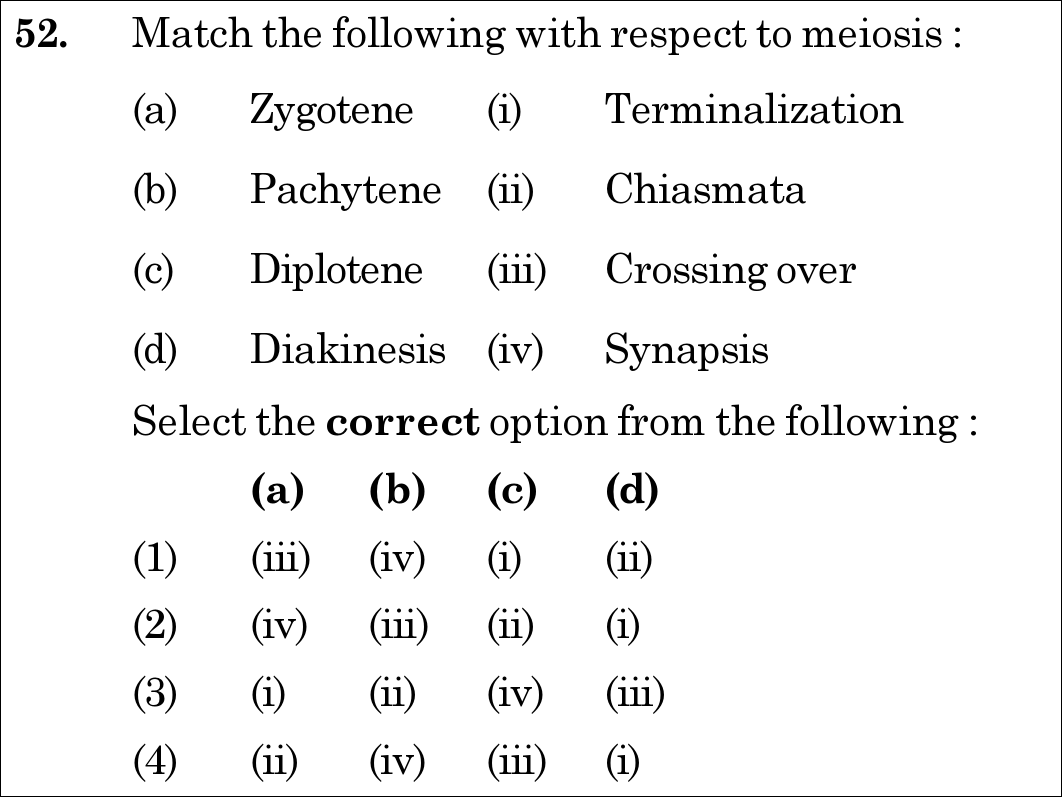
Incorrect. Statement II is false because Meiosis II, not Meiosis I, resembles mitosis.

⚠️
Student Fallacy (Why candidates pick this trap): Failing to distinguish between Meiosis I and Meiosis II.
2 B
✗ Incorrect
Verdict & Scientific Reason:

Incorrect. Statement I is a proven cytological fact.

⚠️
Student Fallacy (Why candidates pick this trap): Doubting diakinesis chromosome condensation.
3 C
✓ 100% Correct
Verdict & Scientific Reason:

100% accurate. Chromosomes are fully condensed at diakinesis; Meiosis II is the division that mirrors mitosis.

💡
Why this is airtight: None; thorough mastery of cell division mechanics.
4 D
✗ Incorrect
Verdict & Scientific Reason:

Completely inverted.

⚠️
Student Fallacy (Why candidates pick this trap): Opposite conceptual understanding.
⚠️

NTA Trap Alert: Meiosis I vs Meiosis II Mitotic Resemblance

NCERT has an explicit line: "Meiosis II resembles a normal mitosis." Examiners routinely change the Roman numeral to "Meiosis I" to trap hasty readers.

🛡️ How to avoid the -1 mark: Watch the Roman numerals: Meiosis ONE is Odd/Unique (Reduces 2n -> n); Meiosis TWO is Twin to Mitosis!
📖

Core NEET Syllabus Standard

NEET Biology Core Syllabus · Cell Cycle and Cell Division Standard Benchmark
Core Scientific Principle Tested:

"Chromosomes reach maximum condensation by the end of prophase I (diakinesis). Meiosis II (not Meiosis I) resembles mitosis."

Syllabus Focus: Meiosis - Stages and Significance
✓ Core NEET UG Syllabus Anchor Syllabus & Academic Standards ↗
Meiosis One is Reductional and Grand; Meiosis Two is Mitosis shaking hands!
NEET 2025 · Q158 Easy
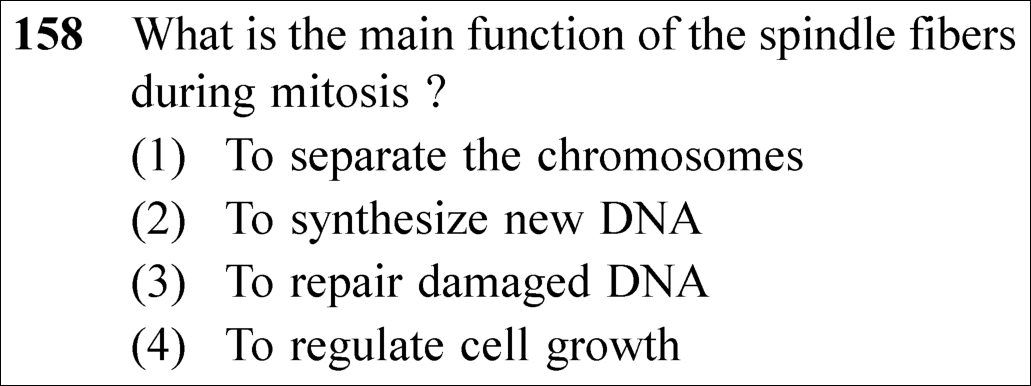
Official NEET 2025 Question 158 - Cell Cycle and Cell Division
1 To separate the chromosomes ✓ Key
2 To synthesize new DNA
3 To repair damaged DNA
4 To regulate cell growth
💡 Verified Solution & 30-Second Hack
✓
Verified Against NTA Final Answer Key
Option (1) : To separate the chromosomes
📚 Cell Cycle and Cell Division Easy
📋 Given Parameters & Problem Setup
Cell Division Phase Mitosis (specifically Anaphase)
Organelle / Structure Spindle fibers (microtubular apparatus)
Target Main biological function
⚡

The 30-Second Exam Hall Shortcut: ⚡ Spindle Fiber Action Fingerprint

⏱️ Save ~20 seconds

Spindle fibers attach to kinetochores and shorten during anaphase to pull sister chromatids apart to opposite poles -> To separate the chromosomes!

1 Recall spindle apparatus function during mitosis from NCERT Section 10.2:
2 - In metaphase: Spindle fibers attach to kinetochores of chromosomes and align them at the metaphase plate.
3 - In anaphase: Centromeres split simultaneously and shortening of spindle fibers pulls the two sister chromatids (daughter chromosomes) to opposite poles.
4 - The cardinal role of the mitotic spindle is chromosome separation/segregation!
5 Select Option (1) To separate the chromosomes!
🛡️
Why You Can 100% Trust This Shortcut: Mitotic Stages & Metaphase Chromosome Alignment (NCERT Biology · Cell Cycle and Cell Division: Metaphase plate alignment).
📐

Step-by-Step Rigorous Workflow & Mathematical Proof

Step 1

Assembly and Attachment of Mitotic Spindle Fibers

During prophase and prometaphase, microtubule organizing centers (centrosomes) assemble the bipolar mitotic spindle:

  • • Spindle fibers are polymeric microtubules composed of α\alpha- and β\beta-tubulin heterodimers.
  • • Kinetochore microtubules bind specifically to the proteinaceous trilaminar kinetochores assembled on centromeres of condensed chromosomes.
  • • During metaphase, dynamic tension from opposing spindle poles congresses all chromosomes to the equatorial plane (metaphase plate).
Step 2

Mechanics of Chromosome Separation in Anaphase

Driving chromosome segregation into daughter nuclei:

  • • At the onset of anaphase, cohesin complexes holding sister chromatids together are cleaved.
  • • Depolymerization of kinetochore microtubules at their plus ends generates mechanical pulling forces.
  • • These forces pull the split sister chromatids (now individual daughter chromosomes) toward opposite centrosomal poles.
  • • This guarantees equal and faithful genetic distribution into both newly forming daughter cells.
Step 3

Conclusion

The fundamental and primary function of spindle fibers during mitosis is to separate the chromosomes.

Spindle Fibers→AnaphaseSeparate sister chromatids (chromosomes)\text{Spindle Fibers} \xrightarrow{\text{Anaphase}} \text{Separate sister chromatids (chromosomes)}
⭐

360° Option Elimination Engine Key Feature

Diagnose every choice: Know exactly why the right option works and why distractors fail.

4-Option Deep Scan
1 A
✓ 100% Correct
Verdict & Scientific Reason:

100% correct. Spindle fibers exert directional traction to segregate daughter chromosomes to opposite poles.

💡
Why this is airtight: None; fundamental cytology knowledge.
2 B
✗ Incorrect
Verdict & Scientific Reason:

Incorrect. DNA synthesis is carried out by DNA polymerases during the S phase of interphase, not by spindle fibers.

⚠️
Student Fallacy (Why candidates pick this trap): Confusing cell division apparatus with S-phase replication enzymes.
3 C
✗ Incorrect
Verdict & Scientific Reason:

Incorrect. DNA repair is mediated by enzymatic repair pathways (e.g. photolyase, excision endonucleases), not spindle fibers.

⚠️
Student Fallacy (Why candidates pick this trap): Confusing chromosomal movement with DNA repair mechanisms.
4 D
✗ Incorrect
Verdict & Scientific Reason:

Incorrect. Cell growth is regulated during G1 and G2 phases by cyclins, CDKs, and metabolic signaling networks.

⚠️
Student Fallacy (Why candidates pick this trap): Vague attribution of general cell cycle functions.
⚠️

NTA Trap Alert: Kinetochore vs Spindle Fiber Identity

Kinetochores are the disc-shaped protein structures ON the centromere that serve as the landing dock. Spindle fibers are the dynamic cables that pull on them to SEPARATE the chromosomes.

🛡️ How to avoid the -1 mark: Spindle fibers = The mechanical ropes that separate chromosomes.
📖

Core NEET Syllabus Standard

NEET Biology Core Syllabus · Cell Cycle and Cell Division Standard Benchmark
Core Scientific Principle Tested:

"Spindle fibers attach to kinetochores and contract during anaphase to separate sister chromatids to opposite poles."

Syllabus Focus: Mitosis · Metaphase and Anaphase
✓ Core NEET UG Syllabus Anchor Syllabus & Academic Standards ↗
Spindle = Split & Separate the chromosomes!
NEET 2024 · Q114 Easy
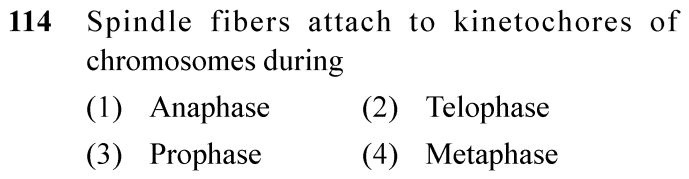
Official NEET 2024 Question 114 - Cell Cycle and Cell Division
1 Anaphase
2 Telophase
3 Prophase
4 Metaphase ✓ Key
💡 Verified Solution & 30-Second Hack
✓
Verified Against NTA Final Answer Key
Option (4) : Metaphase
📚 Cell Cycle and Cell Division Easy
📋 Given Parameters & Problem Setup
Event Attachment of spindle fibres to kinetochores of chromosomes
Cell Division Phase Mitotic stages
⚡

The 30-Second Exam Hall Shortcut: ⚡ Metaphase Key Hallmark

⏱️ Save ~20 seconds

Metaphase is defined by two key events: 1) Spindle fibres attach to kinetochores; 2) Chromosomes align along the equatorial metaphase plate!

1 Recall mitotic hallmarks:
2 - Prophase: Chromatin condensation, centrosome migration.
3 - Metaphase: Spindle fibres attach to kinetochores; chromosomes line up at equator.
4 - Anaphase: Centromere splitting, chromatid separation to opposite poles.
5 - Telophase: Nuclear envelope reforms, chromosome decondensation.
6 Spindle attachment to kinetochores = Metaphase -> Option (4) / D.
🛡️
Why You Can 100% Trust This Shortcut: NCERT Biology · Cell Cycle and Cell Division (Metaphase Characteristics)
📐

Step-by-Step Rigorous Workflow & Mathematical Proof

Step 1

Recognize the Onset of Metaphase

The complete disintegration of the nuclear envelope marks the start of the second phase of mitosis, metaphase. Hence the chromosomes are spread through the cytoplasm of the cell.

Step 2

Examine Kinetochores and Spindle Attachment

Small disc-shaped structures at the surface of the centromeres are called kinetochores. These structures serve as the sites of attachment of spindle fibres formed by spindle microtubules.

Step 3

Confirm the Definitive Phase

NCERT explicitly states that metaphase is characterized by spindle fibres attaching to kinetochores of chromosomes and chromosomes moving to the spindle equator.

⭐

360° Option Elimination Engine Key Feature

Diagnose every choice: Know exactly why the right option works and why distractors fail.

4-Option Deep Scan
1 (1)
✗ Incorrect
Verdict & Scientific Reason:

In anaphase, sister chromatids separate and are pulled toward opposite poles.

⚠️
Student Fallacy (Why candidates pick this trap): In anaphase, sister chromatids separate and are pulled toward opposite poles.
2 (2)
✗ Incorrect
Verdict & Scientific Reason:

In telophase, chromosomes reach respective poles, decondense, and nuclear envelopes reform.

⚠️
Student Fallacy (Why candidates pick this trap): In telophase, chromosomes reach respective poles, decondense, and nuclear envelopes reform.
3 (3)
✗ Incorrect
Verdict & Scientific Reason:

In prophase, chromatin condenses and the mitotic spindle begins assembly, but kinetochore attachment occurs upon nuclear envelope breakdown at metaphase.

⚠️
Student Fallacy (Why candidates pick this trap): In prophase, chromatin condenses and the mitotic spindle begins assembly, but kinetochore attachment occurs upon nuclear envelope breakdown at metaphase.
4 (4)
✓ 100% Correct
Verdict & Scientific Reason:

Metaphase is characterized by attachment of spindle fibres to kinetochores of chromosomes.

💡
Why this is airtight: None.
⚠️

NTA Trap Alert: Prophase vs Metaphase Transition

Confusing the initiation of spindle assembly (prophase) with actual kinetochore capture/attachment (metaphase).

🛡️ How to avoid the -1 mark: Remember: Spindle fibers formally attach to kinetochores at metaphase.
📖

Core NEET Syllabus Standard

Biology Core Botany · Cell Cycle and Cell Division Standard Benchmark
Core Scientific Principle Tested:

"Small disc-shaped structures at the surface of the centromeres are called kinetochores. These structures serve as the sites of attachment of spindle fibres... Hence, the metaphase is characterised by all the chromosomes coming to lie at the equator."

Syllabus Focus: Stages of Mitosis: Spindle Fibre Attachment to Kinetochores
✓ Core NEET UG Syllabus Anchor Syllabus & Academic Standards ↗
NEET 2024 · Q121 Easy
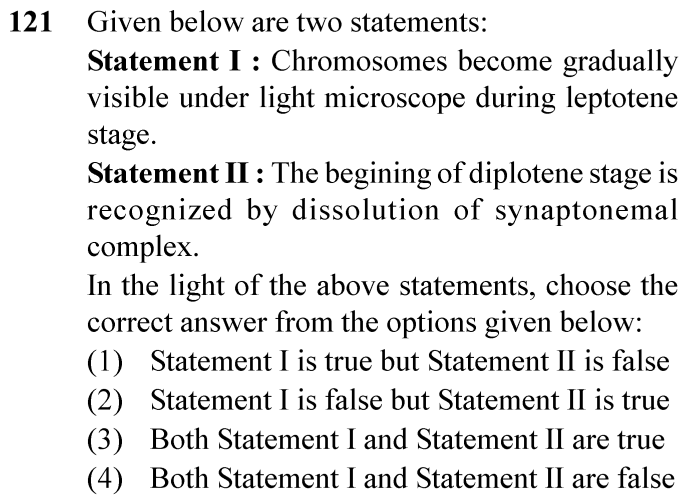
Official NEET 2024 Question 121 - Cell Cycle and Cell Division
1
2
3 ✓ Key
4
💡 Verified Solution & 30-Second Hack
✓
Verified Against NTA Final Answer Key
Option (3) : Both Statement I and Statement II are true
📚 Cell Cycle and Cell Division Easy
📋 Given Parameters & Problem Setup
Statement I During leptotene stage, chromosomes become gradually visible under the light microscope.
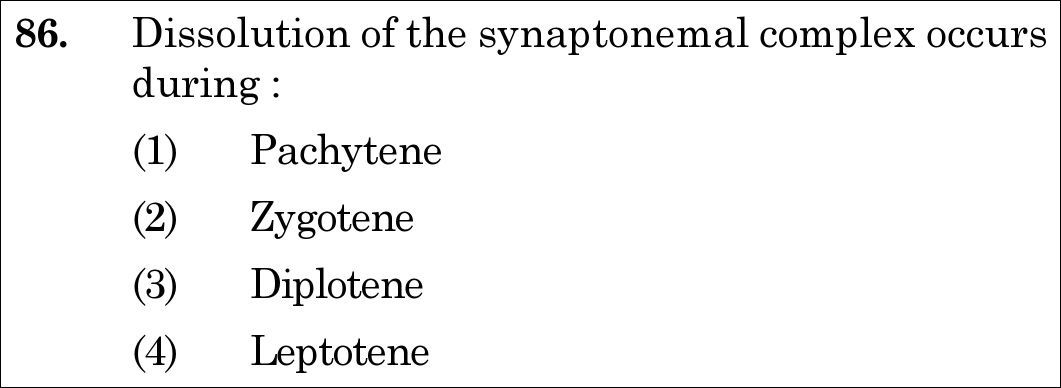
Statement II The beginning of diplotene is recognized by the dissolution of the synaptonemal complex.
⚡

The 30-Second Exam Hall Shortcut: ⚡ Prophase I Sub-stage Verbatim Match

⏱️ Save ~20 seconds

Both statements are verbatim NCERT lines: Leptotene = chromosomes become visible; Diplotene = dissolution of synaptonemal complex and chiasmata formation!

1 Examine Statement I: Leptotene involves progressive chromatin compaction, making chromosomes gradually visible under light microscopy -> TRUE.
2 Examine Statement II: Diplotene is marked by the dissolution of the synaptonemal complex and separation of homologous chromosomes (except at chiasmata) -> TRUE.
3 Both statements are true -> Option (3) / C.
🛡️
Why You Can 100% Trust This Shortcut: NCERT Biology · Cell Cycle and Cell Division (Prophase I of Meiosis)
📐

Step-by-Step Rigorous Workflow & Mathematical Proof

Step 1

Evaluate Statement I (Leptotene Dynamics)

During leptotene stage, the chromosomes become gradually visible under the light microscope. The compaction of chromosomes continues throughout leptotene. Thus, Statement I is completely true.

Step 2

Evaluate Statement II (Diplotene Dynamics)

The beginning of diplotene is recognized by the dissolution of the synaptonemal complex and the tendency of the recombined homologous chromosomes of the bivalents to separate from each other except at the sites of crossovers (forming X-shaped chiasmata). Thus, Statement II is completely true.

Step 3

Combine Findings

Both Statement I and Statement II are true statements, corresponding to Option (3).

⭐

360° Option Elimination Engine Key Feature

Diagnose every choice: Know exactly why the right option works and why distractors fail.

4-Option Deep Scan
1 (1)
✗ Incorrect
Verdict & Scientific Reason:

Statement II is also factually true.

⚠️
Student Fallacy (Why candidates pick this trap): Statement II is also factually true.
2 (2)
✗ Incorrect
Verdict & Scientific Reason:

Statement I is factually true.

⚠️
Student Fallacy (Why candidates pick this trap): Statement I is factually true.
3 (3)
✓ 100% Correct
Verdict & Scientific Reason:

Both statements match verbatim descriptions in NCERT for leptotene and diplotene stages.

💡
Why this is airtight: None.
4 (4)
✗ Incorrect
Verdict & Scientific Reason:

Neither statement is false.

⚠️
Student Fallacy (Why candidates pick this trap): Neither statement is false.
⚠️

NTA Trap Alert: Diakinesis vs Diplotene Chiasmata

Confusing dissolution of the synaptonemal complex (beginning of diplotene) with terminalisation of chiasmata (diakinesis).

🛡️ How to avoid the -1 mark: Synaptonemal complex dissolves in diplotene; chiasmata terminalise in diakinesis.
📖

Core NEET Syllabus Standard

Biology Core Botany · Cell Cycle and Cell Division Standard Benchmark
Core Scientific Principle Tested:

"During leptotene stage the chromosomes become gradually visible under the light microscope... The beginning of diplotene is recognised by the dissolution of the synaptonemal complex and the tendency of the recombined homologous chromosomes of the bivalents to separate."

Syllabus Focus: Sequential Sub-stages of Prophase I: Leptotene and Diplotene
✓ Core NEET UG Syllabus Anchor Syllabus & Academic Standards ↗
NEET 2024 · Q152 Easy
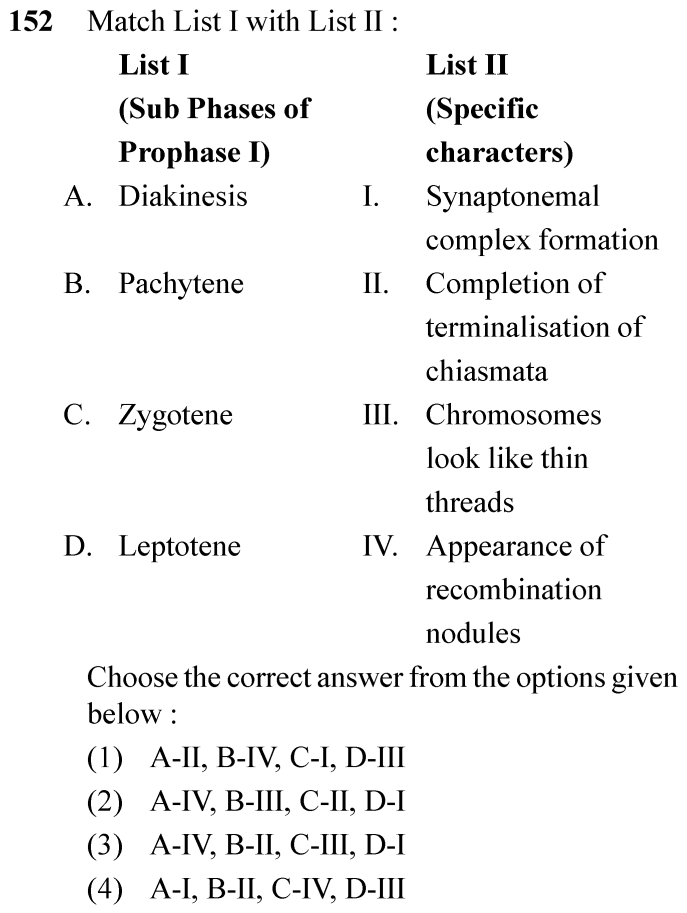
Official NEET 2024 Question 152 - Cell Cycle and Cell Division
1 ✓ Key
2
3
4
💡 Verified Solution & 30-Second Hack
✓
Verified Against NTA Final Answer Key
Option (1) : A-II, B-IV, C-I, D-III
📚 Cell Cycle and Cell Division Easy
📋 Given Parameters & Problem Setup
List I (Sub-phases of Prophase I) A: Diakinesis; B: Pachytene; C: Zygotene; D: Leptotene
List II (Hallmark Events) I: Synaptonemal complex formation; II: Completion of terminalisation of chiasmata; III: Chromosomes look like thin threads; IV: Appearance of recombination nodules
⚡

The 30-Second Exam Hall Shortcut: ⚡ Prophase I Sequential Landmarks (L-Z-P-D-D)

⏱️ Save ~25 seconds

Leptotene = Thin threads (III); Zygotene = Synaptonemal complex (I); Pachytene = Recombination nodules / crossing over (IV); Diakinesis = Terminalisation of chiasmata (II)! Match: A-II, B-IV, C-I, D-III!

1 A. Diakinesis: Final stage characterized by terminalisation of chiasmata (II).
2 B. Pachytene: Appearance of recombination nodules at sites of crossing over (IV).
3 C. Zygotene: Synapsis accompanied by formation of synaptonemal complex (I).
4 D. Leptotene: Chromatin condenses into long, thin thread-like chromosomes (III).
5 Order: A-II, B-IV, C-I, D-III -> Option (1) / A.
🛡️
Why You Can 100% Trust This Shortcut: NCERT Biology · Cell Cycle and Cell Division (Meiosis I Prophase Stages)
📐

Step-by-Step Rigorous Workflow & Mathematical Proof

Step 1

Trace Zygotene and Leptotene Features

During leptotene, chromosomes become gradually visible under light microscopy appearing like thin individual threads (D -> III). During zygotene, homologous chromosomes begin pairing (synapsis) accompanied by the formation of the complex structure called synaptonemal complex (C -> I).

Step 2

Trace Pachytene and Diakinesis Features

During pachytene, bivalents show four chromatids and recombination nodules appear at sites where crossing over occurs between non-sister chromatids (B -> IV). The final stage of meiotic prophase I is diakinesis, marked by the completion of terminalisation of chiasmata (A -> II).

Step 3

Assemble Combination

A-II, B-IV, C-I, D-III corresponds to Option (1).

⭐

360° Option Elimination Engine Key Feature

Diagnose every choice: Know exactly why the right option works and why distractors fail.

4-Option Deep Scan
1 (1)
✓ 100% Correct
Verdict & Scientific Reason:

Accurately pairs all four prophase I stages with their definitive cytological hallmarks.

💡
Why this is airtight: None.
2 (2)
✗ Incorrect
Verdict & Scientific Reason:

Mismatches Diakinesis with recombination nodules and Leptotene with synaptonemal complex.

⚠️
Student Fallacy (Why candidates pick this trap): Mismatches Diakinesis with recombination nodules and Leptotene with synaptonemal complex.
3 (3)
✗ Incorrect
Verdict & Scientific Reason:

Mismatches Diakinesis with recombination nodules.

⚠️
Student Fallacy (Why candidates pick this trap): Mismatches Diakinesis with recombination nodules.
4 (4)
✗ Incorrect
Verdict & Scientific Reason:

Mismatches Diakinesis with synaptonemal complex.

⚠️
Student Fallacy (Why candidates pick this trap): Mismatches Diakinesis with synaptonemal complex.
⚠️

NTA Trap Alert: Pachytene vs Zygotene Structures

Confusing synaptonemal complex formation (Zygotene) with recombination nodules (Pachytene).

🛡️ How to avoid the -1 mark: Synaptonemal complex forms during Zygotene (synapsis); Recombination nodules appear in Pachytene.
📖

Core NEET Syllabus Standard

Biology Core Zoology · Cell Cycle and Cell Division Standard Benchmark
Core Scientific Principle Tested:

"During zygotene, chromosomes start pairing together and this process of association is called synapsis... accompanied by formation of synaptonemal complex. Pachytene is characterised by the appearance of recombination nodules. Diakinesis is marked by terminalisation of chiasmata."

Syllabus Focus: Sub-phases of Prophase I: Characteristic Cytological Events
✓ Core NEET UG Syllabus Anchor Syllabus & Academic Standards ↗
NEET 2024 · Q185 Easy
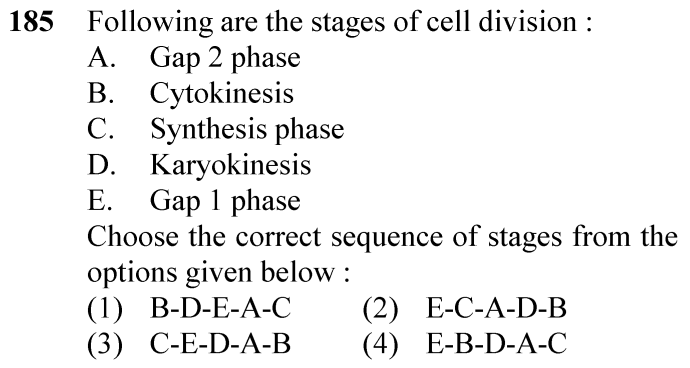
Official NEET 2024 Question 185 - Cell Cycle and Cell Division
1 B-D-E-A-C
2 E-C-A-D-B ✓ Key
3 C-E-D-A-B
4 E-B-D-A-C
💡 Verified Solution & 30-Second Hack
✓
Verified Against NTA Final Answer Key
Option (2) : E-C-A-D-B
📚 Cell Cycle and Cell Division Easy
📋 Given Parameters & Problem Setup
Event Eukaryotic cell division cycle
Stages A: Gap 2 phase (G2); B: Cytokinesis; C: Synthesis phase (S); D: Karyokinesis; E: Gap 1 phase (G1)
⚡

The 30-Second Exam Hall Shortcut: ⚡ Universal Cell Cycle Chronology (G1 -> S -> G2 -> M)

⏱️ Save ~20 seconds

Cell cycle order is always: G1 phase (E) -> S phase (C) -> G2 phase (A) -> Karyokinesis (D) -> Cytokinesis (B)! Sequence: E -> C -> A -> D -> B!

1 Recall the sequential phases of the cell cycle:
2 Gap 1 (G1) phase: Interval between mitosis and DNA replication (E).
3 Synthesis (S) phase: DNA replication occurs (C).
4 Gap 2 (G2) phase: Protein synthesis in preparation for mitosis (A).
5 Karyokinesis: Nuclear division (prophase, metaphase, anaphase, telophase) (D).
6 Cytokinesis: Division of cytoplasm to form two daughter cells (B).
7 Sequential progression: E -> C -> A -> D -> B -> Option (2) / B.
🛡️
Why You Can 100% Trust This Shortcut: NCERT Biology · Cell Cycle and Cell Division (Phases of Cell Cycle)
📐

Step-by-Step Rigorous Workflow & Mathematical Proof

Step 1

Interphase Progression (G1 -> S -> G2)

Interphase, though called the resting phase, is the time during which the cell is preparing for division by undergoing both cell growth and DNA replication in an orderly manner. It is divided into three phases: - G1 phase (Gap 1): Cell is metabolically active and continuously grows (Stage E). - S phase (Synthesis): DNA replication takes place (Stage C). - G2 phase (Gap 2): Proteins are synthesised in preparation for mitosis while cell growth continues (Stage A).

Step 2

M Phase Progression (Karyokinesis -> Cytokinesis)

The M Phase starts with the nuclear division, corresponding to the separation of daughter chromosomes (karyokinesis) (Stage D) and usually ends with division of cytoplasm (cytokinesis) (Stage B).

Step 3

Select Valid Sequence

The correct progression is E -> C -> A -> D -> B, which corresponds to Option (2).

⭐

360° Option Elimination Engine Key Feature

Diagnose every choice: Know exactly why the right option works and why distractors fail.

4-Option Deep Scan
1 (1)
✗ Incorrect
Verdict & Scientific Reason:

Starts with cytokinesis.

⚠️
Student Fallacy (Why candidates pick this trap): Starts with cytokinesis.
2 (2)
✓ 100% Correct
Verdict & Scientific Reason:

Accurately outlines standard eukaryotic cell cycle: G1 -> S -> G2 -> Karyokinesis -> Cytokinesis.

💡
Why this is airtight: None.
3 (3)
✗ Incorrect
Verdict & Scientific Reason:

Places S phase before G1 phase.

⚠️
Student Fallacy (Why candidates pick this trap): Places S phase before G1 phase.
4 (4)
✗ Incorrect
Verdict & Scientific Reason:

Places cytokinesis before nuclear division.

⚠️
Student Fallacy (Why candidates pick this trap): Places cytokinesis before nuclear division.
⚠️

NTA Trap Alert: Cytokinesis vs Karyokinesis Order

Placing cytokinesis (cytoplasm division) before karyokinesis (nuclear division).

🛡️ How to avoid the -1 mark: Nucleus must divide first (karyokinesis) before the cell body divides (cytokinesis).
📖

Core NEET Syllabus Standard

Biology Core Zoology · Cell Cycle and Cell Division Standard Benchmark
Core Scientific Principle Tested:

"The interphase is divided into three further phases: G1 phase (Gap 1), S phase (Synthesis), G2 phase (Gap 2)... The M Phase represents the phase when the actual cell division occurs, starting with karyokinesis and ending with cytokinesis."

Syllabus Focus: Sequential Phases of the Eukaryotic Cell Cycle
✓ Core NEET UG Syllabus Anchor Syllabus & Academic Standards ↗
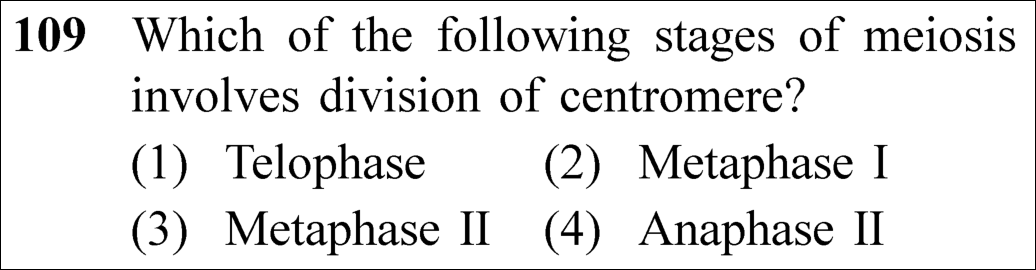
NEET 2023 · Q109 Easy
Official NEET 2023 Question 109 - Cell Cycle and Cell Division
1 Telophase
2 Metaphase I
3 Metaphase II
4 Anaphase II ✓ Key
💡 Verified Solution & 30-Second Hack
✓
Verified Against NTA Final Answer Key
Option (4) : Anaphase II
📚 Cell Cycle and Cell Division Easy
📋 Given Parameters & Problem Setup
Division Type Meiosis (Reductional followed by Equational)
Event Division / splitting of the centromere
⚡

The 30-Second Exam Hall Shortcut: ⚡ Anaphase I vs. Anaphase II Rule

⏱️ Save ~20 seconds

In Anaphase I, homologous chromosomes separate while centromeres remain intact. Centromere division strictly occurs in Anaphase II (equational division, analogous to mitosis)!

1 Metaphase I: Bivalents align at equatorial plate; centromeres do not divide.
2 Anaphase I: Homologous chromosomes disjoin; sister chromatids remain attached at their centromeres.
3 Metaphase II: Chromosomes align at equator individually.
4 Anaphase II: Simultaneous splitting of centromeres allows sister chromatids to move toward opposite poles.
5 Match Option (4) Anaphase II.
🛡️
Why You Can 100% Trust This Shortcut: Canonical NCERT Cell Division chromosome dynamics during meiotic segregation.
📐

Step-by-Step Rigorous Workflow & Mathematical Proof

Step 1

Contrast Between Meiotic Anaphase Stages

Chromosome dynamics differ fundamentally between the two meiotic anaphase stages:

Anaphase I:Disjunction of homologous chromosomes; Centromeres do NOT splitAnaphase II:Splitting of centromeres of each chromosome; Sister chromatids separate\begin{aligned} \text{\textbf{Anaphase I:}} & \quad \text{Disjunction of homologous chromosomes; } \mathbf{\text{Centromeres do NOT split}} \\[4pt] \text{\textbf{Anaphase II:}} & \quad \text{Splitting of centromeres of each chromosome; } \mathbf{\text{Sister chromatids separate}} \end{aligned}
Step 2

NCERT Canonical Description of Anaphase II

NCERT defines Anaphase II: "It begins with the simultaneous splitting of the centromere of each chromosome (which was holding the sister chromatids together), allowing them to move toward opposite poles of the cell."

Step 3

Chromatid Conversion to Daughter Chromosomes

Upon splitting of the centromere in Anaphase II, each sister chromatid officially becomes an independent individual daughter chromosome.

⭐

360° Option Elimination Engine Key Feature

Diagnose every choice: Know exactly why the right option works and why distractors fail.

4-Option Deep Scan
1 1
✗ Incorrect
Verdict & Scientific Reason:

In telophase, chromosomes arrive at spindle poles, decondense, and nuclear envelopes reform; centromere splitting has already occurred.

⚠️
Student Fallacy (Why candidates pick this trap): Confusing terminal nuclear reconstitution with poleward segregation.
2 2
✗ Incorrect
Verdict & Scientific Reason:

In Metaphase I, bivalent homologous pairs align at the metaphase plate; centromeres remain undivided.

⚠️
Student Fallacy (Why candidates pick this trap): Confusing alignment on equatorial plate with mechanical splitting.
3 3
✗ Incorrect
Verdict & Scientific Reason:

In Metaphase II, individual chromosomes align at the equator, but centromeres only divide at the onset of Anaphase II.

⚠️
Student Fallacy (Why candidates pick this trap): Prematurely assigning centromere division to metaphase rather than anaphase.
4 4
✓ 100% Correct
Verdict & Scientific Reason:

Simultaneous splitting of centromeres is the defining biochemical event of Anaphase II.

💡
Why this is airtight: None; precise textbook fact.
⚠️

NTA Trap Alert: Anaphase I vs. Anaphase II Trap

Students frequently rush and mistake Anaphase I for centromere splitting. In Anaphase I, centromeres do NOT divide; only homologous chromosomes separate.

🛡️ How to avoid the -1 mark: Remember: Homologs separate in Anaphase I (no splitting). Sister chromatids separate in Anaphase II (centromere splits).
📖

Core NEET Syllabus Standard

NCERT Biology · Cell Cycle and Cell Division Standard Benchmark
Core Scientific Principle Tested:

"Anaphase II begins with the simultaneous splitting of the centromere of each chromosome, allowing sister chromatids to move toward opposite poles."

Syllabus Focus: Meiosis II
✓ Core NEET UG Syllabus Anchor Syllabus & Academic Standards ↗
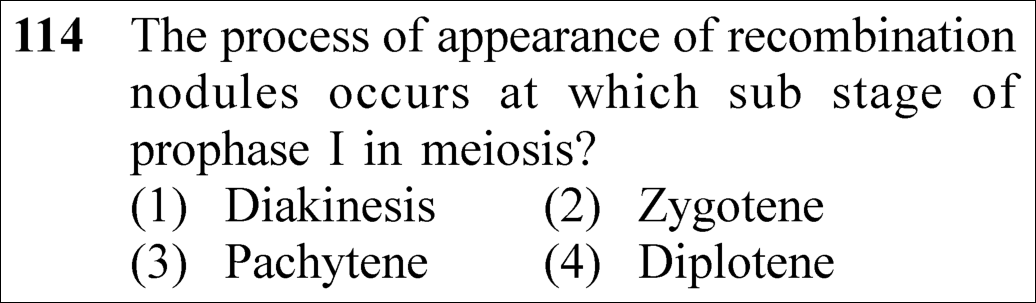
NEET 2023 · Q114 Easy
Official NEET 2023 Question 114 - Cell Cycle and Cell Division
1 Diakinesis
2 Zygotene
3 Pachytene ✓ Key
4 Diplotene
💡 Verified Solution & 30-Second Hack
✓
Verified Against NTA Final Answer Key
Option (3) : Pachytene
📚 Cell Cycle and Cell Division Easy
📋 Given Parameters & Problem Setup
Division Phase Prophase I of Meiosis
Cytological Feature Appearance of recombination nodules
⚡

The 30-Second Exam Hall Shortcut: ⚡ LZPDD Meiosis Anchor: Recombination Nodules = Pachytene

⏱️ Save ~20 seconds

Remember the five sub-stages: Leptotene (compaction), Zygotene (synapsis/synaptonemal complex), Pachytene (crossing over & recombination nodules), Diplotene (chiasmata), Diakinesis (terminalisation). Recombination nodules appear in Pachytene!

1 Zygotene: Homologous chromosomes synapse; synaptonemal complex forms.
2 Pachytene: Bivalents clearly visible as tetrads; recombination nodules appear; crossing over mediated by recombinase.
3 Diplotene: Dissolution of synaptonemal complex; X-shaped chiasmata become visible.
4 Diakinesis: Terminalisation of chiasmata.
5 Match Option (3) Pachytene.
🛡️
Why You Can 100% Trust This Shortcut: Canonical NCERT Cell Division Prophase I sub-stage cytological markers.
📐

Step-by-Step Rigorous Workflow & Mathematical Proof

Step 1

Chronology of Prophase I Sub-stages

Prophase I is exceptionally prolonged and categorized into five consecutive stages based on chromosomal behavior:

Leptotene:Progressive condensation and compaction of chromatinZygotene:Synapsis mediated by synaptonemal complexPachytene:Recombination nodules appear; crossing over occursDiplotene:Dissolution of synaptonemal complex; chiasmata visibleDiakinesis:Terminalisation of chiasmata; nuclear envelope breakdown\begin{aligned} \text{Leptotene:} & \quad \text{Progressive condensation and compaction of chromatin} \\[3pt] \text{Zygotene:} & \quad \text{Synapsis mediated by synaptonemal complex} \\[3pt] \text{\textbf{Pachytene:}} & \quad \text{\textbf{Recombination nodules appear; crossing over occurs}} \\[3pt] \text{Diplotene:} & \quad \text{Dissolution of synaptonemal complex; chiasmata visible} \\[3pt] \text{Diakinesis:} & \quad \text{Terminalisation of chiasmata; nuclear envelope breakdown} \end{aligned}
Step 2

Nature of Recombination Nodules

Recombination nodules are protein-rich multicomponent enzymatic complexes (containing recombinase, DNA endonucleases, and ligases) that assemble along the synaptonemal complex between non-sister chromatids of homologous chromosomes at pachytene.

Step 3

Verbatim NCERT Definition

NCERT states verbatim: "This stage is characterized by the appearance of recombination nodules, the sites at which crossing over occurs between non-sister chromatids of the homologous chromosomes."

⭐

360° Option Elimination Engine Key Feature

Diagnose every choice: Know exactly why the right option works and why distractors fail.

4-Option Deep Scan
1 1
✗ Incorrect
Verdict & Scientific Reason:

Diakinesis is the final stage marked by terminalisation of chiasmata, spindle assembly, and nucleolus disappearance.

⚠️
Student Fallacy (Why candidates pick this trap): Confusing terminalisation of chiasmata with initial nodule assembly.
2 2
✗ Incorrect
Verdict & Scientific Reason:

Zygotene is characterized by synapsis and formation of the synaptonemal complex, not recombination nodules.

⚠️
Student Fallacy (Why candidates pick this trap): Assuming crossing over and nodule formation happen simultaneously with pairing in zygotene.
3 3
✓ 100% Correct
Verdict & Scientific Reason:

Exact NCERT definition: appearance of recombination nodules and crossing over takes place in pachytene.

💡
Why this is airtight: None; textbook verbatim.
4 4
✗ Incorrect
Verdict & Scientific Reason:

Diplotene is recognized by the dissolution of the synaptonemal complex and the appearance of X-shaped chiasmata.

⚠️
Student Fallacy (Why candidates pick this trap): Confusing visible chiasmata with recombination nodules.
⚠️

NTA Trap Alert: Zygotene vs. Pachytene Synapsis Trap

Students frequently conflate the assembly of the synaptonemal complex (zygotene) with the appearance of recombination nodules (pachytene).

🛡️ How to avoid the -1 mark: Zygotene = Synaptonemal complex forms. Pachytene = Recombination nodules appear & crossing over occurs.
📖

Core NEET Syllabus Standard

NCERT Biology · Cell Cycle and Cell Division Standard Benchmark
Core Scientific Principle Tested:

"Pachytene stage is characterized by the appearance of recombination nodules, the sites at which crossing over occurs between non-sister chromatids of the homologous chromosomes."

Syllabus Focus: Meiosis I - Prophase I
✓ Core NEET UG Syllabus Anchor Syllabus & Academic Standards ↗
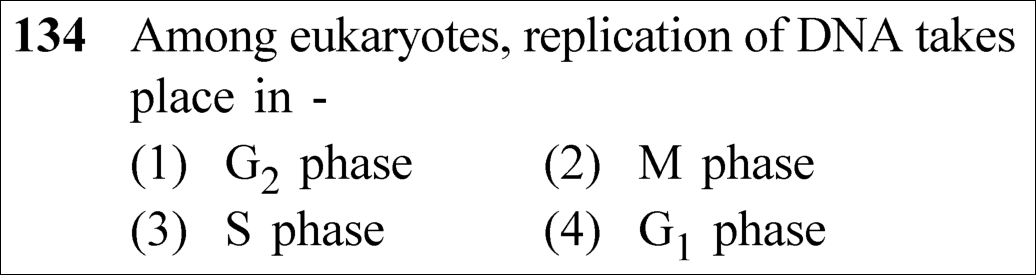
NEET 2023 · Q134 Easy
Official NEET 2023 Question 134 - Cell Cycle and Cell Division
1
2
3 ✓ Key
4
💡 Verified Solution & 30-Second Hack
✓
Verified Against NTA Final Answer Key
Option (3) : S phase
📚 Cell Cycle and Cell Division Easy
📋 Given Parameters & Problem Setup
Event Replication of nuclear DNA
Cell Type Eukaryotes
⚡

The 30-Second Exam Hall Shortcut: ⚡ Cell Cycle S Phase: S = Synthesis of DNA

⏱️ Save ~20 seconds

The cell cycle interphase consists of G1 (growth), S (synthesis/DNA replication), and G2 (protein synthesis). DNA replication takes place exclusively in the S phase, doubling DNA content from 2C to 4C!

1 G1 phase: Growth, metabolically active, RNA/protein synthesis before DNA replication.
2 S phase: Synthesis phase; DNA replication occurs in nucleus; centriole duplicates in cytoplasm.
3 G2 phase: Tubulin and mitotic protein synthesis.
4 M phase: Nuclear and cytoplasmic division.
5 Match Option (3) S phase.
🛡️
Why You Can 100% Trust This Shortcut: Canonical NCERT Cell Division interphase phase transitions.
📐

Step-by-Step Rigorous Workflow & Mathematical Proof

Step 1

Phases of Interphase

Interphase is subdivided into three distinct sequential phases:

G1 Phase (Gap 1):Metabolic growth, interval between mitosis and DNA synthesisS Phase (Synthesis):DNA replication and doubling of DNA content (2C→4C)G2 Phase (Gap 2):Synthesis of tubulin and proteins for mitosis\begin{aligned} \mathbf{G_1\text{ Phase (Gap 1):}} & \quad \text{Metabolic growth, interval between mitosis and DNA synthesis} \\[3pt] \mathbf{S\text{ Phase (Synthesis):}} & \quad \mathbf{\text{DNA replication and doubling of DNA content } (2C \to 4C)} \\[3pt] \mathbf{G_2\text{ Phase (Gap 2):}} & \quad \text{Synthesis of tubulin and proteins for mitosis} \end{aligned}
Step 2

Verbatim NCERT Reference

NCERT states verbatim: "S or synthesis phase marks the period during which DNA synthesis or replication takes place. During this time the amount of DNA per cell doubles. If the initial amount of DNA is denoted as 2C then it increases to 4C."

Step 3

Chromosome Number Invariance

Crucially, while the DNA content doubles from 2C2C to 4C4C, the chromosome number remains unchanged at 2n2n because sister chromatids remain physically united at the centromere until anaphase.

⭐

360° Option Elimination Engine Key Feature

Diagnose every choice: Know exactly why the right option works and why distractors fail.

4-Option Deep Scan
1 1
✗ Incorrect
Verdict & Scientific Reason:

In G2 phase, proteins (like tubulin) are synthesized in preparation for mitosis while cell growth continues.

⚠️
Student Fallacy (Why candidates pick this trap): Confusing post-replication mitotic preparation with replication itself.
2 2
✗ Incorrect
Verdict & Scientific Reason:

M phase is the stage of chromosome condensation, karyokinesis, and cytokinesis; replication has already concluded.

⚠️
Student Fallacy (Why candidates pick this trap): Confusing chromosome segregation with DNA synthesis.
3 3
✓ 100% Correct
Verdict & Scientific Reason:

DNA replication takes place exclusively during the S (Synthesis) phase of interphase.

💡
Why this is airtight: None; fundamental cell biology.
4 4
✗ Incorrect
Verdict & Scientific Reason:

G1 phase precedes DNA replication; the cell is metabolically active and grows continuously.

⚠️
Student Fallacy (Why candidates pick this trap): Confusing pre-replication preparation with actual replication.
⚠️

NTA Trap Alert: DNA Content vs. Chromosome Number Trap

Students frequently think that because DNA doubles in S phase, the chromosome number doubles too. Chromosome count remains 2n2n; only DNA content increases from 2C2C to 4C4C.

🛡️ How to avoid the -1 mark: DNA doubles (2C→4C2C \to 4C), but chromosome number stays constant (2n→2n2n \to 2n) in S phase.
📖

Core NEET Syllabus Standard

NCERT Biology · Cell Cycle and Cell Division Standard Benchmark
Core Scientific Principle Tested:

"S or synthesis phase marks the period during which DNA synthesis or replication takes place."

Syllabus Focus: Interphase (S Phase)
✓ Core NEET UG Syllabus Anchor Syllabus & Academic Standards ↗
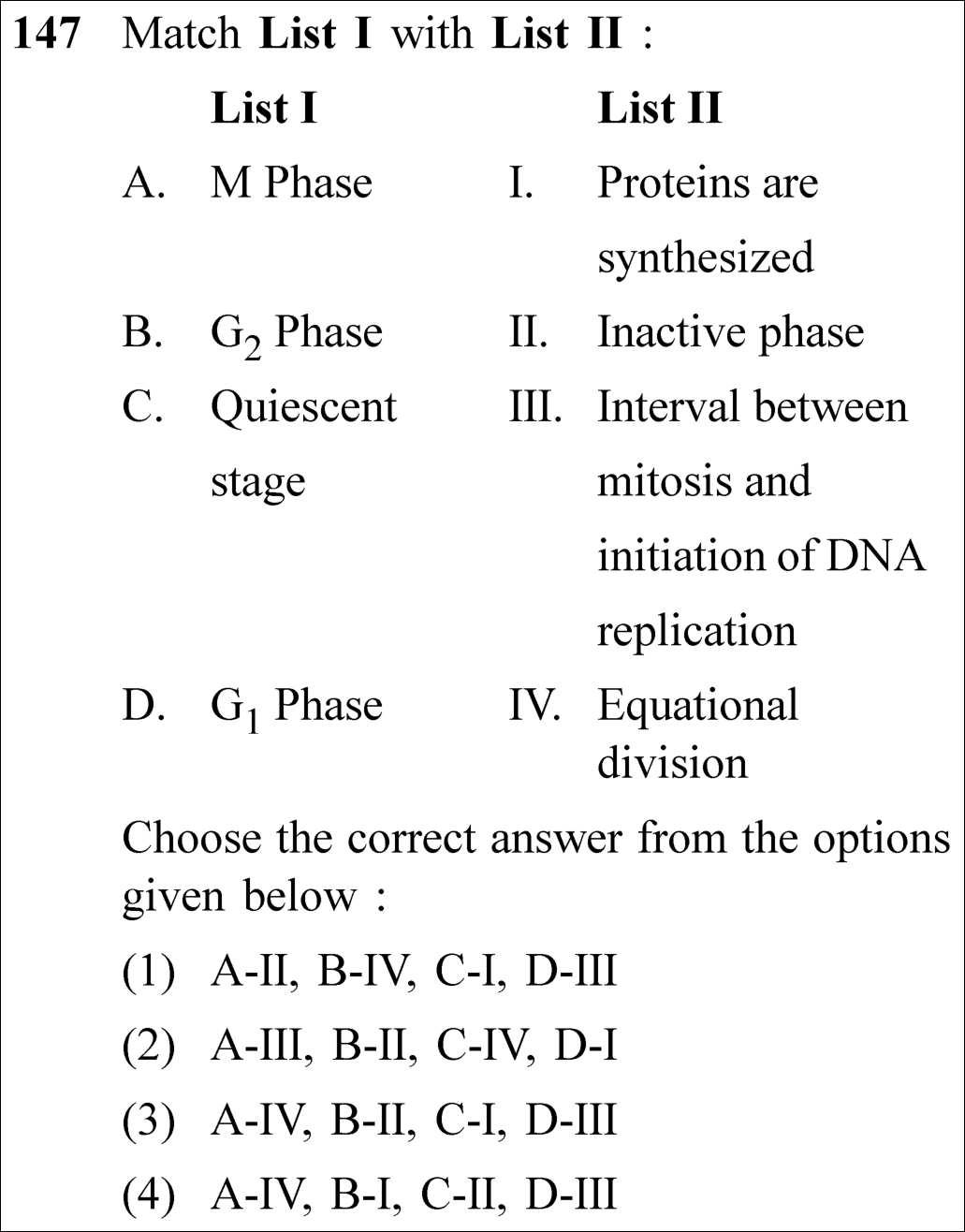
NEET 2023 · Q147 Easy
Official NEET 2023 Question 147 - Cell Cycle and Cell Division
1
2
3
4 ✓ Key
💡 Verified Solution & 30-Second Hack
✓
Verified Against NTA Final Answer Key
Option (4) : A-IV, B-I, C-II, D-III
📚 Cell Cycle and Cell Division Easy
📋 Given Parameters & Problem Setup
List I (Phases) M Phase, G2 Phase, Quiescent stage (G0), G1 Phase
List II (Characteristics) Proteins synthesized, Inactive phase, Interval between mitosis and replication, Equational division
⚡

The 30-Second Exam Hall Shortcut: ⚡ Cell Cycle Phase Hallmark Matcher

⏱️ Save ~25 seconds

Match each phase to its NCERT definition: M Phase = Equational division (IV). G2 Phase = Proteins synthesized (I). Quiescent stage = Inactive phase G0 (II). G1 Phase = Interval between mitosis and DNA replication (III)! Match Option (4)!

1 M Phase: Mitosis involves equational segregation of chromosomes -> A-IV.
2 G2 Phase: Proteins (e.g., tubulin) are synthesized in preparation for mitosis -> B-I.
3 Quiescent stage (G0): Cells enter an inactive phase where they remain metabolically active but do not proliferate -> C-II.
4 G1 Phase: Interval between mitosis and initiation of DNA replication -> D-III.
5 Match combination: A-IV, B-I, C-II, D-III -> Option (4).
🛡️
Why You Can 100% Trust This Shortcut: Canonical NCERT Cell Cycle phase definitions and metabolic characteristics.
📐

Step-by-Step Rigorous Workflow & Mathematical Proof

Step 1

Analysis of Cell Cycle Phases

Correlating each cell cycle phase with its verbatim NCERT definition:

\begin{aligned} \text{\textbf{A. M Phase:}} & \quad \text{Equational division (chromosome number maintained)} \implies \mathbf{\text{IV}} \\[3pt] \text{\textbf{B. } G_2\text{\textbf{ Phase:}}} & \quad \text{Proteins are synthesised in preparation for mitosis} \implies \mathbf{\text{I}} \\[3pt] \text{\textbf{C. Quiescent stage (} G_0 \text{\textbf{):}}} & \quad \text{Cells exit cycle and enter an inactive phase} \implies \mathbf{\text{II}} \\[3pt] \text{\textbf{D. } G_1\text{\textbf{ Phase:}}} & \quad \text{Interval between mitosis and initiation of DNA replication} \implies \mathbf{\text{III}} \end{aligned}
Step 2

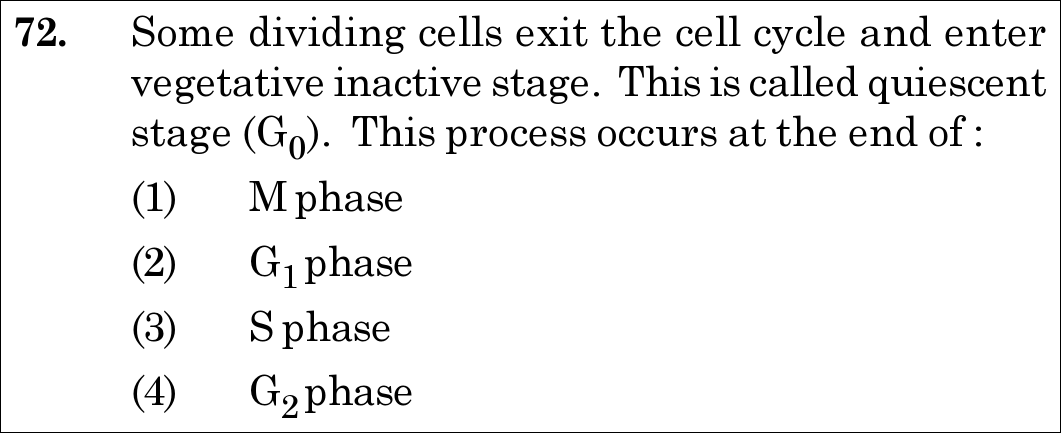
Verification of Quiescent Phase G0

NCERT explicitly states: "These cells that do not divide further exit G1 phase to enter an inactive stage called quiescent stage (G0) of the cell cycle. Cells in this stage remain metabolically active but no longer proliferate."

Step 3

Option Elimination

A-IV is present in Options (3) and (4). B-I uniquely identifies Option (4), while Option (3) incorrectly assigns B to II.

⭐

360° Option Elimination Engine Key Feature

Diagnose every choice: Know exactly why the right option works and why distractors fail.

4-Option Deep Scan
1 1
✗ Incorrect
Verdict & Scientific Reason:

Mismatches M phase with inactive phase.

⚠️
Student Fallacy (Why candidates pick this trap): Calling M phase inactive.
2 2
✗ Incorrect
Verdict & Scientific Reason:

Mismatches M phase with G1 interval.

⚠️
Student Fallacy (Why candidates pick this trap): Scrambling interphase definitions.
3 3
✗ Incorrect
Verdict & Scientific Reason:

Assigns G2 phase to inactive phase (II) instead of protein synthesis (I).

⚠️
Student Fallacy (Why candidates pick this trap): Swapping G2 and G0 descriptions.
4 4
✓ 100% Correct
Verdict & Scientific Reason:

Every phase matches its canonical NCERT characteristic verbatim.

💡
Why this is airtight: None; textbook verbatim match.
⚠️

NTA Trap Alert: G0 "Inactive Phase" Misconception Trap

Although NCERT terms G0 an "inactive phase", cells in G0 are strictly active metabolically; "inactive" refers solely to the cessation of cell proliferation/division.

🛡️ How to avoid the -1 mark: Remember: G0 = Inactive regarding division, but fully active metabolically.
📖

Core NEET Syllabus Standard

NCERT Biology · Cell Cycle and Cell Division Standard Benchmark
Core Scientific Principle Tested:

"M Phase is equational division; G2 phase synthesises proteins; Quiescent stage G0 is an inactive proliferative phase; G1 is the interval between mitosis and DNA replication."

Syllabus Focus: Phases of Cell Cycle
✓ Core NEET UG Syllabus Anchor Syllabus & Academic Standards ↗
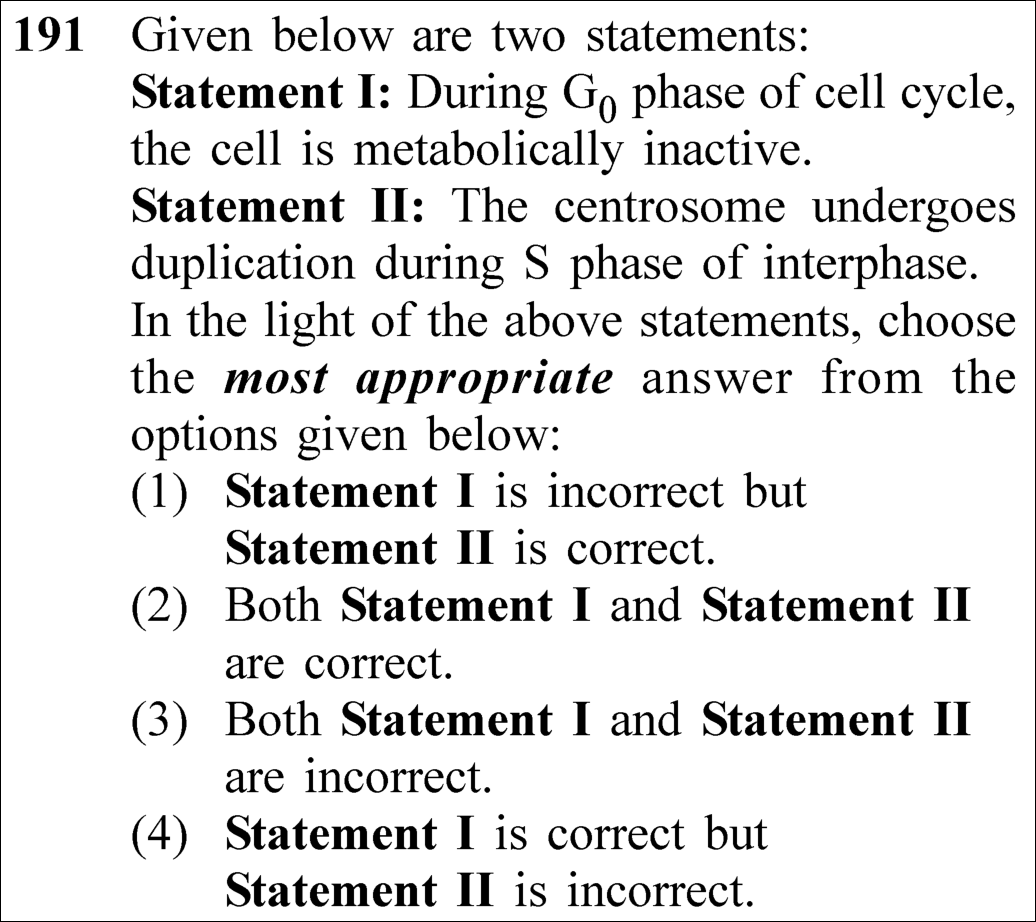
NEET 2023 · Q191 Easy
Official NEET 2023 Question 191 - Cell Cycle and Cell Division
1 ✓ Key
2
3
4
💡 Verified Solution & 30-Second Hack
✓
Verified Against NTA Final Answer Key
Option (1) : Statement I is incorrect but Statement II is correct.
📚 Cell Cycle and Cell Division Easy
📋 Given Parameters & Problem Setup
Statement I During G0 phase of cell cycle, the cell is metabolically inactive.
Statement II Centrosome undergoes duplication during S phase of interphase.
⚡

The 30-Second Exam Hall Shortcut: ⚡ G0 Metabolism Rule: Metabolically ACTIVE, Not Inactive!

⏱️ Save ~20 seconds

Cells in the quiescent stage (G0G_0) exit the division cycle but remain METABOLICALLY ACTIVE (synthesizing ATP and proteins, e.g., neurons and cardiac myocytes). Statement I is FALSE! Statement II is TRUE (centrosome duplicates in cytoplasm during S phase). Select Option (1)!

1 Check Statement I: Claims G0 cells are metabolically inactive -> False (NCERT: "Cells in this stage remain metabolically active but no longer proliferate").
2 Check Statement II: Centrosome duplicates in cytoplasm during S phase of interphase -> Verbatim NCERT, Correct.
3 Statement I is incorrect but Statement II is correct.
4 Match Option (1).
🛡️
Why You Can 100% Trust This Shortcut: Canonical NCERT Cell Division interphase molecular milestones.
📐

Step-by-Step Rigorous Workflow & Mathematical Proof

Step 1

Evaluation of Statement I (Quiescent G0 Phase Metabolism)

Cells that suspend division (e.g., heart cells, neurons) exit G1G_1 to enter the quiescent stage (G0G_0). These cells do not replicate DNA or divide, but carry out full cellular respiration, protein synthesis, and basal metabolism:

G0 Cells  ⟹  Metabolically ACTIVE(≠Inactive)  ⟹  Statement I is INCORRECT\text{\textbf{G}}_0\text{\textbf{ Cells}} \implies \mathbf{\text{Metabolically ACTIVE}} \quad (\neq \text{Inactive}) \implies \text{Statement I is } \mathbf{\text{INCORRECT}}
Step 2

Evaluation of Statement II (S-Phase Cytoplasmic Events)

During the synthesis (SS) phase in animal cells, nuclear events and cytoplasmic events proceed in parallel: 1. Nuclear event: Nuclear DNA replication (2C→4C2C \to 4C). 2. Cytoplasmic event: Centrosome (centriole pair) duplication in the cytoplasm.

S Phase={Nucleus:DNA replication (2C→4C)Cytoplasm:Centrosome duplicates  ⟹  Statement II is CORRECT\text{\textbf{S Phase}} = \begin{cases} \text{Nucleus:} & \text{DNA replication } (2C \to 4C) \\[2pt] \mathbf{\text{Cytoplasm:}} & \mathbf{\text{Centrosome duplicates}} \end{cases} \implies \text{Statement II is } \mathbf{\text{CORRECT}}
Step 3

Verbatim NCERT Reference

NCERT states verbatim: - "Cells in this stage [G0] remain metabolically active but no longer proliferate unless called on to do so." (Statement I is FALSE) - "In animal cells, during the S phase, DNA replication begins in the nucleus, and the centriole duplicates in the cytoplasm." (Statement II is TRUE)

⭐

360° Option Elimination Engine Key Feature

Diagnose every choice: Know exactly why the right option works and why distractors fail.

4-Option Deep Scan
1 1
✓ 100% Correct
Verdict & Scientific Reason:

Statement I falsely calls G0 metabolically inactive; Statement II correctly identifies centrosome duplication during S phase.

💡
Why this is airtight: None; rigorous cell biology literacy.
2 2
✗ Incorrect
Verdict & Scientific Reason:

Statement I is false because resting cells are actively metabolizing.

⚠️
Student Fallacy (Why candidates pick this trap): Confusing mitotic quiescence with metabolic death/inactivity.
3 3
✗ Incorrect
Verdict & Scientific Reason:

Statement II is a well-established textbook fact.

⚠️
Student Fallacy (Why candidates pick this trap): Assuming centrioles duplicate in G2 phase.
4 4
✗ Incorrect
Verdict & Scientific Reason:

Both statement verdicts are completely reversed.

⚠️
Student Fallacy (Why candidates pick this trap): Inverting both cell cycle concepts.
⚠️

NTA Trap Alert: Proliferative Inactivity vs. Metabolic Inactivity Trap

Students frequently equate "not dividing" with "metabolically inactive". A heart cell in G0 pumps blood 70 times a minute and consumes massive ATP; it is extraordinarily active metabolically, it just doesn't divide!

🛡️ How to avoid the -1 mark: Remember: G0 = Mitotically inactive, but METABOLICALLY ACTIVE.
📖

Core NEET Syllabus Standard

NCERT Biology · Cell Cycle and Cell Division Standard Benchmark
Core Scientific Principle Tested:

"Cells in G0 stage remain metabolically active but do not proliferate. In S phase, the centriole/centrosome duplicates in the cytoplasm."

Syllabus Focus: Phases of Cell Cycle (G0 and S Phase)
✓ Core NEET UG Syllabus Anchor Syllabus & Academic Standards ↗
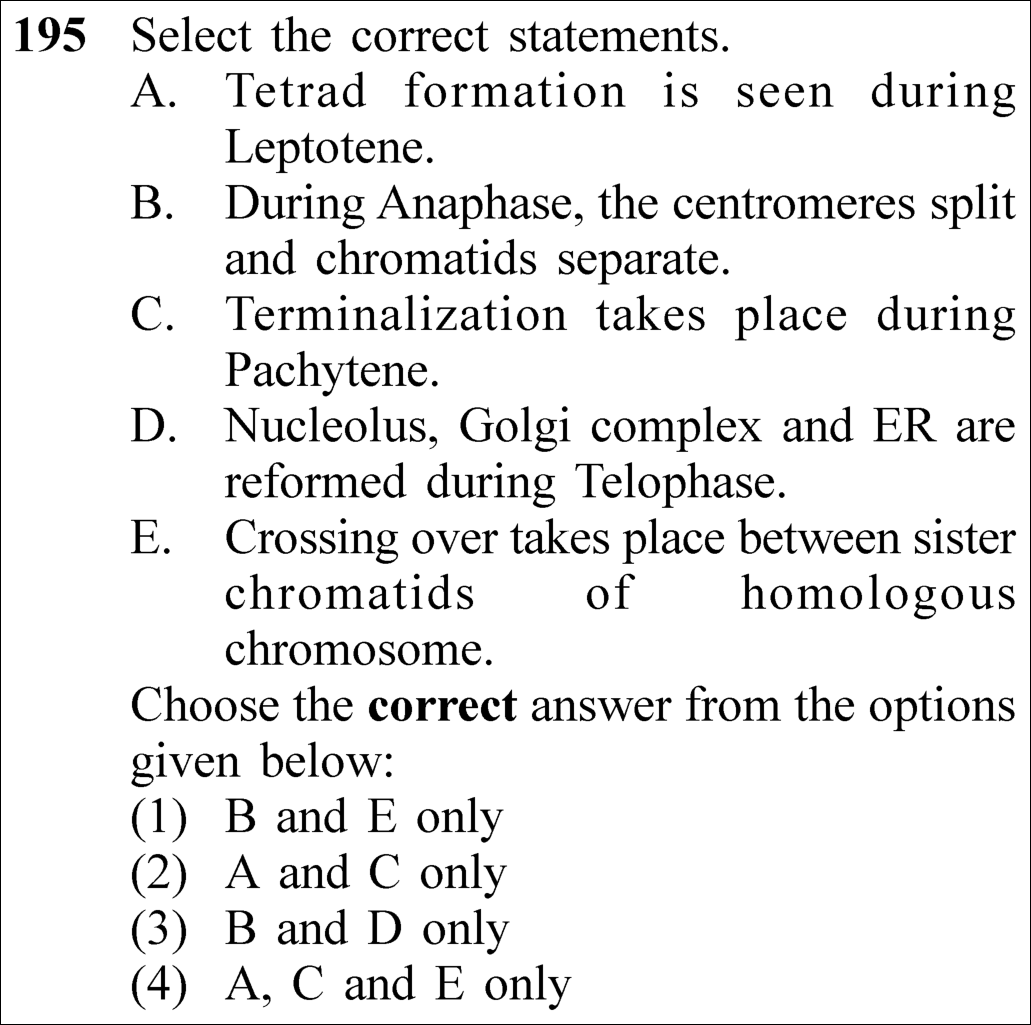
NEET 2023 · Q195 Easy
Official NEET 2023 Question 195 - Cell Cycle and Cell Division
1
2
3 ✓ Key
4
💡 Verified Solution & 30-Second Hack
✓
Verified Against NTA Final Answer Key
Option (3) : B and D only
📚 Cell Cycle and Cell Division Easy
📋 Given Parameters & Problem Setup
Statements 5 statements (A-E) on meiotic and mitotic events
⚡

The 30-Second Exam Hall Shortcut: ⚡ Mitotic & Meiotic Landmark Filter: B & D are TRUE!

⏱️ Save ~25 seconds

Spot the errors in A, C, and E: Tetrads appear in Zygotene/Pachytene (not Leptotene, A is false). Terminalization occurs in Diakinesis (not Pachytene, C is false). Crossing over occurs between NON-SISTER chromatids (not sister, E is false). Anaphase splits centromeres (B) and Telophase reforms organelles (D)! Match Option (3) B and D only!

1 Statement A: Tetrad in Leptotene -> False (Leptotene is compaction; tetrads seen in Zygotene/Pachytene).
2 Statement B: Anaphase centromeres split and chromatids separate -> True.
3 Statement C: Terminalization in Pachytene -> False (Pachytene is crossing over; terminalization is Diakinesis).
4 Statement D: Nucleolus, Golgi, ER reform in Telophase -> True.
5 Statement E: Crossing over between sister chromatids -> False (Between NON-SISTER chromatids of homologous chromosomes).
6 B and D only -> Select Option (3).
🛡️
Why You Can 100% Trust This Shortcut: Canonical NCERT Cell Division chromosome dynamics and karyokinetic stages.
📐

Step-by-Step Rigorous Workflow & Mathematical Proof

Step 1

Evaluation of Statements B and D (Valid Statements)

Analyzing the mitotic and meiotic cytological events according to NCERT: - Statement B: At the onset of anaphase, each chromosome arranged at the metaphase plate splits simultaneously at its centromere, and sister chromatids separate toward opposite poles. (Statement B is TRUE) - Statement D: Telophase reverses prophase events: chromosomes decondense, the nuclear envelope assembles, and the nucleolus, Golgi complex, and ER reform. (Statement D is TRUE)

Anaphase:Centromere splits ⟶Chromatids separate  ⟹  TRUE (B)Telophase:Reformation of Nucleolus, Golgi, and ER  ⟹  TRUE (D)\begin{aligned} \text{\textbf{Anaphase:}} & \quad \text{Centromere splits } \longrightarrow \text{Chromatids separate} \implies \mathbf{\text{TRUE (B)}} \\[3pt] \text{\textbf{Telophase:}} & \quad \text{Reformation of Nucleolus, Golgi, and ER} \implies \mathbf{\text{TRUE (D)}} \end{aligned}
Step 2

Evaluation of Statements A, C, and E (Invalid Statements)

Analyzing the specific errors planted in the distractors: - Statement A: Leptotene is characterized by progressive condensation of chromatin. Bivalents/tetrads form during zygotene and are clearly visible as tetrads during pachytene. - Statement C: Terminalization of chiasmata is the defining hallmark of the final stage of prophase I, diakinesis, not pachytene. - Statement E: Crossing over occurs between non-sister chromatids of homologous chromosomes. Recombination between identical sister chromatids would yield no genetic variation.

Step 3

Conclusion

Only Statements B and D are factually correct. Option (3) is the required answer.

⭐

360° Option Elimination Engine Key Feature

Diagnose every choice: Know exactly why the right option works and why distractors fail.

4-Option Deep Scan
1 1
✗ Incorrect
Verdict & Scientific Reason:

Statement E is false because crossing over involves non-sister chromatids.

⚠️
Student Fallacy (Why candidates pick this trap): Overlooking the critical word "sister" in Statement E.
2 2
✗ Incorrect
Verdict & Scientific Reason:

Both A (tetrad in leptotene) and C (terminalization in pachytene) are false.

⚠️
Student Fallacy (Why candidates pick this trap): Confusing prophase I sub-stage sequences.
3 3
✓ 100% Correct
Verdict & Scientific Reason:

Both Statements B (anaphase centromere division) and D (telophase organelle reformation) are verbatim NCERT facts.

💡
Why this is airtight: None; textbook verbatim precision.
4 4
✗ Incorrect
Verdict & Scientific Reason:

All three statements A, C, and E are false.

⚠️
Student Fallacy (Why candidates pick this trap): Selecting all the erroneous statements.
⚠️

NTA Trap Alert: Sister vs. Non-Sister Chromatid Crossing Over Trap

NTA frequently uses the trap phrase "crossing over between sister chromatids". Recombination between sister chromatids is genetically silent and does not produce recombinants; crossing over MUST occur between non-sister chromatids.

🛡️ How to avoid the -1 mark: Crossing over = Strictly NON-SISTER chromatids of homologous chromosomes.
📖

Core NEET Syllabus Standard

NCERT Biology · Cell Cycle and Cell Division Standard Benchmark
Core Scientific Principle Tested:

"In anaphase centromeres split and chromatids separate; in telophase nucleolus, Golgi complex and ER reform."

Syllabus Focus: Mitosis and Meiosis Stages
✓ Core NEET UG Syllabus Anchor Syllabus & Academic Standards ↗
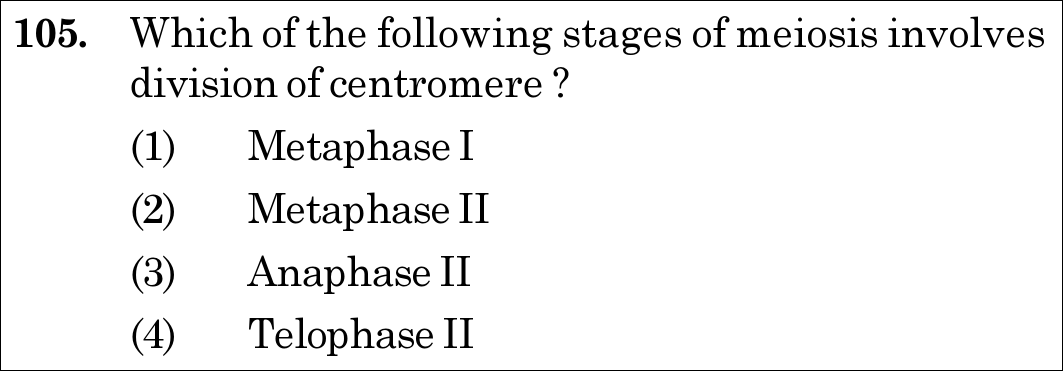
NEET 2021 · Q105 Easy
Official NEET 2021 Question 105 - Cell Cycle and Cell Division
1 Metaphase I
2 Metaphase II
3 Anaphase II ✓ Key
4 Telophase II
💡 Verified Solution & 30-Second Hack
✓
Verified Against NTA Final Answer Key
Option (3) : Anaphase II
📚 Cell Cycle and Cell Division Easy
📋 Given Parameters & Problem Setup
Biological Process Meiotic Cell Division
Event Splitting / division of centromere
⚡

The 30-Second Exam Hall Shortcut: ⚡ Anaphase I = Homolog Separation; Anaphase II = Centromere Split!

⏱️ Save ~20 seconds

In Meiosis I (Anaphase I), homologous chromosome pairs separate without centromere division! Centromeres split exclusively during Anaphase II, allowing sister chromatids to disjoin and migrate as individual chromosomes. Match Option (3)!

1 Recall Meiosis I is reductional division: homologous chromosomes separate at Anaphase I; sister chromatids remain conjoined at their centromeres.
2 Meiosis II is equational division: centromeres divide longitudinally at Anaphase II, separating sister chromatids.
3 Metaphase stages involve alignment on equatorial plates, not division.
4 Match Option (3).
🛡️
Why You Can 100% Trust This Shortcut: Canonical NCERT Cell Division mechanics of Meiosis.
📐

Step-by-Step Rigorous Workflow & Mathematical Proof

Step 1

Contrast Between Anaphase I and Anaphase II Mechanics

The behavior of centromeres is the single defining difference between meiotic stages:

Anaphase I:Disjunction of homologous chromosomes; Centromeres do NOT divideAnaphase II:Simultaneous splitting of centromeres; Sister chromatids separate\begin{aligned} \text{\textbf{Anaphase I:}} & \quad \text{Disjunction of homologous chromosomes; } \mathbf{\text{Centromeres do NOT divide}} \\[4pt] \text{\textbf{Anaphase II:}} & \quad \text{Simultaneous splitting of centromeres; } \mathbf{\text{Sister chromatids separate}} \end{aligned}
Step 2

Equational Nature of Meiosis II

Meiosis II closely resembles a standard mitotic division. At Anaphase II, the cohesin proteins at the centromeric region are cleaved, the centromere divides, and the kinetochore microtubules pull sister chromatids toward opposite spindle poles.

⭐

360° Option Elimination Engine Key Feature

Diagnose every choice: Know exactly why the right option works and why distractors fail.

4-Option Deep Scan
1 1
✗ Incorrect
Verdict & Scientific Reason:

In Metaphase I, bivalents align on the double equatorial plate; no centromere division occurs.

⚠️
Student Fallacy (Why candidates pick this trap): Confusing equatorial alignment with chromosomal splitting.
2 2
✗ Incorrect
Verdict & Scientific Reason:

In Metaphase II, chromosomes align individually on the equatorial plate; division takes place subsequently in anaphase.

⚠️
Student Fallacy (Why candidates pick this trap): Believing centromeres divide as soon as chromosomes align on the metaphase plate.
3 3
✓ 100% Correct
Verdict & Scientific Reason:

The centromere of each chromosome divides simultaneously at Anaphase II, allowing sister chromatids to migrate to opposite poles.

💡
Why this is airtight: None. Textbook fact.
4 4
✗ Incorrect
Verdict & Scientific Reason:

In Telophase II, chromosomes decondense and nuclear envelopes reform around daughter nuclei.

⚠️
Student Fallacy (Why candidates pick this trap): Confusing nuclear reconstitution and cytokinesis with centromere splitting.
⚠️

NTA Trap Alert: Anaphase I vs Anaphase II Centromere Misconception

Many candidates wrongly assume centromeres divide in both Anaphase I and Anaphase II. In Anaphase I, only whole dyad chromosomes separate; centromeres remain intact.

🛡️ How to avoid the -1 mark: Fix the rule: In Meiosis, centromeres divide ONLY ONCE — precisely at Anaphase II.
📖

Core NEET Syllabus Standard

NEET / NCERT Biology · Cell Cycle and Cell Division Standard Benchmark
Core Scientific Principle Tested:

"Division of centromeres and separation of sister chromatids occurs during Anaphase II of meiosis."

Syllabus Focus: Stages of Meiosis II (Anaphase II)
✓ Core NEET UG Syllabus Anchor Syllabus & Academic Standards ↗
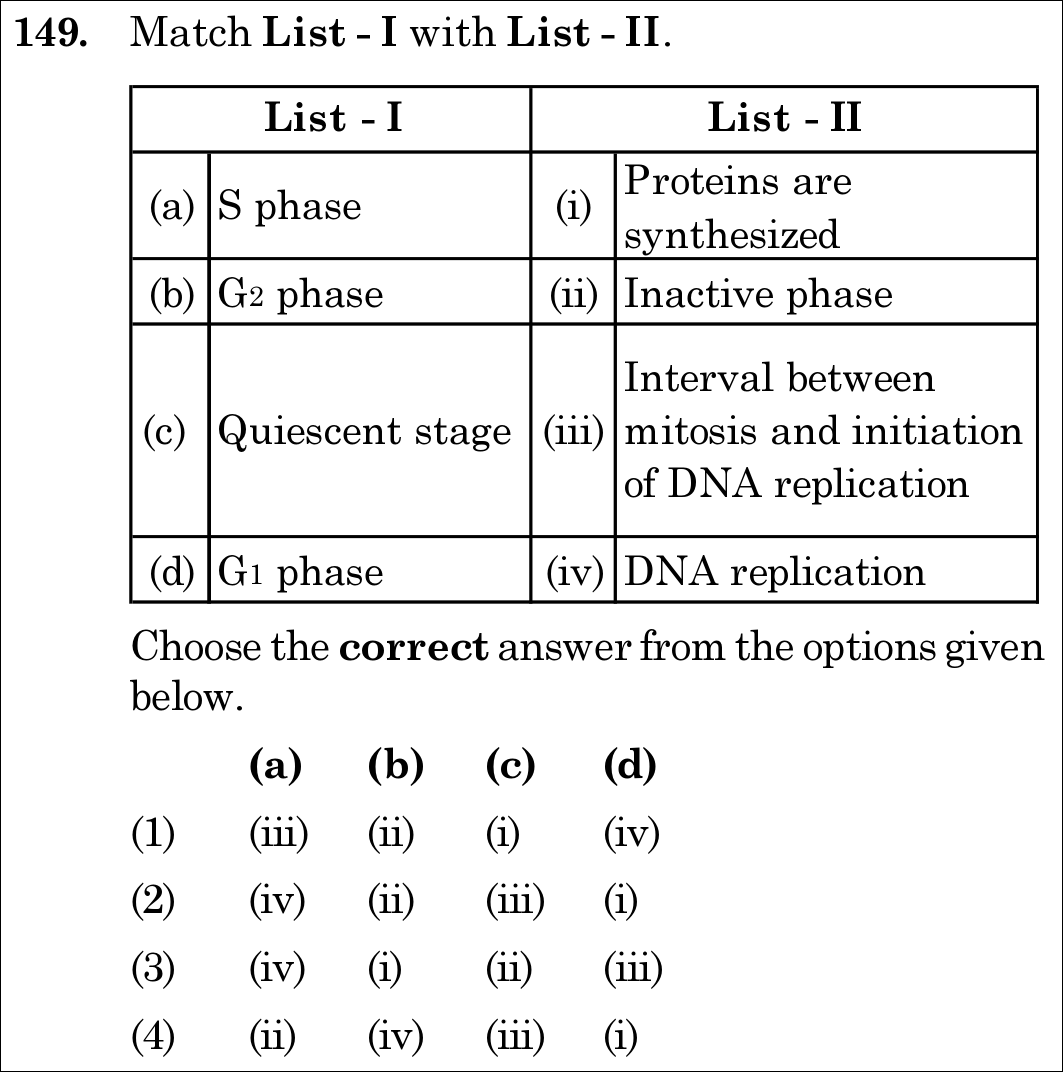
NEET 2021 · Q149 Easy
Official NEET 2021 Question 149 - Cell Cycle and Cell Division
1 (iii) (ii) (i) (iv)
2 (iv) (ii) (iii) (i)
3 (iv) (i) (ii) (iii) ✓ Key
4 (ii) (iv) (iii) (i)
💡 Verified Solution & 30-Second Hack
✓
Verified Against NTA Final Answer Key
Option (3) : (a)-(iv), (b)-(i), (c)-(ii), (d)-(iii)
📚 Cell Cycle and Cell Division Easy
📋 Given Parameters & Problem Setup
List I (Phases) (a) S phase, (b) G2 phase, (c) Quiescent stage, (d) G1 phase
List II (Events) (i) Proteins are synthesized, (ii) Inactive phase, (iii) Interval between mitosis and initiation of DNA replication, (iv) DNA replication
⚡

The 30-Second Exam Hall Shortcut: ⚡ Fast Cell Cycle Pairing: S = DNA Replication (a-iv) & G0 = Quiescent Inactive (c-ii)

⏱️ Save ~20 seconds

S phase = DNA replication (a-iv); G2 phase = Tubulin/Proteins synthesized for mitosis (b-i); Quiescent stage (G0) = Metabolically active but non-dividing inactive phase (c-ii); G1 phase = Interval between mitosis and DNA replication (d-iii). Gives (a)-(iv), (b)-(i), (c)-(ii), (d)-(iii)   ⟹  \implies Option (3)!

1 (a) S phase (Synthesis phase): DNA replication occurs   ⟹  \implies (iv).
2 (b) G2 phase: Proteins (e.g., tubulin) are synthesized in preparation for mitosis   ⟹  \implies (i).
3 (c) Quiescent stage (G0G_0): Cells exit cell cycle into an inactive non-proliferative state   ⟹  \implies (ii).
4 (d) G1 phase: Interval between mitosis and initiation of DNA replication   ⟹  \implies (iii).
5 Match Option (3).
🛡️
Why You Can 100% Trust This Shortcut: Canonical NCERT Cell Cycle and Cell Division on Phases of Cell Cycle.
📐

Step-by-Step Rigorous Workflow & Mathematical Proof

Step 1

Sequential Events in the Eukaryotic Cell Cycle

Interphase represents over 95% of cell cycle duration and is divided into three distinct stages along with the quiescent exit phase:

G1 phase:Interval between mitosis and initiation of DNA replication  ⟹  (d)-(iii)S phase:DNA replication and doubling of nuclear DNA content (2C→4C)  ⟹  (a)-(iv)G2 phase:Proteins are synthesized while cell growth continues  ⟹  (b)-(i)G0 (Quiescent):Cells exit cycle; metabolically active but suspended division (inactive phase)  ⟹  (c)-(ii)\begin{aligned} \mathbf{G_1} \text{ phase:} & \quad \text{Interval between mitosis and initiation of DNA replication} \implies \text{(d)-(iii)} \\[4pt] \mathbf{S} \text{ phase:} & \quad \mathbf{\text{DNA replication and doubling of nuclear DNA content } (2C \to 4C)} \implies \text{(a)-(iv)} \\[4pt] \mathbf{G_2} \text{ phase:} & \quad \text{Proteins are synthesized while cell growth continues} \implies \text{(b)-(i)} \\[4pt] \mathbf{G_0} \text{ (Quiescent):} & \quad \text{Cells exit cycle; metabolically active but suspended division (inactive phase)} \implies \text{(c)-(ii)} \end{aligned}
Step 2

Option Alignment

Matching (a)-(iv), (b)-(i), (c)-(ii), (d)-(iii) leads uniquely to Option (3).

⭐

360° Option Elimination Engine Key Feature

Diagnose every choice: Know exactly why the right option works and why distractors fail.

4-Option Deep Scan
1 1
✗ Incorrect
Verdict & Scientific Reason:

Mismatches S phase with G1 interval and G1 phase with DNA replication.

⚠️
Student Fallacy (Why candidates pick this trap): Inverting S phase and G1 phase.
2 2
✗ Incorrect
Verdict & Scientific Reason:

Mismatches G2 phase with inactive phase and quiescent stage with G1 interval.

⚠️
Student Fallacy (Why candidates pick this trap): Confusing quiescent G0 with G2.
3 3
✓ 100% Correct
Verdict & Scientific Reason:

Exact, canonical assignment of all four cell cycle phases to their NCERT defining features.

💡
Why this is airtight: None. Textbook definition pairing.
4 4
✗ Incorrect
Verdict & Scientific Reason:

Mismatches S phase with inactive phase.

⚠️
Student Fallacy (Why candidates pick this trap): Gross misalignment of interphase stages.
⚠️

NTA Trap Alert: G1 Phase Definition Wording Trap

NCERT defines G1 as: "corresponds to the interval between mitosis and initiation of DNA replication". Memorizing this exact phrasing eliminates doubt instantly.

🛡️ How to avoid the -1 mark: Mitosis →\to G1 →\to S (DNA replication) →\to G2 →\to Mitosis.
📖

Core NEET Syllabus Standard

NEET / NCERT Biology · Cell Cycle and Cell Division Standard Benchmark
Core Scientific Principle Tested:

"G1 phase is interval between mitosis and DNA replication. In S phase, DNA replication occurs. In G2 phase, proteins are synthesized. Cells in G0 stage remain metabolically active but inactive in division (quiescent)."

Syllabus Focus: Phases of Cell Cycle: Interphase and G0 Phase
✓ Core NEET UG Syllabus Anchor Syllabus & Academic Standards ↗
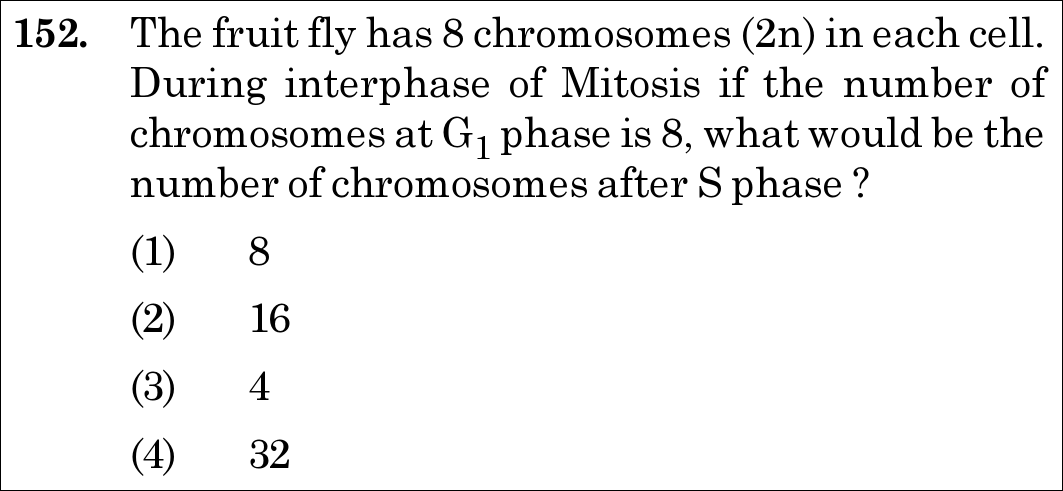
NEET 2021 · Q152 Easy
Official NEET 2021 Question 152 - Cell Cycle and Cell Division
1 ✓ Key
2
3
4
💡 Verified Solution & 30-Second Hack
✓
Verified Against NTA Final Answer Key
Option (1) : 8
📚 Cell Cycle and Cell Division Easy
📋 Given Parameters & Problem Setup
Organism Fruit fly (Drosophila melanogaster)
Diploid chromosome number (2n) 8 chromosomes at G1 phase
Target Stage After S phase of interphase
⚡

The 30-Second Exam Hall Shortcut: ⚡ "DNA Doubles (2C → 4C), Chromosome Number Never Changes (2n → 2n)"

⏱️ Save ~30 seconds

During the synthesis (S) phase of interphase, DNA replication doubles the amount of DNA per cell from 2C to 4C, but the chromosome number remains unchanged at 2n. If G1 has 8 chromosomes, after S phase it still has 8 chromosomes. Match Option (1) in 5 seconds!

1 Recall the golden cell cycle rule: S-phase duplicates DNA strands into sister chromatids joined at a single centromere.
2 Chromosome count equals the number of centromeres: 1 centromere = 1 chromosome.
3 Chromosomes at G1 = 8 (2n) → Chromosomes after S phase = 8 (2n).
4 Match Option (1).
🛡️
Why You Can 100% Trust This Shortcut: NCERT Biology · Cell Cycle and Cell Division (Interphase S-phase: DNA content doubles from 2C to 4C, but chromosome number remains 2n).
📐

Step-by-Step Rigorous Workflow & Mathematical Proof

Step 1

Distinction Between DNA Content and Chromosome Number

During interphase of the mitotic cell cycle, the cell transitions through G1G_1, SS, and G2G_2 phases: - In G1G_1 phase: The chromosome number is diploid (2n=82n = 8) and the DNA content is 2C2C. - In SS phase (Synthesis phase): Semi-conservative replication of nuclear DNA occurs. The DNA quantity doubles from 2C2C to 4C4C. - However, the newly formed sister chromatids remain attached to each other at the same centromere. Because chromosome count is defined strictly by the number of functional centromeres, the chromosome number does not increase.

At G1 phase:2n=8,DNA content=2CAfter S phase:2n=8,DNA content=4C\begin{aligned} \text{At } G_1 \text{ phase:} & \quad 2n = 8, \quad \text{DNA content} = 2C \\[4pt] \text{After } S \text{ phase:} & \quad \mathbf{2n = 8}, \quad \text{DNA content} = 4C \end{aligned}
Step 2

Application to Drosophila melanogaster

For Drosophila melanogaster with 2n=82n = 8: - Chromosomes in G1G_1: 8 - Chromosomes in SS: 8 (each consisting of two identical sister chromatids) - Chromosomes in G2G_2: 8 - The physical separation of sister chromatids into individual daughter chromosomes only occurs later during mitotic Anaphase.

⭐

360° Option Elimination Engine Key Feature

Diagnose every choice: Know exactly why the right option works and why distractors fail.

4-Option Deep Scan
1 1
✓ 100% Correct
Verdict & Scientific Reason:

Correct. S phase duplicates the DNA content (2C to 4C) but preserves the total chromosome number (2n = 8) because sister chromatids remain bound at the common centromere.

💡
Why this is airtight: None. This demonstrates clear understanding of the centromere-based definition of chromosomes.
2 2
✗ Incorrect
Verdict & Scientific Reason:

Incorrect. 16 would represent the number of chromatids, not chromosomes. The chromosome number doubles only transiently in anaphase after centromeric fission.

⚠️
Student Fallacy (Why candidates pick this trap): The classic trap: students know DNA doubles, so they naively assume the chromosome number also doubles from 8 to 16.
3 3
✗ Incorrect
Verdict & Scientific Reason:

Incorrect. A reduction from 8 to 4 occurs only during Meiosis I (reductional division), never during mitotic interphase.

⚠️
Student Fallacy (Why candidates pick this trap): Aspirants confuse mitotic interphase with meiotic reduction, mistakenly halving the chromosome number to n = 4.
4 4
✗ Incorrect
Verdict & Scientific Reason:

Incorrect. There is no biological mechanism during interphase that quadruples chromosome number to 32.

⚠️
Student Fallacy (Why candidates pick this trap): Students perform arbitrary doubling calculations (8×2×2=328 \times 2 \times 2 = 32) without conceptual grounding.
⚠️

NTA Trap Alert: DNA Doubling vs Chromosome Doubling Equivocation

Students habitually confuse DNA mass (which doubles from 2C to 4C during S phase) with chromosome number (which remains strictly 2n until anaphase separation).

🛡️ How to avoid the -1 mark: Count centromeres! One centromere = one chromosome, regardless of whether it consists of one monad or two sister chromatids.
📖

Core NEET Syllabus Standard

NEET / NCERT Biology · Cell Cycle and Cell Division Standard Benchmark
Core Scientific Principle Tested:

"In S-phase, DNA replication doubles DNA mass from 2C to 4C without changing chromosome count (remains 2n)."

Syllabus Focus: Interphase and S-Phase Molecular Events
✓ Core NEET UG Syllabus Anchor Syllabus & Academic Standards ↗
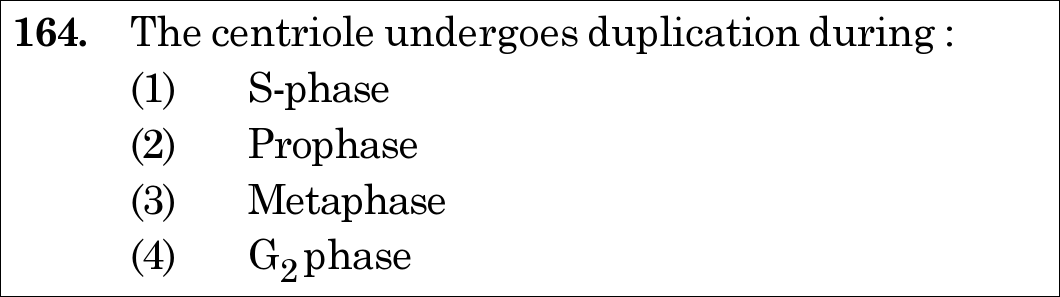
NEET 2021 · Q164 Easy
Official NEET 2021 Question 164 - Cell Cycle and Cell Division
1 S-phase ✓ Key
2 Prophase
3 Metaphase
4 G2 phase
💡 Verified Solution & 30-Second Hack
✓
Verified Against NTA Final Answer Key
Option (1) : S-phase
📚 Cell Cycle and Cell Division Easy
📋 Given Parameters & Problem Setup
Organelle Centriole
Event Duplication during cell cycle
⚡

The 30-Second Exam Hall Shortcut: ⚡ "S-Phase: DNA Duplicates in Nucleus, Centrioles Duplicate in Cytoplasm"

⏱️ Save ~25 seconds

NCERT verbatim rule: "In animal cells, during the S-phase, DNA replication begins in the nucleus, and the centriole duplicates in the cytoplasm." Both core duplication events happen synchronously in S-phase! Match Option (1) in 3 seconds!

1 Recall the hallmark events of S-phase in animal cells.
2 Nuclear event = DNA replication (2C → 4C).
3 Cytoplasmic event = Centriole duplication (one pair becomes two pairs).
4 Match Option (1).
🛡️
Why You Can 100% Trust This Shortcut: NCERT Biology · Cell Cycle and Cell Division (Interphase S-phase: DNA replicates in the nucleus while centriole duplicates in the cytoplasm of animal cells).
📐

Step-by-Step Rigorous Workflow & Mathematical Proof

Step 1

Synchronized Nuclear and Cytoplasmic Events of S-Phase

The synthesis (SS) phase of interphase is characterized by coordinated replication of genetic and spindle-organizing structures in animal cells: - In the Nucleus: Semi-conservative DNA replication occurs, doubling the DNA content from 2C2C to 4C4C. - In the Cytoplasm: The centrosome, containing a pair of orthogonally oriented centrioles, duplicates so that two centrosomes (each with two centrioles) are formed. - This duplication is indispensable because each centrosome will later migrate to opposite poles during prophase to organize the mitotic spindle apparatus.

S-Phase Events  ⟹  {Nucleus:DNA Replication (2C→4C)Cytoplasm:Centriole Duplication\text{S-Phase Events} \implies \begin{cases} \textbf{Nucleus:} & \text{DNA Replication } (2C \rightarrow 4C) \\[3pt] \textbf{Cytoplasm:} & \mathbf{Centriole\ Duplication} \end{cases}
Step 2

Evaluation of Other Cell Cycle Stages

- G1G_1 phase: Gap 1 involves metabolic growth, RNA and protein synthesis; centrioles do not replicate. - G2G_2 phase: Gap 2 involves synthesis of tubulin and preparations for mitosis. - Prophase: Centrosomes (already duplicated during S-phase) begin their bipolar migration; aster rays and spindle fibers assemble. - Metaphase: Chromosomes align on the equatorial plate.

⭐

360° Option Elimination Engine Key Feature

Diagnose every choice: Know exactly why the right option works and why distractors fail.

4-Option Deep Scan
1 1
✓ 100% Correct
Verdict & Scientific Reason:

Correct. Centriole duplication occurs concurrently with DNA replication during the S phase of interphase in the cytoplasm of animal cells.

💡
Why this is airtight: None. Textbook definition.
2 2
✗ Incorrect
Verdict & Scientific Reason:

Incorrect. During prophase, duplicated centrosomes migrate to opposite poles; they do not duplicate during prophase.

⚠️
Student Fallacy (Why candidates pick this trap): Students see centrosomes moving apart in prophase diagrams and wrongly conclude they are duplicating there.
3 3
✗ Incorrect
Verdict & Scientific Reason:

Incorrect. In metaphase, centrioles reside at established spindle poles and align chromosomes at the equator.

⚠️
Student Fallacy (Why candidates pick this trap): Confusing metaphase spindle organization with organelle duplication.
4 4
✗ Incorrect
Verdict & Scientific Reason:

Incorrect. Centriole duplication is already finished by the time the cell exits S-phase and enters G2.

⚠️
Student Fallacy (Why candidates pick this trap): Assuming pre-mitotic organelle duplication continues through G2.
⚠️

NTA Trap Alert: Centriole Migration (Prophase) vs Duplication (S-Phase)

Candidates routinely confuse the duplication of centrioles (which takes place invisibly in the cytoplasm during S-phase) with the visible separation/migration of centrioles to opposite poles (which occurs during prophase).

🛡️ How to avoid the -1 mark: Remember: Duplication = S-phase; Separation/Migration to poles = Prophase.
📖

Core NEET Syllabus Standard

NEET / NCERT Biology · Cell Cycle and Cell Division Standard Benchmark
Core Scientific Principle Tested:

"In animal cells, DNA replication occurs in the nucleus and centriole duplication occurs in the cytoplasm during S-phase."

Syllabus Focus: S-Phase of Cell Cycle
✓ Core NEET UG Syllabus Anchor Syllabus & Academic Standards ↗
NEET 2021 · Q181 Easy
Official NEET 2021 Question 181 - Cell Cycle and Cell Division
1 Leptotene
2 Zygotene
3 Diakinesis ✓ Key
4 Pachytene
💡 Verified Solution & 30-Second Hack
✓
Verified Against NTA Final Answer Key
Option (3) : Diakinesis
📚 Cell Cycle and Cell Division Easy
📋 Given Parameters & Problem Setup
Meiotic Phase Prophase I of Meiosis I
Diagnostic Morphological Event Terminalisation of chiasmata
Question Objective Identify the exact sub-stage exhibiting this hallmark
⚡

The 30-Second Exam Hall Shortcut: ⚡ "Prophase I Sub-stages: LZPD-D Mnemonic → Diakinesis = Terminalisation"

⏱️ Save ~20 seconds

Prophase I sequence: Leptotene (compaction) → Zygotene (synapsis) → Pachytene (crossing over) → Diplotene (chiasmata appear) → Diakinesis (terminalisation of chiasmata). Diakinesis is marked by terminalisation! Select Option (3).

1 Recall Prophase I 5-stage mnemonic: Lazy Zebras Play Deep Down (Leptotene, Zygotene, Pachytene, Diplotene, Diakinesis).
2 Map key diagnostic events: - Zygotene: Synaptonemal complex & synapsis. - Pachytene: Crossing over (recombinase enzyme). - Diplotene: Dissolution of complex, X-shaped chiasmata formed. - Diakinesis: Terminalisation of chiasmata (chiasmata shift to chromosome tips).
3 Question asks for "terminalisation of chiasmata" -> Diakinesis.
4 Select Option (3).
🛡️
Why You Can 100% Trust This Shortcut: NCERT Biology · Cell Cycle and Cell Division (Meiosis I: The final stage of meiotic prophase I is diakinesis. This is marked by terminalisation of chiasmata).
📐

Step-by-Step Rigorous Workflow & Mathematical Proof

Step 1

Chronology and Cytological Milestones of Prophase I

Meiosis I Prophase I is an extended, intricate phase subdivided into five successive stages: 1. Leptotene: Chromatin condenses; chromosomes become progressively visible under light microscopy. 2. Zygotene: Homologous chromosomes undergo pairing (synapsis), mediated by the formation of the tripartite nucleoprotein synaptonemal complex to produce bivalents (tetrads). 3. Pachytene: Non-sister chromatids of homologous chromosomes exchange genetic segments (crossing over) at recombination nodules, catalyzed by the enzyme recombinase. 4. Diplotene: Dissolution of the synaptonemal complex occurs; paired homologs separate except at crossover sites, revealing X-shaped chiasmata. 5. Diakinesis: The terminal sub-stage characterized by terminalisation of chiasmata, where cross-over contact points slide toward telomeric ends like unzipping a zipper. The nucleolus disappears, and the nuclear envelope disintegrates.

Prophase I Stages  ⟹  {Leptotene:CondensationZygotene:Synapsis (Synaptonemal Complex)Pachytene:Crossing Over (Recombinase)Diplotene:Chiasmata visibleDiakinesis:Terminalisation of Chiasmata\text{Prophase I Stages} \implies \begin{cases} \textbf{Leptotene:} & \text{Condensation} \\ \textbf{Zygotene:} & \text{Synapsis (Synaptonemal Complex)} \\ \textbf{Pachytene:} & \text{Crossing Over (Recombinase)} \\ \textbf{Diplotene:} & \text{Chiasmata visible} \\ \textbf{Diakinesis:} & \mathbf{Terminalisation\,of\,Chiasmata} \end{cases}
Step 2

Diagnostic Alignment

NCERT explicitly defines Diakinesis as: "The final stage of meiotic prophase I is diakinesis. This is marked by terminalisation of chiasmata." Thus, Diakinesis is the precise answer.

⭐

360° Option Elimination Engine Key Feature

Diagnose every choice: Know exactly why the right option works and why distractors fail.

4-Option Deep Scan
1 1
✗ Incorrect
Verdict & Scientific Reason:

Incorrect. Leptotene is the first stage marked by initial chromosome compaction, long before homologous pairing or crossing over occurs.

⚠️
Student Fallacy (Why candidates pick this trap): Random guessing among stage names.
2 2
✗ Incorrect
Verdict & Scientific Reason:

Incorrect. Zygotene is characterized by synapsis and formation of the synaptonemal complex.

⚠️
Student Fallacy (Why candidates pick this trap): Confusing the initiation of pairing (synapsis) with the final resolution of chiasmata.
3 3
✓ 100% Correct
Verdict & Scientific Reason:

Correct. Diakinesis is canonically characterized by the terminalisation of chiasmata.

💡
Why this is airtight: None. Candidate accurately pairs Diakinesis with terminalisation.
4 4
✗ Incorrect
Verdict & Scientific Reason:

Incorrect. Pachytene is characterized by crossing over and recombination nodule formation.

⚠️
Student Fallacy (Why candidates pick this trap): Confusing the creation of genetic exchange (crossing over in pachytene) with the shifting of chiasmata (diakinesis).
⚠️

NTA Trap Alert: Diplotene vs Diakinesis Chiasmata Trap

Chiasmata first become *visible* during Diplotene (due to synaptonemal complex breakdown). However, *terminalisation* of chiasmata (shifting to the ends) occurs in Diakinesis.

🛡️ How to avoid the -1 mark: Remember: Chiasmata appear in Diplotene; Chiasmata terminalise in Diakinesis.
📖

Core NEET Syllabus Standard

NEET / NCERT Biology · Cell Cycle and Cell Division Standard Benchmark
Core Scientific Principle Tested:

"Terminalisation of chiasmata is the hallmark feature of diakinesis."

Syllabus Focus: Meiosis I Prophase Stages
✓ Core NEET UG Syllabus Anchor Syllabus & Academic Standards ↗
NEET 2020 · Q14 Easy
Official NEET 2020 Question 14 - Cell Cycle and Cell Division
1 DNA synthesis or replication takes place.
2 Reorganisation of all cell components takes place.
3 Cell is metabolically active, grows but does not replicate its DNA. ✓ Key
4 Nuclear Division takes place.
💡 Verified Solution & 30-Second Hack
✓
Verified Against NTA Final Answer Key
Option (3) : Cell is metabolically active, grows but does not replicate its DNA.
📚 Cell Cycle and Cell Division Easy
📋 Given Parameters & Problem Setup
Cell Cycle Phase G1 Phase (Gap 1 of Interphase)
Question Objective Identify the correct physiological and cytological statement
⚡

The 30-Second Exam Hall Shortcut: ⚡ "G1 Phase = Metabolically Active, Cell Growth, NO DNA Replication!"

⏱️ Save ~20 seconds

G1 phase is the interval between mitosis and DNA replication. The cell is metabolically active and continuously grows in size, but DNA replication occurs strictly in the subsequent S phase! Option (3) is verbatim from NCERT.

1 Recall Interphase phases in sequence: G1 phase →\to S phase →\to G2 phase.
2 Match events: - G1 phase: Active metabolism, protein and RNA synthesis, organelle duplication, cell growth (NO DNA replication). - S phase: DNA replication and doubling of DNA content (2C→4C2C \to 4C). - G2 phase: Protein synthesis in preparation for mitosis. - M phase: Nuclear and cell division.
3 Select Option (3): Cell is metabolically active, grows but does not replicate its DNA.
🛡️
Why You Can 100% Trust This Shortcut: NCERT Biology · Cell Cycle and Cell Division (Phases of Cell Cycle: During G1 phase the cell is metabolically active and continuously grows but does not replicate its DNA. DNA synthesis or replication takes place during S phase).
📐

Step-by-Step Rigorous Workflow & Mathematical Proof

Step 1

Cytological Profile of the G1 Phase (Gap 1)

Interphase accounts for >95% of cell cycle duration, and G1 phase corresponds to the temporal interval between the completion of telophase (mitosis) and the initiation of chromosomal DNA replication: - Metabolic Activity: High rates of transcription (mRNA, tRNA, rRNA) and translation occur. Enzymes required for DNA synthesis (DNA polymerases, kinases, ribonucleotide reductase) are synthesized. - Cellular Growth: The volume of the cytoplasm increases, and cytoplasmic organelles (mitochondria, ribosomes, endoplasmic reticulum) proliferate. - Absence of DNA Replication: The nuclear DNA content remains strictly at the basal diploid complement (2C2C), and chromosomes remain un-replicated monads. Replication of DNA occurs exclusively during the subsequent S (Synthesis) phase.

G1 Phase  ⟹  {Metabolic Activity→Highly ActiveCell Volume→Continuous GrowthDNA Replication→ABSENT (Restricted to S phase)\textbf{G}_1 \textbf{ Phase} \implies \begin{cases} \text{Metabolic Activity} & \to \mathbf{Highly\,Active} \\[3pt] \text{Cell Volume} & \to \mathbf{Continuous\,Growth} \\[3pt] \text{DNA Replication} & \to \mathbf{ABSENT\,(Restricted\,to\,S\,phase)} \end{cases}
Step 2

Critique of Distractor Statements

- (1) DNA synthesis takes place: False; occurs exclusively in the S phase. - (2) Reorganisation of cell components: False; occurs in early Prophase / Mitosis. - (4) Nuclear division: False; karyokinesis is a hallmark of the M phase.

⭐

360° Option Elimination Engine Key Feature

Diagnose every choice: Know exactly why the right option works and why distractors fail.

4-Option Deep Scan
1 A
✗ Incorrect
Verdict & Scientific Reason:

Incorrect. DNA synthesis and chromosome replication take place in the S (Synthesis) phase.

⚠️
Student Fallacy (Why candidates pick this trap): Confusing G1 (Gap 1) with S phase.
2 B
✗ Incorrect
Verdict & Scientific Reason:

Incorrect. Massive reorganisation of cell components characterizes the mitotic (M) phase.

⚠️
Student Fallacy (Why candidates pick this trap): Confusing interphase cell growth with mitotic division.
3 C
✓ 100% Correct
Verdict & Scientific Reason:

Correct. Matches the verbatim NCERT definition of the G1 phase of interphase.

💡
Why this is airtight: None. Candidate accurately remembers cell cycle phase definitions.
4 D
✗ Incorrect
Verdict & Scientific Reason:

Incorrect. Nuclear division (karyokinesis) occurs during the M phase.

⚠️
Student Fallacy (Why candidates pick this trap): Confusing interphase preparation with nuclear division.
⚠️

NTA Trap Alert: Resting Stage Misconception Trap

Interphase was historically called the "resting stage". Students mistakenly infer that G1 cells are inactive. In reality, G1 cells are intensely metabolically active, growing rapidly while preparing substrates for DNA replication.

🛡️ How to avoid the -1 mark: Remember: G1 = Metabolically Active & Growing, but DNA replication is strictly S-phase.
📖

Core NEET Syllabus Standard

NEET / NCERT Biology · Cell Cycle and Cell Division Standard Benchmark
Core Scientific Principle Tested:

"During G1 phase, the cell is metabolically active and continuously grows but does not replicate its DNA."

Syllabus Focus: Interphase G1 Phase
✓ Core NEET UG Syllabus Anchor Syllabus & Academic Standards ↗
NEET 2020 · Q52 Easy
Official NEET 2020 Question 52 - Cell Cycle and Cell Division
1 (iii) (iv) (i) (ii)
2 (iv) (iii) (ii) (i) ✓ Key
3 (i) (ii) (iv) (iii)
4 (ii) (iv) (iii) (i)
💡 Verified Solution & 30-Second Hack
✓
Verified Against NTA Final Answer Key
Option (2) : (a)-(iv), (b)-(iii), (c)-(ii), (d)-(i)
📚 Cell Cycle and Cell Division Easy
📋 Given Parameters & Problem Setup
Column I (Sub-stages) (a) Zygotene, (b) Pachytene, (c) Diplotene, (d) Diakinesis
Column II (Hallmarks) (i) Terminalization, (ii) Chiasmata, (iii) Crossing over, (iv) Synapsis
⚡

The 30-Second Exam Hall Shortcut: ⚡ "Zygotene = Synapsis; Pachytene = Crossing Over; Diplotene = Chiasmata; Diakinesis = Terminalization"

⏱️ 30 seconds

Zygotene forms synaptonemal complex (Synapsis, a->iv). Pachytene features recombinase-mediated Crossing Over (b->iii). Diplotene shows X-shaped Chiasmata (c->ii). Diakinesis culminates in Terminalization of chiasmata (d->i). Combination is (iv), (iii), (ii), (i) -> Option 2 in 10 seconds!

1 Zygotene -> Synapsis of homologous chromosomes (iv).
2 Pachytene -> Crossing over between non-sister chromatids (iii).
3 Diplotene -> Dissolution of synaptonemal complex, revealing Chiasmata (ii).
4 Diakinesis -> Terminalization of chiasmata (i).
5 Mapping: (a)-(iv), (b)-(iii), (c)-(ii), (d)-(i) -> Option 2.
🛡️
Why You Can 100% Trust This Shortcut: NCERT Biology · Cell Cycle and Cell Division (Meiosis I: Prophase I Sub-stages)
📐

Step-by-Step Rigorous Workflow & Mathematical Proof

Step 1

Zygotene (a) -> Synapsis (iv)

During Zygotene, chromosomes start pairing together through a process called synapsis, facilitated by the formation of a proteinaceous synaptonemal complex forming bivalents.

Step 2

Pachytene (b) -> Crossing Over (iii)

During Pachytene, four chromatids of each bivalent chromosome become distinct as tetrads. Crossing over occurs between non-sister chromatids of homologous chromosomes, mediated by enzyme recombinase.

Step 3

Diplotene (c) -> Chiasmata (ii)

The beginning of Diplotene is recognized by the dissolution of the synaptonemal complex and tendency of homologous chromosomes to separate, except at sites of crossovers, creating X-shaped structures called chiasmata.

Step 4

Diakinesis (d) -> Terminalization (i)

The final stage of meiotic prophase I is Diakinesis, which is marked by the terminalization of chiasmata as chromosomes fully condense and nucleolus disappears.

⭐

360° Option Elimination Engine Key Feature

Diagnose every choice: Know exactly why the right option works and why distractors fail.

4-Option Deep Scan
1 A
✗ Incorrect
Verdict & Scientific Reason:

Incorrect; mispairs Zygotene with crossing over (crossing over occurs in pachytene).

⚠️
Student Fallacy (Why candidates pick this trap): Confusing the chronological order of synapsis and crossing over.
2 B
✓ 100% Correct
Verdict & Scientific Reason:

Accurate pairing across all four substages of Meiosis Prophase I.

💡
Why this is airtight: None; standard meiotic stages sequence.
3 C
✗ Incorrect
Verdict & Scientific Reason:

Incorrect; inverts terminalization and synapsis.

⚠️
Student Fallacy (Why candidates pick this trap): Reversing early prophase with late prophase events.
4 D
✗ Incorrect
Verdict & Scientific Reason:

Incorrect; chiasmata do not become visible in Zygotene.

⚠️
Student Fallacy (Why candidates pick this trap): Failing to remember that chiasmata appear only in diplotene.
⚠️

NTA Trap Alert: Pachytene vs Diplotene vs Diakinesis

Pachytene = Crossing over happens. Diplotene = Chiasmata first appear (X-shape). Diakinesis = Chiasmata terminate (Terminalization).

🛡️ How to avoid the -1 mark: Mnemonic: "Z-Syn, P-Cross, Dip-Chias, Dia-Term" (Zygotene-Synapsis, Pachytene-Crossing over, Diplotene-Chiasmata, Diakinesis-Terminalization).
📖

Core NEET Syllabus Standard

Zoology · Cell Cycle and Cell Division Standard Benchmark
Core Scientific Principle Tested:

""

Syllabus Focus: Prophase I Sub-stages and Hallmark Events: Zygotene, Pachytene, Diplotene, Diakinesis
✓ Core NEET UG Syllabus Anchor Syllabus & Academic Standards ↗
NEET 2020 · Q72 Medium
Official NEET 2020 Question 72 - Cell Cycle and Cell Division
1 M phase
2 G1 phase ✓ Key
3 S phase
4 G2 phase
💡 Verified Solution & 30-Second Hack
✓
Verified Against NTA Final Answer Key
Option (2) : G1 phase
📚 Cell Cycle and Cell Division Medium
📋 Given Parameters & Problem Setup
Cellular Stage Quiescent stage (G0 stage)
Physiological State Metabolically active but no longer proliferating unless called upon
Question Objective Identify which cell cycle phase cells exit at the end of to enter G0
⚡

The 30-Second Exam Hall Shortcut: ⚡ "Cells Exit G1 Phase to Enter Quiescent G0 Stage!"

⏱️ 25 seconds

Some cells in adult animals (like heart cells and neurons) do not divide further. These cells exit the cycle by suspending proliferation at the restriction/decision point at the END of G1 phase to enter the quiescent stage (G0). Mark G1 phase (Option 2) in 5 seconds!

1 Recall NCERT text: "Some cells in the adult animal do not appear to exhibit division... These cells that do not divide further exit G1 phase to enter an inactive stage called quiescent stage (G0) of the cell cycle."
2 G0 cells remain metabolically active but do not replicate DNA (they never enter S phase).
3 Thus, exit occurs at the end of G1 phase.
4 Select Option (2) G1 phase.
🛡️
Why You Can 100% Trust This Shortcut: NCERT Biology · Cell Cycle and Cell Division (Phases of Cell Cycle: G0 Quiescent Stage)
📐

Step-by-Step Rigorous Workflow & Mathematical Proof

Step 1

Understand the G0 Phase Concept

Cells that do not continue dividing exit the regular progression of the cell cycle and enter a specialized non-proliferative resting state designated as the quiescent stage (G0).

Step 2

Specific Exit Point from the Cycle

NCERT states verbatim: "These cells that do not divide further exit G1 phase to enter an inactive stage called quiescent stage (G0) of the cell cycle."

Step 3

Metabolic Characteristics of G0 Cells

Cells in G0 stage remain metabolically active, maintaining basic cellular functions and tissue homeostasis, but no longer proliferate unless specifically stimulated (e.g., hepatocytes following partial hepatectomy).

Step 4

Differentiate Alternative Phases

M phase is followed by cytokinesis, delivering daughter cells into G1; S phase is committed DNA replication; G2 phase prepares for mitosis. The commitment decision to divide or withdraw occurs in G1.

⭐

360° Option Elimination Engine Key Feature

Diagnose every choice: Know exactly why the right option works and why distractors fail.

4-Option Deep Scan
1 A
✗ Incorrect
Verdict & Scientific Reason:

Incorrect; after M phase, cells normally enter G1 phase before deciding whether to proceed to S phase or exit into G0.

⚠️
Student Fallacy (Why candidates pick this trap): Thinking that exiting division immediately after mitosis means exiting M phase.
2 B
✓ 100% Correct
Verdict & Scientific Reason:

Factually exact; cells exit at the restriction point of the G1 phase to enter the G0 quiescent state.

💡
Why this is airtight: None; explicit textbook statement.
3 C
✗ Incorrect
Verdict & Scientific Reason:

Incorrect; once a cell enters S phase, DNA replication has begun and the cell is committed to dividing, unable to enter G0.

⚠️
Student Fallacy (Why candidates pick this trap): Misunderstanding the cell cycle commitment point.
4 D
✗ Incorrect
Verdict & Scientific Reason:

Incorrect; G2 cells possess duplicated DNA (4C) and are preparing for mitosis, not resting in G0.

⚠️
Student Fallacy (Why candidates pick this trap): Confusing post-synthetic pause with quiescent G0.
⚠️

NTA Trap Alert: Exit G1 vs Exit M Phase Phrasing

NCERT explicitly states: "cells exit G1 phase to enter G0". The checkpoint determining whether to replicate DNA (S phase) or become quiescent (G0) is in G1.

🛡️ How to avoid the -1 mark: Commit to memory: G0 entry = EXIT FROM G1 PHASE!
📖

Core NEET Syllabus Standard

Zoology · Cell Cycle and Cell Division Standard Benchmark
Core Scientific Principle Tested:

""

Syllabus Focus: Quiescent Stage (G0) Entry: Cells Exit Cell Cycle at the End of G1 Phase
✓ Core NEET UG Syllabus Anchor Syllabus & Academic Standards ↗
NEET 2020 · Q86 Easy
Official NEET 2020 Question 86 - Cell Cycle and Cell Division
1 Pachytene
2 Zygotene
3 Diplotene ✓ Key
4 Leptotene
💡 Verified Solution & 30-Second Hack
✓
Verified Against NTA Final Answer Key
Option (3) : Diplotene
📚 Cell Cycle and Cell Division Easy
📋 Given Parameters & Problem Setup
Meiotic Sub-stage Prophase I
Cytological Hallmark Dissolution of the synaptonemal complex
Question Objective Identify the exact sub-stage during which dissolution occurs
⚡

The 30-Second Exam Hall Shortcut: ⚡ "Synaptonemal Complex: FORMED in Zygotene, DISSOLVES in Diplotene!"

⏱️ 20 seconds

The synaptonemal complex is formed during Zygotene (synapsis) and maintained during Pachytene (crossing over). The beginning of DIPLOTENE is explicitly recognized by the DISSOLUTION OF THE SYNAPTONEMAL COMPLEX! Mark Diplotene (Option 3) in 5 seconds.

1 Zygotene = Formation of synaptonemal complex (synapsis).
2 Pachytene = Crossing over mediated by recombinase.
3 Diplotene = Dissolution of synaptonemal complex and visibility of X-shaped chiasmata.
4 Diakinesis = Terminalization of chiasmata.
5 Select Option (3) Diplotene.
🛡️
Why You Can 100% Trust This Shortcut: NCERT Biology · Cell Cycle and Cell Division (Meiosis: Prophase I Sub-stages)
📐

Step-by-Step Rigorous Workflow & Mathematical Proof

Step 1

Review Prophase I Chronology

Prophase I of meiosis is subdivided into five successive stages based on chromosomal behavior: Leptotene, Zygotene, Pachytene, Diplotene, and Diakinesis.

Step 2

Analyze Diplotene Characteristics

NCERT states verbatim: "The beginning of diplotene is recognised by the dissolution of the synaptonemal complex and the tendency of the recombined homologous chromosomes of the bivalents to separate from each other except at the sites of crossovers."

Step 3

Resulting Morphology (Chiasmata)

These remaining X-shaped crossover connection structures are called chiasmata, which become prominently visible in diplotene precisely because the synaptonemal complex has dissolved elsewhere along the chromosome arms.

Step 4

Eliminate Other Sub-stages

In Leptotene chromosomes condense; in Zygotene synaptonemal complex forms; in Pachytene crossing over occurs; in Diakinesis chiasmata terminalize. Thus, dissolution uniquely marks Diplotene.

⭐

360° Option Elimination Engine Key Feature

Diagnose every choice: Know exactly why the right option works and why distractors fail.

4-Option Deep Scan
1 A
✗ Incorrect
Verdict & Scientific Reason:

Incorrect; in Pachytene the synaptonemal complex is intact and active, facilitating crossing over between non-sister chromatids.

⚠️
Student Fallacy (Why candidates pick this trap): Assuming dissolution happens immediately upon crossing over completion.
2 B
✗ Incorrect
Verdict & Scientific Reason:

Incorrect; in Zygotene the synaptonemal complex is ASSEMBLED (formed), not dissolved.

⚠️
Student Fallacy (Why candidates pick this trap): Confusing assembly of synaptonemal complex with its dissolution.
3 C
✓ 100% Correct
Verdict & Scientific Reason:

Factually exact; NCERT defines the beginning of diplotene by the dissolution of the synaptonemal complex.

💡
Why this is airtight: None; direct textbook definition.
4 D
✗ Incorrect
Verdict & Scientific Reason:

Incorrect; Leptotene is the initial stage where chromatin condenses; the complex has not yet even formed.

⚠️
Student Fallacy (Why candidates pick this trap): Confusing early condensation with late prophase separation.
⚠️

NTA Trap Alert: Synaptonemal Complex Timeline

Zygotene: FORMATION of synaptonemal complex. Pachytene: CROSSING OVER occurs within complex. Diplotene: DISSOLUTION of synaptonemal complex.

🛡️ How to avoid the -1 mark: Formed in Zygotene -> Dissolved in Diplotene!
📖

Core NEET Syllabus Standard

Zoology · Cell Cycle and Cell Division Standard Benchmark
Core Scientific Principle Tested:

""

Syllabus Focus: Diplotene Stage: Dissolution of Synaptonemal Complex and Chiasmata Appearance
✓ Core NEET UG Syllabus Anchor Syllabus & Academic Standards ↗

Solve 4 NEET Questions a Day — One per Subject

Cover all 1,140 official NEET questions in 285 days at your own pace. Progress is saved on your device. No login needed.