
The 30-Second Exam Hall Shortcut: ⚡ Root Finding & Physical Cutoff Shortcut
Find where terminal velocity equals zero!
Step-by-Step Rigorous Workflow & Mathematical Proof
Formulate Dynamic Equilibrium for a Falling Sphere
When a sphere reaches terminal velocity v_t in a viscous medium, net downward acceleration is zero:
- • Weight of sphere: W = sigma * V * g = sigma * (4/3 pi r^3) * g.
- • Upthrust (Buoyant force): F_B = rho * V * g = rho * (4/3 pi r^3) * g.
- • Stokes' viscous drag force: F_v = 6 pi eta r v_t.
Express Terminal Velocity in terms of Density Ratio
Equate net gravitational force to viscous drag and solve for v_t:
- • Let x = sigma / rho and constant k = (2 r^2 g rho) / (9 eta).
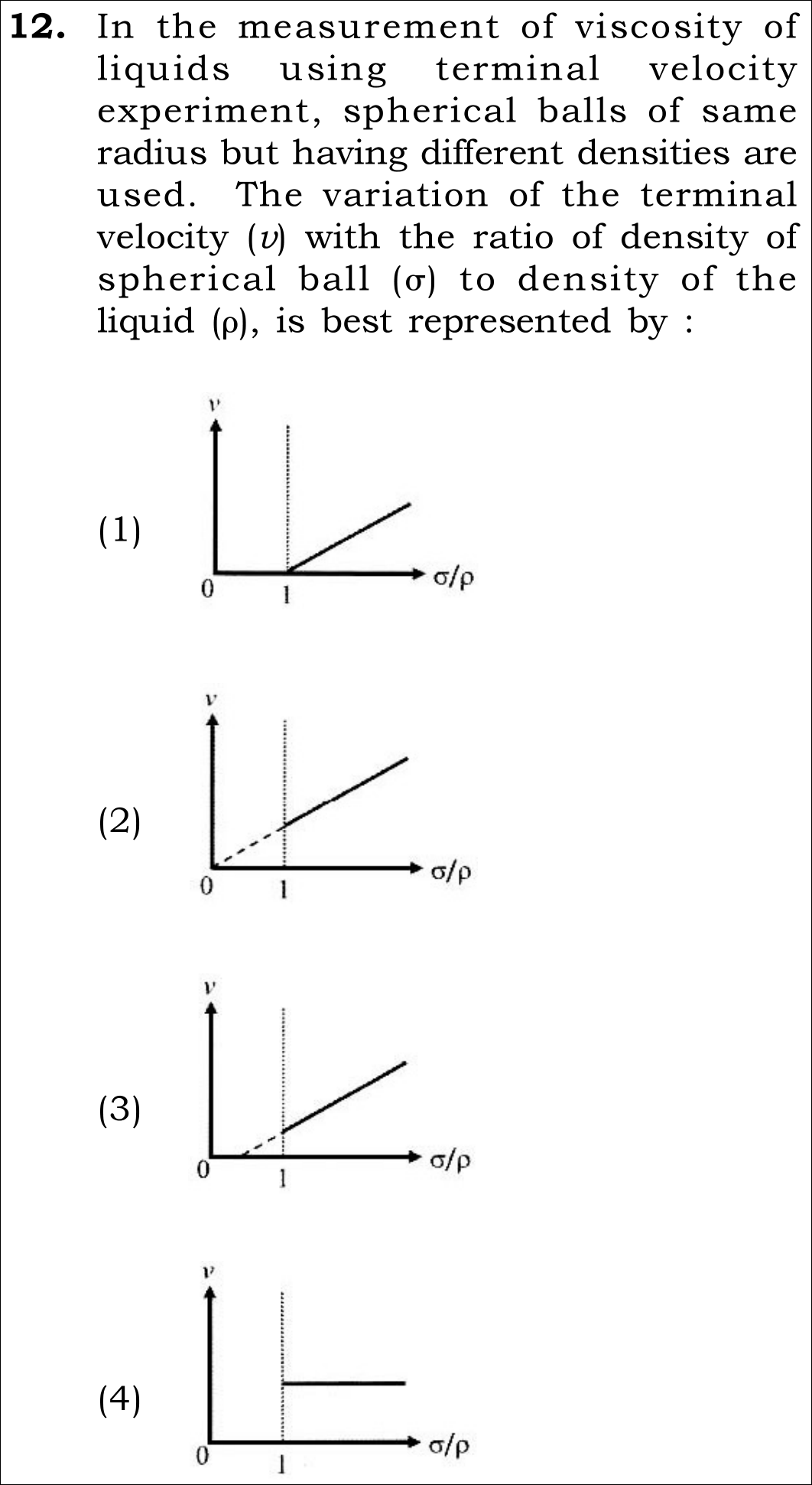
- • Then v_t = k * (x - 1).
- • This is a straight line equation of the form y = m(x - x_0) with x-intercept x_0 = 1.
Analyze Physical Boundary Conditions and Graph Shape
Evaluate physical behavior across different density regimes:
- • If sigma < rho, the ball floats upward (or remains at rest on the surface); falling terminal velocity is 0.
- • At sigma / rho = 1, downward terminal velocity is exactly 0.
- • For sigma / rho > 1, terminal velocity increases linearly with slope k.
- • Matches Graph (1) perfectly, corresponding to Option (1).
360° Option Elimination Engine Key Feature
Diagnose every choice: Know exactly why the right option works and why distractors fail.
Exact physical representation of Stokes' Law and Archimedes' principle; confirmed by Official NTA Key.
Violates static equilibrium.
Neglects buoyant upthrust completely.
Ignores dependence of driving weight on ball density.
NTA Trap Alert: Neglecting Buoyant Upthrust (The Origin Extrapolation Trap)
Students who forget Archimedes' principle assume v_t ~ sigma and pick Graph (3), which passes through the origin.
Core NEET Syllabus Standard
"Terminal velocity of a spherical body falling in a fluid: v_t = (2/9)*(r^2*g/eta)*(sigma - rho). Sinking occurs only when sigma > rho."