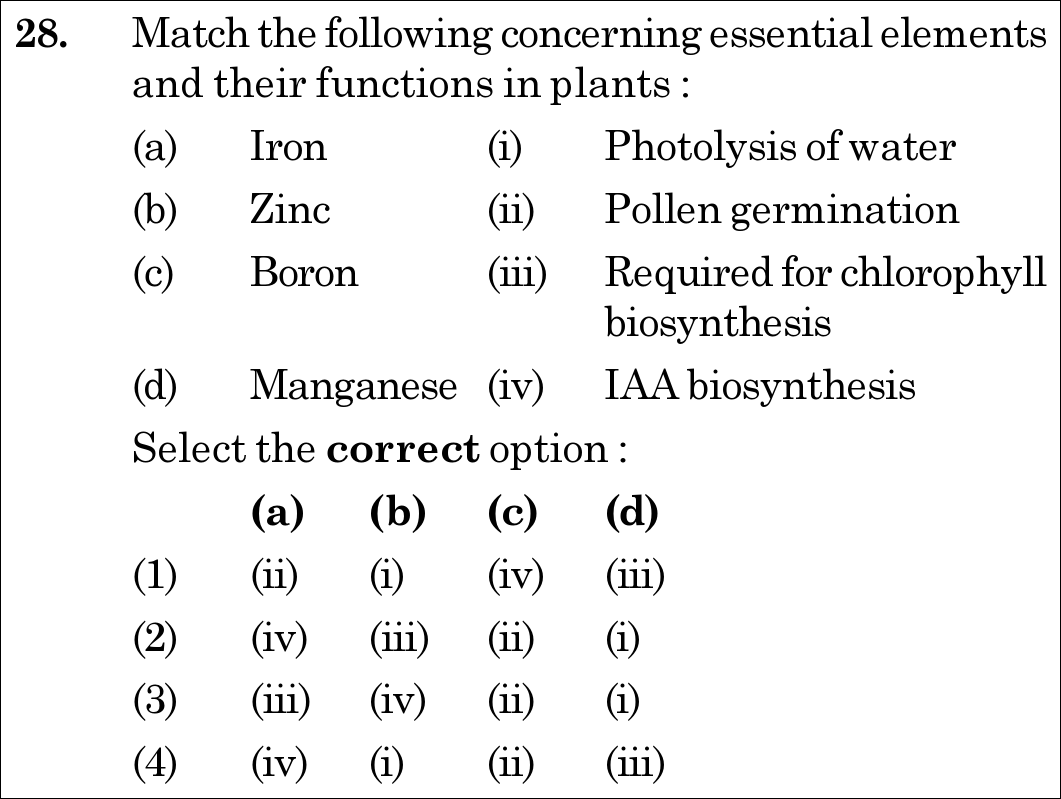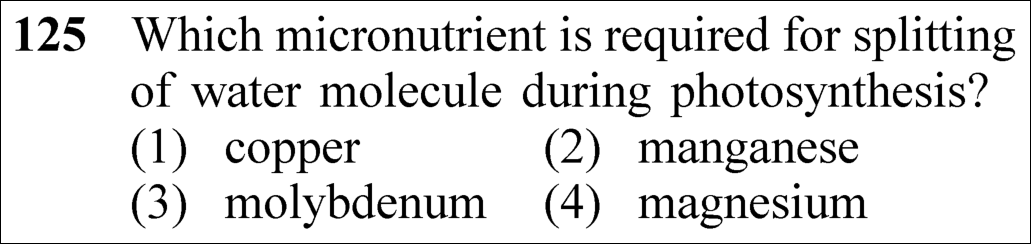
The 30-Second Exam Hall Shortcut: ⚡ Photolysis of Water = Manganese () & Chlorine ()
The oxygen-evolving complex (OEC) of PS II contains a catalytic cluster of 4 manganese atoms (). NCERT explicitly states: "The best defined function of manganese is in the splitting of water to liberate oxygen during photosynthesis!"
Step-by-Step Rigorous Workflow & Mathematical Proof
Mechanism of Water Splitting in Photosystem II
Photolysis occurs on the inner (lumenal) face of the thylakoid membrane associated with PS II, requiring manganese (), calcium (), and chloride () ions:
Verbatim NCERT Association
Under Manganese (), NCERT explicitly declares: "The best defined function of manganese is in the splitting of water to liberate oxygen during photosynthesis."
Nutrient Classification Clarification
The question specifically stipulates "micronutrient". While magnesium () is essential for photosynthesis as the central porphyrin ring coordinator of chlorophyll, magnesium is a macronutrient, whereas manganese is a micronutrient.
360° Option Elimination Engine Key Feature
Diagnose every choice: Know exactly why the right option works and why distractors fail.
Copper participates in electron transfer as a component of plastocyanin, but does not split water.
Matches NCERT verbatim: manganese is the key catalytic micronutrient required for the photolysis of water.
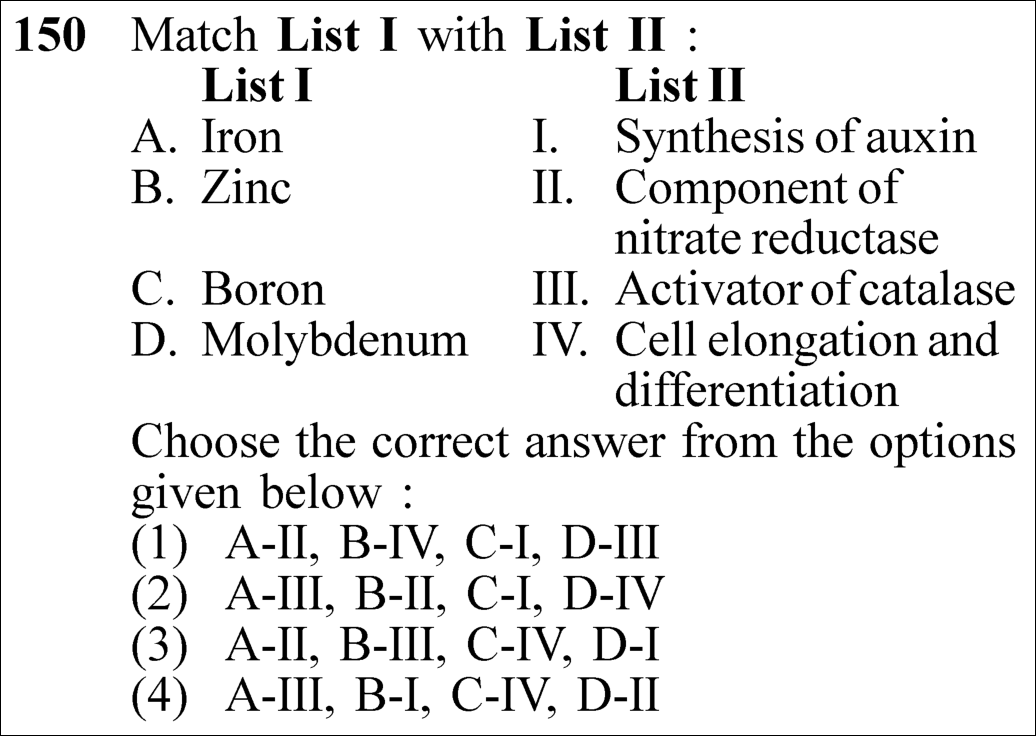
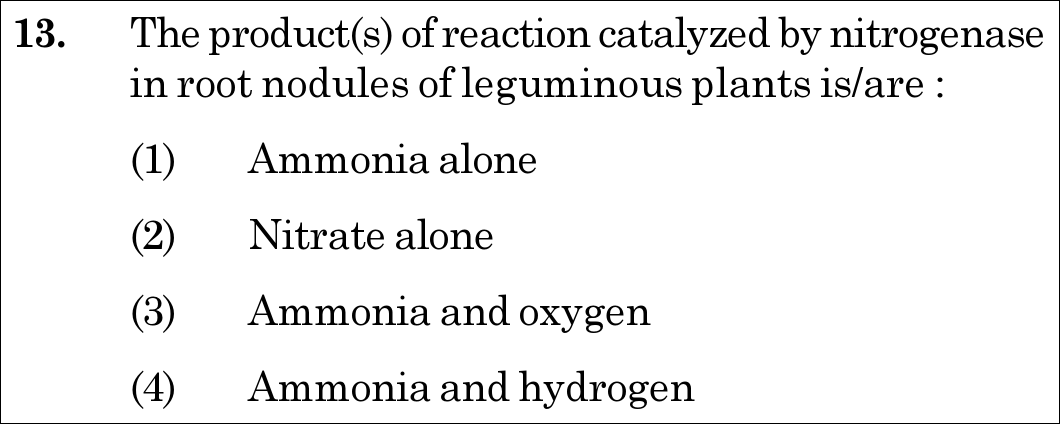
Molybdenum is an essential cofactor for nitrogenase and nitrate reductase in nitrogen metabolism.
Magnesium is a macronutrient coordinated in the central ring of chlorophyll and an activator of RuBisCO; it does not split water.
NTA Trap Alert: Manganese vs. Magnesium Trap
Students frequently mix up Manganese (, micronutrient for photolysis) with Magnesium (, macronutrient in chlorophyll core).
Core NEET Syllabus Standard
"The best defined function of manganese is in the splitting of water to liberate oxygen during photosynthesis."