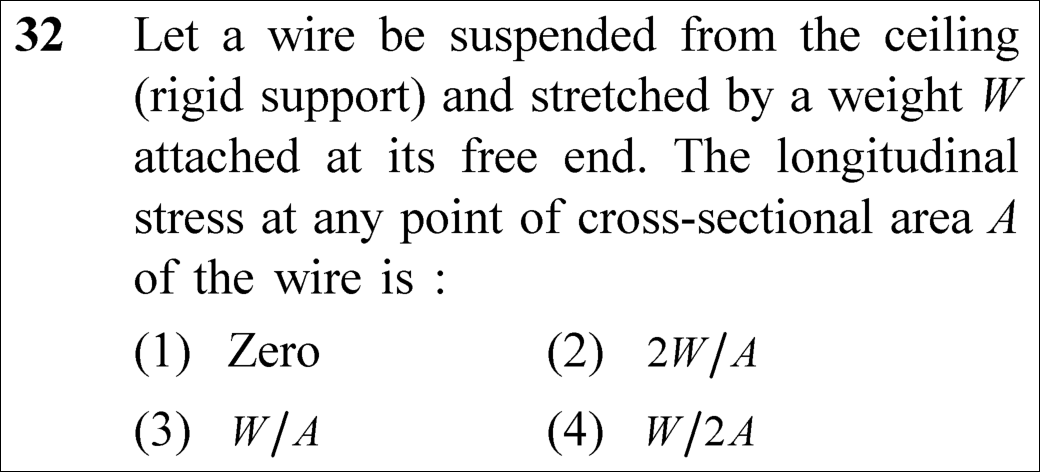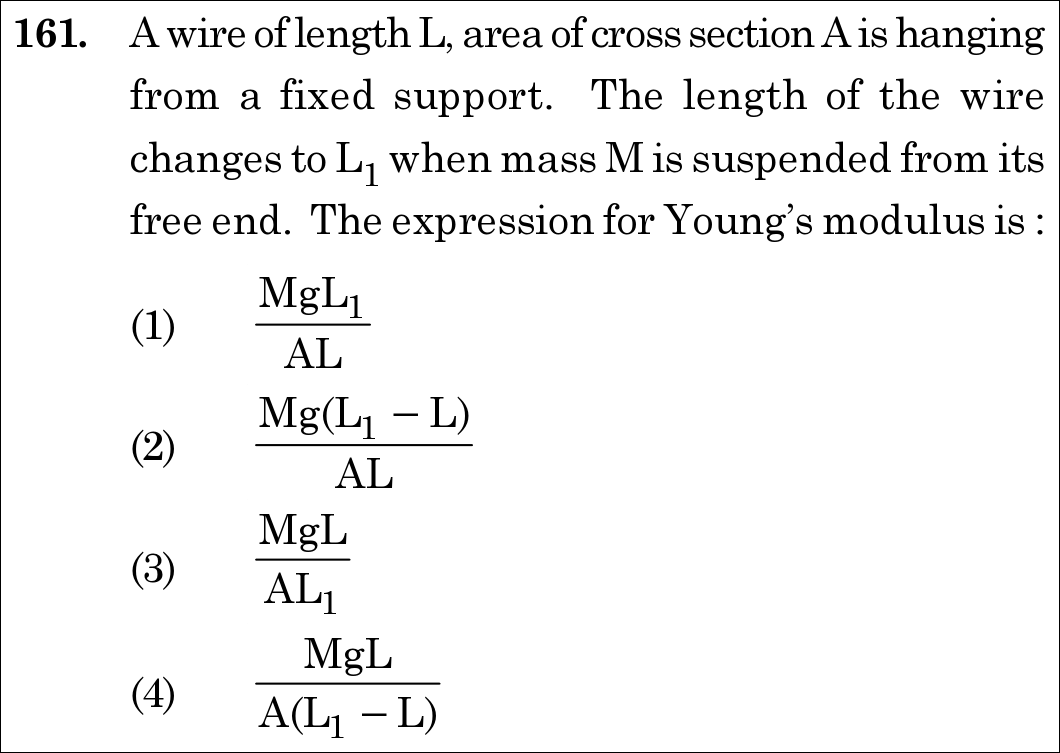
The 30-Second Exam Hall Shortcut: ⚡ Hooke’s Law Direct Substitution
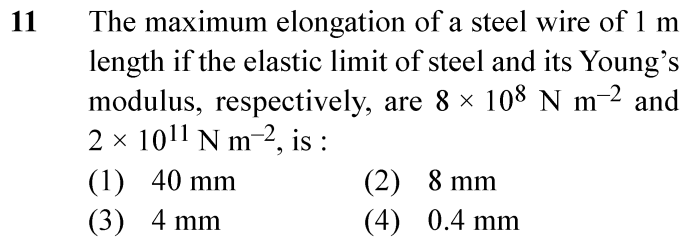
ΔL_max = (σ_max / Y) × L = (8 × 10⁸ / 2 × 10¹¹) × 1 = 4 × 10⁻³ m = 4 mm!
Step-by-Step Rigorous Workflow & Mathematical Proof
Definition of Elastic Limit and Hooke’s Law
Up to the elastic limit, deformation is completely reversible, and Hooke’s law holds rigorously. Young’s modulus Y is defined as the ratio of tensile stress σ to tensile strain ε:
Formulation for Maximum Elongation
To find the maximum elongation ΔL_max without exceeding the elastic limit, we use the maximum allowable stress σ_max:
Numerical Calculation
Substituting σ_max = 8 × 10⁸ N m⁻², L = 1 m, and Y = 2 × 10¹¹ N m⁻²:
Unit Conversion to Millimeters
Since 1 m = 1000 mm:
360° Option Elimination Engine Key Feature
Diagnose every choice: Know exactly why the right option works and why distractors fail.
Off by a factor of 10.
Fails to divide by the factor of 2 in Young’s modulus.
Accurate evaluation: ΔL = 4 × 10⁻³ m = 4 mm.
Off by a factor of 10.
NTA Trap Alert: Power of Ten Metric Conversion Slip
Students frequently mix up 10⁻³ m as 0.4 mm or 40 mm when rushing.
Core NEET Syllabus Standard
"Tensile strain is the ratio of tensile stress to Young’s modulus (ΔL/L = σ/Y)."