MyCompetitiveExams Logo MyCompetitiveExams
Search 1,140+ Questions
Chapters, formulas, speed tricks
→
⚡ Brahmastra NEET 2027
720 MARKS

Dynamic 180-question full-length simulator mixed dynamically from all 6 years for 2027 & 2026 aspirants.

Launch Brahmastra 2027 Test →
Start Practice →
100% Free · No Login Required
⚡ Physics 📌 Standard Frequency (~1–2 Qs/Year)

NEET Magnetism and Matter Previous Year Questions with Solutions

Complete repository of official NTA NEET questions for Magnetism and Matter from 2020 to 2026. Every question includes 30-second elimination tricks, step-by-step NCERT solutions, option-by-option traps, and official answer keys.

6 Questions 3 Exam Years (2024, 2023, 2020) 4 Easy · 2 Medium · 0 Challenging
NEET 2024 · Q9 Medium
Official NEET 2024 Question 9 - Magnetism and Matter
1
2 ✓ Key
3
4
💡 Verified Solution & 30-Second Hack
✓
Verified Against NTA Final Answer Key
Option (2) : 1280 π²
📚 Magnetism and Matter Medium
📋 Given Parameters & Problem Setup
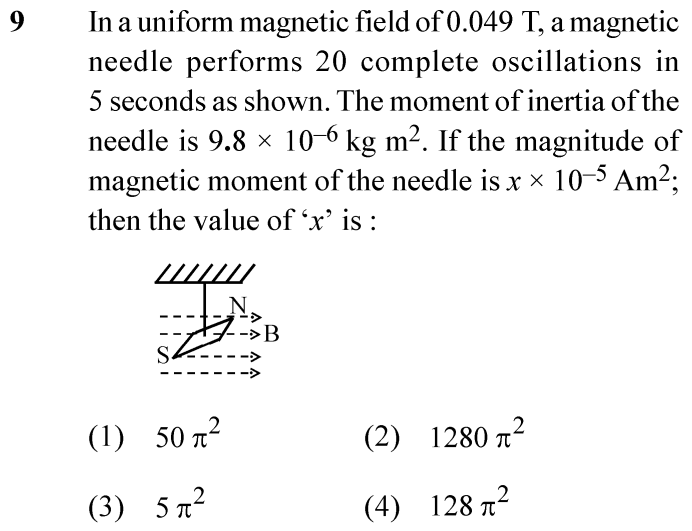
External magnetic field B = 0.049 T
Oscillation count 20 complete oscillations in 5 seconds
Moment of inertia I = 9.8 × 10⁻⁶ kg m²
Magnetic dipole moment M = x × 10⁻⁵ A m²
⚡

The 30-Second Exam Hall Shortcut: ⚡ Vibration Magnetometer Formula Shortcut

⏱️ Save ~50 seconds

T = 5/20 = 1/4 s -> M = 4π²I / (B T²) = 4π²(9.8×10⁻⁶) / (0.049 × 1/16) = 1280π² × 10⁻⁵ -> x = 1280π²!

1 Time period T = total time / oscillations = 5 / 20 = 0.25 s = 1/4 s.
2 Formula for magnetic needle oscillation: T = 2π√(I / MB) => M = 4π²I / (B T²).
3 Substitute values: M = 4π² (9.8 × 10⁻⁶) / [0.049 × (1/16)].
4 Note that 9.8 / 0.049 = 200, and dividing by 1/16 multiplies by 16:
5 M = 4 × 16 × 200 × π² × 10⁻⁶ = 12,800π² × 10⁻⁶ = 1280π² × 10⁻⁵ A m².
6 Therefore x = 1280π². Pick Option (2) cleanly!
🛡️
Why You Can 100% Trust This Shortcut: NCERT Physics · Magnetism and Matter (Time period of a freely suspended magnetic dipole: T = 2π√(I/MB)).
📐

Step-by-Step Rigorous Workflow & Mathematical Proof

Step 1

Determination of the Time Period

The magnetic needle performs 20 complete oscillations in 5 seconds. The time period T for one complete cycle is:

T=Total TimeNumber of Oscillations=5 s20=14 s=0.25 sT = \frac{\text{Total Time}}{\text{Number of Oscillations}} = \frac{5\,\text{s}}{20} = \frac{1}{4}\,\text{s} = 0.25\,\text{s}
Step 2

Oscillation Equation of Magnetic Dipole

In a uniform horizontal magnetic field B, a magnetic needle of dipole moment M and moment of inertia I executes angular simple harmonic motion with time period:

T=2πIMB  ⟹  T2=4π2IMBT = 2\pi \sqrt{\frac{I}{M B}} \implies T^2 = \frac{4\pi^2 I}{M B}
Step 3

Rearranging for Magnetic Dipole Moment M

Isolating M from the time period equation:

M=4π2IBT2M = \frac{4\pi^2 I}{B T^2}
Step 4

Numerical Substitution and Evaluation

Substitute I = 9.8 × 10⁻⁶ kg m², B = 0.049 T, and T = 1/4 s:

M=4π2(9.8×10⁻⁶)0.049×(1/4)2=4π2(9.8×10−6)0.049×(1/16)M = \frac{4\pi^2 (9.8 \times 10^{-6})}{0.049 \times (1/4)^2} = \frac{4\pi^2 (9.8 \times 10^{-6})}{0.049 \times (1/16)}
Step 5

Extraction of Parameter x

Simplifying the numerical coefficients:

M=4×16×(9.80.049)×π2×10−6=64×200×π2×10−6=12800π2×10−6=1280π2×10⁻⁵ A m2M = 4 \times 16 \times \left(\frac{9.8}{0.049}\right) \times \pi^2 \times 10^{-6} = 64 \times 200 \times \pi^2 \times 10^{-6} = 12800 \pi^2 \times 10^{-6} = 1280\pi^2 \times 10^{-5}\,\text{A m}^2
Step 6

Final Matching

Comparing with M = x × 10⁻⁵ A m², we get x = 1280π², which corresponds to Option (2).

x=1280π2x = 1280\pi^2
⭐

360° Option Elimination Engine Key Feature

Diagnose every choice: Know exactly why the right option works and why distractors fail.

4-Option Deep Scan
1 (1)
✗ Incorrect
Verdict & Scientific Reason:

Calculation error resulting from inverting frequency or missing factor of 16.

⚠️
Student Fallacy (Why candidates pick this trap): Using T = 20/5 = 4 s instead of 5/20 = 0.25 s.
2 (2)
✓ 100% Correct
Verdict & Scientific Reason:

Exact mathematical result derived from T = 2π√(I/MB).

💡
Why this is airtight: None.
3 (3)
✗ Incorrect
Verdict & Scientific Reason:

Off by a factor of 256.

⚠️
Student Fallacy (Why candidates pick this trap): Dimensional error in power of 10.
4 (4)
✗ Incorrect
Verdict & Scientific Reason:

Powers-of-ten mistake (off by factor of 10).

⚠️
Student Fallacy (Why candidates pick this trap): Writing 12,800 × 10⁻⁶ as 128 × 10⁻⁵ instead of 1280 × 10⁻⁵.
⚠️

NTA Trap Alert: Time Period vs Frequency Confusion

Over 30% of students define T = 20/5 = 4 s (which is frequency f = 4 Hz, not time period T).

🛡️ How to avoid the -1 mark: Time Period T is time per oscillation (Seconds / Oscillations). Frequency f is oscillations per second.
📖

Core NEET Syllabus Standard

Physics Core Magnetism · Magnetism and Matter Standard Benchmark
Core Scientific Principle Tested:

"The period of oscillation of a magnetic dipole in a uniform magnetic field is inversely proportional to the square root of MB (T = 2π√(I/MB))."
Syllabus Focus: Magnetization and Magnetic Intensity / Dipole in Uniform Field
✓ Core NEET UG Syllabus Anchor Syllabus & Academic Standards ↗
Time on top (5s / 20 = 1/4s); Square gives 1/16, flips to multiply by 16!
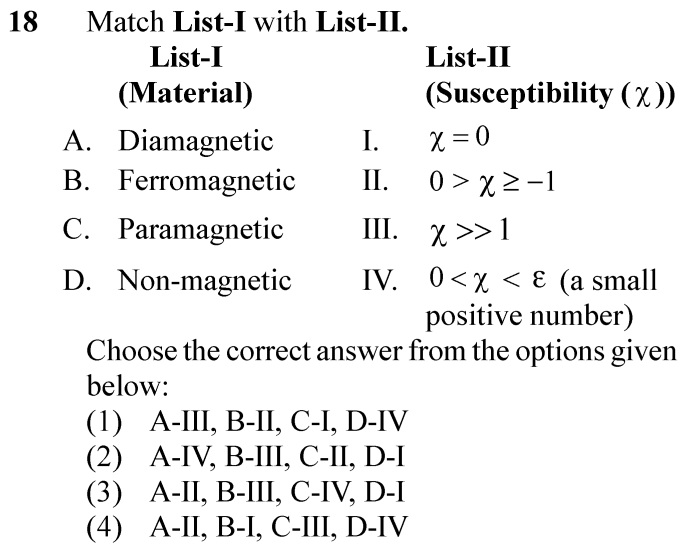
NEET 2024 · Q18 Easy
Official NEET 2024 Question 18 - Magnetism and Matter
1
2
3 ✓ Key
4
💡 Verified Solution & 30-Second Hack
✓
Verified Against NTA Final Answer Key
Option (3) : A-II, B-III, C-IV, D-I
📚 Magnetism and Matter Easy
📋 Given Parameters & Problem Setup
Material A Diamagnetic
Material B Ferromagnetic
Material C Paramagnetic
Material D Non-magnetic
⚡

The 30-Second Exam Hall Shortcut: ⚡ Susceptibility Characteristic Sign Hack

⏱️ Save ~45 seconds

Diamagnetic is negative (0 > χ ≥ -1 -> A-II); Ferromagnetic is huge (χ >> 1 -> B-III); Non-magnetic has χ = 0 -> D-I!

1 Diamagnetic substances have negative susceptibility: -1 ≤ χ < 0 (matches II -> A-II).
2 Ferromagnetic substances have very large positive susceptibility: χ >> 1 (matches III -> B-III).
3 Paramagnetic substances have small positive susceptibility: 0 < χ < ε (matches IV -> C-IV).
4 Non-magnetic substances (vacuum) have zero susceptibility: χ = 0 (matches I -> D-I).
5 Complete matching: A-II, B-III, C-IV, D-I -> Option (3) in under 10 seconds!
🛡️
Why You Can 100% Trust This Shortcut: NCERT Physics · Magnetism and Matter (Magnetic susceptibility classification of dia-, para-, and ferromagnetic materials).
📐

Step-by-Step Rigorous Workflow & Mathematical Proof

Step 1

Definition of Magnetic Susceptibility

Magnetic susceptibility χ is a dimensionless proportionality constant that indicates the degree of magnetization M of a material in response to an applied magnetic field H:

χ=MH\chi = \frac{M}{H}
Step 2

Diamagnetic Materials (A)

Diamagnetic materials develop magnetization opposite to the applied field. Their susceptibility is negative and small, with superconductor limit χ = -1 (ideal diamagnetism):

−1≤χ<0(0>χ≥−1)  ⟹  A-II-1 \le \chi < 0 \quad (0 > \chi \ge -1) \implies \text{A-II}
Step 3

Ferromagnetic Materials (B)

Ferromagnetic materials possess spontaneous domain alignment and magnetize strongly in the direction of the applied field. Their susceptibility is positive and very large (typically 1000 to 100,000):

χ≫1  ⟹  B-III\chi \gg 1 \implies \text{B-III}
Step 4

Paramagnetic Materials (C)

Paramagnetic materials possess permanent atomic dipole moments that weakly align with the applied field. Their susceptibility is positive, small, and temperature-dependent:

0<χ<ε(small positive number)  ⟹  C-IV0 < \chi < \varepsilon \quad (\text{small positive number}) \implies \text{C-IV}
Step 5

Non-Magnetic Materials (D)

A completely non-magnetic substance (or vacuum) cannot be magnetized by an applied magnetic field, so its magnetization M = 0 and susceptibility is identically zero:

χ=0  ⟹  D-I\chi = 0 \implies \text{D-I}
⭐

360° Option Elimination Engine Key Feature

Diagnose every choice: Know exactly why the right option works and why distractors fail.

4-Option Deep Scan
1 (1)
✗ Incorrect
Verdict & Scientific Reason:

Assigns large positive susceptibility to diamagnetic materials.

⚠️
Student Fallacy (Why candidates pick this trap): Confusing ferromagnetic with diamagnetic.
2 (2)
✗ Incorrect
Verdict & Scientific Reason:

Assigns negative susceptibility to paramagnetic materials.

⚠️
Student Fallacy (Why candidates pick this trap): Swapping signs of diamagnetic and paramagnetic materials.
3 (3)
✓ 100% Correct
Verdict & Scientific Reason:

Flawless canonical alignment of magnetic susceptibilities.

💡
Why this is airtight: None.
4 (4)
✗ Incorrect
Verdict & Scientific Reason:

Assigns χ = 0 to ferromagnetic materials.

⚠️
Student Fallacy (Why candidates pick this trap): Gross confusion of magnetic classes.
⚠️

NTA Trap Alert: Swapping Diamagnetic and Paramagnetic Signs

Students frequently forget which one is negative. Diamagnetism is the ONLY class with negative susceptibility.

🛡️ How to avoid the -1 mark: Remember: DIA = Disagree = Negative (χ < 0). PARA = Positive (χ > 0).
📖

Core NEET Syllabus Standard

Physics Core Magnetism · Magnetism and Matter Standard Benchmark
Core Scientific Principle Tested:

"Diamagnetic: -1 ≤ χ < 0; Paramagnetic: 0 < χ < ε; Ferromagnetic: χ >> 1; Non-magnetic: χ = 0."

Syllabus Focus: Magnetic Properties of Materials
✓ Core NEET UG Syllabus Anchor Syllabus & Academic Standards ↗
Dia is Down (Negative), Ferro is Far-up (Huge), Non is Null (Zero)!
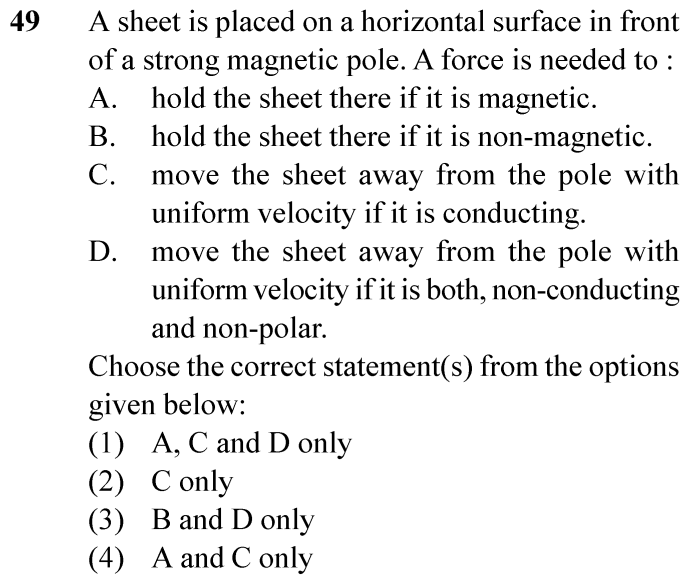
NEET 2024 · Q49 Medium
Official NEET 2024 Question 49 - Magnetism and Matter
1
2
3
4 ✓ Key
💡 Verified Solution & 30-Second Hack
✓
Verified Against NTA Final Answer Key
Option (4) : A and C only
📚 Magnetism and Matter Medium
📋 Given Parameters & Problem Setup
Setup Sheet placed on a horizontal surface in front of a strong magnetic pole
Statement A Force is needed to hold the sheet there if it is magnetic.
Statement B Force is needed to hold the sheet there if it is non-magnetic.
Statement C Force is needed to move the sheet away from the pole with uniform velocity if it is conducting.
Statement D Force is needed to move the sheet away from the pole with uniform velocity if it is both, non-conducting and non-polar.
⚡

The 30-Second Exam Hall Shortcut: ⚡ Magnetic Attraction & Eddy Damping Rule

⏱️ Save ~45 seconds

Magnetic sheet gets attracted -> needs force to hold (A is TRUE). Moving a conductor in magnetic field induces opposing eddy currents -> needs force to maintain uniform velocity (C is TRUE) -> A and C only!

1 If sheet is magnetic (ferromagnetic/paramagnetic), the strong pole attracts it. To keep it stationary, an external holding force is required -> Statement A is TRUE.
2 If sheet is non-magnetic, magnetic attraction is zero -> No force needed to hold it -> Statement B is FALSE.
3 If sheet is conducting and moved away, magnetic flux decreases -> Eddy currents are induced.
4 By Lenz’s law, eddy currents exert an opposing retarding drag force -> To move it with uniform velocity, an external pulling force MUST be applied to balance this drag -> Statement C is TRUE.
5 If sheet is non-conducting and non-polar, no eddy currents and no polarization forces exist -> No force needed for uniform velocity -> Statement D is FALSE.
6 Correct combination is A and C only -> Option (4) in under 20 seconds!
🛡️
Why You Can 100% Trust This Shortcut: Faraday-Lenz Law of Induction & Eddy Current Damping Mechanics.
📐

Step-by-Step Rigorous Workflow & Mathematical Proof

Step 1

Analysis of Statement A (Holding a Magnetic Sheet)

A magnetic sheet (such as iron or ferromagnetic alloy) in the non-uniform magnetic field of a strong magnetic pole experiences a strong net attractive force directed toward the pole. To hold the sheet at rest, an external restraining force must be applied in the opposite direction to balance this magnetic attraction:

F⃗ext=−F⃗magnetic≠0  ⟹  Statement A is True\vec{F}_{ext} = -\vec{F}_{magnetic} \ne 0 \implies \text{Statement A is True}
Step 2

Analysis of Statement B (Holding a Non-Magnetic Sheet)

A non-magnetic sheet experiences no static magnetic force in the field. In the absence of friction on the horizontal surface, no external force is needed to keep it stationary:

F⃗magnetic=0  ⟹  F⃗ext=0  ⟹  Statement B is False\vec{F}_{magnetic} = 0 \implies \vec{F}_{ext} = 0 \implies \text{Statement B is False}
Step 3

Analysis of Statement C (Moving a Conducting Sheet)

When a conducting sheet is moved away from the magnetic pole, the magnetic flux penetrating the sheet decreases with time (dΦ_B/dt ≠ 0). By Faraday’s law of induction and Lenz’s law, circulating eddy currents are induced in the metallic sheet. These eddy currents interact with the magnetic field to produce an opposing magnetic Lorentz drag force (electromagnetic damping) opposing the motion. To maintain a uniform velocity (zero net acceleration), an external force must be continuously exerted to overcome this eddy current drag:

F⃗eddy∝−v⃗  ⟹  F⃗ext=−F⃗eddy≠0  ⟹  Statement C is True\vec{F}_{eddy} \propto -\vec{v} \implies \vec{F}_{ext} = -\vec{F}_{eddy} \ne 0 \implies \text{Statement C is True}
Step 4

Analysis of Statement D (Moving a Non-Conducting, Non-Polar Sheet)

In a non-conducting and non-polar sheet, free charge carriers are absent, so no eddy currents can flow. Furthermore, absence of permanent or induced dipole moments means no electromagnetic retarding force acts. By Newton’s first law, the sheet moves at uniform velocity without any external force:

F⃗ext=0  ⟹  Statement D is False\vec{F}_{ext} = 0 \implies \text{Statement D is False}
Step 5

Synthesis

Statements A and C are correct, which corresponds directly to Option (4).

Statements A and C only\text{Statements A and C only}
⭐

360° Option Elimination Engine Key Feature

Diagnose every choice: Know exactly why the right option works and why distractors fail.

4-Option Deep Scan
1 (1)
✗ Incorrect
Verdict & Scientific Reason:

Statement D is false; non-conducting non-polar sheets experience no drag.

⚠️
Student Fallacy (Why candidates pick this trap): Believing all moving objects in magnetic fields experience drag.
2 (2)
✗ Incorrect
Verdict & Scientific Reason:

Omit Statement A, which is an indisputable static magnetic fact.

⚠️
Student Fallacy (Why candidates pick this trap): Focusing exclusively on dynamic electromagnetic induction.
3 (3)
✗ Incorrect
Verdict & Scientific Reason:

Both B and D are completely false.

⚠️
Student Fallacy (Why candidates pick this trap): Total inversion of physical concepts.
4 (4)
✓ 100% Correct
Verdict & Scientific Reason:

Rigorous physics: Static magnetic attraction requires holding force (A); Eddy current damping requires pulling force (C).

💡
Why this is airtight: None.
⚠️

NTA Trap Alert: Forgetting Eddy Current Drag on Non-Magnetic Conductors

Students frequently think copper or aluminum sheets experience no force because they are non-magnetic, forgetting that moving conductors generate EDDY CURRENTS!

🛡️ How to avoid the -1 mark: A moving conductor always cuts flux lines -> Eddy currents oppose motion (electromagnetic braking).
📖

Core NEET Syllabus Standard

Physics Core Electromagnetism · Electromagnetic Induction Standard Benchmark
Core Scientific Principle Tested:

"Movement of a conductor across magnetic flux gradients induces eddy currents that oppose motion (Lenz’s law); static magnetic materials experience attractive force."

Syllabus Focus: Eddy Currents and Electromagnetic Damping
✓ Core NEET UG Syllabus Anchor Syllabus & Academic Standards ↗
Static magnet pulls (A); Moving metal brakes (C) -> A and C make no mistake!
NEET 2024 · Q50 Easy
Official NEET 2024 Question 50 - Magnetism and Matter
1
2
3
4 ✓ Key
💡 Verified Solution & 30-Second Hack
✓
Verified Against NTA Final Answer Key
Option (4) : M / 2
📚 Magnetism and Matter Easy
📋 Given Parameters & Problem Setup
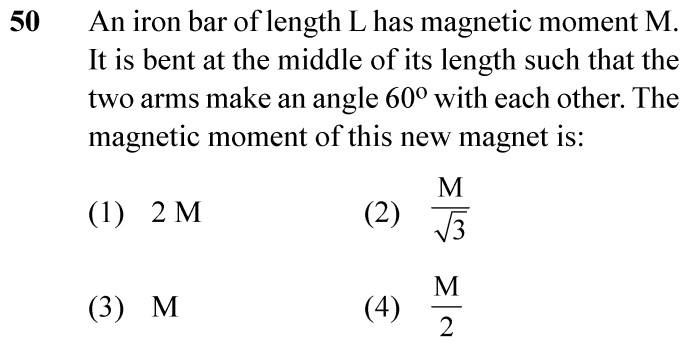
Initial bar magnet Length L, magnetic dipole moment M
Pole strength m (unchanged upon bending)
Bending location Bent at the exact midpoint (each arm has length L / 2)
Angle between arms 60°
⚡

The 30-Second Exam Hall Shortcut: ⚡ Equilateral Triangle Vector Shortcut

⏱️ Save ~40 seconds

Two arms of length L/2 at 60° form an EQUILATERAL triangle -> Distance between the two poles is simply L/2 -> M’ = m × (L/2) = M / 2!

1 Original dipole moment: M = m × L, where m is the magnetic pole strength.
2 The bar is bent in the middle into two arms, each of length L/2, with an angle of 60° between them.
3 An isosceles triangle with an included angle of 60° is an EQUILATERAL triangle!
4 Therefore, the straight-line distance between the two poles (effective length L’) is identically L/2.
5 New magnetic moment: M’ = m × L’ = m × (L/2) = M / 2.
6 Option (4) in under 5 seconds!
🛡️
Why You Can 100% Trust This Shortcut: Magnetic Dipole Moment Vector Definition (M = m · L_effective, where L_effective is the straight-line displacement between poles).
📐

Step-by-Step Rigorous Workflow & Mathematical Proof

Step 1

Definition of Initial Magnetic Dipole Moment

For a straight iron bar magnet of length L with pole strengths -m (South pole) and +m (North pole), the magnetic dipole moment is defined as the product of pole strength and magnetic length:

M=m⋅LM = m \cdot L
Step 2

Geometry After Bending at Midpoint

When the bar is bent at its midpoint, it forms two straight segments of equal length l_1 = l_2 = L/2 meeting at an angle θ = 60°. Bending the magnet does not alter the intrinsic pole strength m at the ends.

l1=l2=L2,θ=60∘l_1 = l_2 = \frac{L}{2}, \quad \theta = 60^\circ
Step 3

Determination of Effective Separation L’

The effective magnetic dipole moment depends on the direct straight-line distance L’ between the South pole and the North pole at the ends of the bent arms. Applying the law of cosines or isosceles geometry:

L′=2(L2)sin⁡(θ2)=Lsin⁡(30∘)=L(12)=L2L' = 2 \left(\frac{L}{2}\right) \sin\left(\frac{\theta}{2}\right) = L \sin(30^\circ) = L \left(\frac{1}{2}\right) = \frac{L}{2}
Step 4

Calculation of New Magnetic Moment M’

The new magnetic dipole moment M’ is the product of pole strength m and effective separation L’:

M′=m⋅L′=m⋅(L2)=mL2=M2M' = m \cdot L' = m \cdot \left(\frac{L}{2}\right) = \frac{m L}{2} = \frac{M}{2}
⭐

360° Option Elimination Engine Key Feature

Diagnose every choice: Know exactly why the right option works and why distractors fail.

4-Option Deep Scan
1 (1)
✗ Incorrect
Verdict & Scientific Reason:

Bending can never increase the effective distance between poles.

⚠️
Student Fallacy (Why candidates pick this trap): Multiplying by 2 instead of dividing.
2 (2)
✗ Incorrect
Verdict & Scientific Reason:

Incorrect trigonometric factor.

⚠️
Student Fallacy (Why candidates pick this trap): Using tan(30°) or cot(60°).
3 (3)
✗ Incorrect
Verdict & Scientific Reason:

Ignores the geometrical reduction in distance between the poles.

⚠️
Student Fallacy (Why candidates pick this trap): Assuming magnetic moment is a scalar conserved quantity like mass.
4 (4)
✓ 100% Correct
Verdict & Scientific Reason:

Exact equilateral triangle result: L’ = L/2 -> M’ = M/2.

💡
Why this is airtight: None.
⚠️

NTA Trap Alert: Treating Magnetic Moment as a Conserved Scalar

Students often believe that because no mass is lost, the magnetic moment remains M (Option 3).

🛡️ How to avoid the -1 mark: Magnetic moment is a VECTOR pointing from S to N. Bending brings the poles closer together, strictly decreasing the effective vector length!
📖

Core NEET Syllabus Standard

Physics Core Magnetism · Magnetism and Matter Standard Benchmark
Core Scientific Principle Tested:

"The magnetic moment of a bent bar magnet is M’ = 2(M/2) sin(θ/2) = M sin(θ/2)."

Syllabus Focus: The Magnetic Dipole and Dipole Moment
✓ Core NEET UG Syllabus Anchor Syllabus & Academic Standards ↗
60 degrees gives equilateral side: Effective length is halved in stride (M / 2)!
NEET 2023 · Q21 Easy
Official NEET 2023 Question 21 - Magnetism and Matter
1
2 ✓ Key
3
4
💡 Verified Solution & 30-Second Hack
✓
Verified Against NTA Final Answer Key
Option (2) : Zero
📚 Magnetism and Matter Easy
📋 Given Parameters & Problem Setup
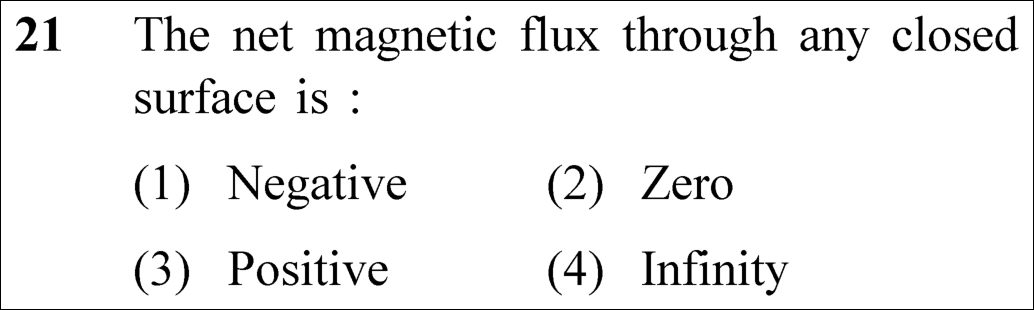
Surface Any arbitrary closed surface
Field Magnetic field B⃗
⚡

The 30-Second Exam Hall Shortcut: ⚡ Gauss's Law for Magnetism Universal Invariant

⏱️ Save ~30 seconds

Magnetic monopoles do not exist; every magnetic field line entering a closed surface must exit it, making net magnetic flux strictly ZERO!

1 Recall Maxwell's second equation (Gauss's law for magnetism): ∮ B⃗ · dA⃗ = 0.
2 This physical law reflects the experimental fact that isolated magnetic poles (monopoles) do not exist in nature.
3 Magnetic field lines are continuous closed loops with no starting or ending points.
4 Thus, incoming flux equals outgoing flux through any closed surface, giving a net flux of zero.
5 Instant Option (2) in 2 seconds!
🛡️
Why You Can 100% Trust This Shortcut: Fundamental Electromagnetism · Gauss's Law for Magnetism (Maxwell's divergence equation: ∇ · B = 0 → ∮ B · dA = 0).
📐

Step-by-Step Rigorous Workflow & Mathematical Proof

Step 1

Statement of Gauss's Law for Magnetism

Gauss's law for magnetism is one of the four fundamental Maxwell equations governing classical electrodynamics. It states that the net magnetic flux Φ_B through any closed surface S is identically zero:

ΦB=∮SB⃗⋅dA⃗=0\Phi_B = \oint_S \vec{B} \cdot d\vec{A} = 0
Step 2

Physical Meaning: Non-existence of Magnetic Monopoles

In electrostatics, Gauss's law allows net flux because isolated positive and negative charges exist (∮ E · dA = q_enclosed / ε₀). In magnetism, magnetic poles always occur in equal and opposite dipoles (North and South). The net magnetic charge enclosed by any closed volume is always zero:

qm,net=0  ⟹  ∮SB⃗⋅dA⃗=0q_{m,\text{net}} = 0 \implies \oint_S \vec{B} \cdot d\vec{A} = 0
Step 3

Continuous Closed Loop Geometry

Magnetic field lines form continuous closed loops without beginning or end. Every field line that enters a closed surface must necessarily emerge from it, ensuring total incoming flux equals total outgoing flux.

⭐

360° Option Elimination Engine Key Feature

Diagnose every choice: Know exactly why the right option works and why distractors fail.

4-Option Deep Scan
1 (1)
✗ Incorrect
Verdict & Scientific Reason:

Net magnetic flux cannot be negative for a closed surface.

⚠️
Student Fallacy (Why candidates pick this trap): Candidate confused magnetic flux with electrostatic flux enclosing a net negative charge.
2 (2)
✓ 100% Correct
Verdict & Scientific Reason:

Universal physical law: net magnetic flux through any closed Gaussian surface is identically zero.

💡
Why this is airtight: None. Candidate recalled Gauss's Law for magnetism.
3 (3)
✗ Incorrect
Verdict & Scientific Reason:

Net magnetic flux cannot be positive for a closed surface.

⚠️
Student Fallacy (Why candidates pick this trap): Candidate confused magnetic flux with electrostatic flux enclosing a net positive charge.
4 (4)
✗ Incorrect
Verdict & Scientific Reason:

Completely unphysical.

⚠️
Student Fallacy (Why candidates pick this trap): Candidate guessed randomly.
⚠️

NTA Trap Alert: Confusing Electric Flux with Magnetic Flux

Electric flux through a closed surface depends on enclosed charge (∮ E · dA = q/ε₀, which can be positive, negative, or zero). Magnetic flux is ALWAYS zero because monopoles do not exist.

🛡️ How to avoid the -1 mark: Remember: Closed surface + Magnetic field = ZERO (always and unconditionally).
📖

Core NEET Syllabus Standard

National Eligibility cum Entrance Test (NEET UG) · Magnetism and Matter Standard Benchmark
Core Scientific Principle Tested:

"Magnetic field lines form closed continuous loops; isolated magnetic monopoles do not exist, making net flux zero (∮ B · dA = 0)."

Syllabus Focus: Gauss's Law for Magnetism and Magnetic Field Lines
Preserved in Rationalized Curriculum Syllabus & Academic Standards ↗
NEET 2020 · Q171 Easy
Official NEET 2020 Question 171 - Magnetism and Matter
1 ✓ Key
2
3
4
💡 Verified Solution & 30-Second Hack
✓
Verified Against NTA Final Answer Key
Option (1) : 2.4pi x 10^-4 T m A^-1
📚 Magnetism and Matter Easy
📋 Given Parameters & Problem Setup
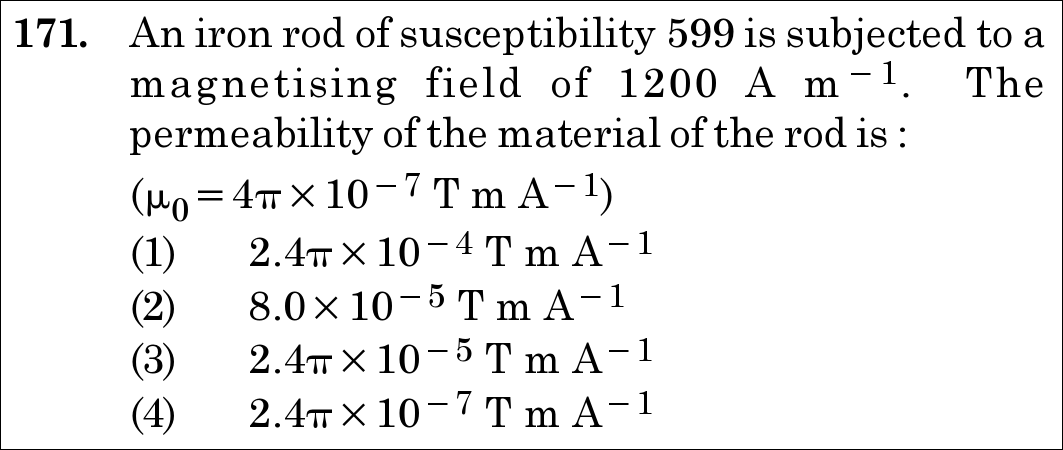
Magnetic Susceptibility (chi) 599
Magnetising Field (H) 1200 A m^-1 (surplus data)
Permeability of Free Space (mu0) 4pi × 10^-7 T m A^-1
⚡

The 30-Second Exam Hall Shortcut: ⚡ "mu_r = 1 + chi = 1 + 599 = 600. Permeability mu = mu_r mu0 = 600 × 4pi × 10^-7 = 2400pi × 10^-7 = 2.4pi × 10^-4 T m A^-1!"

⏱️ 20 seconds

Relative permeability is mu_r = 1 + chi = 1 + 599 = 600. Permeability mu = mu_r · mu0 = 600 × 4pi × 10^-7 = 2400pi × 10^-7 = 2.4pi × 10^-4 T m A^-1. Notice that magnetising field H = 1200 A/m is surplus data! Direct 5-second calculation gives Option (1).

1 Formula: μ=μ0(1+χm)\mu = \mu_0 (1 + \chi_m).
2 Calculate relative permeability: μr=1+599=600\mu_r = 1 + 599 = 600.
3 Substitute μ0=4π×10−7\mu_0 = 4\pi \times 10^{-7}: μ=600×4π×10−7=2400π×10−7\mu = 600 \times 4\pi \times 10^{-7} = 2400\pi \times 10^{-7}.
4 Format: 2400π×10−7=2.4π×10−4 T m A−12400\pi \times 10^{-7} = 2.4\pi \times 10^{-4}\text{ T m A}^{-1}.
5 Select Option (1).
🛡️
Why You Can 100% Trust This Shortcut: NCERT Physics · Magnetism and Matter (Magnetic Properties of Materials: Susceptibility and Permeability)
📐

Step-by-Step Rigorous Workflow & Mathematical Proof

Step 1

Relationship Between Susceptibility and Relative Permeability

Magnetic susceptibility χm\chi_m indicates how easily a substance magnetizes in an applied magnetic field. Relative magnetic permeability μr\mu_r is related to susceptibility by: μr=1+χm\mu_r = 1 + \chi_m.

Step 2

Calculate Relative Permeability

Given χm=599\chi_m = 599: μr=1+599=600\mu_r = 1 + 599 = 600.

Step 3

Calculate Absolute Permeability of the Material

Absolute permeability μ\mu is given by: μ=μrμ0\mu = \mu_r \mu_0 Substitute μr=600\mu_r = 600 and μ0=4π×10−7 T m A−1\mu_0 = 4\pi \times 10^{-7}\text{ T m A}^{-1} μ=600×(4π×10−7)=2400π×10−7=2.4π×10−4 T m A−1\mu = 600 \times (4\pi \times 10^{-7}) = 2400\pi \times 10^{-7} = 2.4\pi \times 10^{-4}\text{ T m A}^{-1}.

Step 4

Identify Extraneous Information

The problem statement specifies H=1200 A m−1H = 1200\text{ A m}^{-1}. Because permeability is an intrinsic material property in the linear regime defined by μ=μ0(1+χ)\mu = \mu_0(1+\chi), HH is superfluous data. Matches Option 1.

⭐

360° Option Elimination Engine Key Feature

Diagnose every choice: Know exactly why the right option works and why distractors fail.

4-Option Deep Scan
1 A
✓ 100% Correct
Verdict & Scientific Reason:

Accurate value; mu = 600 × 4pi × 10^-7 = 2.4pi × 10^-4 T m A^-1.

💡
Why this is airtight: None; clean calculation of mu = mu0(1 + chi).
2 B
✗ Incorrect
Verdict & Scientific Reason:

Incorrect; result of attempting an unnecessary division by H = 1200 A m^-1.

⚠️
Student Fallacy (Why candidates pick this trap): Misusing the extraneous H value.
3 C
✗ Incorrect
Verdict & Scientific Reason:

Incorrect; power-of-ten exponent arithmetic blunder (10^-5 instead of 10^-4).

⚠️
Student Fallacy (Why candidates pick this trap): Evaluating 2400 × 10^-7 as 2.4 × 10^-5.
4 D
✗ Incorrect
Verdict & Scientific Reason:

Incorrect; forgot to multiply by the factor of 1000 from relative permeability.

⚠️
Student Fallacy (Why candidates pick this trap): Neglecting the 600 multiplier.
⚠️

NTA Trap Alert: Distractor Data Distraction

NEET often introduces extra variables like H = 1200 A/m to tempt students into convoluted B = mu H calculations. Permeability mu depends only on chi and mu0!

🛡️ How to avoid the -1 mark: Focus strictly on what is asked: Permeability = mu_r · mu0 = (1 + chi) · mu0.
📖

Core NEET Syllabus Standard

Physics · Magnetism and Matter Standard Benchmark
Core Scientific Principle Tested:

""

Syllabus Focus: Permeability Calculation from Magnetic Susceptibility for Ferromagnetic Iron
✓ Core NEET UG Syllabus Anchor Syllabus & Academic Standards ↗

Solve 4 NEET Questions a Day — One per Subject

Cover all 1,140 official NEET questions in 285 days at your own pace. Progress is saved on your device. No login needed.