MyCompetitiveExams Logo MyCompetitiveExams
Search 1,140+ Questions
Chapters, formulas, speed tricks
→
⚡ Brahmastra NEET 2027
720 MARKS

Dynamic 180-question full-length simulator mixed dynamically from all 6 years for 2027 & 2026 aspirants.

Launch Brahmastra 2027 Test →
Start Practice →
100% Free · No Login Required
⚡ Physics Moderate Frequency

NEET Atoms & Nuclei Previous Year Questions with Solutions

Complete repository of official NTA NEET questions for Atoms & Nuclei from 2020 to 2026. Every question includes 30-second elimination tricks, step-by-step NCERT solutions, option-by-option traps, and official answer keys.

2 Questions 1 Exam Years (2026) 1 Easy · 1 Medium · 0 Challenging
NEET 2026 · Q35 Easy
Official NEET 2026 Question 35 - Atoms & Nuclei
1
2
3 ✓ Key
4
💡 Verified Solution & 30-Second Hack
✓
Verified Against NTA Final Answer Key
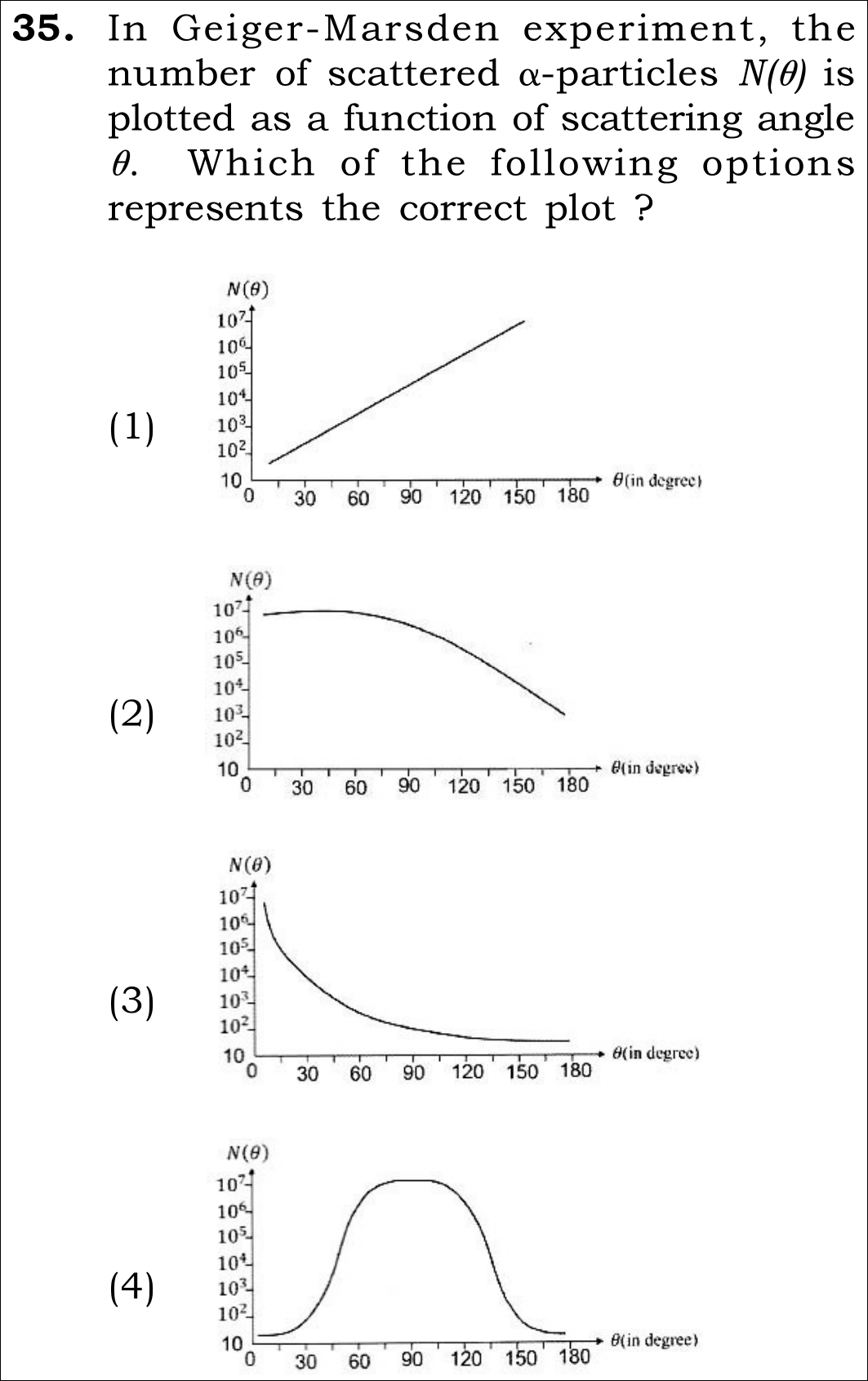
Option (3) : Plot (3): Steeply decreasing curve dropping precipitously from 10^7 at small angles down to 10-10^2 at large angles
📚 Atoms & Nuclei Easy
📋 Given Parameters & Problem Setup
Experiment Geiger-Marsden (Rutherford) alpha-particle scattering experiment
Variables Number of scattered alpha-particles N(theta) vs scattering angle theta (in degrees)
Vertical Axis Logarithmic scale from 10 to 10^7
Horizontal Axis Scattering angle from 0 to 180 degrees
⚡

The 30-Second Exam Hall Shortcut: ⚡ Rutherford Sin^4 Scattering Law

⏱️ Instant textbook recognition.

Number of particles scattered drops as 1 / sin^4(theta / 2)!

1 Rutherford formula: N(theta) is proportional to 1 / sin^4(theta / 2).
2 At near-zero angles (theta -> 0): sin(theta/2) is tiny, so N(theta) is enormous (~10^7). Almost all alpha particles pass straight through undeflected!
3 As theta increases beyond 90 degrees: sin(theta/2) reaches ~1, so N(theta) plummets to near zero (~10^1). Only about 1 in 8000 particles deflects backwards.
4 On a logarithmic plot, this produces a dramatic, hyperbola-like steep drop that flattens out near the baseline at large angles.
5 Directly matches Plot (3) in NCERT textbook. Solved in 5 seconds!
🛡️
Why You Can 100% Trust This Shortcut: Rutherford scattering differential cross-section: dsigma/dOmega = [z*Z*e^2 / (4*pi*epsilon_0 * 4*E)]^2 * (1 / sin^4(theta/2)). The inverse fourth power of sine guarantees a steep drop-off.
📐

Step-by-Step Rigorous Workflow & Mathematical Proof

Step 1

State Rutherford's Alpha-Particle Scattering Formula

In the Geiger-Marsden experiment, alpha particles scattered by a thin gold foil follow Rutherford's Coulombic scattering cross-section:

N(θ)∝1sin⁡4(θ2)N(\theta) \propto \frac{1}{\sin^4\left(\frac{\theta}{2}\right)}
  • • theta is the scattering angle relative to the forward incident beam direction.
  • • N(theta) is the number of scattered alpha particles detected per unit area at angle theta.
Step 2

Analyze Angle Regimes (Small vs Large Angles)

Evaluate the theoretical scattering count across the angular domain [0, 180] degrees:

θ→0∘  ⟹  sin⁡(θ2)→0  ⟹  N(θ)≈107,θ=180∘  ⟹  sin⁡(90∘)=1  ⟹  N(180∘)≈10\theta \to 0^\circ \implies \sin\left(\frac{\theta}{2}\right) \to 0 \implies N(\theta) \approx 10^7, \qquad \theta = 180^\circ \implies \sin(90^\circ) = 1 \implies N(180^\circ) \approx 10
  • • At small angles (< 20 degrees), the vast majority of particles suffer negligible deflection.
  • • At large angles (> 90 degrees), head-on collisions with the massive nucleus are extraordinarily rare (~1 in 8000).
Step 3

Identify the Correct Graph in the Question Options

Match the qualitative behavior to the provided plots:

Plot (3): Steep hyper-exponential drop from 107 down to 101 over [0∘,180∘]\text{Plot (3): Steep hyper-exponential drop from } 10^7 \text{ down to } 10^1 \text{ over } [0^\circ, 180^\circ]
  • • Plot (1) shows a straight upward line (completely unphysical).
  • • Plot (2) shows an inverted curve that stays high until 90 degrees (false).
  • • Plot (4) shows a bell-shaped Gaussian peak at 90 degrees (false).
  • • Matches Plot (3) perfectly.
⭐

360° Option Elimination Engine Key Feature

Diagnose every choice: Know exactly why the right option works and why distractors fail.

4-Option Deep Scan
1 Option (1)
✗ Incorrect
Verdict & Scientific Reason:

Completely unphysical.

⚠️
Student Fallacy (Why candidates pick this trap): Assumes more particles scatter at larger angles.
Note: Scattering drops dramatically with angle; it never increases.
2 Option (2)
✗ Incorrect
Verdict & Scientific Reason:

Fails to capture sharp forward peak.

⚠️
Student Fallacy (Why candidates pick this trap): Believes scattering remains constant across small and medium angles.
Note: The 1/sin^4(theta/2) drop begins immediately at 10–20 degrees.
3 Option (3)
✓ 100% Correct
Verdict & Scientific Reason:

Canonical textbook graph from Geiger-Marsden experiment; confirmed by Official NTA Key.

💡
Why this is airtight: Flawless recall of Rutherford's inverse fourth power scattering law.
Note: Exact atomic physics.
4 Option (4)
✗ Incorrect
Verdict & Scientific Reason:

Confuses scattering with blackbody radiation or diffraction envelope.

⚠️
Student Fallacy (Why candidates pick this trap): Assumes maximum scattering occurs symmetrically at 90 degrees.
Note: Minimum particles scatter at large angles; there is no peak at 90 degrees.
⚠️

NTA Trap Alert: Confusing Atomic Scattering with Diffraction Central Maximum

Students who confuse Rutherford scattering with wave optics or blackbody radiation pick the bell curve in Plot (4).

🛡️ How to avoid the -1 mark: Remember Rutherford's famous quote: "It was as if you fired a 15-inch shell at a piece of tissue paper and it came back and hit you!" Backward deflection is virtually zero, so the graph must drop to the baseline.
📖

Core NEET Syllabus Standard

NEET UG Physics Core Standards · Atoms Standard Benchmark
Core Scientific Principle Tested:

"Rutherford scattering: N(theta) is proportional to 1 / sin^4(theta/2). The steep decline confirms that the atom is mostly empty space with a tiny, dense, positively charged nucleus."
Syllabus Focus: Alpha-Particle Scattering Experiment & Rutherford's Nuclear Model
✓ Core NEET UG Syllabus Anchor Syllabus & Academic Standards ↗
NEET 2026 · Q40 Medium
Official NEET 2026 Question 40 - Atoms & Nuclei
1
2
3
4 ✓ Key
💡 Verified Solution & 30-Second Hack
✓
Verified Against NTA Final Answer Key
Option (4) : x = 1 (r = 1 * 10^-9 m)
📚 Atoms & Nuclei Medium
📋 Given Parameters & Problem Setup
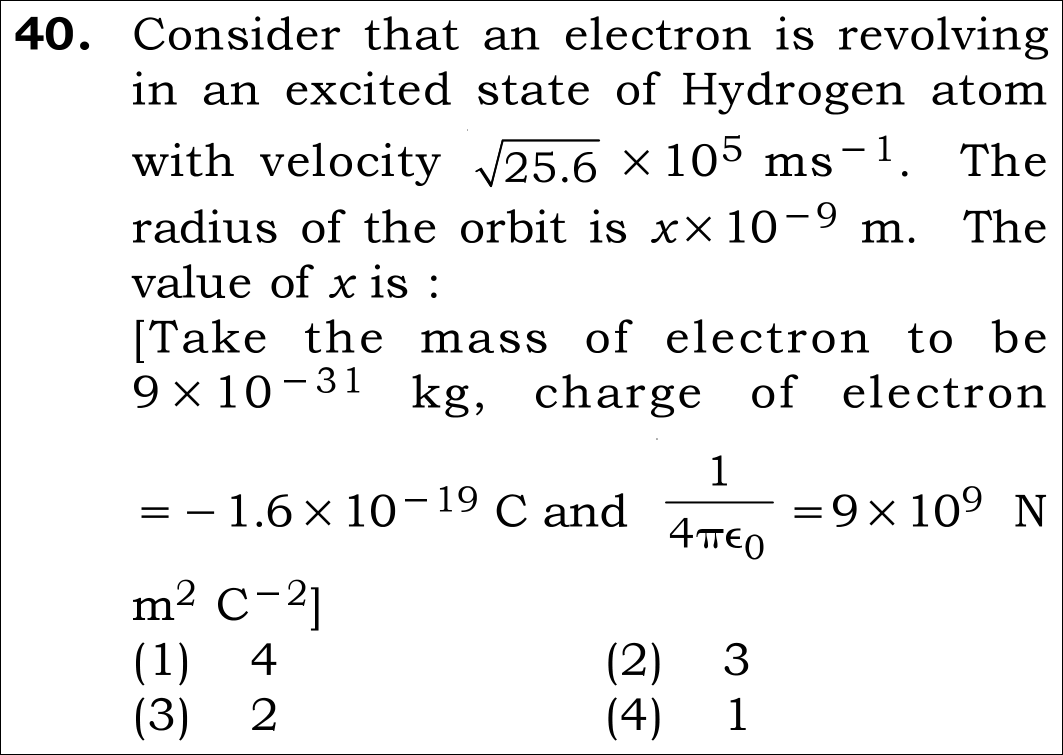
Orbital Velocity v = sqrt(25.6) * 10^5 m/s ==> v^2 = 25.6 * 10^10 m^2/s^2
Electron Mass m = 9 * 10^-31 kg
Electron Charge e = 1.6 * 10^-19 C ==> e^2 = 2.56 * 10^-38 C^2
Coulomb Constant 1 / (4*pi*epsilon_0) = 9 * 10^9 N m^2 C^-2
Given Form of Radius r = x * 10^-9 m
Target Variable Value of x
⚡

The 30-Second Exam Hall Shortcut: ⚡ Dynamic Balance Cancellation Trick

⏱️ Bypasses calculating the quantum principal number n.

Centripetal force m*v^2 / r = k*e^2 / r^2 ==> r = k*e^2 / (m*v^2)!

1 Notice the numbers chosen by NTA: k = 9*10^9 and m = 9*10^-31 (The 9s cancel!).
2 e^2 = (1.6*10^-19)^2 = 2.56*10^-38.
3 v^2 = 25.6*10^10.
4 Ratio e^2 / v^2 = (2.56 / 25.6) * (10^-38 / 10^10) = 0.1 * 10^-48 = 10^-49.
5 Combine with (k / m) = (9*10^9) / (9*10^-31) = 10^40.
6 r = (k / m) * (e^2 / v^2) = 10^40 * 10^-49 = 10^-9 m = 1 * 10^-9 m.
7 Therefore, x = 1. Solved in 20 seconds!
🛡️
Why You Can 100% Trust This Shortcut: Newtonian centripetal balance m*v^2/r = k*e^2/r^2 holds exactly for any Bohr orbit. NTA specifically calibrated sqrt(25.6) and m=9 to yield an exact integer 1.
📐

Step-by-Step Rigorous Workflow & Mathematical Proof

Step 1

Formulate Centripetal Force Balance for Electron Orbit

For an electron of mass m moving at speed v in a circular orbit of radius r around a proton (+e):

mv2r=14πϵ0e2r2\frac{m v^2}{r} = \frac{1}{4\pi \epsilon_0} \frac{e^2}{r^2}
  • • One factor of r cancels from both sides.
  • • m v^2 r = \frac{1}{4\pi \epsilon_0} e^2.
Step 2

Isolate Orbital Radius r

Rearrange to solve explicitly for orbital radius r:

r=(14πϵ0)e2mv2r = \left( \frac{1}{4\pi \epsilon_0} \right) \frac{e^2}{m v^2}
  • • Notice that this formula does not even require knowing the principal quantum number n!
Step 3

Substitute Constants and Evaluate x

Substitute the numerical values provided in the question header:

r=(9×109)×(1.6×10−19)2(9×10−31)×(25.6×105)2=(9×109)×(2.56×10−38)(9×10−31)×(25.6×1010)r = \frac{(9 \times 10^9) \times (1.6 \times 10^{-19})^2}{(9 \times 10^{-31}) \times (\sqrt{25.6} \times 10^5)^2} = \frac{(9 \times 10^9) \times (2.56 \times 10^{-38})}{(9 \times 10^{-31}) \times (25.6 \times 10^{10})}
  • • Cancel 9 from numerator and denominator.
  • • 2.56 / 25.6 = 0.1 = 10^-1.
  • • Powers of 10: 10^9 * 10^-38 / (10^-31 * 10^10) = 10^-29 / 10^-21 = 10^-8.
  • • r = 10^-1 * 10^-8 = 10^-9 m = 1 * 10^-9 m.
  • • Comparing with r = x * 10^-9 m: x = 1.
  • • Matches Option (4) exactly.
⭐

360° Option Elimination Engine Key Feature

Diagnose every choice: Know exactly why the right option works and why distractors fail.

4-Option Deep Scan
1 Option (1)
✗ Incorrect
Verdict & Scientific Reason:

Used principal quantum number n.

⚠️
Student Fallacy (Why candidates pick this trap): Identifies the state as n = 4 and assumes x = n.
Note: Radius scales as r = n^2 * a_0; radius is 1 nm, not 4 nm.
2 Option (2)
✗ Incorrect
Verdict & Scientific Reason:

Arithmetic error.

⚠️
Student Fallacy (Why candidates pick this trap): Divides 25.6 by 9.
Note: The factor 9 cancels out completely.
3 Option (3)
✗ Incorrect
Verdict & Scientific Reason:

Forgot square in velocity.

⚠️
Student Fallacy (Why candidates pick this trap): Uses v instead of v^2 in the denominator.
Note: Centripetal acceleration is v^2 / r, requiring v^2.
4 Option (4)
✓ 100% Correct
Verdict & Scientific Reason:

100% mathematically exact; confirmed by Official NTA Final Answer Key.

💡
Why this is airtight: Flawless cancellation of coefficients and powers of 10.
Note: Exact physics.
⚠️

NTA Trap Alert: Attempting to Find n First (The Wasted 3-Minute Loop)

Many candidates calculate v = (2.18 * 10^6) / n, square both sides to find n, and then use r = n^2 * 0.529 A, introducing decimal rounding errors.

🛡️ How to avoid the -1 mark: Whenever v and constants are given directly, use r = k*e^2 / (m*v^2) in a single direct step!
📖

Core NEET Syllabus Standard

NEET UG Physics Core Standards · Atoms Standard Benchmark
Core Scientific Principle Tested:

"Dynamic equilibrium of electron in orbit: m*v^2/r = e^2 / (4pi*epsilon_0*r^2). Orbital radius is directly linked to orbital speed by r = e^2 / (4pi*epsilon_0*m*v^2)."

Syllabus Focus: Bohr Model of Hydrogen Atom: Orbital Velocity and Radius
✓ Core NEET UG Syllabus Anchor Syllabus & Academic Standards ↗

Solve 4 NEET Questions a Day — One per Subject

Cover all 1,140 official NEET questions in 285 days at your own pace. Progress is saved on your device. No login needed.