MyCompetitiveExams Logo MyCompetitiveExams
Search 1,140+ Questions
Chapters, formulas, speed tricks
→
⚡ Brahmastra NEET 2027
720 MARKS

Dynamic 180-question full-length simulator mixed dynamically from all 6 years for 2027 & 2026 aspirants.

Launch Brahmastra 2027 Test →
Start Practice →
100% Free · No Login Required
Q.111 Botany ⭐ 360° Option Elimination Active
Vault ↗

NEET 2024 Botany Question 111 Solution

Topic: Biotechnology: Principles and Processes · Official NTA Booklet Code T1
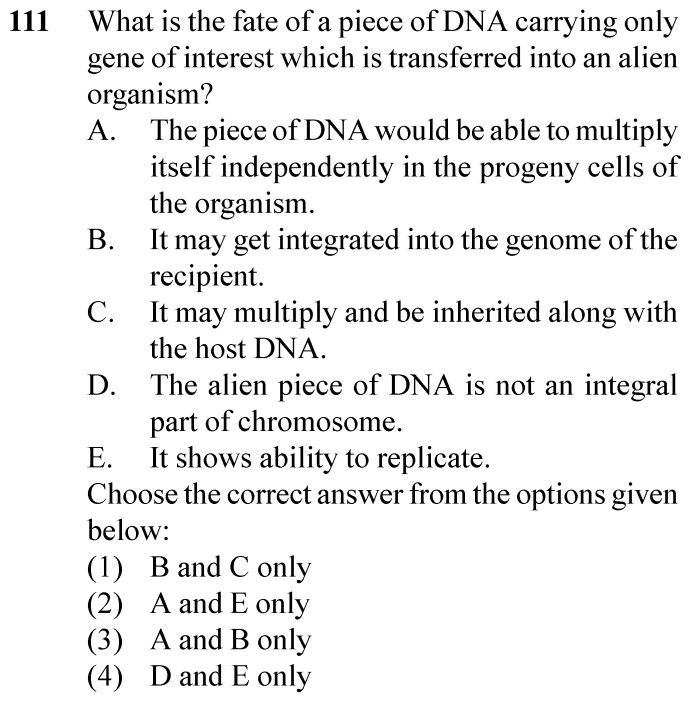
NEET 2024 Botany Question 111: Fate of Alien DNA Fragment Lacking an Origin of Replication (ori)

Question

What is the fate of a piece of DNA carrying only gene of interest which is transferred into an alien organism? A. The piece of DNA would be able to multiply itself independently in the progeny cells of the organism. B. It may get integrated into the genome of the recipient. C. It may multiply and be inherited along with the host DNA. D. The alien piece of DNA is not an integral part of chromosome. E. It shows ability to replicate. Choose the correct answer from the options given below:

✓
Verified Against NTA Final Answer Key
Option (1) : B and C only
📚 Biotechnology: Principles and Processes Medium
📋 Given Parameters & Problem Setup
Transferred Entity Piece of alien DNA lacking origin of replication (ori)
Host System Recipient cell organism
⚡

The 30-Second Exam Hall Shortcut: ⚡ Fate of Alien DNA Rule

⏱️ Save ~30 seconds

Without ori, alien DNA cannot replicate autonomously as an episome (A is false). But if it integrates into host genome, it replicates passively with host chromosome (B and C are true)!

1 A. Cannot multiply itself as it lacks ori -> True alone, but statement A says "can multiply autonomously" -> False!
2 B. May get integrated into host genome -> True!
3 C. Multiplies and inherits along with host DNA once integrated -> True!
4 D. Alien DNA without ori cannot replicate independently.
5 Hence, B and C only -> Option (1) / A.
🛡️
Why You Can 100% Trust This Shortcut: NCERT Biology · Biotechnology: Principles and Processes (Origin of Replication)
📐

Step-by-Step Rigorous Workflow & Mathematical Proof

Step 1

Understand the Origin of Replication Requirement

An alien piece of DNA transferred into an alien organism cannot replicate by itself unless it is part of a chromosome or vector having a specific sequence known as the "origin of replication" (ori).

Step 2

Evaluate Integration Mechanism

If the alien DNA gets integrated into the recipient genome (host chromosome), it becomes part of the chromosome and gains the ability to replicate during host cell division, multiplying and segregating along with the host DNA.

Step 3

Identify Correct Statements

Statements B (it may get integrated into the genome of the recipient) and C (it may multiply and be inherited along with host DNA) represent biologically sound outcomes described in NCERT.

⭐

360° Option Elimination Engine Key Feature

Diagnose every choice: Know exactly why the right option works and why distractors fail.

4-Option Deep Scan
1 (1)
✓ 100% Correct
Verdict & Scientific Reason:

Correctly identifies that integration into the host chromosome allows passive replication and inheritance.

💡
Why this is airtight: None.
2 (2)
✗ Incorrect
Verdict & Scientific Reason:

Statement A incorrectly asserts autonomous replication without an ori.

⚠️
Student Fallacy (Why candidates pick this trap): Statement A incorrectly asserts autonomous replication without an ori.
3 (3)
✗ Incorrect
Verdict & Scientific Reason:

Omits chromosomal integration dynamics.

⚠️
Student Fallacy (Why candidates pick this trap): Omits chromosomal integration dynamics.
4 (4)
✗ Incorrect
Verdict & Scientific Reason:

Fails to include simultaneous replication with host DNA upon integration (C).

⚠️
Student Fallacy (Why candidates pick this trap): Fails to include simultaneous replication with host DNA upon integration (C).
⚠️

NTA Trap Alert: Autonomous vs Chromosomal Replication

Believing an alien DNA fragment can replicate as an extrachromosomal element without an origin of replication.

🛡️ How to avoid the -1 mark: Autonomous replication strictly mandates an ori site; without it, multiplication is only possible via chromosomal integration.
📖

Core NEET Syllabus Standard

Biology Core Botany · Biotechnology: Principles and Processes Standard Benchmark
Core Scientific Principle Tested:

"Most likely, this piece of DNA would not be able to multiply itself in the progeny cells of the organism. But, when it gets integrated into the genome of the recipient, it may multiply and be inherited along with the host DNA. This is because the alien piece of DNA has become part of a chromosome, which has the ability to replicate."

Syllabus Focus: Fate of Alien DNA Fragment Lacking an Origin of Replication (ori)
✓ Core NEET UG Syllabus Anchor Syllabus & Academic Standards ↗

Ready to attempt under real exam pressure?

Test your speed and accuracy in the authentic 200-minute timed NTA simulator.

Launch NEET 2024 CBT Test →

Spotted a mistake in this solution? Report an error ([email protected])

⚖️ Legal & Fair Dealing Notice: Sourced from publicly released NEET 2024 question papers and NEET answer keys for private study, research, and non-commercial educational practice under Fair Dealing (Section 52(1)(a) of the Indian Copyright Act, 1957). Not affiliated with or endorsed by NTA or NMC.

Solve 4 NEET Questions a Day — One per Subject

Cover all 1,140 official NEET questions in 285 days at your own pace. Progress is saved on your device. No login needed.