MyCompetitiveExams Logo MyCompetitiveExams
Search 1,140+ Questions
Chapters, formulas, speed tricks
→
⚡ Brahmastra NEET 2027
720 MARKS

Dynamic 180-question full-length simulator mixed dynamically from all 6 years for 2027 & 2026 aspirants.

Launch Brahmastra 2027 Test →
Start Practice →
100% Free · No Login Required
Q.20 Physics ⭐ 360° Option Elimination Active
Vault ↗

NEET 2023 Physics Question 20 Solution

Topic: Semiconductor Electronics: Materials, Devices and Simple Circuits · Official NTA Booklet Code G5
NEET 2023 Physics Question 20: Capacitor Filter Action in Full Wave Rectifiers

Question

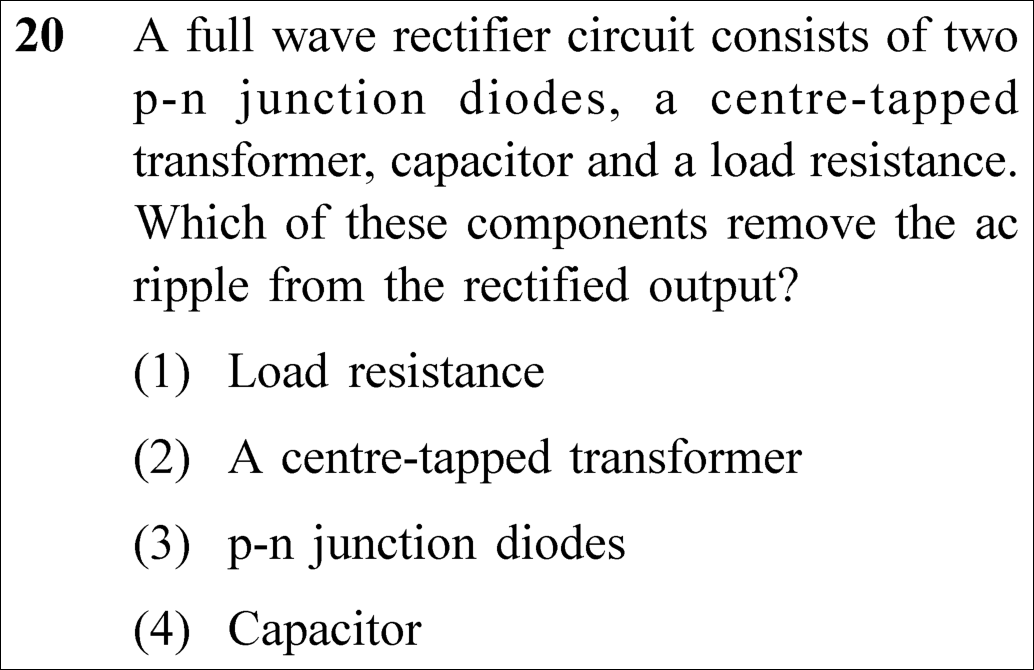
A full wave rectifier circuit consists of two p-n junction diodes, a centre-tapped transformer, capacitor and a load resistance. Which of these components remove the ac ripple from the rectified output?

✓
Verified Against NTA Final Answer Key
Option (4) : Capacitor
📚 Semiconductor Electronics: Materials, Devices and Simple Circuits Easy
📋 Given Parameters & Problem Setup
Circuit Full wave rectifier with centre-tapped transformer, 2 diodes, capacitor, and load resistor
Target Action Component that removes the AC ripple from rectified output
⚡

The 30-Second Exam Hall Shortcut: ⚡ Filter Circuit Component Memory Hook

⏱️ Save ~30 seconds

A rectifier converts AC to pulsating DC; to smooth/remove the AC ripple, a CAPACITOR filter (or inductor choke) is used!

1 Diodes perform rectification (convert bidirectional AC into pulsating unidirectional DC).
2 The output across the diodes contains both a DC component and an unwanted AC ripple.
3 To remove/filter this AC ripple, a capacitor is connected in parallel with the load (or an inductor in series).
4 The capacitor offers low reactance to AC (X_C = 1/ωC) bypassing it to ground, while blocking DC and forcing steady DC through the load.
5 Therefore, the Capacitor removes the AC ripple. Instant Option (4)!
🛡️
Why You Can 100% Trust This Shortcut: NCERT Physics · Semiconductor Electronics (Filter circuits: Capacitor connected in parallel with load resistance removes the AC ripple).
📐

Step-by-Step Rigorous Workflow & Mathematical Proof

Step 1

Nature of Rectified Output

The output of a full-wave rectifier consisting of two p-n junction diodes and a center-tapped transformer is unidirectional but pulsates periodically with twice the input frequency (ripple frequency = 2f). This output consists of a desired DC component superimposed with unwanted AC ripple harmonics.

Step 2

Role of Capacitor as a Filter

To obtain a steady DC voltage without fluctuations, a filter circuit is employed. A capacitor filter is connected in parallel with the load resistance R_L. Its capacitive reactance is frequency-dependent:

XC=12πfrippleCX_C = \frac{1}{2\pi f_{\text{ripple}} C}
Step 3

Bypass Mechanism

For the high-frequency AC ripple components, X_C is very low, providing an easy low-impedance bypass path. For DC (f = 0), X_C → ∞, meaning zero DC current leaks through the capacitor, forcing steady DC voltage across the load resistance R_L:

XC,DC=∞,XC,AC≪RLX_{C,\text{DC}} = \infty, \qquad X_{C,\text{AC}} \ll R_L
⭐

360° Option Elimination Engine Key Feature

Diagnose every choice: Know exactly why the right option works and why distractors fail.

4-Option Deep Scan
1 (1)
✗ Incorrect
Verdict & Scientific Reason:

The load resistance consumes output power and dissipates current; it has no filtering capability.

⚠️
Student Fallacy (Why candidates pick this trap): Candidate confused the output load terminal with the filtering element.
2 (2)
✗ Incorrect
Verdict & Scientific Reason:

The transformer steps down AC voltage and provides out-of-phase AC signals for alternating conduction.

⚠️
Student Fallacy (Why candidates pick this trap): Candidate confused voltage transformation with ripple suppression.
3 (3)
✗ Incorrect
Verdict & Scientific Reason:

Diodes perform rectification (converting AC into pulsating DC); they create the ripple, not filter it.

⚠️
Student Fallacy (Why candidates pick this trap): Candidate confused the rectification stage with the filtering stage.
4 (4)
✓ 100% Correct
Verdict & Scientific Reason:

Accurate component: capacitor acts as a low-pass filter, smoothing pulsating voltage and removing AC ripple.

💡
Why this is airtight: None. Candidate correctly identified the capacitor filter circuit.
⚠️

NTA Trap Alert: Confusing Rectification (Diodes) with Filtering (Capacitor)

Many candidates see "remove AC" and think of the diodes. Diodes remove the negative half-cycles to make current unidirectional, but the capacitor removes the ripple to make it smooth DC.

🛡️ How to avoid the -1 mark: Diodes = Rectifier. Capacitor = Filter (Ripple Remover).
📖

Core NEET Syllabus Standard

National Eligibility cum Entrance Test (NEET UG) · Semiconductor Electronics: Materials, Devices and Simple Circuits Standard Benchmark
Core Scientific Principle Tested:

"Capacitor connected in parallel across load resistance charges during peak voltage and discharges through load during dips, removing AC ripple."

Syllabus Focus: Full Wave Rectifier and Capacitor Filter Circuits
Preserved in Rationalized Curriculum Syllabus & Academic Standards ↗

Ready to attempt under real exam pressure?

Test your speed and accuracy in the authentic 200-minute timed NTA simulator.

Launch NEET 2023 CBT Test →

Spotted a mistake in this solution? Report an error ([email protected])

⚖️ Legal & Fair Dealing Notice: Sourced from publicly released NEET 2023 question papers and NEET answer keys for private study, research, and non-commercial educational practice under Fair Dealing (Section 52(1)(a) of the Indian Copyright Act, 1957). Not affiliated with or endorsed by NTA or NMC.

Solve 4 NEET Questions a Day — One per Subject

Cover all 1,140 official NEET questions in 285 days at your own pace. Progress is saved on your device. No login needed.