MyCompetitiveExams Logo MyCompetitiveExams
Search 1,140+ Questions
Chapters, formulas, speed tricks
→
⚡ Brahmastra NEET 2027
720 MARKS

Dynamic 180-question full-length simulator mixed dynamically from all 6 years for 2027 & 2026 aspirants.

Launch Brahmastra 2027 Test →
Start Practice →
100% Free · No Login Required
Q.13 Physics ⭐ 360° Option Elimination Active
Vault ↗

NEET 2023 Physics Question 13 Solution

Topic: Semiconductor Electronics: Materials, Devices and Simple Circuits · Official NTA Booklet Code G5
NEET 2023 Physics Question 13: Photovoltaic Devices and Zener Diode Characteristics

Question

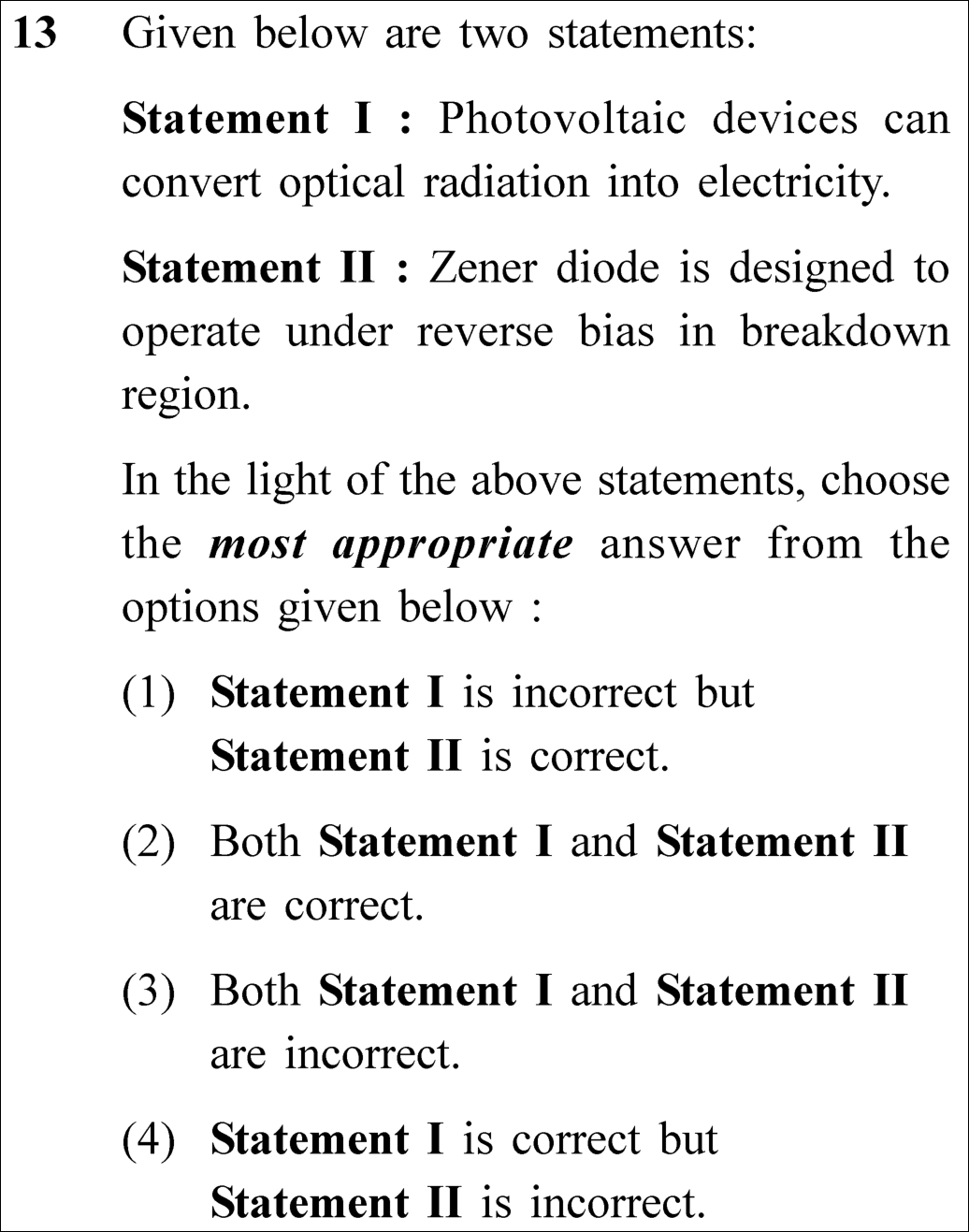
Given below are two statements: Statement I: Photovoltaic devices can convert optical radiation into electricity. Statement II: Zener diode is designed to operate under reverse bias in breakdown region. In the light of the above statements, choose the most appropriate answer from the options given below:

✓
Verified Against NTA Final Answer Key
Option (2) : Both Statement I and Statement II are correct.
📚 Semiconductor Electronics: Materials, Devices and Simple Circuits Easy
📋 Given Parameters & Problem Setup
Statement I Photovoltaic devices can convert optical radiation into electricity.
Statement II Zener diode is designed to operate under reverse bias in breakdown region.
⚡

The 30-Second Exam Hall Shortcut: ⚡ NCERT Direct Conceptual Verification

⏱️ Save ~40 seconds

Photovoltaic = Photo (light) to Volt (electricity); Zener diode = Reverse breakdown voltage regulator. Both are verbatim true statements!

1 Inspect Statement I: Solar cells / photovoltaic cells absorb photons to generate electron-hole pairs, converting optical radiation into electrical power. This is strictly TRUE.
2 Inspect Statement II: Zener diodes are heavily doped p-n junctions engineered specifically to operate safely in the reverse breakdown zone without damage. This is strictly TRUE.
3 Conclude immediately that both statements are correct.
4 Pick Option (2) in 5 seconds flat!
🛡️
Why You Can 100% Trust This Shortcut: NCERT Physics · Semiconductor Electronics (Photovoltaic generation: optical to electrical conversion; Zener diode operating point: reverse breakdown region).
📐

Step-by-Step Rigorous Workflow & Mathematical Proof

Step 1

Validation of Statement I (Photovoltaic Devices)

A photovoltaic device (solar cell) operates on the principle of the photovoltaic effect. When incident photons of energy hν > E_g strike the junction, electron-hole pairs are generated in the depletion region. The built-in junction electric field separates electrons to the n-side and holes to the p-side, establishing a photo-voltage across an external load without any external bias:

hν≥Eg  ⟹  Optical Radiation⟶Electrical Energyh\nu \ge E_g \implies \text{Optical Radiation} \longrightarrow \text{Electrical Energy}
Step 2

Validation of Statement II (Zener Diode Operation)

A Zener diode is a special-purpose semiconductor diode that is heavily doped on both p and n sides, resulting in a very thin depletion layer (~10⁻⁶ m) and intense junction electric field (~5 × 10⁶ V/m). It is specifically designed to operate under reverse bias in the Zener breakdown region, where the voltage across it remains virtually constant despite sharp variations in current, serving as a voltage stabilizer:

Vreverse=VZ=constant(in reverse breakdown region)V_{\text{reverse}} = V_Z = \text{constant} \quad (\text{in reverse breakdown region})
Step 3

Final Combined Deduction

Since both Statement I and Statement II represent foundational, canonical principles of semiconductor devices, Option (2) is the uniquely correct choice.

⭐

360° Option Elimination Engine Key Feature

Diagnose every choice: Know exactly why the right option works and why distractors fail.

4-Option Deep Scan
1 (1)
✗ Incorrect
Verdict & Scientific Reason:

Falsely declares photovoltaic devices do not convert light to electricity.

⚠️
Student Fallacy (Why candidates pick this trap): Candidate confused photovoltaic with photoconductive or LED devices.
2 (2)
✓ 100% Correct
Verdict & Scientific Reason:

Both statements are factually and theoretically accurate according to standard semiconductor physics.

💡
Why this is airtight: None. Candidate correctly verified both optoelectronic and breakdown principles.
3 (3)
✗ Incorrect
Verdict & Scientific Reason:

Both statements are canonical textbook truths.

⚠️
Student Fallacy (Why candidates pick this trap): Candidate incorrectly thought Zener diodes operate in forward bias.
4 (4)
✗ Incorrect
Verdict & Scientific Reason:

Falsely asserts Zener diode does not operate in reverse breakdown.

⚠️
Student Fallacy (Why candidates pick this trap): Candidate confused general rectifier diodes (which avoid breakdown) with Zener diodes (which are built for breakdown).
⚠️

NTA Trap Alert: Confusing Standard Diode Breakdown with Zener Diode Design

In normal rectifier diodes, reverse breakdown can cause thermal runaway and destroy the device. In Zener diodes, heavy doping allows safe, reversible, continuous operation in reverse breakdown.

🛡️ How to avoid the -1 mark: Remember: Zener diodes are uniquely manufactured TO OPERATE in reverse breakdown as voltage regulators.
📖

Core NEET Syllabus Standard

National Eligibility cum Entrance Test (NEET UG) · Semiconductor Electronics: Materials, Devices and Simple Circuits Standard Benchmark
Core Scientific Principle Tested:

"Solar cells generate EMF from optical radiation; Zener diodes maintain stable voltage in reverse breakdown."

Syllabus Focus: Special Purpose p-n Junction Diodes: Solar Cells and Zener Diode
Preserved in Rationalized Curriculum Syllabus & Academic Standards ↗

Ready to attempt under real exam pressure?

Test your speed and accuracy in the authentic 200-minute timed NTA simulator.

Launch NEET 2023 CBT Test →

Spotted a mistake in this solution? Report an error ([email protected])

⚖️ Legal & Fair Dealing Notice: Sourced from publicly released NEET 2023 question papers and NEET answer keys for private study, research, and non-commercial educational practice under Fair Dealing (Section 52(1)(a) of the Indian Copyright Act, 1957). Not affiliated with or endorsed by NTA or NMC.

Solve 4 NEET Questions a Day — One per Subject

Cover all 1,140 official NEET questions in 285 days at your own pace. Progress is saved on your device. No login needed.