MyCompetitiveExams Logo MyCompetitiveExams
Search 1,140+ Questions
Chapters, formulas, speed tricks
→
⚡ Brahmastra NEET 2027
720 MARKS

Dynamic 180-question full-length simulator mixed dynamically from all 6 years for 2027 & 2026 aspirants.

Launch Brahmastra 2027 Test →
Start Practice →
100% Free · No Login Required
Q.27 Botany ⭐ 360° Option Elimination Active
Vault ↗

NEET 2020 Botany Question 27 Solution

Topic: Biotechnology: Principles and Processes · Official NTA Booklet Code E1
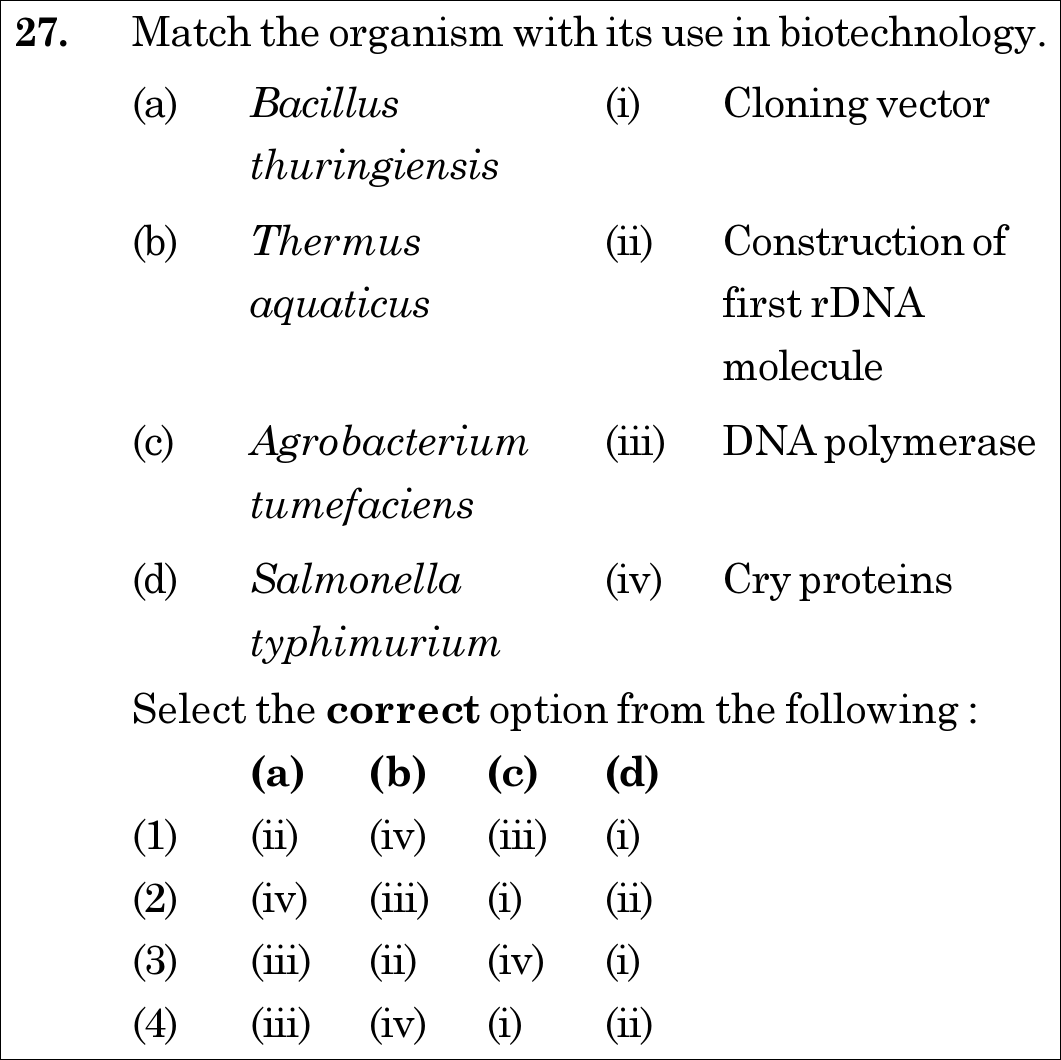
NEET 2020 Botany Question 27: Biotechnological Model Organisms: Bt, Taq, Agrobacterium, and Salmonella

Question

Match the organism with its use in biotechnology. (a) Bacillus (i) Cloning vector thuringiensis (b) Thermus (ii) Construction of aquaticus first rDNA molecule (c) Agrobacterium (iii) DNA polymerase tumefaciens (d) Salmonella (iv) Cry proteins typhimurium Select the correct option from the following: (a) (b) (c) (d)

  1. (1)(ii) (iv) (iii) (i)
  2. (2)(iv) (iii) (i) (ii)
  3. (3)(iii) (ii) (iv) (i)
  4. (4)(iii) (iv) (i) (ii)
✓
Verified Against NTA Final Answer Key
Option (2) : (a)-(iv), (b)-(iii), (c)-(i), (d)-(ii)
📚 Biotechnology: Principles and Processes Easy
📋 Given Parameters & Problem Setup
Column I (Organisms) (a) Bacillus thuringiensis, (b) Thermus aquaticus, (c) Agrobacterium tumefaciens, (d) Salmonella typhimurium
Column II (Biotech Applications) (i) Cloning vector, (ii) Construction of first rDNA molecule, (iii) DNA polymerase, (iv) Cry proteins
⚡

The 30-Second Exam Hall Shortcut: ⚡ "Bt = Cry Endotoxins, Taq = Thermostable DNA Polymerase"

⏱️ Save ~25 seconds

Bacillus thuringiensis produces insecticidal Cry proteins ((a)-(iv)). Thermus aquaticus yields thermostable Taq DNA polymerase for PCR ((b)-(iii)). Agrobacterium tumefaciens provides Ti plasmid cloning vector ((c)-(i)). Salmonella typhimurium was used by Cohen & Boyer to build the first rDNA molecule ((d)-(ii)). Match is (iv), (iii), (i), (ii) -> Option (2)!

1 Match (a) Bacillus thuringiensis -> (iv) Cry proteins (crystal endotoxins against bollworms).
2 Match (b) Thermus aquaticus -> (iii) DNA polymerase (Taq polymerase in PCR).
3 Match (c) Agrobacterium tumefaciens -> (i) Cloning vector (disarmed Ti plasmid in dicots).
4 Match (d) Salmonella typhimurium -> (ii) Construction of first rDNA molecule (Stanley Cohen and Herbert Boyer in 1972).
5 Match sequence (iv), (iii), (i), (ii) -> Option (2).
🛡️
Why You Can 100% Trust This Shortcut: NCERT Biology · Biotechnology: Principles and Processes (Milestones and Tools: First recombinant DNA was constructed by Cohen and Boyer using plasmid of Salmonella typhimurium; Thermus aquaticus provides thermostable Taq polymerase; Agrobacterium tumefaciens is used as cloning vector; Bacillus thuringiensis produces Cry proteins).
📐

Step-by-Step Rigorous Workflow & Mathematical Proof

Step 1

Biotechnological Mapping of Model Organisms

- (a) *Bacillus thuringiensis*: A soil bacterium that synthesizes crystalline proteinaceous endotoxins (Cry proteins) during sporulation. The cloned *cry* genes (*cryIAc*, *cryIIAb*, *cryIAb*) have been engineered into transgenic crops (Bt cotton, Bt corn) to confer endogenous pest resistance against lepidopteran, coleopteran, and dipteran insect pests. - (b) *Thermus aquaticus*: A thermophilic bacterium inhabiting hot geothermal springs. It is the biological source of the thermostable enzyme Taq DNA polymerase, which remains enzymatically active during the high-temperature denaturation phase (~94 °C) of PCR. - (c) *Agrobacterium tumefaciens*: A natural plant genetic engineer that transfers its Tumor-inducing (Ti plasmid) into dicot genomes. Disarmed, modified Ti plasmids serve as the primary cloning vectors for transferring foreign genes into higher plants. - (d) *Salmonella typhimurium*: The bacterium from which Stanley Cohen and Herbert Boyer isolated an antibiotic resistance gene plasmid in 1972, ligating it into a plasmid vector to construct the first artificial recombinant DNA molecule.

Bacillus thuringiensis  ⟺  Cry proteins[(a)→(iv)]Thermus aquaticus  ⟺  DNA polymerase (Taq)[(b)→(iii)]Agrobacterium tumefaciens  ⟺  Cloning vector (Ti plasmid)[(c)→(i)]Salmonella typhimurium  ⟺  First rDNA molecule[(d)→(ii)]\begin{aligned} \textit{Bacillus thuringiensis} &\iff \text{Cry proteins} \quad [\text{(a)} \to \text{(iv)}] \\ \textit{Thermus aquaticus} &\iff \text{DNA polymerase (Taq)} \quad [\text{(b)} \to \text{(iii)}] \\ \textit{Agrobacterium tumefaciens} &\iff \text{Cloning vector (Ti plasmid)} \quad [\text{(c)} \to \text{(i)}] \\ \textit{Salmonella typhimurium} &\iff \text{First rDNA molecule} \quad [\text{(d)} \to \text{(ii)}] \end{aligned}
Step 2

Option Alignment

Matching sequence is: (a)-(iv), (b)-(iii), (c)-(i), (d)-(ii). This corresponds precisely to Option (2).

⭐

360° Option Elimination Engine Key Feature

Diagnose every choice: Know exactly why the right option works and why distractors fail.

4-Option Deep Scan
1 A
✗ Incorrect
Verdict & Scientific Reason:

Incorrect. Assigns Bt to the first rDNA molecule and Thermus aquaticus to Cry proteins.

⚠️
Student Fallacy (Why candidates pick this trap): Swapping bacterial milestones.
2 B
✓ 100% Correct
Verdict & Scientific Reason:

Correct. Perfectly aligns each historical and technological microorganism with its application.

💡
Why this is airtight: None. Direct recall of foundational biotechnology chapters.
3 C
✗ Incorrect
Verdict & Scientific Reason:

Incorrect. Assigns Bt to DNA polymerase and Agrobacterium to Cry proteins.

⚠️
Student Fallacy (Why candidates pick this trap): Gross misalignment of biotech tools.
4 D
✗ Incorrect
Verdict & Scientific Reason:

Incorrect. Misattributes DNA polymerase to Bt.

⚠️
Student Fallacy (Why candidates pick this trap): Confusing insecticidal proteins with polymerases.
⚠️

NTA Trap Alert: Salmonella vs E. coli Milestone Confusion Trap

Cohen and Boyer introduced the recombinant plasmid into *Escherichia coli* for cloning, but the antibiotic-resistance plasmid itself was originally harvested from *Salmonella typhimurium*.

🛡️ How to avoid the -1 mark: Remember: Cohen & Boyer used Salmonella typhimurium plasmid to build the first rDNA.
📖

Core NEET Syllabus Standard

NEET / NCERT Biology · Biotechnology: Principles and Processes Standard Benchmark
Core Scientific Principle Tested:

"Bt produces Cry proteins, Thermus aquaticus yields Taq polymerase, Agrobacterium serves as vector, and Salmonella was used for the first rDNA molecule."

Syllabus Focus: Tools of Recombinant DNA Technology
✓ Core NEET UG Syllabus Anchor Syllabus & Academic Standards ↗

Ready to attempt under real exam pressure?

Test your speed and accuracy in the authentic 180-minute timed NTA simulator.

Launch NEET 2020 CBT Test →

Spotted a mistake in this solution? Report an error ([email protected])

⚖️ Legal & Fair Dealing Notice: Sourced from publicly released NEET 2020 question papers and NEET answer keys for private study, research, and non-commercial educational practice under Fair Dealing (Section 52(1)(a) of the Indian Copyright Act, 1957). Not affiliated with or endorsed by NTA or NMC.

Solve 4 NEET Questions a Day — One per Subject

Cover all 1,140 official NEET questions in 285 days at your own pace. Progress is saved on your device. No login needed.