MyCompetitiveExams Logo MyCompetitiveExams
Search 1,140+ Questions
Chapters, formulas, speed tricks
→
⚡ Brahmastra NEET 2027
720 MARKS

Dynamic 180-question full-length simulator mixed dynamically from all 6 years for 2027 & 2026 aspirants.

Launch Brahmastra 2027 Test →
Start Practice →
100% Free · No Login Required
Q.26 Botany ⭐ 360° Option Elimination Active
Vault ↗

NEET 2020 Botany Question 26 Solution

Topic: Animal Kingdom · Official NTA Booklet Code E1
NEET 2020 Botany Question 26: Fundamental Diagnostic Hallmarks of Phylum Chordata and Subphyla

Question

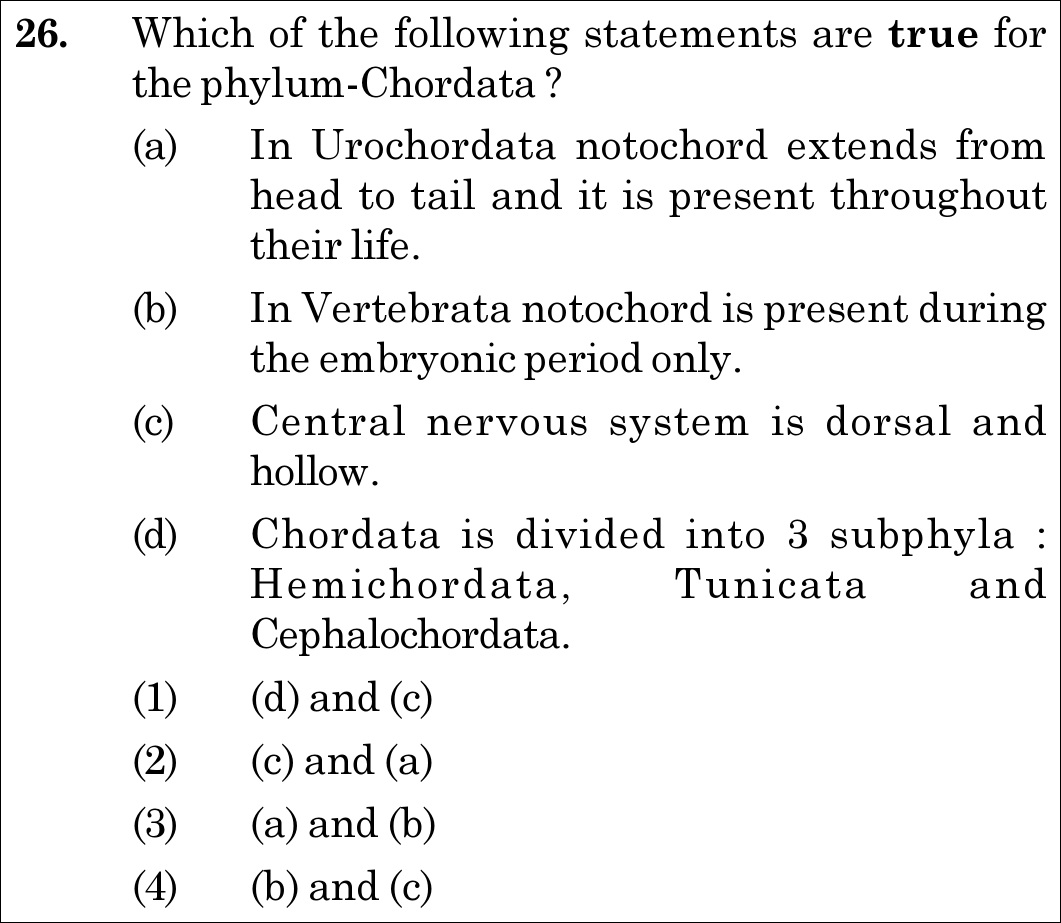
Which of the following statements are true for the phylum-Chordata? (a) In Urochordata notochord extends from head to tail and it is present throughout their life. (b) In Vertebrata notochord is present during the embryonic period only. (c) Central nervous system is dorsal and hollow. (d) Chordata is divided into 3 subphyla: Hemichordata, Tunicata and Cephalochordata.

  1. (1)(d) and (c)
  2. (2)(c) and (a)
  3. (3)(a) and (b)
  4. (4)(b) and (c)
✓
Verified Against NTA Final Answer Key
Option (4) : (b) and (c)
📚 Animal Kingdom Medium
📋 Given Parameters & Problem Setup
Statement (a) In Urochordata notochord extends from head to tail and it is present throughout their life
Statement (b) In Vertebrata notochord is present during the embryonic period only
Statement (c) Central nervous system is dorsal and hollow
Statement (d) Chordata is divided into 3 subphyla: Hemichordata, Tunicata and Cephalochordata
⚡

The 30-Second Exam Hall Shortcut: ⚡ "Notochord in Embryo Only (b is True) & Dorsal Hollow CNS (c is True)!"

⏱️ Save ~25 seconds

In Vertebrates, the embryonic notochord is replaced by a bony or cartilaginous vertebral column in adults (b is TRUE). Chordates characteristically possess a single dorsal, hollow nerve cord (c is TRUE). Statement (a) confuses Urochordata with Cephalochordata, and (d) treats Hemichordata as a subphylum. (b) and (c) are the only true statements! Select Option (4).

1 Check Statement (a): In Urochordata (Tunicata), notochord is present ONLY in larval tail; in Cephalochordata it extends head-to-tail throughout life. Statement (a) is FALSE.
2 Check Statement (b): In Vertebrata, notochord exists during embryonic stages and is replaced by a vertebral column in adults. Statement (b) is TRUE.
3 Check Statement (c): Chordates possess a dorsal, hollow, single central nervous system. Statement (c) is TRUE.
4 Check Statement (d): Chordata is divided into Urochordata, Cephalochordata, and Vertebrata (Hemichordata is a separate non-chordate phylum). Statement (d) is FALSE.
5 True statements: (b) and (c) -> Select Option (4).
🛡️
Why You Can 100% Trust This Shortcut: NCERT Biology · Animal Kingdom (Phylum Chordata: Central nervous system is dorsal, hollow and single. In subphylum Urochordata, notochord is present only in larval tail, while in Cephalochordata, it extends from head to tail region and is persistent throughout their life. The members of subphylum Vertebrata possess notochord during the embryonic period; the notochord is replaced by a cartilaginous or bony vertebral column in the adult).
📐

Step-by-Step Rigorous Workflow & Mathematical Proof

Step 1

Diagnostic Hallmarks of Phylum Chordata

Phylum Chordata is defined by four canonical features present at some stage of ontogeny: 1. Notochord. 2. Dorsal hollow nerve cord (Statement (c) is True; contrasts with ventral solid cord in non-chordates). 3. Pharyngeal gill slits. 4. Post-anal tail.

Step 2

Taxonomic Subdivisions of Chordata

Phylum Chordata is divided into three subphyla: - 1. Subphylum Urochordata (Tunicata): Notochord is present strictly in the tail of the free-swimming larva (retrogressive metamorphosis causes loss in sessile adults, e.g. *Ascidia*, *Salpa*). Statement (a) falsely describes Cephalochordata (*Branchiostoma*). - 2. Subphylum Cephalochordata: Notochord extends from head to tail (rostrum to caudal tip) and persists throughout life. - 3. Subphylum Vertebrata: The notochord is present during the embryonic period only; it is subsequently replaced by a cartilaginous or bony vertebral column in the adult (Statement (b) is True: "All vertebrates are chordates, but all chordates are not vertebrates"). - Status of Hemichordata: Historically classified as a subphylum of Chordata, Hemichordata is now classified as an independent non-chordate phylum because the stomochord is not a true notochord (making statement (d) false).

{(b) Vertebrata:Notochord embryonic only ⟶Replaced by Vertebral Column [True](c) CNS:Dorsal and Hollow[True](a) Urochordata:Notochord in larval tail only [False](d) Subphyla:Urochordata, Cephalochordata, Vertebrata [False]\begin{cases} \textbf{(b) Vertebrata:} & \text{Notochord embryonic only } \longrightarrow \text{Replaced by Vertebral Column } [\mathbf{True}] \\[4pt] \textbf{(c) CNS:} & \mathbf{Dorsal\,and\,Hollow} \quad [\mathbf{True}] \\[4pt] \textbf{(a) Urochordata:} & \text{Notochord in larval tail only } [\mathbf{False}] \\[4pt] \textbf{(d) Subphyla:} & \text{Urochordata, Cephalochordata, Vertebrata } [\mathbf{False}] \end{cases}
⭐

360° Option Elimination Engine Key Feature

Diagnose every choice: Know exactly why the right option works and why distractors fail.

4-Option Deep Scan
1 A
✗ Incorrect
Verdict & Scientific Reason:

Incorrect because statement (d) is false; Hemichordata is a separate phylum, not a subphylum of Chordata.

⚠️
Student Fallacy (Why candidates pick this trap): Relying on obsolete classification schemes where Hemichordata was a chordate subphylum.
2 B
✗ Incorrect
Verdict & Scientific Reason:

Incorrect because statement (a) is false; head-to-tail persistent notochord defines Cephalochordata, not Urochordata.

⚠️
Student Fallacy (Why candidates pick this trap): Confusing Urochordata (tail only) with Cephalochordata (head to tail).
3 C
✗ Incorrect
Verdict & Scientific Reason:

Incorrect due to the falsehood of statement (a).

⚠️
Student Fallacy (Why candidates pick this trap): Failing to eliminate the urochordate notochord error.
4 D
✓ 100% Correct
Verdict & Scientific Reason:

Correct. Accurately confirms that embryonic notochord replacement defines Vertebrata and dorsal hollow cord defines Chordata CNS.

💡
Why this is airtight: None. Candidate accurately identifies modern phylogenetic classifications.
⚠️

NTA Trap Alert: Urochordata vs Cephalochordata Notochord Span Trap

NCERT clearly contrasts the two protochordates: "Uro-" means TAIL (notochord in larval tail only); "Cephalo-" means HEAD (notochord from head to tail, persistent throughout life). Statement (a) swaps these definitions.

🛡️ How to avoid the -1 mark: Remember: Uro = Tail only; Cephalo = Head-to-tail for life.
📖

Core NEET Syllabus Standard

NEET / NCERT Biology · Animal Kingdom Standard Benchmark
Core Scientific Principle Tested:

"Chordates have a dorsal hollow CNS; in vertebrates, the notochord is embryonic and replaced by a vertebral column."

Syllabus Focus: Phylum Chordata
✓ Core NEET UG Syllabus Anchor Syllabus & Academic Standards ↗

Ready to attempt under real exam pressure?

Test your speed and accuracy in the authentic 180-minute timed NTA simulator.

Launch NEET 2020 CBT Test →

Spotted a mistake in this solution? Report an error ([email protected])

⚖️ Legal & Fair Dealing Notice: Sourced from publicly released NEET 2020 question papers and NEET answer keys for private study, research, and non-commercial educational practice under Fair Dealing (Section 52(1)(a) of the Indian Copyright Act, 1957). Not affiliated with or endorsed by NTA or NMC.

Solve 4 NEET Questions a Day — One per Subject

Cover all 1,140 official NEET questions in 285 days at your own pace. Progress is saved on your device. No login needed.