MyCompetitiveExams Logo MyCompetitiveExams
Search 1,140+ Questions
Chapters, formulas, speed tricks
→
⚡ Brahmastra NEET 2027
720 MARKS

Dynamic 180-question full-length simulator mixed dynamically from all 6 years for 2027 & 2026 aspirants.

Launch Brahmastra 2027 Test →
Start Practice →
100% Free · No Login Required
🧬 Zoology 📌 Standard Frequency (~1–2 Qs/Year)

NEET Strategies for Enhancement in Food Production Previous Year Questions with Solutions

Complete repository of official NTA NEET questions for Strategies for Enhancement in Food Production from 2020 to 2026. Every question includes 30-second elimination tricks, step-by-step NCERT solutions, option-by-option traps, and official answer keys.

6 Questions 3 Exam Years (2023, 2021, 2020) 4 Easy · 2 Medium · 0 Challenging
NEET 2023 · Q186 Medium
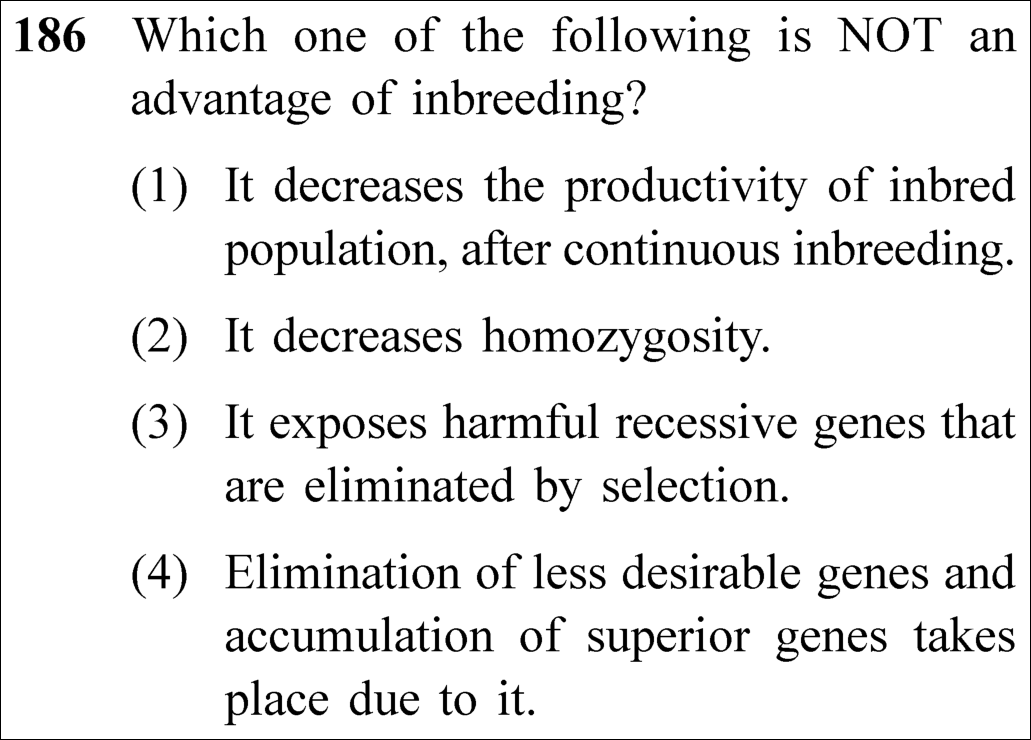
Official NEET 2023 Question 186 - Strategies for Enhancement in Food Production
1 It decreases the productivity of inbred population, after continuous inbreeding. ✓ Key
2 It decreases homozygosity.
3 It exposes harmful recessive genes that are eliminated by selection.
4 Elimination of less desirable genes and accumulation of superior genes takes place due to it.
💡 Verified Solution & 30-Second Hack
✓
Verified Against NTA Final Answer Key
Option (1) : It decreases the productivity of inbred population, after continuous inbreeding.
📚 Strategies for Enhancement in Food Production Medium
📋 Given Parameters & Problem Setup
Criterion Identify which statement is NOT an advantage of inbreeding
⚡

The 30-Second Exam Hall Shortcut: ⚡ Inbreeding Depression is a DISADVANTAGE, Never an Advantage!

⏱️ Save ~20 seconds

Continuous close inbreeding causes "inbreeding depression"—a severe reduction in fertility and productivity. This is the primary danger and disadvantage of inbreeding, NOT an advantage! Select Option (1)!

1 Inbreeding advantages: Increases homozygosity, exposes harmful recessives for elimination by selection, accumulates superior genes.
2 Inbreeding disadvantage / danger: Continued close inbreeding reduces fertility and productivity (inbreeding depression).
3 Option (1) describes this disadvantage.
4 Match Option (1).
🛡️
Why You Can 100% Trust This Shortcut: Canonical NCERT Animal Breeding inbreeding genetics and depression definitions.
📐

Step-by-Step Rigorous Workflow & Mathematical Proof

Step 1

Definition and Genetic Consequences of Inbreeding

Inbreeding refers to the mating of more closely related individuals within the same breed for 4–6 generations. It increases homozygosity (AAAA or aaaa):

Close Inbreeding⟶Homozygosity ↑  ⟹  {Exposes harmful recessive alleles to selectionAccumulates superior traits\text{Close Inbreeding} \longrightarrow \text{Homozygosity } \uparrow \implies \begin{cases} \text{Exposes harmful recessive alleles to selection} \\[2pt] \text{Accumulates superior traits} \end{cases}
Step 2

Inbreeding Depression as a Severe Disadvantage

When close inbreeding is practiced continuously without outcrossing, deleterious recessive alleles accumulate and vigor declines, resulting in inbreeding depression:

Continuous Inbreeding⟶Inbreeding Depression (Fertility & Productivity ↓)  ⟹  Major Disadvantage\text{Continuous Inbreeding} \longrightarrow \mathbf{\text{Inbreeding Depression (Fertility \& Productivity }} \downarrow\mathbf{)} \implies \text{Major Disadvantage}
Step 3

Verbatim NCERT Reference

NCERT states under Animal Breeding: "However, continued inbreeding, especially close inbreeding, usually reduces fertility and even productivity. This is called inbreeding depression. Whenever this becomes a problem, selected animals of the breeding population should be mated with unrelated superior animals of the same breed."

⭐

360° Option Elimination Engine Key Feature

Diagnose every choice: Know exactly why the right option works and why distractors fail.

4-Option Deep Scan
1 1
✓ 100% Correct
Verdict & Scientific Reason:

This describes inbreeding depression—a prominent harmful hazard and disadvantage, hence NOT an advantage.

💡
Why this is airtight: None; identifies the stated disadvantage.
2 2
✗ Incorrect
Verdict & Scientific Reason:

Factually wrong statement about inbreeding (inbreeding increases homozygosity), but Option 1 is the canonical textbook disadvantage addressed in the question.

⚠️
Student Fallacy (Why candidates pick this trap): Overlooking that Option 1 is the explicit textbook definition of inbreeding depression.
3 3
✗ Incorrect
Verdict & Scientific Reason:

This is an authentic genetic advantage of inbreeding cited verbatim in NCERT.

⚠️
Student Fallacy (Why candidates pick this trap): Failing to realize that exposing bad genes allows them to be culled.
4 4
✗ Incorrect
Verdict & Scientific Reason:

This is an authentic selective advantage of inbreeding cited verbatim in NCERT.

⚠️
Student Fallacy (Why candidates pick this trap): Confusing gene accumulation advantage with disadvantage.
⚠️

NTA Trap Alert: Advantage vs. Biological Consequence Trap

Students often get confused by the negative statement in Option 1. Option 1 accurately describes what actually happens during severe inbreeding (inbreeding depression), but because it is detrimental, it CANNOT be considered an "advantage".

🛡️ How to avoid the -1 mark: Decreasing productivity is a negative outcome (disadvantage); therefore, it is NOT an advantage!
📖

Core NEET Syllabus Standard

NCERT Biology · Strategies for Enhancement in Food Production Standard Benchmark
Core Scientific Principle Tested:

"Continued inbreeding usually reduces fertility and even productivity (inbreeding depression). This is a serious disadvantage, not an advantage."
Syllabus Focus: Animal Breeding (Inbreeding)
✓ Core NEET UG Syllabus Anchor Syllabus & Academic Standards ↗
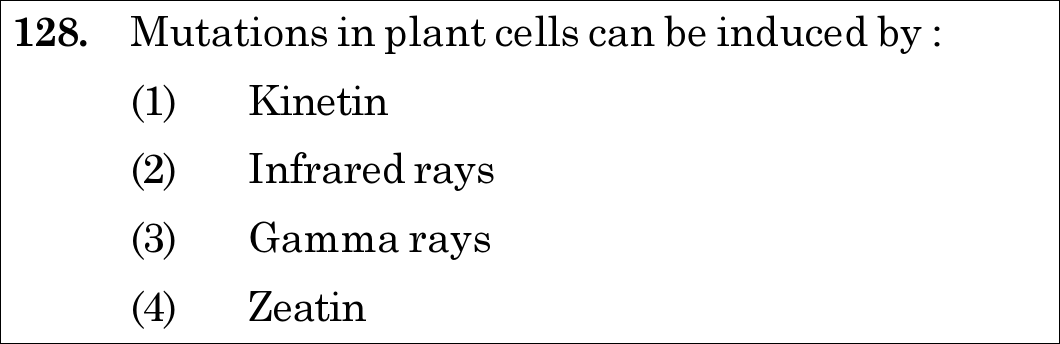
NEET 2021 · Q128 Easy
Official NEET 2021 Question 128 - Strategies for Enhancement in Food Production
1 Kinetin
2 Infrared rays
3 Gamma rays ✓ Key
4 Zeatin
💡 Verified Solution & 30-Second Hack
✓
Verified Against NTA Final Answer Key
Option (3) : Gamma rays
📚 Strategies for Enhancement in Food Production Easy
📋 Given Parameters & Problem Setup
Phenomenon Artificial induction of mutations in plant cells
Candidate Agents Kinetin, Infrared rays, Gamma rays, Zeatin
⚡

The 30-Second Exam Hall Shortcut: ⚡ Gamma Rays = Mutation Breeding in Mung Bean

⏱️ Save ~15 seconds

Mutations in plant breeding are induced artificially using physical mutagens like Gamma rays (or chemical mutagens like EMS)! In mung bean, resistance to yellow mosaic virus and powdery mildew was successfully induced by gamma rays. Match Option (3)!

1 Kinetin and Zeatin are cytokinins (phytohormones promoting cell division, not mutagens).
2 Infrared rays are low-energy thermal radiation that cannot break covalent DNA bonds.
3 Gamma rays are high-energy ionizing physical mutagens capable of causing DNA strand breaks and mutations.
4 Match Option (3).
🛡️
Why You Can 100% Trust This Shortcut: Canonical NCERT Biology on Mutation Breeding and Crop Improvement.
📐

Step-by-Step Rigorous Workflow & Mathematical Proof

Step 1

Concept of Mutation Breeding

Mutation breeding is the process of breeding crops by inducing mutations artificially using chemical or physical mutagens, followed by screening and selection of plants with desirable agronomic traits:

Step 2

Action of Ionizing Physical Mutagens

High-energy ionizing radiation—specifically gamma rays (typically emitted by Cobalt-60 sources)—penetrates plant tissues, generating free radicals and causing single- and double-strand breaks in chromosomal DNA:

Plant Cells→γ-rays (Cobalt-60)DNA Double-Strand Breaks / Transversions  ⟹  Induced Mutations\text{Plant Cells} \xrightarrow{\gamma\text{-rays (Cobalt-60)}} \text{DNA Double-Strand Breaks / Transversions} \implies \mathbf{\text{Induced Mutations}}
Step 3

Canonical NCERT Exemplar

In mung bean (*Vigna radiata*), resistance to Yellow Mosaic Virus (YMVYMV) and powdery mildew was induced through mutation breeding using gamma irradiation.

⭐

360° Option Elimination Engine Key Feature

Diagnose every choice: Know exactly why the right option works and why distractors fail.

4-Option Deep Scan
1 1
✗ Incorrect
Verdict & Scientific Reason:

Kinetin is a synthetic adenine-derivative cytokinin that induces cytokinesis and shoot morphogenesis in plant tissue culture, not mutations.

⚠️
Student Fallacy (Why candidates pick this trap): Confusing plant tissue culture growth hormones with mutagens.
2 2
✗ Incorrect
Verdict & Scientific Reason:

Infrared radiation is non-ionizing thermal radiation with insufficient photon energy to alter nucleotide chemical structure.

⚠️
Student Fallacy (Why candidates pick this trap): Assuming any electromagnetic wave can cause genetic mutations.
3 3
✓ 100% Correct
Verdict & Scientific Reason:

Gamma rays are high-energy ionizing physical mutagens routinely used to induce mutations in plant cells.

💡
Why this is airtight: None. Verbatim textbook example.
4 4
✗ Incorrect
Verdict & Scientific Reason:

Zeatin is a naturally occurring cytokinin first isolated from corn kernels (*Zea mays*), possessing no mutagenic properties.

⚠️
Student Fallacy (Why candidates pick this trap): Confusing natural cytokinins with mutagens.
⚠️

NTA Trap Alert: Hormones vs Mutagens Categorical Trap

Options (1) Kinetin and (4) Zeatin are familiar biotechnology words. However, they are growth promoters, not mutagens.

🛡️ How to avoid the -1 mark: Remember: Gamma rays are the classic physical mutagen in the NCERT syllabus (tested in both Genetics and Food Enhancement).
📖

Core NEET Syllabus Standard

NEET / NCERT Biology · Strategies for Enhancement in Food Production Standard Benchmark
Core Scientific Principle Tested:

"It is possible to induce mutations artificially through use of chemicals or radiations (like gamma rays), and selecting and using the plants that have the desirable character as a source in breeding."

Syllabus Focus: Plant Breeding for Disease Resistance: Mutation
✓ Core NEET UG Syllabus Anchor Syllabus & Academic Standards ↗
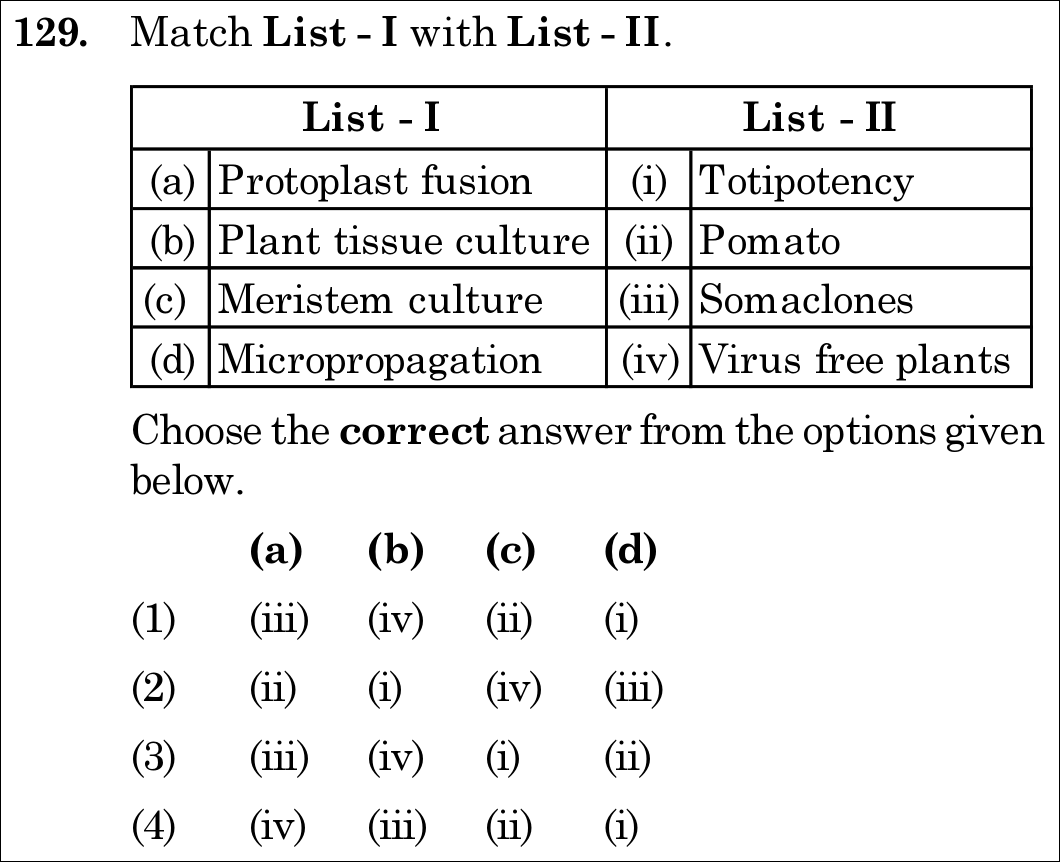
NEET 2021 · Q129 Easy
Official NEET 2021 Question 129 - Strategies for Enhancement in Food Production
1 (iii) (iv) (ii) (i)
2 (ii) (i) (iv) (iii) ✓ Key
3 (iii) (iv) (i) (ii)
4 (iv) (iii) (ii) (i)
💡 Verified Solution & 30-Second Hack
✓
Verified Against NTA Final Answer Key
Option (2) : (a)-(ii), (b)-(i), (c)-(iv), (d)-(iii)
📚 Strategies for Enhancement in Food Production Easy
📋 Given Parameters & Problem Setup
List I (a) Protoplast fusion, (b) Plant tissue culture, (c) Meristem culture, (d) Micropropagation
List II (i) Totipotency, (ii) Pomato, (iii) Somaclones, (iv) Virus free plants
⚡

The 30-Second Exam Hall Shortcut: ⚡ Fast Pairing: Protoplast Fusion = Pomato (a-ii) & Meristem = Virus Free (c-iv)

⏱️ Save ~20 seconds

Protoplast fusion produced somatic hybrid Pomato (a-ii); Plant tissue culture relies on cellular Totipotency (b-i); Shoot apical Meristem culture produces Virus-free plants (c-iv); Micropropagation produces genetically identical Somaclones (d-iii). Matches Option (2)!

1 Protoplast fusion: Somatic hybridization of tomato + potato   ⟹  \implies Pomato (a)-(ii).
2 Plant tissue culture: Capacity to generate a whole plant from an explant is Totipotency   ⟹  \implies (b)-(i).
3 Meristem culture: Shoot apical meristem is free of virus, yielding Virus-free plants   ⟹  \implies (c)-(iv).
4 Micropropagation: Rapid clonal propagation yielding genetically identical Somaclones   ⟹  \implies (d)-(iii).
5 Match Option (2).
🛡️
Why You Can 100% Trust This Shortcut: Canonical NCERT Plant Tissue Culture definitions and applications.
📐

Step-by-Step Rigorous Workflow & Mathematical Proof

Step 1

Biological Principles in Tissue Culture Matching

Analyzing the specific scientific correspondence for each biotechnology technique:

(a) Protoplast fusion⟷(ii) Somatic hybridization yielding Pomato (Solanum lycopersicum + S. tuberosum)(b) Plant tissue culture⟷(i) Fundamental cellular property: Totipotency(c) Meristem culture⟷(iv) Production of healthy, Virus-free plants from infected stock(d) Micropropagation⟷(iii) Large-scale production of genetically identical Somaclones\begin{aligned} \text{(a) Protoplast fusion} & \longleftrightarrow \text{(ii) Somatic hybridization yielding Pomato (Solanum lycopersicum + S. tuberosum)} \\[3pt] \text{(b) Plant tissue culture} & \longleftrightarrow \text{(i) Fundamental cellular property: Totipotency} \\[3pt] \text{(c) Meristem culture} & \longleftrightarrow \text{(iv) Production of healthy, Virus-free plants from infected stock} \\[3pt] \text{(d) Micropropagation} & \longleftrightarrow \text{(iii) Large-scale production of genetically identical Somaclones} \end{aligned}
Step 2

Option Elimination Check

Matching (a)-(ii) immediately eliminates Options (1), (3), and (4). Cross-checking (b)-(i), (c)-(iv), and (d)-(iii) confirms Option (2) is completely and uniquely correct.

⭐

360° Option Elimination Engine Key Feature

Diagnose every choice: Know exactly why the right option works and why distractors fail.

4-Option Deep Scan
1 1
✗ Incorrect
Verdict & Scientific Reason:

Mismatches Protoplast fusion with somaclones and Meristem culture with pomato.

⚠️
Student Fallacy (Why candidates pick this trap): Gross misalignment of tissue culture concepts.
2 2
✓ 100% Correct
Verdict & Scientific Reason:

Every pair matches the exact NCERT application definitions of plant tissue culture.

💡
Why this is airtight: None. Accurate pairing.
3 3
✗ Incorrect
Verdict & Scientific Reason:

Mismatches Micropropagation with pomato and Tissue culture with virus-free plants.

⚠️
Student Fallacy (Why candidates pick this trap): Confusing micropropagation with protoplast fusion.
4 4
✗ Incorrect
Verdict & Scientific Reason:

Mismatches Protoplast fusion with virus-free plants.

⚠️
Student Fallacy (Why candidates pick this trap): Conflating somatic hybridization with apical meristem culture.
⚠️

NTA Trap Alert: Somaclones vs Totipotency Pairing Slip

Both totipotency and somaclones are central to plant tissue culture. Remember: Totipotency is the inherent cellular capacity; Somaclones are the resultant identical offspring of micropropagation.

🛡️ How to avoid the -1 mark: Meristem = Virus-free (always tested); Protoplasts = Pomato.
📖

Core NEET Syllabus Standard

NEET / NCERT Biology · Strategies for Enhancement in Food Production Standard Benchmark
Core Scientific Principle Tested:

"Protoplasts can be fused to produce somatic hybrids (pomato); totipotency underlies tissue culture; meristems give virus-free plants; micropropagation produces somaclones."

Syllabus Focus: Tissue Culture: Totipotency, Micropropagation, Somatic Hybridization
✓ Core NEET UG Syllabus Anchor Syllabus & Academic Standards ↗
NEET 2021 · Q182 Easy
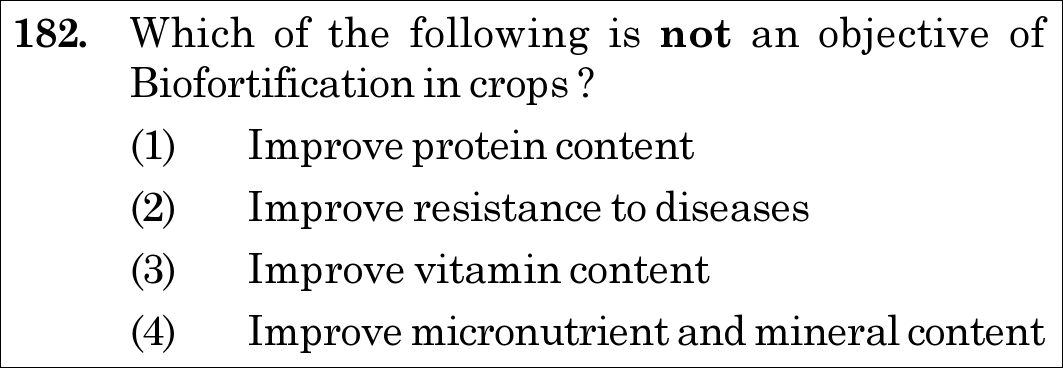
Official NEET 2021 Question 182 - Strategies for Enhancement in Food Production
1 Improve protein content
2 Improve resistance to diseases ✓ Key
3 Improve vitamin content
4 Improve micronutrient and mineral content
💡 Verified Solution & 30-Second Hack
✓
Verified Against NTA Final Answer Key
Option (2) : Improve resistance to diseases
📚 Strategies for Enhancement in Food Production Easy
📋 Given Parameters & Problem Setup
Agricultural Biotechnology Strategy Biofortification
Question Objective Identify which listed goal is NOT an objective of biofortification
⚡

The 30-Second Exam Hall Shortcut: ⚡ "Biofortification = Human Nutritional Quality, NOT Disease Resistance"

⏱️ Save ~20 seconds

Biofortification specifically aims to enhance nutritional quality (Proteins, Oils, Vitamins, Micronutrients/Minerals) to alleviate hidden hunger in humans. Breeding for disease resistance protects crop plants from fungal/bacterial/viral pathogens — an entirely different agricultural goal!

1 Recall NCERT 4 explicit objectives of biofortification: (1) Protein content and quality (2) Oil content and quality (3) Vitamin content (4) Micronutrient and mineral content.
2 Check listed options: - (1) Protein content -> Official objective - (2) Resistance to diseases -> NOT a biofortification objective! - (3) Vitamin content -> Official objective - (4) Micronutrient and mineral content -> Official objective.
3 Select Option (2) as the false objective.
🛡️
Why You Can 100% Trust This Shortcut: NCERT Biology · Strategies for Enhancement in Food Production (Biofortification: Breeding crops with higher levels of vitamins and minerals, or higher protein and healthier fats is the most practical means to improve public health. Breeding for improved nutritional quality is undertaken with the objectives of improving: (i) Protein content and quality, (ii) Oil content and quality, (iii) Vitamin content, and (iv) Micronutrient and mineral content).
📐

Step-by-Step Rigorous Workflow & Mathematical Proof

Step 1

Definition and Scope of Biofortification

Over 840 million people worldwide suffer from insufficient food intake, and far more suffer from "hidden hunger" (deficiencies in micronutrients, iron, vitamin A, iodine, and zinc). Biofortification is the breeding of staple crops with elevated levels of vitamins, minerals, proteins, or healthier fatty acids to directly enhance human nutritional security.

Biofortification Objectives={1.Protein content and quality2.Oil content and quality3.Vitamin content4.Micronutrient and mineral content\textbf{Biofortification Objectives} = \begin{cases} 1. & \text{Protein content and quality} \\ 2. & \text{Oil content and quality} \\ 3. & \text{Vitamin content} \\ 4. & \text{Micronutrient and mineral content} \end{cases}
Step 2

Distinction Between Crop Protection and Biofortification

- Plant breeding for disease resistance (e.g., Himgiri wheat resistant to leaf and stripe rust; Pusa Swarnim mustard resistant to white rust) is engineered to prevent yield loss from phytopathogens (fungi, bacteria, viruses). - Disease resistance confers agronomic protection to the plant, whereas biofortification improves dietary nutritive density for human consumption.

⭐

360° Option Elimination Engine Key Feature

Diagnose every choice: Know exactly why the right option works and why distractors fail.

4-Option Deep Scan
1 1
✗ Incorrect
Verdict & Scientific Reason:

Incorrect. Improving protein content and quality is one of the primary canonical objectives of biofortification (e.g. Atlas 66 wheat, maize with twice lysine/tryptophan).

⚠️
Student Fallacy (Why candidates pick this trap): Failing to realize that protein quality is a core target of biofortification.
2 2
✓ 100% Correct
Verdict & Scientific Reason:

Correct as the non-objective. Breeding for disease resistance is a separate crop protection objective, not nutritional biofortification.

💡
Why this is airtight: None. Candidate accurately differentiates nutritional breeding from phytopathological defense breeding.
3 3
✗ Incorrect
Verdict & Scientific Reason:

Incorrect. Improving vitamin content (e.g. Vitamin A enriched carrots/spinach) is a prime biofortification objective.

⚠️
Student Fallacy (Why candidates pick this trap): Overlooking golden rice and vitamin-fortified vegetables.
4 4
✗ Incorrect
Verdict & Scientific Reason:

Incorrect. Iron and zinc fortification (e.g. iron-fortified rice) is an explicit objective of biofortification.

⚠️
Student Fallacy (Why candidates pick this trap): Ignoring iron-deficiency anaemia alleviation programs.
⚠️

NTA Trap Alert: Broad Plant Breeding Objectives Conflation Trap

Students often lump all plant breeding benefits together (pest resistance, disease resistance, high yield, nutrient density). Biofortification strictly refers to nutritive value (vitamins, minerals, proteins, fats).

🛡️ How to avoid the -1 mark: Remember: Bio-FORTIFICATION = Fortifying food nutrients for humans.
📖

Core NEET Syllabus Standard

NEET / NCERT Biology · Strategies for Enhancement in Food Production Standard Benchmark
Core Scientific Principle Tested:

"Biofortification focuses on protein, oil, vitamin, and micronutrient/mineral content; disease resistance is an agronomic protection trait."

Syllabus Focus: Biofortification
✓ Core NEET UG Syllabus Anchor Syllabus & Academic Standards ↗
NEET 2021 · Q195 Medium
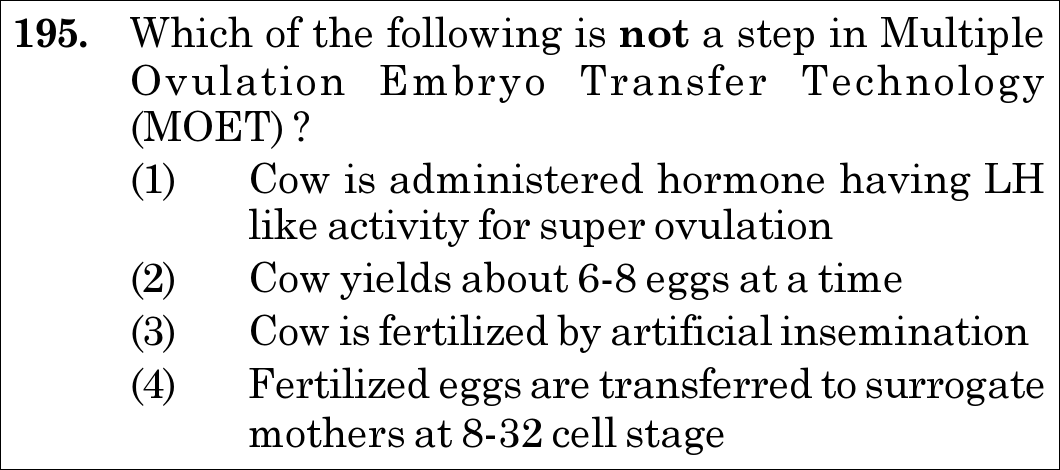
Official NEET 2021 Question 195 - Strategies for Enhancement in Food Production
1 Cow is administered hormone having LH like activity for super ovulation ✓ Key
2 Cow yields about 6-8 eggs at a time
3 Cow is fertilized by artificial insemination
4 Fertilized eggs are transferred to surrogate mothers at 8-32 cell stage
💡 Verified Solution & 30-Second Hack
✓
Verified Against NTA Final Answer Key
Option (1) : Cow is administered hormone having LH like activity for super ovulation
📚 Strategies for Enhancement in Food Production Medium
📋 Given Parameters & Problem Setup
Biotechnology Programme Multiple Ovulation Embryo Transfer (MOET)
Target Animal Cattle (Cow / Herd Improvement)
Question Objective Identify which statement is NOT an authentic step in the MOET protocol
⚡

The 30-Second Exam Hall Shortcut: ⚡ "MOET uses FSH-like activity (NOT LH) to Stimulate Follicular Maturation!"

⏱️ Save ~25 seconds

In MOET, the genetic mother cow is administered hormones with FSH-like activity (Follicle Stimulating Hormone) to induce multiple follicles to mature (yielding 6–8 eggs instead of 1). Statement (1) claims "LH-like activity" — which is FALSE! Option (1) is the invalid step.

1 Recall MOET endocrine trigger: A cow is administered hormones with FSH-like activity (NOT LH-like).
2 Identify superovulation yield: Cow produces 6–8 ova instead of one egg normally produced per cycle.
3 Fertilization & Recovery: Inseminated artificially or mated with elite bull; embryos non-surgically flushed at 8–32 cell stage.
4 Surrogate transfer: Embryos transferred to surrogate recipient cows; genetic dam is ready for another round.
5 Statement (1) falsely claims "LH-like activity" and is therefore the correct answer.
🛡️
Why You Can 100% Trust This Shortcut: NCERT Biology · Strategies for Enhancement in Food Production (Controlled Breeding Experiments: In MOET, a cow is administered hormones, with FSH-like activity, to induce follicular maturation and super ovulation – instead of one egg, which they normally yield per cycle, they produce 6-8 eggs).
📐

Step-by-Step Rigorous Workflow & Mathematical Proof

Step 1

Step-by-Step Protocol of MOET Technology

Multiple Ovulation Embryo Transfer Technology (MOET) is an advanced herd improvement programme used to rapidly multiply high-milk-yielding females and high-quality-lean-meat bulls: - Step 1 (Hormonal Induction of Superovulation): A superior genetic mother cow is injected with gonadotropins possessing FSH-like activity (e.g. equine chorionic gonadotropin or pituitary FSH). This drives the synchronous maturation of multiple Graafian follicles, yielding 6 to 8 ova (superovulation) instead of the solitary ovum normally shed in an estrous cycle. - Step 2 (Fertilization): The superovulated cow is either mated with an elite pedigree bull or artificially inseminated using high-grade semen. - Step 3 (Non-Surgical Embryo Recovery): At the 8 to 32 cell stage (morula/early blastocyst), the developing embryos are non-surgically flushed and harvested using a catheter. - Step 4 (Transfer to Surrogates): The harvested embryos are transferred into lower-genetic-merit surrogate recipient cows, while the genetic mother is freed for another superovulation cycle.

Step 2

Endocrine Dissection: Why LH is False

Luteinizing Hormone (LH) induces ovulation of a mature follicle and luteinization of the ruptured follicle into a corpus luteum. LH cannot stimulate multiple immature primordial/primary follicles to grow and mature; that is the unique physiological role of FSH (Follicle Stimulating Hormone). Therefore, claiming that hormones with LH-like activity are administered for superovulation is physiologically and canonically false.

Superovulation Induction  ⟹  FSH-like Activity(NOT LH-like activity)  ⟹  6–8 Eggs/Cycle\text{Superovulation Induction} \implies \mathbf{FSH\text{-like Activity}} \quad (\text{NOT LH-like activity}) \implies 6\text{--}8 \text{ Eggs/Cycle}
⭐

360° Option Elimination Engine Key Feature

Diagnose every choice: Know exactly why the right option works and why distractors fail.

4-Option Deep Scan
1 1
✓ 100% Correct
Verdict & Scientific Reason:

Correct as the non-step. The cow is administered hormones with FSH-like activity, not LH-like activity.

💡
Why this is airtight: None. Candidate notices the precise hormone swap between FSH and LH.
2 2
✗ Incorrect
Verdict & Scientific Reason:

This is a genuine step. Superovulation successfully produces 6–8 eggs instead of 1.

⚠️
Student Fallacy (Why candidates pick this trap): Believing cows cannot produce more than 2 eggs even with superovulation.
3 3
✗ Incorrect
Verdict & Scientific Reason:

This is a genuine step. The superovulated cow is routinely bred via artificial insemination with superior bull semen.

⚠️
Student Fallacy (Why candidates pick this trap): Assuming natural mating is mandatory in MOET.
4 4
✗ Incorrect
Verdict & Scientific Reason:

This is a genuine step. Non-surgical recovery and transfer take place at the 8–32 cell stage.

⚠️
Student Fallacy (Why candidates pick this trap): Confusing human IVF transfer stages (ZIFT at 8-cell, IUT at >8 cell) with MOET surrogate transfer.
⚠️

NTA Trap Alert: FSH vs LH Hormonal Role Confusion Trap

Both FSH and LH are gonadotropins. Paper setters deliberately substitute LH for FSH because casual readers know both are involved in reproduction. Superovulation requires follicular growth, which is driven by FSH.

🛡️ How to avoid the -1 mark: Remember: Follicles need Follicle Stimulating Hormone (FSH) for superovulation.
📖

Core NEET Syllabus Standard

NEET / NCERT Biology · Strategies for Enhancement in Food Production Standard Benchmark
Core Scientific Principle Tested:

"In MOET, a cow is administered hormones with FSH-like activity (not LH) to induce follicular maturation and superovulation."

Syllabus Focus: Controlled Breeding Experiments (MOET)
✓ Core NEET UG Syllabus Anchor Syllabus & Academic Standards ↗
NEET 2020 · Q46 Easy
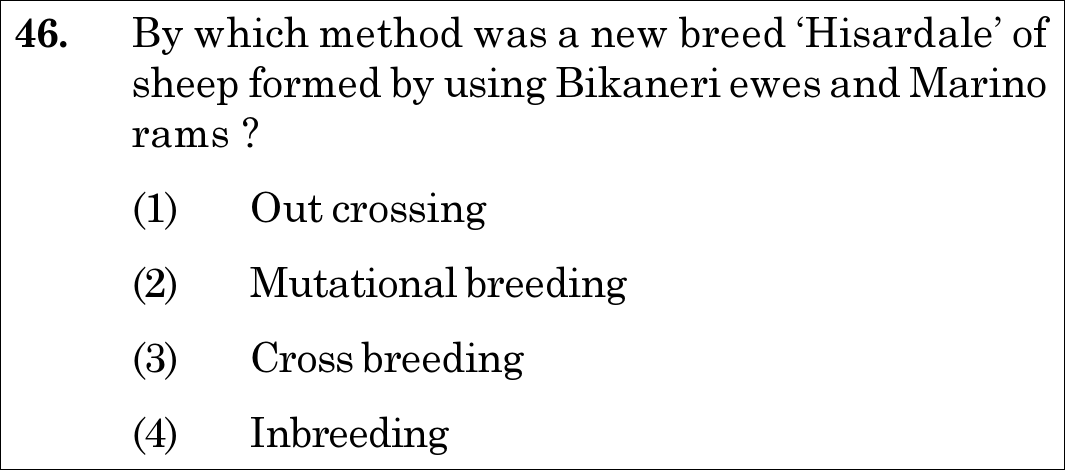
Official NEET 2020 Question 46 - Strategies for Enhancement in Food Production
1 Out crossing
2 Mutational breeding
3 Cross breeding ✓ Key
4 Inbreeding
💡 Verified Solution & 30-Second Hack
✓
Verified Against NTA Final Answer Key
Option (3) : Cross breeding
📚 Strategies for Enhancement in Food Production Easy
📋 Given Parameters & Problem Setup
Organism & Breed Hisardale (new breed of sheep in Punjab)
Parental Stocks Bikaneri ewes (female) × Merino rams (male)
Question Objective Identify the animal breeding method used
⚡

The 30-Second Exam Hall Shortcut: ⚡ "Two Different Breeds Mated = CROSS BREEDING (Hisardale)!"

⏱️ 30 seconds

Bikaneri ewe (indigenous breed) mated with Merino ram (exotic Australian breed) represents mating superior individuals of TWO DIFFERENT BREEDS. By definition, this is Cross Breeding! Mark Option (3) in 5 seconds.

1 Inbreeding = Mating within same breed for 4-6 generations.
2 Outcrossing = Mating within same breed with no common ancestors for 4-6 generations.
3 Cross breeding = Superior male of one breed mated with superior female of another breed (Bikaneri ewes × Merino rams -> Hisardale).
4 Select Option (3) Cross breeding.
🛡️
Why You Can 100% Trust This Shortcut: NCERT Biology · Strategies for Enhancement in Food Production (Animal Breeding: Cross-Breeding)
📐

Step-by-Step Rigorous Workflow & Mathematical Proof

Step 1

Define Cross Breeding

In cross-breeding, superior males of one breed are mated with superior females of another breed. This approach allows desirable qualities of two different breeds to be combined into a new stable commercial breed.

Step 2

NCERT Classic Landmark: Hisardale Sheep

Hisardale is a well-known new breed of sheep developed in Punjab by crossing Bikaneri ewes with exotic Merino rams.

Step 3

Differentiate Animal Breeding Categories

Out-crossing involves mating animals of the same breed that have no common ancestors on either side of pedigree up to 4-6 generations. Interspecific hybridization involves mating males and females of two different related species (e.g., mule = female horse × male donkey).

Step 4

Conclude Selection

Since Bikaneri and Merino are two distinct breeds of sheep, this is a textbook example of cross-breeding.

⭐

360° Option Elimination Engine Key Feature

Diagnose every choice: Know exactly why the right option works and why distractors fail.

4-Option Deep Scan
1 A
✗ Incorrect
Verdict & Scientific Reason:

Incorrect; out-crossing refers to mating of animals within the SAME breed having no common ancestors for 4-6 generations.

⚠️
Student Fallacy (Why candidates pick this trap): Confusing out-crossing (within breed) with cross-breeding (between different breeds).
2 B
✗ Incorrect
Verdict & Scientific Reason:

Incorrect; mutational breeding uses physical/chemical mutagens to induce new genetic variations (used mostly in plants like mung bean), not conventional sheep mating.

⚠️
Student Fallacy (Why candidates pick this trap): Confusing artificial mutagenesis with selective animal breeding.
3 C
✓ 100% Correct
Verdict & Scientific Reason:

Factually exact; Hisardale sheep was produced by cross breeding Bikaneri ewes and Merino rams.

💡
Why this is airtight: None; direct NCERT animal husbandry example.
4 D
✗ Incorrect
Verdict & Scientific Reason:

Incorrect; inbreeding refers to the mating of closely related individuals within the same breed for 4-6 generations, leading to inbreeding depression.

⚠️
Student Fallacy (Why candidates pick this trap): Misunderstanding inbreeding terminology.
⚠️

NTA Trap Alert: Out-Crossing vs Cross-Breeding vs Interspecific Hybridization

Out-crossing = SAME breed (no common ancestors 4-6 generations). Cross-breeding = TWO DIFFERENT breeds (e.g., Hisardale). Interspecific hybridization = TWO DIFFERENT species (e.g., Mule).

🛡️ How to avoid the -1 mark: Different breeds = CROSS-BREEDING!
📖

Core NEET Syllabus Standard

Zoology · Strategies for Enhancement in Food Production Standard Benchmark
Core Scientific Principle Tested:

""

Syllabus Focus: Animal Breeding: Development of Hisardale Sheep via Cross-Breeding
✓ Core NEET UG Syllabus Anchor Syllabus & Academic Standards ↗

Solve 4 NEET Questions a Day — One per Subject

Cover all 1,140 official NEET questions in 285 days at your own pace. Progress is saved on your device. No login needed.