MyCompetitiveExams Logo MyCompetitiveExams
Search 1,140+ Questions
Chapters, formulas, speed tricks
→
⚡ Brahmastra NEET 2027
720 MARKS

Dynamic 180-question full-length simulator mixed dynamically from all 6 years for 2027 & 2026 aspirants.

Launch Brahmastra 2027 Test →
Start Practice →
100% Free · No Login Required
Q.186 Zoology ⭐ 360° Option Elimination Active
Vault ↗

NEET 2023 Zoology Question 186 Solution

Topic: Strategies for Enhancement in Food Production · Official NTA Booklet Code G5
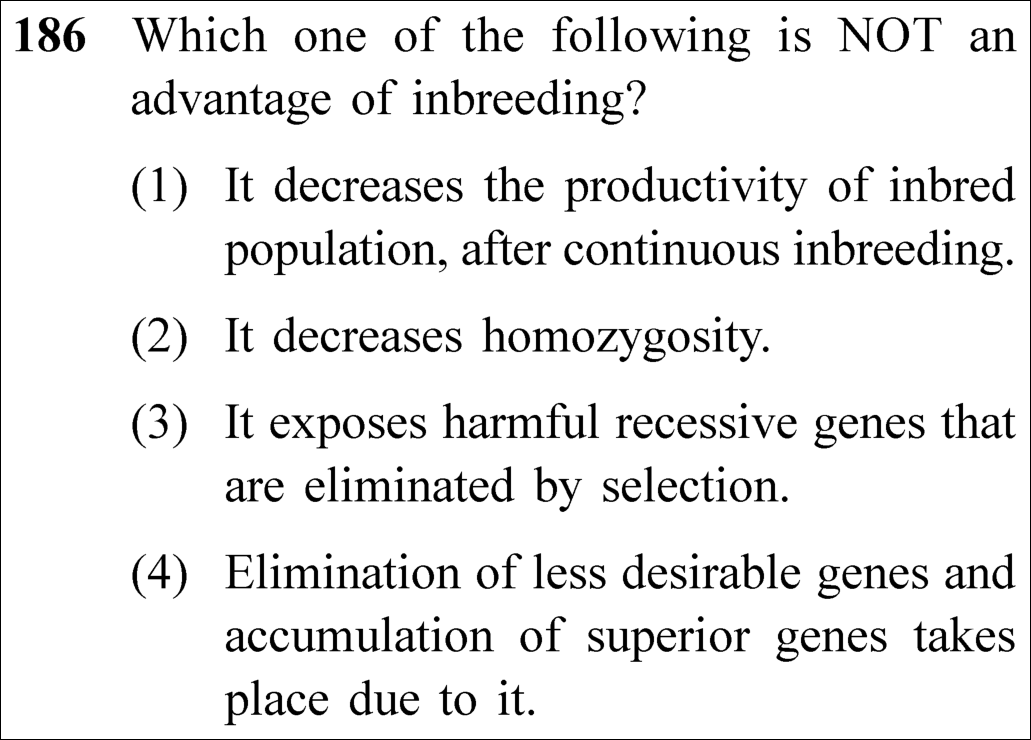
NEET 2023 Zoology Question 186: Inbreeding in Animal Husbandry: Advantages vs. Inbreeding Depression

Question

Which one of the following is NOT an advantage of inbreeding?

  1. (1)It decreases the productivity of inbred population, after continuous inbreeding.
  2. (2)It decreases homozygosity.
  3. (3)It exposes harmful recessive genes that are eliminated by selection.
  4. (4)Elimination of less desirable genes and accumulation of superior genes takes place due to it.
✓
Verified Against NTA Final Answer Key
Option (1) : It decreases the productivity of inbred population, after continuous inbreeding.
📚 Strategies for Enhancement in Food Production Medium
📋 Given Parameters & Problem Setup
Criterion Identify which statement is NOT an advantage of inbreeding
⚡

The 30-Second Exam Hall Shortcut: ⚡ Inbreeding Depression is a DISADVANTAGE, Never an Advantage!

⏱️ Save ~20 seconds

Continuous close inbreeding causes "inbreeding depression"—a severe reduction in fertility and productivity. This is the primary danger and disadvantage of inbreeding, NOT an advantage! Select Option (1)!

1 Inbreeding advantages: Increases homozygosity, exposes harmful recessives for elimination by selection, accumulates superior genes.
2 Inbreeding disadvantage / danger: Continued close inbreeding reduces fertility and productivity (inbreeding depression).
3 Option (1) describes this disadvantage.
4 Match Option (1).
🛡️
Why You Can 100% Trust This Shortcut: Canonical NCERT Animal Breeding inbreeding genetics and depression definitions.
📐

Step-by-Step Rigorous Workflow & Mathematical Proof

Step 1

Definition and Genetic Consequences of Inbreeding

Inbreeding refers to the mating of more closely related individuals within the same breed for 4–6 generations. It increases homozygosity (AAAA or aaaa):

Close Inbreeding⟶Homozygosity ↑  ⟹  {Exposes harmful recessive alleles to selectionAccumulates superior traits\text{Close Inbreeding} \longrightarrow \text{Homozygosity } \uparrow \implies \begin{cases} \text{Exposes harmful recessive alleles to selection} \\[2pt] \text{Accumulates superior traits} \end{cases}
Step 2

Inbreeding Depression as a Severe Disadvantage

When close inbreeding is practiced continuously without outcrossing, deleterious recessive alleles accumulate and vigor declines, resulting in inbreeding depression:

Continuous Inbreeding⟶Inbreeding Depression (Fertility & Productivity ↓)  ⟹  Major Disadvantage\text{Continuous Inbreeding} \longrightarrow \mathbf{\text{Inbreeding Depression (Fertility \& Productivity }} \downarrow\mathbf{)} \implies \text{Major Disadvantage}
Step 3

Verbatim NCERT Reference

NCERT states under Animal Breeding: "However, continued inbreeding, especially close inbreeding, usually reduces fertility and even productivity. This is called inbreeding depression. Whenever this becomes a problem, selected animals of the breeding population should be mated with unrelated superior animals of the same breed."

⭐

360° Option Elimination Engine Key Feature

Diagnose every choice: Know exactly why the right option works and why distractors fail.

4-Option Deep Scan
1 1
✓ 100% Correct
Verdict & Scientific Reason:

This describes inbreeding depression—a prominent harmful hazard and disadvantage, hence NOT an advantage.

💡
Why this is airtight: None; identifies the stated disadvantage.
2 2
✗ Incorrect
Verdict & Scientific Reason:

Factually wrong statement about inbreeding (inbreeding increases homozygosity), but Option 1 is the canonical textbook disadvantage addressed in the question.

⚠️
Student Fallacy (Why candidates pick this trap): Overlooking that Option 1 is the explicit textbook definition of inbreeding depression.
3 3
✗ Incorrect
Verdict & Scientific Reason:

This is an authentic genetic advantage of inbreeding cited verbatim in NCERT.

⚠️
Student Fallacy (Why candidates pick this trap): Failing to realize that exposing bad genes allows them to be culled.
4 4
✗ Incorrect
Verdict & Scientific Reason:

This is an authentic selective advantage of inbreeding cited verbatim in NCERT.

⚠️
Student Fallacy (Why candidates pick this trap): Confusing gene accumulation advantage with disadvantage.
⚠️

NTA Trap Alert: Advantage vs. Biological Consequence Trap

Students often get confused by the negative statement in Option 1. Option 1 accurately describes what actually happens during severe inbreeding (inbreeding depression), but because it is detrimental, it CANNOT be considered an "advantage".

🛡️ How to avoid the -1 mark: Decreasing productivity is a negative outcome (disadvantage); therefore, it is NOT an advantage!
📖

Core NEET Syllabus Standard

NCERT Biology · Strategies for Enhancement in Food Production Standard Benchmark
Core Scientific Principle Tested:

"Continued inbreeding usually reduces fertility and even productivity (inbreeding depression). This is a serious disadvantage, not an advantage."

Syllabus Focus: Animal Breeding (Inbreeding)
✓ Core NEET UG Syllabus Anchor Syllabus & Academic Standards ↗

Ready to attempt under real exam pressure?

Test your speed and accuracy in the authentic 200-minute timed NTA simulator.

Launch NEET 2023 CBT Test →

Spotted a mistake in this solution? Report an error ([email protected])

⚖️ Legal & Fair Dealing Notice: Sourced from publicly released NEET 2023 question papers and NEET answer keys for private study, research, and non-commercial educational practice under Fair Dealing (Section 52(1)(a) of the Indian Copyright Act, 1957). Not affiliated with or endorsed by NTA or NMC.

Solve 4 NEET Questions a Day — One per Subject

Cover all 1,140 official NEET questions in 285 days at your own pace. Progress is saved on your device. No login needed.