MyCompetitiveExams Logo MyCompetitiveExams
Search 1,140+ Questions
Chapters, formulas, speed tricks
→
⚡ Brahmastra NEET 2027
720 MARKS

Dynamic 180-question full-length simulator mixed dynamically from all 6 years for 2027 & 2026 aspirants.

Launch Brahmastra 2027 Test →
Start Practice →
100% Free · No Login Required
🧬 Zoology ⭐ High Weightage (~2–3 Qs/Year)

NEET Respiration in Plants Previous Year Questions with Solutions

Complete repository of official NTA NEET questions for Respiration in Plants from 2020 to 2026. Every question includes 30-second elimination tricks, step-by-step NCERT solutions, option-by-option traps, and official answer keys.

8 Questions 6 Exam Years (2026, 2025, 2024, 2023, 2021, 2020) 6 Easy · 2 Medium · 0 Challenging
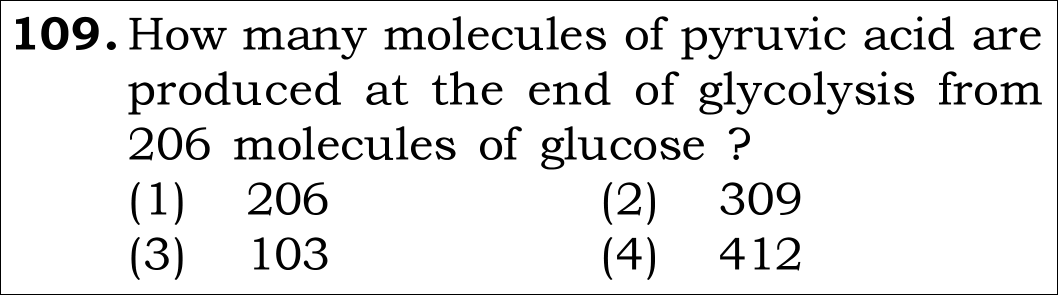
NEET 2026 · Q109 Easy
Official NEET 2026 Question 109 - Respiration in Plants
1 206
2 309
3 103
4 412 ✓ Key
💡 Verified Solution & 30-Second Hack
✓
Verified Against NTA Final Answer Key
Option (4) : 412
📚 Respiration in Plants Easy
📋 Given Parameters & Problem Setup
Starting Substrate 206 molecules of glucose (C₆H₁₂O₆)
Metabolic Pathway Glycolysis (EMP pathway in cytoplasm)
⚡

The 30-Second Exam Hall Shortcut: ⚡ 1 Glucose = 2 Pyruvate Rule

⏱️ Save ~40 seconds

Simply multiply the number of glucose molecules by 2!

1 Recall fundamental glycolysis cleavage stoichiometry:
2 1 molecule of 6-carbon glucose yields 2 molecules of 3-carbon pyruvic acid.
3 Calculate: 206 × 2 = 412.
4 Option (4) is 412. Done in 3 seconds!
🛡️
Why You Can 100% Trust This Shortcut: Universal biochemical law: C₆H₁₂O₆ -> 2 CH₃COCOOH.
📐

Step-by-Step Rigorous Workflow & Mathematical Proof

Step 1

Biochemical Equation of Glycolysis

Glycolysis occurs in the cytoplasm of all living cells. A single molecule of hexose sugar (glucose, 6 carbons) undergoes a 10-step enzymatic sequence ending with cleavage into two molecules of triose keto-acid (pyruvic acid, 3 carbons).

1 Glucose (6C)+2NAD++2ADP+2Pi→EMP2 Pyruvic acid (3C)+2NADH+2H++2ATP1\text{ Glucose (6C)} + 2\text{NAD}^+ + 2\text{ADP} + 2\text{P}_i \xrightarrow{\text{EMP}} 2\text{ Pyruvic acid (3C)} + 2\text{NADH} + 2\text{H}^+ + 2\text{ATP}
  • • Stoichiometric yield: 2 pyruvic acid molecules per 1 glucose molecule consumed.
Step 2

Calculate for 206 Molecules of Glucose

Multiply the input glucose quantity by the stoichiometric conversion factor of 2.

Molecules of Pyruvic Acid=206×2=412\text{Molecules of Pyruvic Acid} = 206 \times 2 = 412
  • • 206 × 2 = 412 molecules of pyruvic acid.
Step 3

Evaluate Against Options

Looking at the available options: (1) 206, (2) 309, (3) 103, (4) 412. Option (4) is the exact calculated value.

Correct Option=412  [Option (4)]\text{Correct Option} = \mathbf{412} \; [\text{Option (4)}]
  • • Matches official NTA final answer key Option D / (4).
⭐

360° Option Elimination Engine Key Feature

Diagnose every choice: Know exactly why the right option works and why distractors fail.

4-Option Deep Scan
1 A
✗ Incorrect
Verdict & Scientific Reason:

Incorrect. Assumes a 1:1 stoichiometric ratio between glucose and pyruvic acid.

⚠️
Student Fallacy (Why candidates pick this trap): Ignoring the enzymatic splitting of fructose-1,6-bisphosphate into two triose molecules.
2 B
✗ Incorrect
Verdict & Scientific Reason:

Incorrect. Represents a 1.5 ratio, which is chemically impossible.

⚠️
Student Fallacy (Why candidates pick this trap): Arithmetic miscalculation.
3 C
✗ Incorrect
Verdict & Scientific Reason:

Incorrect. Divides 206 by 2 instead of multiplying.

⚠️
Student Fallacy (Why candidates pick this trap): Confusing substrate-to-product stoichiometry by dividing instead of multiplying.
4 D
✓ 100% Correct
Verdict & Scientific Reason:

100% mathematically and biochemically exact: 206 × 2 = 412.

💡
Why this is airtight: None; precise stoichiometry.
⚠️

NTA Trap Alert: Inverting the Multiplication Factor

Some hurried students see "2 pyruvic acid per glucose" and divide the number of glucose molecules by 2, yielding 103 (Option 3).

🛡️ How to avoid the -1 mark: Always remember: 1 6-carbon molecule breaks into TWO 3-carbon molecules. The number of molecules must DOUBLE!
📖

Core NEET Syllabus Standard

NEET Biology Core Syllabus · Respiration in Plants Standard Benchmark
Core Scientific Principle Tested:

"In glycolysis, partial oxidation of one molecule of glucose gives rise to two molecules of pyruvic acid."
Syllabus Focus: Glycolysis
✓ Core NEET UG Syllabus Anchor Syllabus & Academic Standards ↗
One glucose splits in two, so two hundred and six gives four hundred and twelve for you!
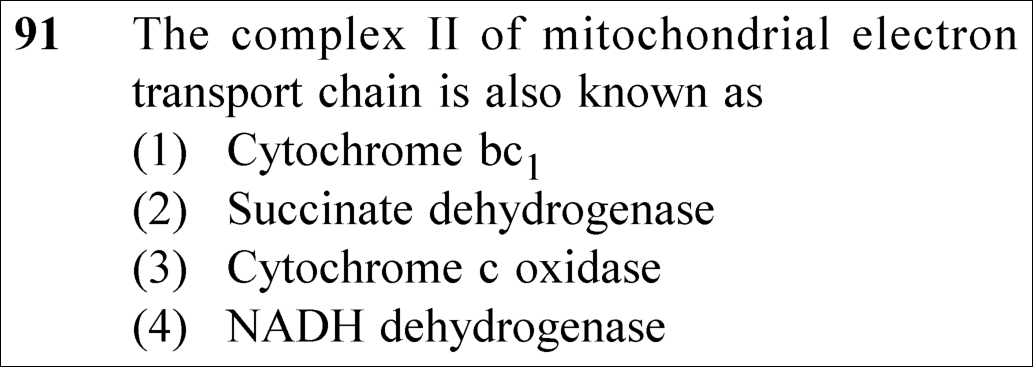
NEET 2025 · Q91 Easy
Official NEET 2025 Question 91 - Respiration in Plants
1
2 ✓ Key
3
4
💡 Verified Solution & 30-Second Hack
✓
Verified Against NTA Final Answer Key
Option (2) : Succinate dehydrogenase
📚 Respiration in Plants Easy
📋 Given Parameters & Problem Setup
Target Complex Complex II of the mitochondrial Electron Transport Chain (ETC)
Organelle Location Inner mitochondrial membrane
⚡

The 30-Second Exam Hall Shortcut: ⚡ ETS Enzyme Complex Fingerprint

⏱️ Save ~25 seconds

Complex I = NADH dehydrogenase, Complex II = Succinate dehydrogenase, Complex III = Cytochrome bc₁, Complex IV = Cytochrome c oxidase, Complex V = ATP synthase! Complex II is Succinate dehydrogenase!

1 Recall the 5 multi-protein complexes of the inner mitochondrial membrane:
2 - Complex I: NADH dehydrogenase (transfers electrons from NADH to ubiquinone).
3 - Complex II: Succinate dehydrogenase (oxidizes succinate to fumarate in Krebs cycle and transfers electrons to ubiquinone via FADH₂).
4 - Complex III: Cytochrome bc₁ complex.
5 - Complex IV: Cytochrome c oxidase (contains cytochromes a and a₃ and two Cu centres).
6 - Complex V: ATP synthase (coupling factor F₀-F₁).
7 Complex II is uniquely Succinate dehydrogenase!
8 Select Option (2) in under 5 seconds!
🛡️
Why You Can 100% Trust This Shortcut: NCERT Biology · Respiration in Plants (Mitochondrial ETS: Complex II is succinate dehydrogenase).
📐

Step-by-Step Rigorous Workflow & Mathematical Proof

Step 1

Organization of the Mitochondrial Electron Transport System (ETS)

Metabolic oxidation of NADH + H⁺ and FADH₂ generated during glycolysis and the TCA cycle transfers electrons through a series of enzyme complexes embedded in the inner mitochondrial membrane:

Complex I=NADH:ubiquinone oxidoreductase (NADH dehydrogenase)\text{Complex I} = \text{NADH:ubiquinone oxidoreductase (NADH dehydrogenase)}
  • • Complex I transfers electrons from NADH to ubiquinone (coenzyme Q) with concomitant proton pumping.
Step 2

Identification and Dual Role of Complex II

Complex II functions simultaneously as an enzyme of the Krebs cycle and a component of the electron transport chain:

Succinate+FAD→Complex II (Succinate dehydrogenase)Fumarate+FADH2\text{Succinate} + \text{FAD} \xrightarrow{\text{Complex II (Succinate dehydrogenase)}} \text{Fumarate} + \text{FADH}_2
  • • Electrons from FADH₂ are transferred to ubiquinone to generate ubiquinol (QH₂).
  • • Unlike Complexes I, III, and IV, Complex II does not pump protons across the inner mitochondrial membrane.
Step 3

Review Complexes III, IV, and V

Contrast Complex II with the other options:

Complex III=Cytochrome bc1,Complex IV=Cytochrome c oxidase\text{Complex III} = \text{Cytochrome } bc_1, \quad \text{Complex IV} = \text{Cytochrome } c \text{ oxidase}
  • • Thus Complex II is specifically Succinate dehydrogenase, matching Option (2).
⭐

360° Option Elimination Engine Key Feature

Diagnose every choice: Know exactly why the right option works and why distractors fail.

4-Option Deep Scan
1 A
✗ Incorrect
Verdict & Scientific Reason:

Incorrect. Cytochrome bc₁ is Complex III.

⚠️
Student Fallacy (Why candidates pick this trap): Confusing Complex II with Complex III.
2 B
✓ 100% Correct
Verdict & Scientific Reason:

100% correct. Complex II is canonically Succinate dehydrogenase.

💡
Why this is airtight: None; verbatim NCERT recall.
3 C
✗ Incorrect
Verdict & Scientific Reason:

Incorrect. Cytochrome c oxidase is Complex IV.

⚠️
Student Fallacy (Why candidates pick this trap): Confusing terminal complex with Complex II.
4 D
✗ Incorrect
Verdict & Scientific Reason:

Incorrect. NADH dehydrogenase is Complex I.

⚠️
Student Fallacy (Why candidates pick this trap): Confusing Complex I with Complex II.
⚠️

NTA Trap Alert: Scrambling Numbers of ETS Complexes

Candidates often mix up Complex I (NADH dehydrogenase) and Complex II (Succinate dehydrogenase). Remember that NADH enters first at Complex I, while FADH₂ enters at Complex II!

🛡️ How to avoid the -1 mark: Order of electron entry: NADH at Complex I; Succinate/FADH₂ at Complex II!
📖

Core NEET Syllabus Standard

NEET Biology Core Syllabus · Respiration in Plants Standard Benchmark
Core Scientific Principle Tested:

"Complex II of mitochondrial ETS is succinate dehydrogenase."

Syllabus Focus: Electron Transport System (ETS) and Oxidative Phosphorylation
✓ Core NEET UG Syllabus Anchor Syllabus & Academic Standards ↗
1 = NADH, 2 = Succinate, 3 = bc₁, 4 = Cytochrome c Oxidase ⟹ Complex II = Succinate (Option 2)!
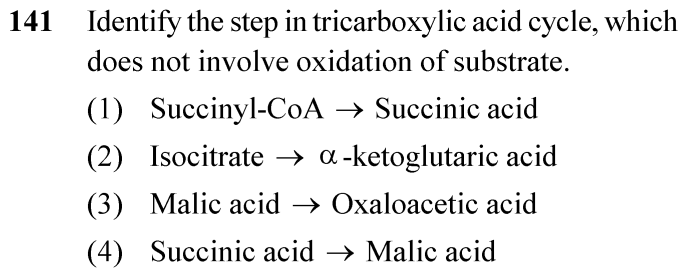
NEET 2024 · Q141 Medium
Official NEET 2024 Question 141 - Respiration in Plants
1 ✓ Key
2
3
4
💡 Verified Solution & 30-Second Hack
✓
Verified Against NTA Final Answer Key
Option (1) : Succinyl-CoA -> Succinic acid
📚 Respiration in Plants Medium
📋 Given Parameters & Problem Setup
Cycle Tricarboxylic Acid (TCA / Krebs) Cycle
Criterion Step that does NOT involve oxidation of substrate (no NAD+/FAD reduction)
⚡

The 30-Second Exam Hall Shortcut: ⚡ TCA Oxidation vs Substrate-Level Phosphorylation

⏱️ Save ~30 seconds

Succinyl-CoA to Succinic acid is substrate-level phosphorylation (GDP + Pi -> GTP), involving thioester cleavage, NOT oxidation! All other three steps reduce NAD⁺ or FAD!

1 Check each step in the TCA cycle for oxidation (dehydrogenation):
2 Succinyl-CoA -> Succinic acid: Cleavage of thioester bond coupled to GDP -> GTP phosphorylation. No hydride transfer or oxidation!
3 Isocitrate -> α-ketoglutaric acid: Oxidation reducing NAD⁺ to NADH + H⁺.
4 Malic acid -> Oxaloacetic acid: Oxidation reducing NAD⁺ to NADH + H⁺.
5 Succinic acid -> Fumaric / Malic acid: Oxidation reducing FAD to FADH₂.
6 The non-oxidative step is Succinyl-CoA -> Succinic acid -> Option (1) / A.
🛡️
Why You Can 100% Trust This Shortcut: NCERT Biology · Respiration in Plants (Tricarboxylic Acid Cycle)
📐

Step-by-Step Rigorous Workflow & Mathematical Proof

Step 1

Review Oxidation Reactions in the TCA Cycle

Oxidation of substrate in the TCA cycle is coupled with the reduction of electron acceptors (NAD+NAD^+ or FADFAD): - Isocitrate to α\alpha-ketoglutarate: Dehydrogenation coupled with NAD+→NADH+H+NAD^+ \rightarrow NADH + H^+. - α\alpha-ketoglutarate to Succinyl-CoA: Dehydrogenation coupled with NAD+→NADH+H+NAD^+ \rightarrow NADH + H^+. - Succinate to Fumarate: Dehydrogenation coupled with FAD→FADH2FAD \rightarrow FADH_2. - Malate to Oxaloacetate: Dehydrogenation coupled with NAD+→NADH+H+NAD^+ \rightarrow NADH + H^+.

Step 2

Analyze Succinyl-CoA Cleavage

During the conversion of succinyl-CoA to succinic acid, a molecule of GTP is synthesized by substrate-level phosphorylation: Succinyl-CoA+GDP+Pi→Succinate+GTP+CoA-SH\text{Succinyl-CoA} + \text{GDP} + P_i \rightarrow \text{Succinate} + \text{GTP} + \text{CoA-SH} This is a cleavage/hydrolysis of a high-energy thioester bond; it does not involve oxidation or reduction.

Step 3

Conclude Option

Conversion of succinyl-CoA to succinic acid does not involve oxidation of the substrate.

⭐

360° Option Elimination Engine Key Feature

Diagnose every choice: Know exactly why the right option works and why distractors fail.

4-Option Deep Scan
1 (1)
✓ 100% Correct
Verdict & Scientific Reason:

This step is substrate-level phosphorylation producing GTP; it involves no oxidation (no NAD+ or FAD reduction).

💡
Why this is airtight: None.
2 (2)
✗ Incorrect
Verdict & Scientific Reason:

Involves oxidative decarboxylation reducing NAD+ to NADH + H+.

⚠️
Student Fallacy (Why candidates pick this trap): Involves oxidative decarboxylation reducing NAD+ to NADH + H+.
3 (3)
✗ Incorrect
Verdict & Scientific Reason:

Involves oxidation of malate by malate dehydrogenase reducing NAD+ to NADH + H+.

⚠️
Student Fallacy (Why candidates pick this trap): Involves oxidation of malate by malate dehydrogenase reducing NAD+ to NADH + H+.
4 (4)
✗ Incorrect
Verdict & Scientific Reason:

Involves succinate dehydrogenase oxidising succinate to fumarate (reducing FAD to FADH2).

⚠️
Student Fallacy (Why candidates pick this trap): Involves succinate dehydrogenase oxidising succinate to fumarate (reducing FAD to FADH2).
⚠️

NTA Trap Alert: Succinyl-CoA vs Succinic Acid

Confusing Succinyl-CoA -> Succinate (substrate phosphorylation) with Succinate -> Fumarate (FAD oxidation).

🛡️ How to avoid the -1 mark: Remember: GTP is made during Succinyl-CoA -> Succinate; FADH2 is made during Succinate -> Fumarate.
📖

Core NEET Syllabus Standard

Biology Core Botany · Respiration in Plants Standard Benchmark
Core Scientific Principle Tested:

"During the conversion of succinyl-CoA to succinic acid a molecule of GTP is synthesised. This is a substrate level phosphorylation. In a coupled reaction GTP is converted to GDP with the simultaneous synthesis of ATP from ADP."

Syllabus Focus: Tricarboxylic Acid (TCA) Cycle: Substrate-Level Phosphorylation vs Oxidation
✓ Core NEET UG Syllabus Anchor Syllabus & Academic Standards ↗
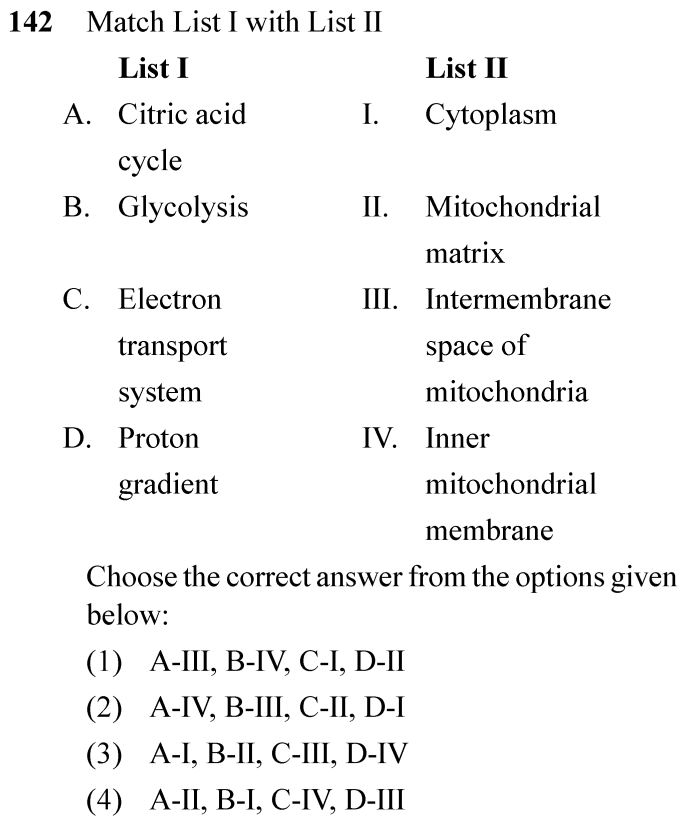
NEET 2024 · Q142 Easy
Official NEET 2024 Question 142 - Respiration in Plants
1
2
3
4 ✓ Key
💡 Verified Solution & 30-Second Hack
✓
Verified Against NTA Final Answer Key
Option (4) : A-II, B-I, C-IV, D-III
📚 Respiration in Plants Easy
📋 Given Parameters & Problem Setup
List I (Processes) A: Citric acid cycle; B: Glycolysis; C: Electron transport system; D: Proton gradient
List II (Sites / Locations) I: Cytoplasm; II: Mitochondrial matrix; III: Intermembrane space of mitochondria; IV: Inner mitochondrial membrane
⚡

The 30-Second Exam Hall Shortcut: ⚡ Cellular Respiration Site Match

⏱️ Save ~25 seconds

Glycolysis = Cytoplasm (I); Krebs cycle = Mitochondrial matrix (II); ETS = Inner mitochondrial membrane (IV); Proton accumulation = Intermembrane space (III)! Result: A-II, B-I, C-IV, D-III!

1 A. Citric acid cycle (Krebs): occurs in Mitochondrial matrix (II).
2 B. Glycolysis (EMP pathway): occurs in Cytoplasm / cytosol (I).
3 C. Electron transport system (ETS): located on Inner mitochondrial membrane (IV).
4 D. Proton gradient: protons (H+H^+) accumulate in the Intermembrane space of mitochondria (III).
5 Matching order: A-II, B-I, C-IV, D-III -> Option (4) / D.
🛡️
Why You Can 100% Trust This Shortcut: NCERT Biology · Respiration in Plants (Compartmentation of Cellular Respiration)
📐

Step-by-Step Rigorous Workflow & Mathematical Proof

Step 1

Locate Glycolysis and Krebs Cycle

Glycolysis takes place in the cytoplasm of the cell and is present in all living organisms (B -> I). The citric acid cycle takes place in the matrix of mitochondria where soluble dehydrogenases reside (A -> II).

Step 2

Locate ETS and Chemiosmotic Proton Accumulation

The electron transport system (ETS) is embedded in the inner mitochondrial membrane (cristae) (C -> IV). As electrons move through the ETS complexes, protons are pumped from the matrix into the intermembrane space, generating the electrochemical proton gradient driving ATP synthesis via Complex V (D -> III).

Step 3

Match with Options

A-II, B-I, C-IV, D-III corresponds to Option (4).

⭐

360° Option Elimination Engine Key Feature

Diagnose every choice: Know exactly why the right option works and why distractors fail.

4-Option Deep Scan
1 (1)
✗ Incorrect
Verdict & Scientific Reason:

Mismatches Citric acid cycle with Intermembrane space and Glycolysis with Inner membrane.

⚠️
Student Fallacy (Why candidates pick this trap): Mismatches Citric acid cycle with Intermembrane space and Glycolysis with Inner membrane.
2 (2)
✗ Incorrect
Verdict & Scientific Reason:

Mismatches Citric acid cycle with Inner membrane.

⚠️
Student Fallacy (Why candidates pick this trap): Mismatches Citric acid cycle with Inner membrane.
3 (3)
✗ Incorrect
Verdict & Scientific Reason:

Mismatches Citric acid cycle with cytoplasm.

⚠️
Student Fallacy (Why candidates pick this trap): Mismatches Citric acid cycle with cytoplasm.
4 (4)
✓ 100% Correct
Verdict & Scientific Reason:

Accurately pairs all four biochemical processes with their specific cellular and organellar subcompartments.

💡
Why this is airtight: None.
⚠️

NTA Trap Alert: Inner Membrane vs Intermembrane Space

Confusing the site of ETS complexes (inner membrane) with the site of proton accumulation (intermembrane space).

🛡️ How to avoid the -1 mark: ETS complexes are embedded in the inner membrane; protons accumulate in the intermembrane space.
📖

Core NEET Syllabus Standard

Biology Core Botany · Respiration in Plants Standard Benchmark
Core Scientific Principle Tested:

"Glycolysis occurs in the cytoplasm. The TCA cycle occurs in the matrix of mitochondria. Electron transport system is located in the inner mitochondrial membrane. The energy released is used to pump protons into the intermembrane space."

Syllabus Focus: Cellular Compartments for Respiratory Processes
✓ Core NEET UG Syllabus Anchor Syllabus & Academic Standards ↗
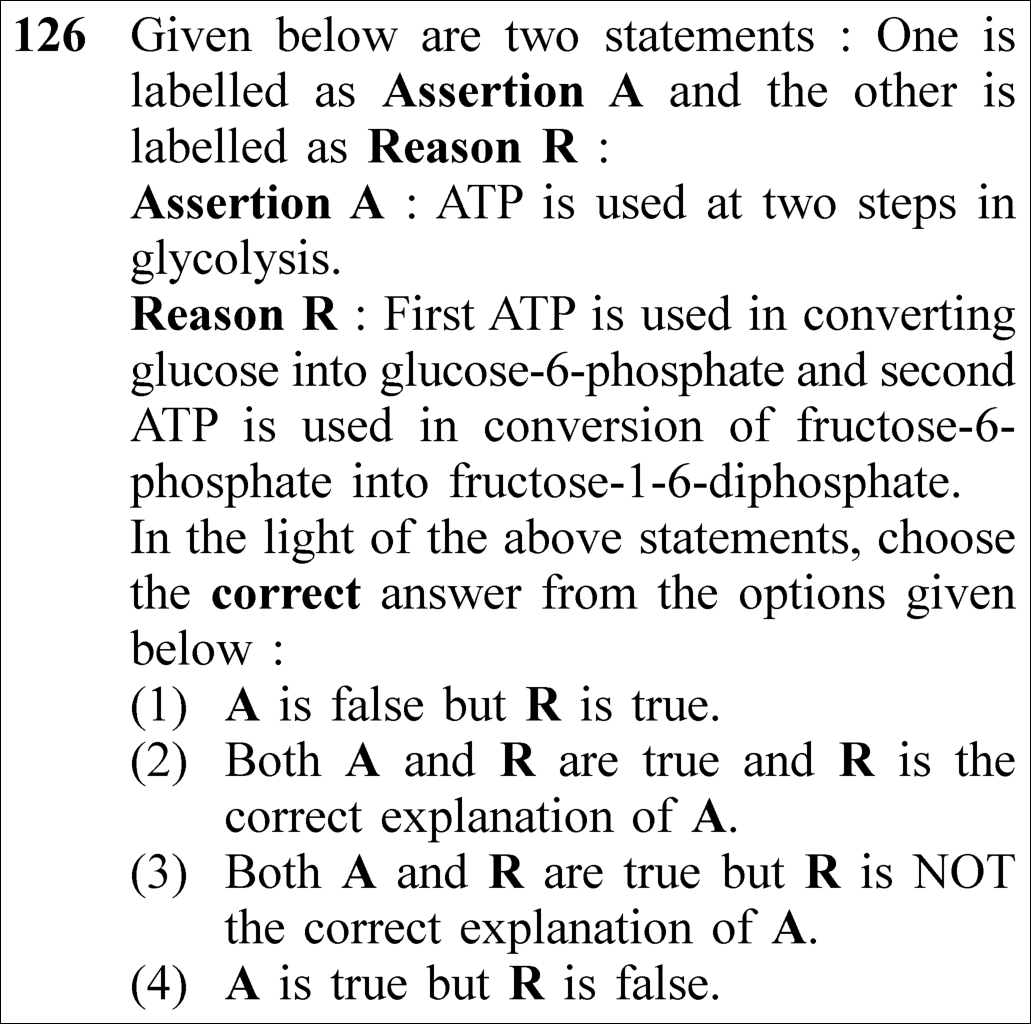
NEET 2023 · Q126 Medium
Official NEET 2023 Question 126 - Respiration in Plants
1 A is false but R is true.
2 Both A and R are true and R is the correct explanation of A. ✓ Key
3 Both A and R are true but R is NOT the correct explanation of A.
4 A is true but R is false.
💡 Verified Solution & 30-Second Hack
✓
Verified Against NTA Final Answer Key
Option (2) : Both A and R are true and R is the correct explanation of A.
📚 Respiration in Plants Medium
📋 Given Parameters & Problem Setup
Assertion (A) ATP is used at two steps in glycolysis.
Reason (R) First ATP is used in converting glucose into glucose-6-phosphate and second ATP is used in conversion of fructose-6-phosphate into fructose-1,6-diphosphate.
⚡

The 30-Second Exam Hall Shortcut: ⚡ Glycolysis Energy Investment Steps: Hexokinase & PFK

⏱️ Save ~25 seconds

Glycolysis begins with an energy investment (preparatory) phase where exactly 2 ATP molecules are consumed: step 1 (Glucose -> G6P) and step 3 (F6P -> F-1,6-BP). Reason specifies these exact two steps, correctly explaining Assertion!

1 Assertion: 2 ATP molecules are utilized in glycolysis -> True (preparatory phase).
2 Reason: Step 1 (Hexokinase) consumes 1st ATP; Step 3 (Phosphofructokinase) consumes 2nd ATP -> True.
3 Reason provides the exact biochemical enumeration explaining why ATP is used at two steps.
4 Match Option (2) Both A and R are true and R is the correct explanation of A.
🛡️
Why You Can 100% Trust This Shortcut: Canonical NCERT Glycolysis biochemical preparatory phase stoichiometry.
📐

Step-by-Step Rigorous Workflow & Mathematical Proof

Step 1

The Preparatory (Investment) Phase of Glycolysis

During the initial phase of the Embden-Meyerhof-Parnas (EMP) pathway, glucose is primed for cleavage via two irreversible kinase-catalyzed phosphorylation reactions:

Step 1:Glucose+ATP→HexokinaseGlucose-6-phosphate+ADPStep 3:Fructose-6-phosphate+ATP→PhosphofructokinaseFructose-1,6-bisphosphate+ADP\begin{aligned} \mathbf{\text{Step 1:}} & \quad \text{Glucose} + \mathbf{\text{ATP}} \xrightarrow{\text{Hexokinase}} \text{Glucose-6-phosphate} + \text{ADP} \\[4pt] \mathbf{\text{Step 3:}} & \quad \text{Fructose-6-phosphate} + \mathbf{\text{ATP}} \xrightarrow{\text{Phosphofructokinase}} \text{Fructose-1,6-bisphosphate} + \text{ADP} \end{aligned}
Step 2

Verbatim NCERT Reference

NCERT states verbatim: "ATP is utilised at two steps: first in the conversion of glucose into glucose 6-phosphate and second in the conversion of fructose 6-phosphate to fructose 1, 6-bisphosphate."

Step 3

Evaluation of Explanation Link

Assertion states that ATP is used at two steps. Reason identifies the exact two enzymatic reactions responsible for this consumption. Therefore, R is the direct and complete explanation of A.

⭐

360° Option Elimination Engine Key Feature

Diagnose every choice: Know exactly why the right option works and why distractors fail.

4-Option Deep Scan
1 1
✗ Incorrect
Verdict & Scientific Reason:

Assertion is factually true: exactly two steps in glycolysis consume ATP.

⚠️
Student Fallacy (Why candidates pick this trap): Thinking glycolysis only yields ATP without any investment phase.
2 2
✓ 100% Correct
Verdict & Scientific Reason:

Both statements are true and Reason provides the exact biochemical justification of Assertion.

💡
Why this is airtight: None; rigorous biochemical logic.
3 3
✗ Incorrect
Verdict & Scientific Reason:

Reason explicitly details the two reactions cited in Assertion, constituting a direct causal explanation.

⚠️
Student Fallacy (Why candidates pick this trap): Misjudging the explanatory relationship between a general claim and its specific proof.
4 4
✗ Incorrect
Verdict & Scientific Reason:

Reason is factually accurate and matches NCERT pathway steps verbatim.

⚠️
Student Fallacy (Why candidates pick this trap): Doubting whether fructose-6-phosphate conversion consumes ATP.
⚠️

NTA Trap Alert: Gross vs. Net ATP Yield Confusion

Glycolysis synthesizes 4 ATP molecules by substrate-level phosphorylation, but consumes 2 ATP in the preparatory phase, yielding a net of 2 ATP. Forgetting the 2 ATP investment leads to confusion.

🛡️ How to avoid the -1 mark: Remember: 2 ATP invested (steps 1 & 3) -> 4 ATP generated (steps 7 & 10) -> Net gain = 2 ATP.
📖

Core NEET Syllabus Standard

NCERT Biology · Respiration in Plants Standard Benchmark
Core Scientific Principle Tested:

"ATP is utilised at two steps: first in the conversion of glucose into glucose 6-phosphate and second in the conversion of fructose 6-phosphate to fructose 1, 6-bisphosphate."

Syllabus Focus: Glycolysis
✓ Core NEET UG Syllabus Anchor Syllabus & Academic Standards ↗
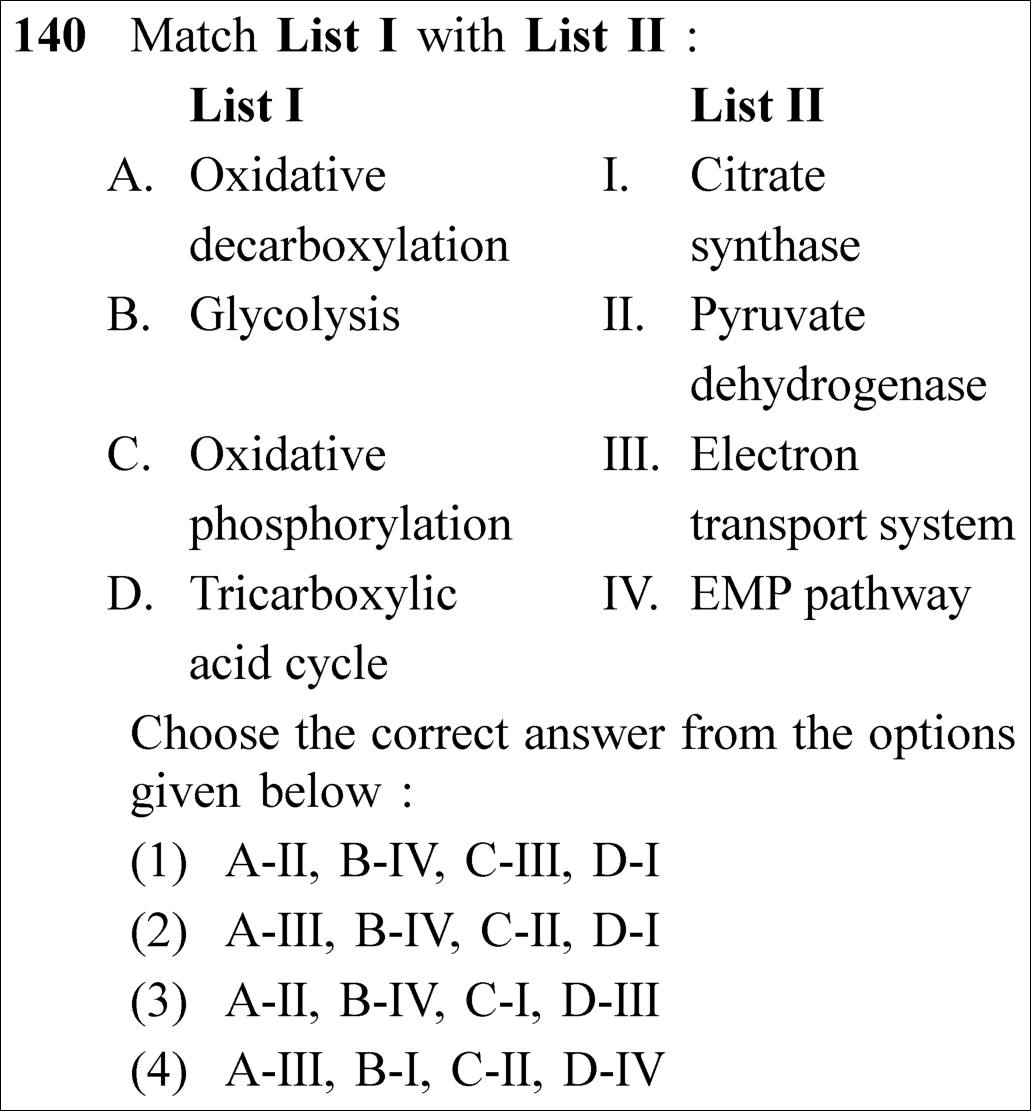
NEET 2023 · Q140 Easy
Official NEET 2023 Question 140 - Respiration in Plants
1 ✓ Key
2
3
4
💡 Verified Solution & 30-Second Hack
✓
Verified Against NTA Final Answer Key
Option (1) : A-II, B-IV, C-III, D-I
📚 Respiration in Plants Easy
📋 Given Parameters & Problem Setup
List I (Pathways) Oxidative decarboxylation, Glycolysis, Oxidative phosphorylation, TCA cycle
List II (Components) Citrate synthase, Pyruvate dehydrogenase, ETS, EMP pathway
⚡

The 30-Second Exam Hall Shortcut: ⚡ Respiratory Pathway 1-to-1 Association Match

⏱️ Save ~25 seconds

Match each reaction to its textbook hallmark: Oxidative decarboxylation of pyruvate = Pyruvate dehydrogenase (II). Glycolysis = EMP pathway (IV). Oxidative phosphorylation = Electron transport system / ETS (III). TCA cycle = Citrate synthase (I)!

1 Oxidative decarboxylation: Pyruvate -> Acetyl CoA catalyzed by Pyruvate dehydrogenase -> A-II.
2 Glycolysis: EMP (Embden, Meyerhof, Parnas) pathway -> B-IV.
3 Oxidative phosphorylation: ATP synthesis coupled to Electron transport system (ETS) -> C-III.
4 Tricarboxylic acid cycle: First committed step catalyzed by Citrate synthase -> D-I.
5 Match combination: A-II, B-IV, C-III, D-I -> Option (1).
🛡️
Why You Can 100% Trust This Shortcut: Canonical NCERT Cellular Respiration pathway nomenclature and enzymology.
📐

Step-by-Step Rigorous Workflow & Mathematical Proof

Step 1

Detailed Pathway Enzymology and Correlates

Analyzing the metabolic pairings in aerobic respiration:

A. Oxidative decarboxylation:Pyruvate+CoA+NAD+→Pyruvate dehydrogenaseAcetyl CoA+CO2+NADH  ⟹  IIB. Glycolysis:Embden-Meyerhof-Parnas pathway (EMP)  ⟹  IVC. Oxidative phosphorylation:Mitochondrial inner membrane Electron Transport System (ETS)  ⟹  IIID. Tricarboxylic acid cycle:Condensation of Acetyl CoA with OAA via Citrate synthase  ⟹  I\begin{aligned} \text{\textbf{A. Oxidative decarboxylation:}} & \quad \text{Pyruvate} + \text{CoA} + \text{NAD}^+ \xrightarrow{\mathbf{\text{Pyruvate dehydrogenase}}} \text{Acetyl CoA} + CO_2 + \text{NADH} \implies \mathbf{\text{II}} \\[4pt] \text{\textbf{B. Glycolysis:}} & \quad \text{Embden-Meyerhof-Parnas pathway (EMP)} \implies \mathbf{\text{IV}} \\[4pt] \text{\textbf{C. Oxidative phosphorylation:}} & \quad \text{Mitochondrial inner membrane Electron Transport System (ETS)} \implies \mathbf{\text{III}} \\[4pt] \text{\textbf{D. Tricarboxylic acid cycle:}} & \quad \text{Condensation of Acetyl CoA with OAA via } \mathbf{\text{Citrate synthase}} \implies \mathbf{\text{I}} \end{aligned}
Step 2

Option Cross-Verification

Matching A-II and B-IV immediately isolates Options (1) and (3). Checking C-III and D-I unambiguously confirms Option (1).

⭐

360° Option Elimination Engine Key Feature

Diagnose every choice: Know exactly why the right option works and why distractors fail.

4-Option Deep Scan
1 1
✓ 100% Correct
Verdict & Scientific Reason:

Every pairing accurately matches the canonical NCERT enzyme and pathway definitions.

💡
Why this is airtight: None; clean biochemical pairing.
2 2
✗ Incorrect
Verdict & Scientific Reason:

Mismatches oxidative decarboxylation with ETS.

⚠️
Student Fallacy (Why candidates pick this trap): Confusing terminal electron transfer with link reaction.
3 3
✗ Incorrect
Verdict & Scientific Reason:

Inverts Oxidative phosphorylation and TCA cycle.

⚠️
Student Fallacy (Why candidates pick this trap): Swapping Citrate synthase with Electron transport system.
4 4
✗ Incorrect
Verdict & Scientific Reason:

Completely scrambled matches across all 4 entries.

⚠️
Student Fallacy (Why candidates pick this trap): Guessing without tracking individual enzymatic reactions.
⚠️

NTA Trap Alert: Oxidative Decarboxylation vs. Phosphorylation Trap

Both terms begin with "Oxidative". Decarboxylation refers to loss of CO2CO_2 from pyruvate via pyruvate dehydrogenase; Phosphorylation refers to ATP synthesis via the ETS complex.

🛡️ How to avoid the -1 mark: Decarboxylation = releases CO2CO_2 (Pyruvate dehydrogenase). Phosphorylation = makes ATP (ETS).
📖

Core NEET Syllabus Standard

NCERT Biology · Respiration in Plants Standard Benchmark
Core Scientific Principle Tested:

"Pyruvate undergoes oxidative decarboxylation by pyruvate dehydrogenase; Glycolysis is EMP pathway; Oxidative phosphorylation occurs via ETS; TCA cycle begins with citrate synthase."

Syllabus Focus: Aerobic Respiration & Fermentation
✓ Core NEET UG Syllabus Anchor Syllabus & Academic Standards ↗
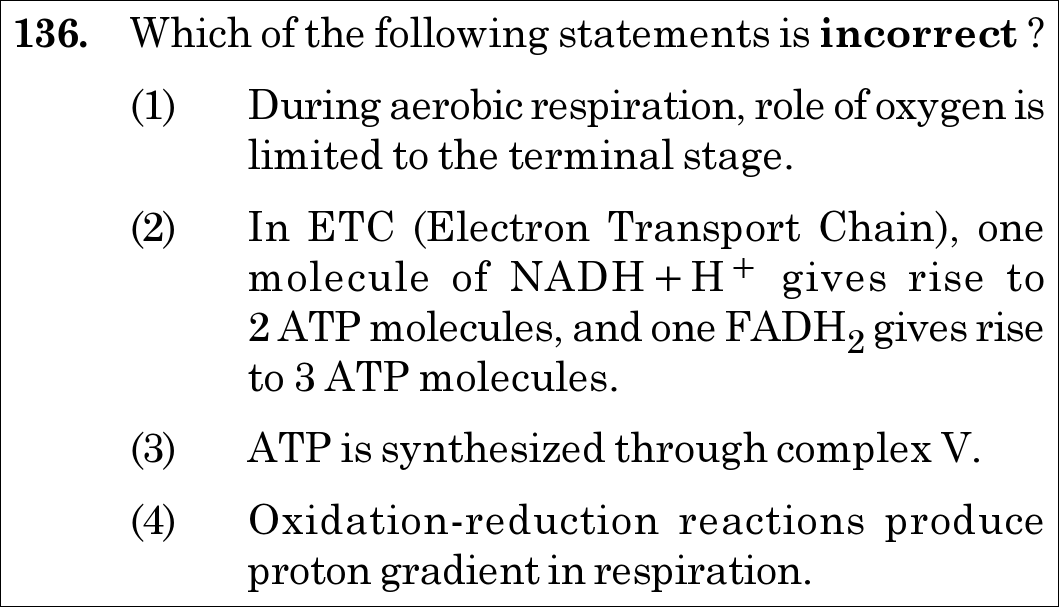
NEET 2021 · Q136 Easy
Official NEET 2021 Question 136 - Respiration in Plants
1 During aerobic respiration, role of oxygen is limited to the terminal stage.
2 In ETC (Electron Transport Chain), one molecule of NADH+H+ gives rise to 2 ATP molecules, and one FADH2 gives rise to 3 ATP molecules. ✓ Key
3 ATP is synthesized through complex V.
4 Oxidation-reduction reactions produce proton gradient in respiration.
💡 Verified Solution & 30-Second Hack
✓
Verified Against NTA Final Answer Key
Option (2) : In ETC (Electron Transport Chain), one molecule of NADH + H+ gives rise to 2 ATP molecules, and one FADH2 gives rise to 3 ATP molecules.
📚 Respiration in Plants Easy
📋 Given Parameters & Problem Setup
Process Aerobic cellular respiration & Electron Transport Chain (ETC)
Target Identify the incorrect statement
⚡

The 30-Second Exam Hall Shortcut: ⚡ 1 NADH = 3 ATP & 1 FADH2 = 2 ATP (The Inverted Ratio Trap!)

⏱️ Save ~20 seconds

According to NCERT energetics, oxidation of 1 NADH + H⁺ yields 3 molecules of ATP, while oxidation of 1 FADH₂ yields 2 molecules of ATP! Statement (2) inverted this ratio (claiming 2 ATP for NADH and 3 ATP for FADH₂), making it blatantly incorrect. Match Option (2)!

1 Check Statement (1): Oxygen is terminal electron acceptor; role is limited to terminal stage   ⟹  \implies TRUE.
2 Check Statement (2): In ETC, 1 NADH yields 2 ATP and 1 FADH2 yields 3 ATP   ⟹  \implies FALSE (NCERT stoichiometry: 1 NADH →\to 3 ATP, 1 FADH2 →\to 2 ATP).
3 Check Statement (3): ATP synthase is Complex V   ⟹  \implies TRUE.
4 Check Statement (4): Redox electron flow pumps protons across inner mitochondrial membrane to create proton gradient   ⟹  \implies TRUE.
5 Match Option (2).
🛡️
Why You Can 100% Trust This Shortcut: Canonical NCERT Respiration in Plants on ETS and Oxidative Phosphorylation.
📐

Step-by-Step Rigorous Workflow & Mathematical Proof

Step 1

Stoichiometry of ATP Synthesis in the ETS

Electrons from NADH+H+NADH + H^+ are transferred to O2O_2 via Complexes I, III, and IV, pumping 10 protons across the inner mitochondrial membrane, whereas electrons from FADH2FADH_2 enter at Complex II, pumping 6 protons. As established in the canonical NCERT text:

1 NADH+H+→Oxidative Phosphorylation3 ATP Molecules1 FADH2→Oxidative Phosphorylation2 ATP Molecules\begin{aligned} \mathbf{1 \text{ NADH} + \text{H}^+} & \xrightarrow{\text{Oxidative Phosphorylation}} \mathbf{3 \text{ ATP Molecules}} \\[4pt] \mathbf{1 \text{ FADH}_2} & \xrightarrow{\text{Oxidative Phosphorylation}} \mathbf{2 \text{ ATP Molecules}} \end{aligned}
Step 2

Evaluation of Statement (2)

Statement (2) asserts that "one molecule of NADH+H+NADH + H^+ gives rise to 2 ATP2\text{ ATP} molecules, and one FADH2FADH_2 gives rise to 3 ATP3\text{ ATP} molecules". This swaps the canonical stoichiometry, making it the incorrect statement requested by the question.

Step 3

Verification of Remaining Statements

- Statement (1): Oxygen acts as the final hydrogen/electron acceptor only at the very end of the ETS (Complex IV) to form metabolic water. - Statement (3): ATP synthase is universally designated as Complex V. - Statement (4): The free energy liberated during redox electron transitions drives active proton pumping into the intermembrane space, generating the electrochemical proton gradient.

⭐

360° Option Elimination Engine Key Feature

Diagnose every choice: Know exactly why the right option works and why distractors fail.

4-Option Deep Scan
1 1
✗ Incorrect
Verdict & Scientific Reason:

This statement is TRUE. Oxygen acts exclusively as the terminal electron and proton acceptor at Complex IV.

⚠️
Student Fallacy (Why candidates pick this trap): Overlooking that oxygen has no role until the terminal cytochrome c oxidase step.
2 2
✓ 100% Correct
Verdict & Scientific Reason:

This statement is FALSE (and hence the correct answer). Canonical yield is 3 ATP per NADH and 2 ATP per FADH2.

💡
Why this is airtight: None. Directly detects the inverted numerical stoichiometry.
3 3
✗ Incorrect
Verdict & Scientific Reason:

This statement is TRUE. Complex V is the mitochondrial ATP synthase comprising F0F_0 and F1F_1 components.

⚠️
Student Fallacy (Why candidates pick this trap): Confusing Complex V with electron carriers Complex I–IV.
4 4
✗ Incorrect
Verdict & Scientific Reason:

This statement is TRUE. Chemiosmotic proton translocation is directly powered by redox reactions across Complexes I, III, and IV.

⚠️
Student Fallacy (Why candidates pick this trap): Thinking the proton gradient is generated by substrate-level phosphorylation.
⚠️

NTA Trap Alert: Swapped Number Trap (3 vs 2 ATP)

NTA loves switching the coefficients: 1 NADH = 3 ATP; 1 FADH2 = 2 ATP. Candidates rushing through the question miss the transposed numbers.

🛡️ How to avoid the -1 mark: Fix the rule: "NADH enters earlier at Complex I   ⟹  \implies 3 ATP; FADH2 enters later at Complex II   ⟹  \implies 2 ATP".
📖

Core NEET Syllabus Standard

NEET / NCERT Biology · Respiration in Plants Standard Benchmark
Core Scientific Principle Tested:

"Oxidation of one molecule of NADH gives rise to 3 molecules of ATP, while that of one molecule of FADH2 produces 2 molecules of ATP."

Syllabus Focus: Electron Transport System (ETS) and Oxidative Phosphorylation
✓ Core NEET UG Syllabus Anchor Syllabus & Academic Standards ↗
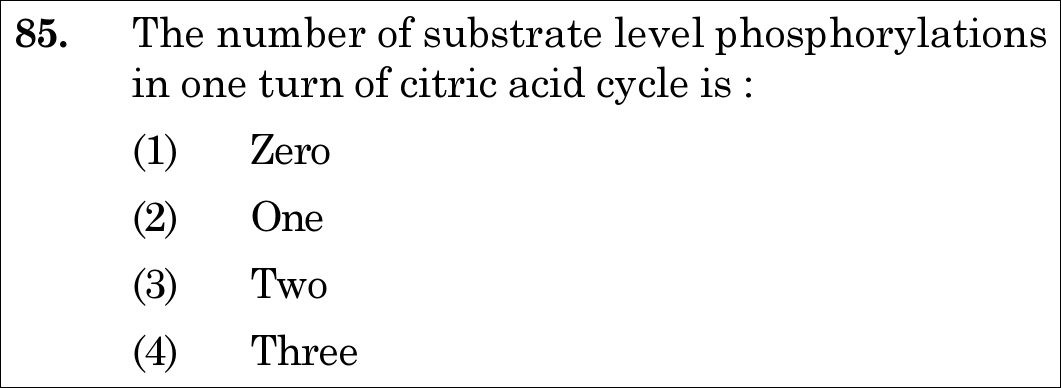
NEET 2020 · Q85 Easy
Official NEET 2020 Question 85 - Respiration in Plants
1 Zero
2 One ✓ Key
3 Two
4 Three
💡 Verified Solution & 30-Second Hack
✓
Verified Against NTA Final Answer Key
Option (2) : One
📚 Respiration in Plants Easy
📋 Given Parameters & Problem Setup
Metabolic Pathway Citric acid cycle (Krebs cycle / TCA cycle)
Cycle Interval One turn of the cycle (per molecule of Acetyl-CoA)
Question Objective Count of substrate level phosphorylations
⚡

The 30-Second Exam Hall Shortcut: ⚡ "1 Turn of Krebs Cycle = Exactly ONE Substrate Level Phosphorylation (Succinyl-CoA -> Succinate)!"

⏱️ 20 seconds

In one turn of the citric acid cycle, substrate level phosphorylation occurs at exactly ONE step: the conversion of Succinyl-CoA to Succinic acid, generating 1 molecule of GTP (which readily transfers phosphate to ADP forming ATP). Per glucose (2 turns), it is two; but per turn, it is ONE! Mark One (Option 2) in 5 seconds.

1 Step: Succinyl-CoA + GDP + Pi -> Succinic acid + CoA + GTP.
2 In coupled reaction, GTP + ADP -> GDP + ATP (Substrate level phosphorylation).
3 In one turn of the citric acid cycle, this reaction occurs exactly ONCE.
4 Select Option (2) One.
🛡️
Why You Can 100% Trust This Shortcut: NCERT Biology · Plant Physiology: Respiration in Plants (Tricarboxylic Acid Cycle)
📐

Step-by-Step Rigorous Workflow & Mathematical Proof

Step 1

Define Substrate Level Phosphorylation

Substrate level phosphorylation is the direct synthesis of ATP/GTP from ADP/GDP coupled to the cleavage of a high-energy metabolic intermediate, occurring independently of the electron transport chain and ATP synthase.

Step 2

Identify the Step in Krebs Cycle

During the conversion of Succinyl-CoA to succinic acid, a molecule of GTP is synthesized by substrate level phosphorylation: Succinyl-CoA+GDP+Pi→Succinyl-CoA synthetaseSuccinate+CoA-SH+GTP\text{Succinyl-CoA} + \text{GDP} + \text{P}_i \xrightarrow{\text{Succinyl-CoA synthetase}} \text{Succinate} + \text{CoA-SH} + \text{GTP} In a coupled reaction, GTP transfers its phosphate to ADP, yielding ATP.

Step 3

Evaluate Cycle Stoichiometry per Turn

In ONE turn of the citric acid cycle (for each Acetyl-CoA entering the cycle), there are: - 3 steps of NADH formation - 1 step of FADH2 formation - Exactly 1 step of substrate-level phosphorylation (GTP/ATP).

Step 4

Avoid Common Pitfall

Per molecule of glucose (which yields 2 molecules of Acetyl-CoA), there are two turns and two substrate-level phosphorylations. But the question explicitly specifies "in ONE turn of citric acid cycle", which is exactly One.

⭐

360° Option Elimination Engine Key Feature

Diagnose every choice: Know exactly why the right option works and why distractors fail.

4-Option Deep Scan
1 A
✗ Incorrect
Verdict & Scientific Reason:

Incorrect; substrate level phosphorylation definitely occurs during the conversion of succinyl-CoA to succinate.

⚠️
Student Fallacy (Why candidates pick this trap): Thinking all ATP in Krebs cycle comes solely from oxidative phosphorylation.
2 B
✓ 100% Correct
Verdict & Scientific Reason:

Factually and biochemically exact; one GTP/ATP is formed directly by substrate-level phosphorylation per single turn of the cycle.

💡
Why this is airtight: None; fundamental cellular respiration stoichiometry.
3 C
✗ Incorrect
Verdict & Scientific Reason:

Incorrect; two substrate level phosphorylations occur per complete GLUCOSE molecule (which undergoes two turns of the cycle), not per ONE turn.

⚠️
Student Fallacy (Why candidates pick this trap): Confusing per-turn stoichiometry with per-glucose stoichiometry.
4 D
✗ Incorrect
Verdict & Scientific Reason:

Incorrect; there are three NADH-producing steps, not three substrate level phosphorylations.

⚠️
Student Fallacy (Why candidates pick this trap): Confusing NADH steps (3) with substrate-level phosphorylation steps (1).
⚠️

NTA Trap Alert: Per Turn vs Per Glucose

Per ONE turn of Krebs cycle = 1 GTP/ATP (One substrate level phosphorylation). Per ONE molecule of GLUCOSE = 2 turns = 2 GTP/ATP.

🛡️ How to avoid the -1 mark: Read the question boundary carefully: "in ONE turn" = 1!
📖

Core NEET Syllabus Standard

Zoology · Respiration in Plants Standard Benchmark
Core Scientific Principle Tested:

""

Syllabus Focus: Citric Acid Cycle (Krebs Cycle): Substrate Level Phosphorylation Count per Turn
✓ Core NEET UG Syllabus Anchor Syllabus & Academic Standards ↗

Solve 4 NEET Questions a Day — One per Subject

Cover all 1,140 official NEET questions in 285 days at your own pace. Progress is saved on your device. No login needed.