NEET 2026 Botany Question 109 Solution
Question
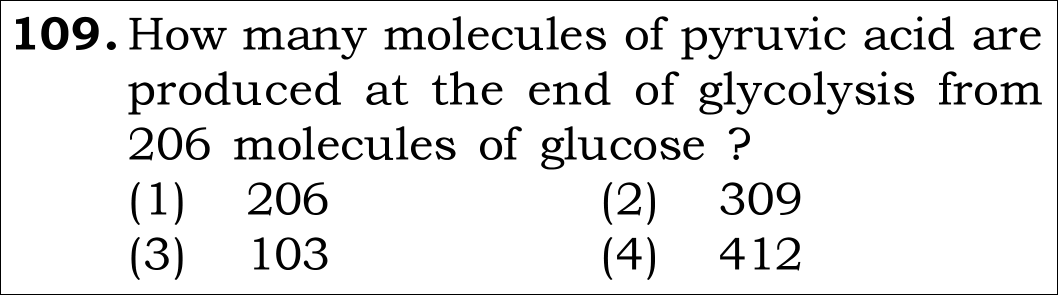
How many molecules of pyruvic acid are produced at the end of glycolysis from 206 molecules of glucose?
- (1)206
- (2)309
- (3)103
- (4)412
Dynamic 180-question full-length simulator mixed dynamically from all 6 years for 2027 & 2026 aspirants.
How many molecules of pyruvic acid are produced at the end of glycolysis from 206 molecules of glucose?
Simply multiply the number of glucose molecules by 2!
Glycolysis occurs in the cytoplasm of all living cells. A single molecule of hexose sugar (glucose, 6 carbons) undergoes a 10-step enzymatic sequence ending with cleavage into two molecules of triose keto-acid (pyruvic acid, 3 carbons).
Multiply the input glucose quantity by the stoichiometric conversion factor of 2.
Looking at the available options: (1) 206, (2) 309, (3) 103, (4) 412. Option (4) is the exact calculated value.
Diagnose every choice: Know exactly why the right option works and why distractors fail.
Incorrect. Assumes a 1:1 stoichiometric ratio between glucose and pyruvic acid.
Incorrect. Represents a 1.5 ratio, which is chemically impossible.
Incorrect. Divides 206 by 2 instead of multiplying.
100% mathematically and biochemically exact: 206 × 2 = 412.
Some hurried students see "2 pyruvic acid per glucose" and divide the number of glucose molecules by 2, yielding 103 (Option 3).
"In glycolysis, partial oxidation of one molecule of glucose gives rise to two molecules of pyruvic acid."
Test your speed and accuracy in the authentic 180-minute timed NTA simulator.
Spotted a mistake in this solution? Report an error ([email protected])
Cover all 1,140 official NEET questions in 285 days at your own pace. Progress is saved on your device. No login needed.