MyCompetitiveExams Logo MyCompetitiveExams
Search 1,140+ Questions
Chapters, formulas, speed tricks
→
⚡ Brahmastra NEET 2027
720 MARKS

Dynamic 180-question full-length simulator mixed dynamically from all 6 years for 2027 & 2026 aspirants.

Launch Brahmastra 2027 Test →
Start Practice →
100% Free · No Login Required
Q.59 Chemistry · Section A ⭐ 360° Option Elimination Active
Vault ↗

NEET 2024 Chemistry Question 59 Solution

Topic: Chemical Kinetics · Official NTA Booklet Code T1
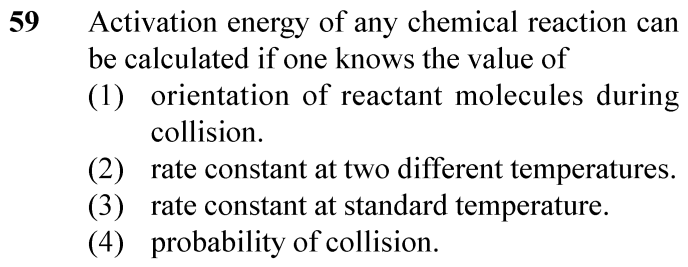
NEET 2024 Chemistry Question 59: Arrhenius Equation and Determination of Activation Energy

Question

Activation energy of any chemical reaction can be calculated if one knows the value of

  1. (1)orientation of reactant molecules during collision.
  2. (2)rate constant at two different temperatures.
  3. (3)rate constant at standard temperature.
  4. (4)probability of collision.
✓
Verified Against NTA Final Answer Key
Option (2) : rate constant at two different temperatures.
📚 Chemical Kinetics Easy
📋 Given Parameters & Problem Setup
Target quantity Activation energy (E_a) of a chemical reaction
Governing equation Arrhenius equation: k = A e^(-E_a / RT)
⚡

The 30-Second Exam Hall Shortcut: ⚡ Two-Point Arrhenius Formula Rule

⏱️ Save ~30 seconds

ln(k2 / k1) = (E_a / R) · (1/T1 - 1/T2) -> Knowing rate constant at two temperatures gives E_a directly!

1 Recall the logarithmic two-temperature Arrhenius equation:
2 ln(k2 / k1) = (E_a / R) [ (T2 - T1) / (T1 · T2) ].
3 Gas constant R is a universal physical constant.
4 If rate constants k1 and k2 are determined at temperatures T1 and T2, E_a is the ONLY unknown variable.
5 Thus, E_a can be computed precisely from the rate constant at two different temperatures.
6 Option (2) in under 5 seconds!
🛡️
Why You Can 100% Trust This Shortcut: NCERT Chemistry · Chemical Kinetics (Temperature dependence of rate of a reaction and two-point Arrhenius calculation).
📐

Step-by-Step Rigorous Workflow & Mathematical Proof

Step 1

The Differential and Logarithmic Arrhenius Form

The Arrhenius equation describes how the rate constant k of a reaction depends exponentially on absolute temperature T and activation energy Ea:

k=Ae−EaRT  ⟹  ln⁡k=ln⁡A−EaRTk = A e^{-\frac{E_a}{RT}} \implies \ln k = \ln A - \frac{E_a}{RT}
Step 2

Two-Point Formulation Eliminating Pre-Exponential Factor A

Writing the equation at two distinct absolute temperatures T1 and T2 with rate constants k1 and k2:

ln⁡k1=ln⁡A−EaRT1,ln⁡k2=ln⁡A−EaRT2\ln k_1 = \ln A - \frac{E_a}{R T_1}, \quad \ln k_2 = \ln A - \frac{E_a}{R T_2}
Step 3

Subtraction and Direct Solution for Activation Energy

Subtracting the first equation from the second eliminates the unknown frequency factor A entirely:

ln⁡(k2k1)=EaR(1T1−1T2)=EaR(T2−T1T1T2)\ln\left(\frac{k_2}{k_1}\right) = \frac{E_a}{R} \left(\frac{1}{T_1} - \frac{1}{T_2}\right) = \frac{E_a}{R} \left(\frac{T_2 - T_1}{T_1 T_2}\right)
Step 4

Conclusion

Because R is known, experimental determination of the rate constant at two distinct temperatures permits exact calculation of Ea without prior knowledge of orientation factors or pre-exponential constant A.

Ea=R⋅T1T2T2−T1ln⁡(k2k1)E_a = \frac{R \cdot T_1 T_2}{T_2 - T_1} \ln\left(\frac{k_2}{k_1}\right)
⭐

360° Option Elimination Engine Key Feature

Diagnose every choice: Know exactly why the right option works and why distractors fail.

4-Option Deep Scan
1 (1)
✗ Incorrect
Verdict & Scientific Reason:

Relates to the steric probability factor P in collision theory, not the calculation of Ea.

⚠️
Student Fallacy (Why candidates pick this trap): Confusing the collision steric factor with activation energy.
2 (2)
✓ 100% Correct
Verdict & Scientific Reason:

Standard Arrhenius two-point method eliminates A and yields Ea directly.

💡
Why this is airtight: None.
3 (3)
✗ Incorrect
Verdict & Scientific Reason:

At a single temperature, Ea cannot be solved without knowing pre-exponential factor A.

⚠️
Student Fallacy (Why candidates pick this trap): Assuming single rate constant suffices without knowing A.
4 (4)
✗ Incorrect
Verdict & Scientific Reason:

Determines collision frequency Z, not the energetic barrier Ea.

⚠️
Student Fallacy (Why candidates pick this trap): Confusing collision rate with kinetic activation barrier.
⚠️

NTA Trap Alert: Attempting to Determine Ea from a Single Temperature

At a single temperature T, the equation k = A exp(-Ea/RT) has two unknowns: A and Ea. You must have two temperatures to eliminate A!

🛡️ How to avoid the -1 mark: Remember: 2 unknowns (A, Ea) require 2 data points (k1 at T1, k2 at T2).
📖

Core NEET Syllabus Standard

Chemistry Core Physical Chemistry · Chemical Kinetics Standard Benchmark
Core Scientific Principle Tested:

"Activation energy Ea is quantitatively determined by evaluating the rate constants at two different temperatures: ln(k2/k1) = (Ea/R)(1/T1 - 1/T2)."

Syllabus Focus: Temperature Dependence of Reaction Rates: Arrhenius Equation
✓ Core NEET UG Syllabus Anchor Syllabus & Academic Standards ↗
Two temperatures, two k’s in sight: Pre-exponential A drops out of the fight!

Ready to attempt under real exam pressure?

Test your speed and accuracy in the authentic 200-minute timed NTA simulator.

Launch NEET 2024 CBT Test →

Spotted a mistake in this solution? Report an error ([email protected])

⚖️ Legal & Fair Dealing Notice: Sourced from publicly released NEET 2024 question papers and NEET answer keys for private study, research, and non-commercial educational practice under Fair Dealing (Section 52(1)(a) of the Indian Copyright Act, 1957). Not affiliated with or endorsed by NTA or NMC.

Solve 4 NEET Questions a Day — One per Subject

Cover all 1,140 official NEET questions in 285 days at your own pace. Progress is saved on your device. No login needed.