📋 Given Parameters & Problem Setup
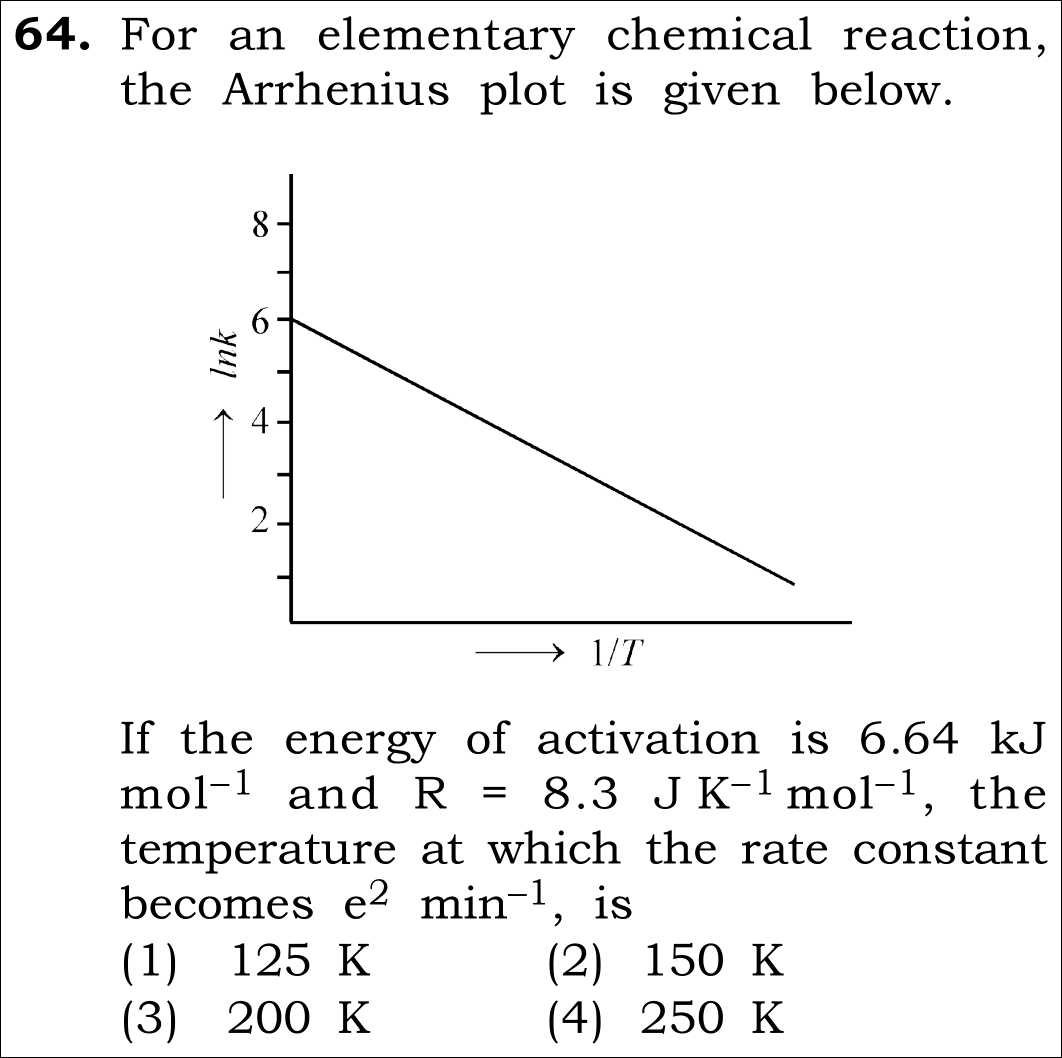
Arrhenius Plot ln k vs 1/T with y-intercept = 6
Activation Energy (E_a) 6.64 kJ mol⁻¹ = 6640 J mol⁻¹
Gas Constant (R) 8.3 J K⁻¹ mol⁻¹
Target Rate Constant (k) e² min⁻¹ (ln k = 2)
ln k = ln A - (E_a / RT). Intercept is ln A = 6 -> When ln k = 2, E_a / RT MUST equal 4!
1 From the graph, at 1/T = 0, y = ln A = 6.
2 Target: k = e² ⇒ ln k = ln(e²) = 2.
3 Substitute: 2 = 6 - (E_a / RT) ⇒ E_a / RT = 4.
4 Solve for T: T = E_a / (4R) = 6640 / (4 × 8.3) = 6640 / 33.2 = 200 K!
5 Option (3) is locked in 15 seconds!
🛡️ Why You Can 100% Trust This Shortcut: Direct mathematical deduction from the logarithmic Arrhenius equation ln k = ln A - E_a/(RT).
⚠️
Students frequently write 6.64 / (4 × 8.3) = 0.2 K because they forget to multiply 6.64 kJ by 1000 to match R in J/(mol K).
🛡️ How to avoid the -1 mark: Always match units: R is in Joules, so E_a MUST be converted from kJ to Joules (6640 J).
📖
NEET Chemistry Core Syllabus · Chemical Kinetics Standard Benchmark
Core Scientific Principle Tested:
"In a plot of ln k vs 1/T, the y-intercept is ln A and the slope is -E_a/R."
Syllabus Focus: Temperature dependence of rate of reaction - Arrhenius equation
ln A is 6, ln k is 2, the drop is 4: T = 6640 / 33.2 = 200 K for sure!