NEET 2024 Botany Question 132 Solution
Question
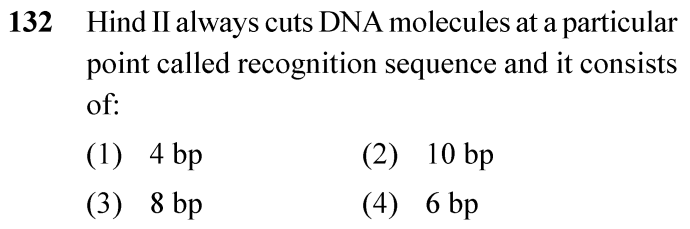
Hind II always cuts DNA molecules at a particular point called recognition sequence and it consists of:
Dynamic 180-question full-length simulator mixed dynamically from all 6 years for 2027 & 2026 aspirants.
Hind II always cuts DNA molecules at a particular point called recognition sequence and it consists of:
Hind II was the very first restriction endonuclease isolated; it always cuts DNA molecules at a specific recognition sequence of exactly 6 base pairs (6 bp)!
The first restriction endonuclease was Hind II, whose functioning depended on a specific DNA nucleotide sequence.
NCERT states: "It was found that Hind II always cut DNA molecules at a particular point by recognizing a specific sequence of six base pairs. This specific base sequence is known as the recognition sequence for Hind II."
Diagnose every choice: Know exactly why the right option works and why distractors fail.
Some restriction enzymes like Alu I and Hae III recognize 4 bp sequences, but Hind II recognizes a 6 bp sequence.
Standard Type II restriction endonucleases do not recognize 10 bp sequences.
Rare-cutting enzymes like Not I recognize 8 bp sequences, but Hind II recognizes 6 bp.
Hind II specifically recognizes and cleaves a specific hexanucleotide (6 bp) recognition sequence.
Guessing 4 bp or 8 bp.
"The first restriction endonuclease - Hind II, whose functioning depended on a specific DNA nucleotide sequence was isolated and characterised five years later. It was found that Hind II always cut DNA molecules at a particular point by recognising a specific sequence of six base pairs."
Test your speed and accuracy in the authentic 200-minute timed NTA simulator.
Spotted a mistake in this solution? Report an error ([email protected])
Cover all 1,140 official NEET questions in 285 days at your own pace. Progress is saved on your device. No login needed.