MyCompetitiveExams Logo MyCompetitiveExams
Search 1,140+ Questions
Chapters, formulas, speed tricks
→
⚡ Brahmastra NEET 2027
720 MARKS

Dynamic 180-question full-length simulator mixed dynamically from all 6 years for 2027 & 2026 aspirants.

Launch Brahmastra 2027 Test →
Start Practice →
100% Free · No Login Required
Q.180 Zoology ⭐ 360° Option Elimination Active
Vault ↗

NEET 2023 Zoology Question 180 Solution

Topic: Animal Kingdom · Official NTA Booklet Code G5
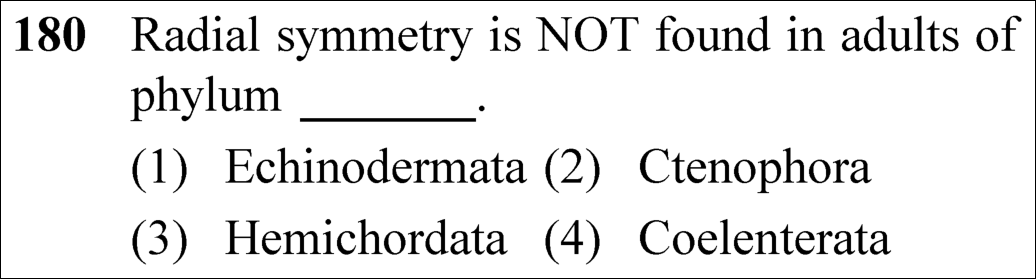
NEET 2023 Zoology Question 180: Body Symmetry Across Animal Phyla: Radial vs. Bilateral Symmetry

Question

Radial symmetry is NOT found in adults of phylum.

  1. (1)Echinodermata
  2. (2)Ctenophora
  3. (3)Hemichordata
  4. (4)Coelenterata
✓
Verified Against NTA Final Answer Key
Option (3) : Hemichordata
📚 Animal Kingdom Easy
📋 Given Parameters & Problem Setup
Criterion Phylum where radial symmetry is NOT found in adults
⚡

The 30-Second Exam Hall Shortcut: ⚡ Radial Symmetry Trio: Coelenterata, Ctenophora, Adult Echinodermata

⏱️ Save ~20 seconds

The only three phyla possessing radial symmetry in NCERT are Coelenterates (Cnidaria), Ctenophores, and adult Echinoderms! All other triploblastic phyla—including Hemichordata (Balanoglossus)—are strictly BILATERALLY symmetrical! Match Option (3) Hemichordata!

1 Coelenterata: Diploblastic, radial symmetry.
2 Ctenophora: Diploblastic, radial/biradial symmetry.
3 Echinodermata: Adults exhibit radial (pentamerous) symmetry; larvae are bilateral.
4 Hemichordata: Triploblastic, coelomate with strictly BILATERAL symmetry.
5 Match Option (3) Hemichordata.
🛡️
Why You Can 100% Trust This Shortcut: Canonical NCERT Animal Kingdom body plan symmetry taxonomy.
📐

Step-by-Step Rigorous Workflow & Mathematical Proof

Step 1

Classification of Animal Phyla by Symmetry

Symmetry is a primary foundational architectural feature used to classify animals into major branches:

Asymmetrical:Most Porifera (sponges)Radial Symmetry:Coelenterata, Ctenophora, and Adult EchinodermataBilateral Symmetry:Platyhelminthes to Chordata (including Hemichordata)\begin{aligned} \text{\textbf{Asymmetrical:}} & \quad \text{Most Porifera (sponges)} \\[4pt] \text{\textbf{Radial Symmetry:}} & \quad \mathbf{\text{Coelenterata, Ctenophora, and Adult Echinodermata}} \\[4pt] \text{\textbf{Bilateral Symmetry:}} & \quad \text{Platyhelminthes to Chordata (including } \mathbf{\text{Hemichordata}}\text{)} \end{aligned}
Step 2

Verbatim NCERT Symmetry Rules

NCERT states under Symmetry: "Coelenterates, ctenophores and echinoderms have this kind of body plan (radial symmetry). Annelids, arthropods, etc., where the body can be divided into identical left and right halves in only one plane, exhibit bilateral symmetry." Under Hemichordata, NCERT specifies: "They are bilaterally symmetrical, triploblastic and coelomate animals."

Step 3

Conclusion

Because Hemichordata exhibits bilateral symmetry throughout its entire life history, radial symmetry is never found in adults of this phylum.

⭐

360° Option Elimination Engine Key Feature

Diagnose every choice: Know exactly why the right option works and why distractors fail.

4-Option Deep Scan
1 1
✗ Incorrect
Verdict & Scientific Reason:

Adult echinoderms (e.g., starfish, sea urchin) display radial (pentaradial) symmetry; hence incorrect for the negative prompt.

⚠️
Student Fallacy (Why candidates pick this trap): Confusing bilateral echinoderm larvae with radial adult echinoderms.
2 2
✗ Incorrect
Verdict & Scientific Reason:

Ctenophores (comb jellies) possess radial/biradial symmetry.

⚠️
Student Fallacy (Why candidates pick this trap): Overlooking radial symmetry in ctenophores.
3 3
✓ 100% Correct
Verdict & Scientific Reason:

Hemichordates are strictly bilaterally symmetrical; radial symmetry is NOT found in this phylum.

💡
Why this is airtight: None; textbook verbatim classification.
4 4
✗ Incorrect
Verdict & Scientific Reason:

Coelenterates (hydra, jellyfish, corals) are classical radially symmetrical diploblasts.

⚠️
Student Fallacy (Why candidates pick this trap): Confusing cnidarians with bilateral animals.
⚠️

NTA Trap Alert: Echinoderm Larval vs. Adult Symmetry Trap

Echinoderms have bilateral larvae and radial adults. Students sometimes remember "bilateral" for echinoderms and select Echinodermata, ignoring the word "adults".

🛡️ How to avoid the -1 mark: Remember: Adult echinoderms ARE radial. Hemichordates are ALWAYS bilateral.
📖

Core NEET Syllabus Standard

NCERT Biology · Animal Kingdom Standard Benchmark
Core Scientific Principle Tested:

"Coelenterates, ctenophores and adult echinoderms have radial symmetry. Hemichordates are bilaterally symmetrical."

Syllabus Focus: Basis of Classification (Symmetry) & Hemichordata
✓ Core NEET UG Syllabus Anchor Syllabus & Academic Standards ↗

Ready to attempt under real exam pressure?

Test your speed and accuracy in the authentic 200-minute timed NTA simulator.

Launch NEET 2023 CBT Test →

Spotted a mistake in this solution? Report an error ([email protected])

⚖️ Legal & Fair Dealing Notice: Sourced from publicly released NEET 2023 question papers and NEET answer keys for private study, research, and non-commercial educational practice under Fair Dealing (Section 52(1)(a) of the Indian Copyright Act, 1957). Not affiliated with or endorsed by NTA or NMC.

Solve 4 NEET Questions a Day — One per Subject

Cover all 1,140 official NEET questions in 285 days at your own pace. Progress is saved on your device. No login needed.