MyCompetitiveExams Logo MyCompetitiveExams
Search 1,140+ Questions
Chapters, formulas, speed tricks
→
⚡ Brahmastra NEET 2027
720 MARKS

Dynamic 180-question full-length simulator mixed dynamically from all 6 years for 2027 & 2026 aspirants.

Launch Brahmastra 2027 Test →
Start Practice →
100% Free · No Login Required
Q.181 Zoology ⭐ 360° Option Elimination Active
Vault ↗

NEET 2023 Zoology Question 181 Solution

Topic: Environmental Issues · Official NTA Booklet Code G5
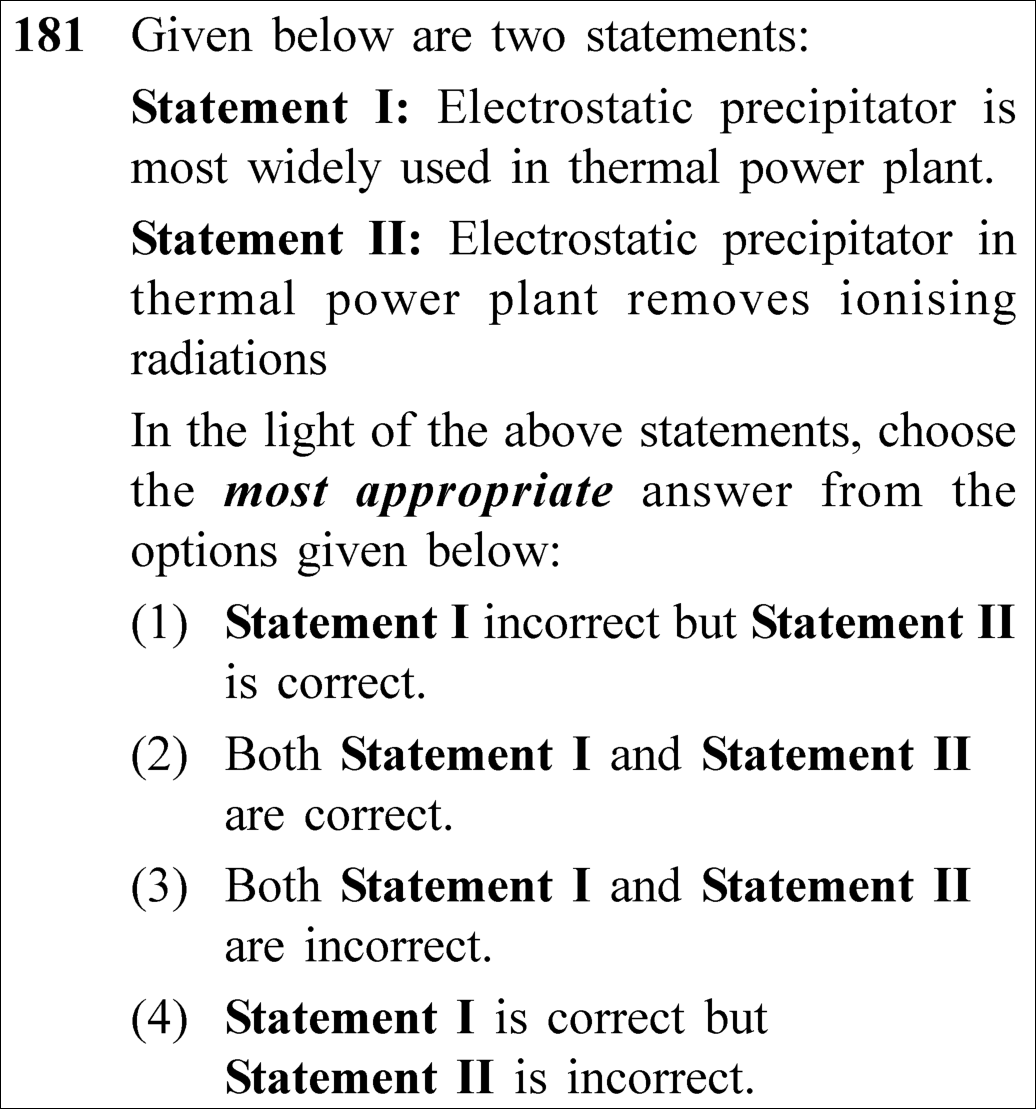
NEET 2023 Zoology Question 181: Control of Air Pollution: Electrostatic Precipitator

Question

Given below are two statements: Statement I: Electrostatic precipitator is most widely used in thermal power plant. Statement II: Electrostatic precipitator in thermal power plant removes ionising radiations In the light of the above statements, choose the most appropriate answer from the options given below:

  1. (1)Statement I incorrect but Statement II is correct.
  2. (2)Both Statement I and Statement II are correct.
  3. (3)Both Statement I and Statement II are incorrect.
  4. (4)Statement I is correct but Statement II is incorrect.
✓
Verified Against NTA Final Answer Key
Option (4) : Statement I is correct but Statement II is incorrect.
📚 Environmental Issues Easy
📋 Given Parameters & Problem Setup
Statement I Electrostatic precipitator is most widely used in thermal power plant.
Statement II Electrostatic precipitator in thermal power plant removes ionising radiations.
⚡

The 30-Second Exam Hall Shortcut: ⚡ Electrostatic Precipitators Remove PARTICLES, Not Radiation!

⏱️ Save ~20 seconds

Electrostatic precipitators remove >99% of particulate matter (fly ash) from thermal power plant smokestacks (Statement I is TRUE). They do NOT remove ionizing radiation (which originates from nuclear sources)! Statement II is FALSE! Select Option (4)!

1 Check Statement I: Electrostatic precipitator is the most widely used device to remove particulate exhaust in thermal power plants -> Verbatim NCERT, Correct.
2 Check Statement II: Claims it removes ionizing radiation -> False (It removes particulate matter via corona discharge and grounded collecting plates).
3 Statement I is correct but Statement II is incorrect.
4 Match Option (4).
🛡️
Why You Can 100% Trust This Shortcut: Canonical NCERT Environmental Issues air pollution control industrial equipment.
📐

Step-by-Step Rigorous Workflow & Mathematical Proof

Step 1

Working Mechanism of Electrostatic Precipitator (ESP)

An electrostatic precipitator operates by maintaining electrode wires at thousands of volts to produce a corona discharge that releases electrons. Electrons attach to dust particles, giving them a net negative charge so that grounded collecting plates attract and capture them:

Dirty Flue Gas→High-voltage Corona (e−)Negatively Charged Dust→Grounded Plates>99% Particulate Matter Removed\text{Dirty Flue Gas} \xrightarrow{\text{High-voltage Corona } (e^-)} \text{Negatively Charged Dust} \xrightarrow{\text{Grounded Plates}} \mathbf{>99\%\text{ Particulate Matter Removed}}
Step 2

Evaluation of Statement I

NCERT states verbatim: "There are several ways of removing particulate matter; the most widely used of which is the electrostatic precipitator, which can remove over 99 per cent particulate matter present in the exhaust from a thermal power plant." Statement I is TRUE.

Step 3

Evaluation of Statement II

Ionizing radiations (alpha, beta, gamma rays) are nuclear emissions managed via thick lead shielding and deep geological disposal of nuclear wastes. ESPs have zero capability to neutralize radiation. Statement II is FALSE.

⭐

360° Option Elimination Engine Key Feature

Diagnose every choice: Know exactly why the right option works and why distractors fail.

4-Option Deep Scan
1 1
✗ Incorrect
Verdict & Scientific Reason:

Inverts the truth value of both statements.

⚠️
Student Fallacy (Why candidates pick this trap): Believing precipitators absorb nuclear radiation.
2 2
✗ Incorrect
Verdict & Scientific Reason:

Statement II is factually absurd from a physical and ecological perspective.

⚠️
Student Fallacy (Why candidates pick this trap): Assuming power plants emit radiation captured by precipitators.
3 3
✗ Incorrect
Verdict & Scientific Reason:

Statement I is an undisputed textbook fact regarding air pollution control.

⚠️
Student Fallacy (Why candidates pick this trap): Doubting thermal power plant reliance on electrostatic precipitators.
4 4
✓ 100% Correct
Verdict & Scientific Reason:

Statement I correctly cites the widespread use of ESPs for particulate capture; Statement II falsely claims it removes ionizing radiation.

💡
Why this is airtight: None; rigorous environmental technology analysis.
⚠️

NTA Trap Alert: Particulate Matter vs. Radiation Trap

Thermal power plants burn pulverized coal, producing massive amounts of particulate fly ash and smoke. Ionizing radiation is an issue for nuclear power plants, not thermal coal plants, and is unaffected by electrostatic precipitators.

🛡️ How to avoid the -1 mark: ESP = Removes Particulate Matter. Nuclear Shielding = Blocks Ionizing Radiation.
📖

Core NEET Syllabus Standard

NCERT Biology · Environmental Issues Standard Benchmark
Core Scientific Principle Tested:

"Electrostatic precipitator is most widely used in thermal power plants to remove over 99 per cent particulate matter."

Syllabus Focus: Air Pollution and Its Control
✓ Core NEET UG Syllabus Anchor Syllabus & Academic Standards ↗

Ready to attempt under real exam pressure?

Test your speed and accuracy in the authentic 200-minute timed NTA simulator.

Launch NEET 2023 CBT Test →

Spotted a mistake in this solution? Report an error ([email protected])

⚖️ Legal & Fair Dealing Notice: Sourced from publicly released NEET 2023 question papers and NEET answer keys for private study, research, and non-commercial educational practice under Fair Dealing (Section 52(1)(a) of the Indian Copyright Act, 1957). Not affiliated with or endorsed by NTA or NMC.

Solve 4 NEET Questions a Day — One per Subject

Cover all 1,140 official NEET questions in 285 days at your own pace. Progress is saved on your device. No login needed.