MyCompetitiveExams Logo MyCompetitiveExams
Search 1,140+ Questions
Chapters, formulas, speed tricks
→
⚡ Brahmastra NEET 2027
720 MARKS

Dynamic 180-question full-length simulator mixed dynamically from all 6 years for 2027 & 2026 aspirants.

Launch Brahmastra 2027 Test →
Start Practice →
100% Free · No Login Required
Q.90 Zoology ⭐ 360° Option Elimination Active
Vault ↗

NEET 2020 Zoology Question 90 Solution

Topic: Environmental Issues · Official NTA Booklet Code E1
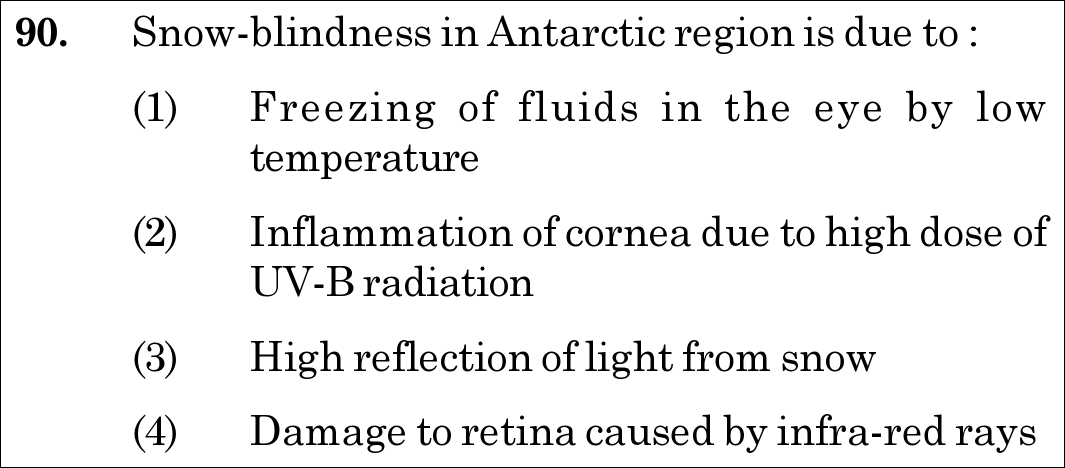
NEET 2020 Zoology Question 90: Photokeratitis: Snow-Blindness Caused by UV-B Induced Inflammation of Cornea

Question

Snow-blindness in Antarctic region is due to:

  1. (1)Freezing of fluids in the eye by low temperature
  2. (2)Inflammation of cornea due to high dose of UV-B radiation
  3. (3)High reflection of light from snow
  4. (4)Damage to retina caused by infra-red rays
✓
Verified Against NTA Final Answer Key
Option (2) : Inflammation of cornea due to high dose of UV-B radiation
📚 Environmental Issues Easy
📋 Given Parameters & Problem Setup
Pathological Condition Snow-blindness in Antarctic region
Etiological Factor Ozone hole and solar radiation
Question Objective Identify the exact pathophysiological cause
⚡

The 30-Second Exam Hall Shortcut: ⚡ "Snow-Blindness = INFLAMMATION OF CORNEA DUE TO UV-B RADIATION!"

⏱️ 20 seconds

Ozone thinning over Antarctica allows high doses of UV-B radiation to reach the Earth. The human cornea absorbs UV-B radiation, and a high dose of UV-B causes painful inflammation of the cornea, called snow-blindness (photokeratitis), and cataract! Mark Option (2) in 5 seconds.

1 UV-B radiation of wavelength shorter than UV-A is normally absorbed by the stratospheric ozone layer.
2 Due to the ozone hole over Antarctica, excessive UV-B reaches the surface.
3 In human eye, cornea absorbs UV-B radiation.
4 A high dose of UV-B causes inflammation of cornea, termed "snow-blindness" and cataract.
5 Select Option (2) Inflammation of cornea due to high dose of UV-B radiation.
🛡️
Why You Can 100% Trust This Shortcut: NCERT Biology · Environmental Issues (Ozone Depletion in Stratosphere: Effects of UV-B Radiation)
📐

Step-by-Step Rigorous Workflow & Mathematical Proof

Step 1

Understand Ozone Depletion and UV Radiations

UV radiation from the sun is categorized into UV-C, UV-B, and UV-A. UV-C is absorbed by the atmosphere; UV-B is largely absorbed by the stratospheric ozone shield. Thinning of the ozone layer over Antarctica allows excessive UV-B to penetrate to the surface.

Step 2

Biological Action of UV-B on the Eye

NCERT explicitly states: "In human eye, cornea absorbs UV-B radiation, and a high dose of UV-B causes inflammation of cornea, called snow-blindness, cataract, etc. Such exposure may permanently damage the cornea."

Step 3

Evaluate Distractor Options

- Option (1) claims freezing of fluids: Antarctic temperatures are cold, but eye fluids do not freeze while alive. - Option (3) claims reflection of visible light from snow: Snow reflects UV-B, but the direct cause of blindness is the corneal inflammation induced by UV-B, not mere visible light reflection. - Option (4) mentions infra-red damage to retina: Snow blindness involves UV-B damage to the CORNEA, not IR damage to the retina.

Step 4

Conclude Option 2

Option (2) precisely articulates the medical definition and NCERT explanation of snow-blindness.

⭐

360° Option Elimination Engine Key Feature

Diagnose every choice: Know exactly why the right option works and why distractors fail.

4-Option Deep Scan
1 A
✗ Incorrect
Verdict & Scientific Reason:

Incorrect; eye humors (aqueous and vitreous) are regulated at core body temperature and do not freeze in snow-blindness.

⚠️
Student Fallacy (Why candidates pick this trap): Associating "Antarctic" with physical freezing of the eye.
2 B
✓ 100% Correct
Verdict & Scientific Reason:

Factually exact; snow-blindness (photokeratitis) is acute inflammation of the corneal epithelium caused by excessive UV-B exposure.

💡
Why this is airtight: None; direct NCERT environmental health statement.
3 C
✗ Incorrect
Verdict & Scientific Reason:

Incorrect; while snow has a high albedo and reflects UV, the biological pathology itself is cornea inflammation caused specifically by UV-B rays, not mere bright visible light.

⚠️
Student Fallacy (Why candidates pick this trap): Attributing the disease solely to glare rather than the damaging UV-B spectrum.
4 D
✗ Incorrect
Verdict & Scientific Reason:

Incorrect; the affected tissue is the CORNEA (not retina) and the radiation type is UV-B (not infra-red).

⚠️
Student Fallacy (Why candidates pick this trap): Confusing corneal UV damage with retinal infrared thermal damage.
⚠️

NTA Trap Alert: Cornea vs Retina & UV-B vs IR

Snow-blindness affects the CORNEA (inflammation/photokeratitis) caused by UV-B radiation. Cataract also affects the lens due to UV-B.

🛡️ How to avoid the -1 mark: Match the pair: Snow-blindness = CORNEA + UV-B!
📖

Core NEET Syllabus Standard

Zoology · Environmental Issues Standard Benchmark
Core Scientific Principle Tested:

""

Syllabus Focus: Photokeratitis: Snow-Blindness Caused by UV-B Induced Inflammation of Cornea
✓ Core NEET UG Syllabus Anchor Syllabus & Academic Standards ↗

Ready to attempt under real exam pressure?

Test your speed and accuracy in the authentic 180-minute timed NTA simulator.

Launch NEET 2020 CBT Test →

Spotted a mistake in this solution? Report an error ([email protected])

⚖️ Legal & Fair Dealing Notice: Sourced from publicly released NEET 2020 question papers and NEET answer keys for private study, research, and non-commercial educational practice under Fair Dealing (Section 52(1)(a) of the Indian Copyright Act, 1957). Not affiliated with or endorsed by NTA or NMC.

Solve 4 NEET Questions a Day — One per Subject

Cover all 1,140 official NEET questions in 285 days at your own pace. Progress is saved on your device. No login needed.