MyCompetitiveExams Logo MyCompetitiveExams
Search 1,140+ Questions
Chapters, formulas, speed tricks
→
⚡ Brahmastra NEET 2027
720 MARKS

Dynamic 180-question full-length simulator mixed dynamically from all 6 years for 2027 & 2026 aspirants.

Launch Brahmastra 2027 Test →
Start Practice →
100% Free · No Login Required
Q.143 Botany ⭐ 360° Option Elimination Active
Vault ↗

NEET 2023 Botany Question 143 Solution

Topic: Biotechnology: Principles and Processes · Official NTA Booklet Code G5
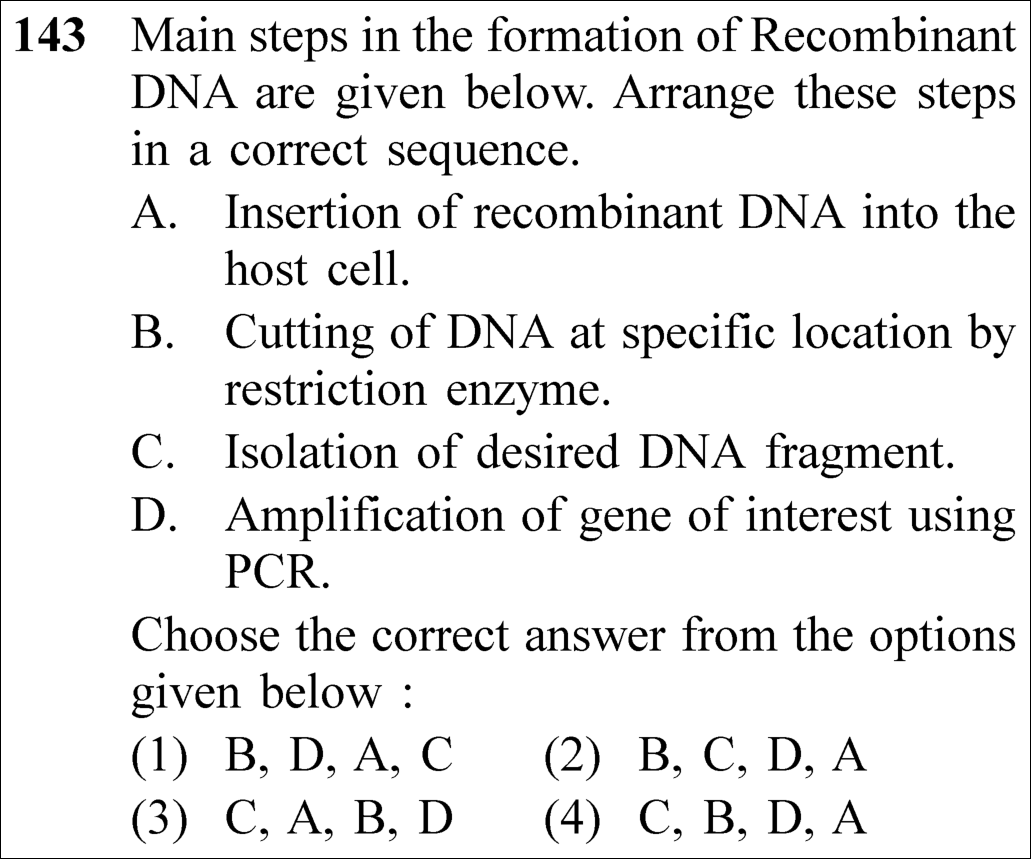
NEET 2023 Botany Question 143: Sequential Steps in Recombinant DNA Technology (Dual-Key Official NTA Question)

Question

Main steps in the formation of Recombinant DNA are given below. Arrange these steps in a correct sequence. A. Insertion of recombinant DNA into the host cell. B. Cutting of DNA at specific location by restriction enzyme. C. Isolation of desired DNA fragment. D. Amplification of gene of interest using PCR. Choose the correct answer from the options given below:

  1. (1)B,D,A,C
  2. (2)B,C,D,A
  3. (3)C,A,B,D
  4. (4)C,B,D,A
✓
Verified Against NTA Final Answer Key
Option (2) : B, C, D, A [Also awarded for Option (4) C, B, D, A by Official NTA Final Answer Key]
📚 Biotechnology: Principles and Processes Medium
📋 Given Parameters & Problem Setup
Step A Insertion of recombinant DNA into the host cell
Step B Cutting of DNA at specific location by restriction enzyme
Step C Isolation of desired DNA fragment
Step D Amplification of gene of interest using PCR
⚡

The 30-Second Exam Hall Shortcut: ⚡ Dual-Key NTA Resolution: (2) B, C, D, A or (4) C, B, D, A

⏱️ Save ~30 seconds

If Step C means isolating the restriction fragment from the gel (elution), the sequence is Cutting (B) -> Gel isolation (C) -> PCR (D) -> Host insertion (A) [Option 2]. If Step C means initial genomic DNA isolation from donor, the sequence is C -> B -> D -> A [Option 4]. NTA officially awarded full marks to BOTH (2) and (4)!

1 Step A (Insertion into host) is unequivocally the final step among the given options.
2 Step D (PCR amplification) requires having the target sequence in hand before transformation.
3 Interpretation 1: Restriction cleavage (B) occurs first, followed by isolation/elution of the specific cut band from agarose gel (C), PCR amplification (D), and transformation (A) -> Sequence: B, C, D, A -> Option (2).
4 Interpretation 2: Isolation of total genetic material/donor DNA (C) comes first, followed by restriction digestion (B), PCR amplification (D), and transformation (A) -> Sequence: C, B, D, A -> Option (4).
5 Official NTA Answer Key accepted BOTH Option (2) and Option (4).
🛡️
Why You Can 100% Trust This Shortcut: Official NTA Final Answer Key (Booklet G5 dual-key award B, D) and NCERT Biotechnology procedural workflows.
📐

Step-by-Step Rigorous Workflow & Mathematical Proof

Step 1

Analysis of Workflow Sequence Under Interpretation 1 (Option 2: B, C, D, A)

In standard molecular cloning protocols described in NCERT Section "Processes of Recombinant DNA Technology": 1. Genomic/vector DNA is cleaved with restriction endonucleases (Step B). 2. The digested mixture is resolved on agarose gel electrophoresis, and the specific desired band is isolated via elution (Step C). 3. The isolated gene of interest is amplified to billions of copies using Polymerase Chain Reaction (Step D). 4. The recombinant construct is inserted into a competent recipient host cell (Step A):

B (Cutting)⟶C (Gel Isolation/Elution)⟶D (PCR Amplification)⟶A (Host Insertion)\mathbf{B} \text{ (Cutting)} \longrightarrow \mathbf{C} \text{ (Gel Isolation/Elution)} \longrightarrow \mathbf{D} \text{ (PCR Amplification)} \longrightarrow \mathbf{A} \text{ (Host Insertion)}
Step 2

Analysis of Workflow Sequence Under Interpretation 2 (Option 4: C, B, D, A)

If Step C ("Isolation of desired DNA fragment") is construed broadly as the initial extraction and purification of donor cellular DNA containing the target gene: 1. Total cellular DNA containing the gene of interest is isolated (Step C). 2. DNA is subjected to restriction enzyme digestion (Step B). 3. Target gene is amplified via PCR (Step D). 4. Recombinant DNA is introduced into the host (Step A):

C (Initial Isolation)⟶B (Restriction Cleavage)⟶D (PCR Amplification)⟶A (Host Insertion)\mathbf{C} \text{ (Initial Isolation)} \longrightarrow \mathbf{B} \text{ (Restriction Cleavage)} \longrightarrow \mathbf{D} \text{ (PCR Amplification)} \longrightarrow \mathbf{A} \text{ (Host Insertion)}
Step 3

Official NTA Consensus

Because both interpretations are scientifically valid and represent sequential steps defined across different subsections of NCERT Biotechnology, NTA officially designated both Option (2) and Option (4) as correct answers in the final answer key.

⭐

360° Option Elimination Engine Key Feature

Diagnose every choice: Know exactly why the right option works and why distractors fail.

4-Option Deep Scan
1 1
✗ Incorrect
Verdict & Scientific Reason:

Places isolation of desired DNA fragment (C) after insertion into host (A), which is chronologically impossible.

⚠️
Student Fallacy (Why candidates pick this trap): Placing gene isolation at the end of the entire protocol.
2 2
✓ 100% Correct
Verdict & Scientific Reason:

Officially accepted by NTA: Cutting DNA (B) -> Isolation of fragment by gel electrophoresis/elution (C) -> PCR amplification (D) -> Host insertion (A).

💡
Why this is airtight: None; officially credited answer.
3 3
✗ Incorrect
Verdict & Scientific Reason:

Places host insertion (A) before restriction cutting (B).

⚠️
Student Fallacy (Why candidates pick this trap): Scrambling transformation before restriction digestion.
4 4
✓ 100% Correct
Verdict & Scientific Reason:

Officially accepted by NTA: Initial DNA isolation (C) -> Restriction cutting (B) -> PCR amplification (D) -> Host insertion (A).

💡
Why this is airtight: None; officially credited answer.
⚠️

NTA Trap Alert: Ambiguity in "Isolation" Step Placement

Step C ("Isolation of desired DNA fragment") can mean either isolating the DNA from the organism prior to cutting, or isolating the specific fragment from an agarose gel after cutting.

🛡️ How to avoid the -1 mark: Notice that both B, C, D, A and C, B, D, A keep D before A; NTA acknowledged this ambiguity by awarding marks for both Option 2 and Option 4.
📖

Core NEET Syllabus Standard

NCERT Biology · Biotechnology: Principles and Processes Standard Benchmark
Core Scientific Principle Tested:

"Processes of recombinant DNA technology involve: Isolation of DNA, Fragmentation of DNA by restriction endonucleases, Isolation of a desired DNA fragment, Amplification of gene of interest using PCR, and Transfer of rDNA into the host."

Syllabus Focus: Processes of Recombinant DNA Technology
✓ Core NEET UG Syllabus Anchor Syllabus & Academic Standards ↗

Ready to attempt under real exam pressure?

Test your speed and accuracy in the authentic 200-minute timed NTA simulator.

Launch NEET 2023 CBT Test →

Spotted a mistake in this solution? Report an error ([email protected])

⚖️ Legal & Fair Dealing Notice: Sourced from publicly released NEET 2023 question papers and NEET answer keys for private study, research, and non-commercial educational practice under Fair Dealing (Section 52(1)(a) of the Indian Copyright Act, 1957). Not affiliated with or endorsed by NTA or NMC.

Solve 4 NEET Questions a Day — One per Subject

Cover all 1,140 official NEET questions in 285 days at your own pace. Progress is saved on your device. No login needed.