MyCompetitiveExams Logo MyCompetitiveExams
Search 1,140+ Questions
Chapters, formulas, speed tricks
→
⚡ Brahmastra NEET 2027
720 MARKS

Dynamic 180-question full-length simulator mixed dynamically from all 6 years for 2027 & 2026 aspirants.

Launch Brahmastra 2027 Test →
Start Practice →
100% Free · No Login Required
Q.33 Botany ⭐ 360° Option Elimination Active
Vault ↗

NEET 2020 Botany Question 33 Solution

Topic: Molecular Basis of Inheritance · Official NTA Booklet Code E1
NEET 2020 Botany Question 33: First Phase of Translation: Aminoacylation of tRNA (Charging of tRNA)

Question

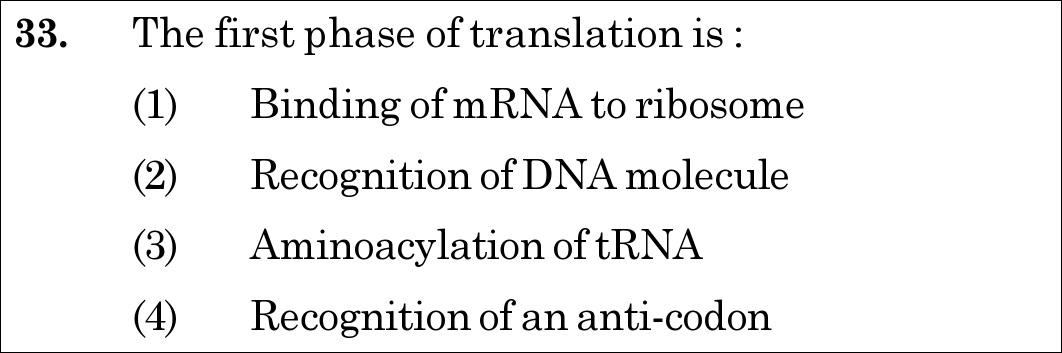
The first phase of translation is:

  1. (1)Binding of mRNA to ribosome
  2. (2)Recognition of DNA molecule
  3. (3)Aminoacylation of tRNA
  4. (4)Recognition of an anti-codon
✓
Verified Against NTA Final Answer Key
Option (3) : Aminoacylation of tRNA
📚 Molecular Basis of Inheritance Easy
📋 Given Parameters & Problem Setup
Biological Process Translation (Protein Synthesis)
Question Objective Identify the very first phase of translation
⚡

The 30-Second Exam Hall Shortcut: ⚡ "First Phase of Translation = Aminoacylation of tRNA (Charging of tRNA)!"

⏱️ Save ~20 seconds

Before peptide bonds can form or ribosomes can assemble, amino acids must be activated by ATP and covalently linked to their cognate tRNA molecules. This initial preparatory step is called Aminoacylation of tRNA (charging of tRNA)! Mark Option (3) in 5 seconds.

1 Recall NCERT introductory paragraph on Translation: - Translation refers to the process of polymerisation of amino acids to form a polypeptide. - Amino acids are activated in the presence of ATP and linked to their cognate tRNA – a process commonly called as charging of tRNA or aminoacylation of tRNA to be more specific. - The very first phase of translation is aminoacylation of tRNA.
2 Select Option (3): Aminoacylation of tRNA.
🛡️
Why You Can 100% Trust This Shortcut: NCERT Biology · Molecular Basis of Inheritance (Translation: The order and sequence of amino acids are defined by the sequence of bases in the mRNA. Amino acids are activated in the presence of ATP and linked to their cognate tRNA – a process commonly called as charging of tRNA or aminoacylation of tRNA to be more specific. The first phase itself is aminoacylation of tRNA).
📐

Step-by-Step Rigorous Workflow & Mathematical Proof

Step 1

Biochemical Energetics and Aminoacylation of tRNA

Polypeptide synthesis requires energetic priming because the formation of an amide peptide bond between free amino acids is thermodynamically unfavorable: 1. Activation of Amino Acid: The amino acid reacts with ATP in the presence of the enzyme aminoacyl-tRNA synthetase to form an enzyme-bound aminoacyl-AMP intermediate (aminoacyl-adenylate), releasing inorganic pyrophosphate (PPiPP_i). 2. Transfer to tRNA (Charging): The amino acid is transferred to the 3′-CCA3'\text{-CCA} terminal ribose of its cognate tRNA, forming high-energy aminoacyl-tRNA (charged tRNA). 3. Sequential Significance: NCERT explicitly designates aminoacylation of tRNA as the first phase of translation. Without charged tRNAs carrying energized amino acids, ribosomal initiation complexes cannot proceed.

Amino Acid+ATP+tRNA→Aminoacyl-tRNA SynthetaseAminoacyl-tRNA (Charged tRNA)+AMP+PPi\text{Amino Acid} + \text{ATP} + \text{tRNA} \xrightarrow{\mathbf{Aminoacyl\text{-}tRNA\,Synthetase}} \mathbf{Aminoacyl\text{-}tRNA\,(Charged\,tRNA)} + \text{AMP} + PP_i
Step 2

Chronology of Subsequent Ribosomal Phases

- Binding of mRNA to ribosome: Occurs during the initiation phase on the small 40S/30S ribosomal subunit, *after* tRNAs have been charged. - Recognition of an anti-codon: Occurs at the ribosomal A-site during the elongation phase.

⭐

360° Option Elimination Engine Key Feature

Diagnose every choice: Know exactly why the right option works and why distractors fail.

4-Option Deep Scan
1 A
✗ Incorrect
Verdict & Scientific Reason:

Incorrect. Ribosomal mRNA binding is part of initiation, which requires pre-charged aminoacyl-tRNAs.

⚠️
Student Fallacy (Why candidates pick this trap): Assuming ribosomal assembly precedes chemical activation of amino acids.
2 B
✗ Incorrect
Verdict & Scientific Reason:

Incorrect. DNA recognition occurs during transcription, not translation.

⚠️
Student Fallacy (Why candidates pick this trap): Confusing transcription with translation.
3 C
✓ 100% Correct
Verdict & Scientific Reason:

Correct. Verbatim NCERT fact: The first phase of translation is aminoacylation (charging) of tRNA.

💡
Why this is airtight: None. Direct recall of molecular biology mechanisms.
4 D
✗ Incorrect
Verdict & Scientific Reason:

Incorrect. Codon-anticodon base pairing occurs during the elongation phase at the A-site.

⚠️
Student Fallacy (Why candidates pick this trap): Confusing elongation codon inspection with the initial phase.
⚠️

NTA Trap Alert: Initiation Complex vs Chemical Charging Trap

Students frequently think "Translation Step 1 = Initiation (Ribosome binds mRNA)". NCERT explicitly highlights that *before* ribosomal initiation, the chemical charging of tRNA (aminoacylation) is the first phase of the entire translation process.

🛡️ How to avoid the -1 mark: Remember: Charging of tRNA (Aminoacylation) is Step 1 of translation.
📖

Core NEET Syllabus Standard

NEET / NCERT Biology · Molecular Basis of Inheritance Standard Benchmark
Core Scientific Principle Tested:

"The first phase of translation is the activation of amino acids and aminoacylation (charging) of tRNA."

Syllabus Focus: Translation
✓ Core NEET UG Syllabus Anchor Syllabus & Academic Standards ↗

Ready to attempt under real exam pressure?

Test your speed and accuracy in the authentic 180-minute timed NTA simulator.

Launch NEET 2020 CBT Test →

Spotted a mistake in this solution? Report an error ([email protected])

⚖️ Legal & Fair Dealing Notice: Sourced from publicly released NEET 2020 question papers and NEET answer keys for private study, research, and non-commercial educational practice under Fair Dealing (Section 52(1)(a) of the Indian Copyright Act, 1957). Not affiliated with or endorsed by NTA or NMC.

Solve 4 NEET Questions a Day — One per Subject

Cover all 1,140 official NEET questions in 285 days at your own pace. Progress is saved on your device. No login needed.